
Determine the necessary mass, volume, or concentration for preparing a solution.
| Activity Type | Relation | Activity value | Units | Action Type | Journal | PubMed Id | doi | Assay Aladdin ID |
|---|
Reagent grade, ≥98% Reagent Grade for sensitive chromatographic and analytical workflows requiring minimal baseline interference.
Room temperature Ships Check lot-specific COA for exact specifications.
SDS, COA, datasheet, and spec sheet available for download. Lot-specific COA accessible via lot number lookup.
Cited in 1363 peer-reviewed publications across chromatography, organic synthesis, and cross-coupling reactions.
Description
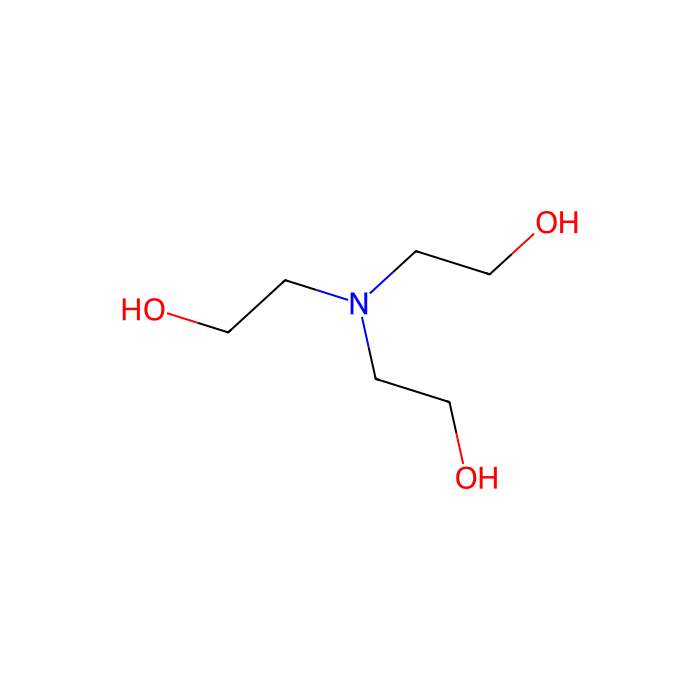
Triethanolamine can be used as:A nitrogen precursor in the preparation of carbon dot derived nanomaterials.A cross-linking agent in the synthesis of methylaluminoxane pre-catalysts applicable in the polymerization of ethylene.A reducing agent to synthesize Ag nanoparticles of biological importance.
Comprehensive hazard, handling, storage, and regulatory compliance document.
Download SDS →Lot-specific quality data. Enter your lot number to retrieve the exact COA.
Look up COA →Full quality attributes and acceptance criteria for this grade.
View spec sheet →Taxonomy Tree
| Kingdom | Organic compounds |
|---|---|
| Superclass | Organic nitrogen compounds |
| 分類 | Organonitrogen compounds |
| Subclass | Amines |
| Intermediate Tree Nodes | Alkanolamines |
| Direct Parent | 1,2-aminoalcohols |
| Alternative Parents | Trialkylamines Primary alcohols Organopnictogen compounds Hydrocarbon derivatives |
| Molecular Framework | Aliphatic acyclic compounds |
| Substituents | Tertiary aliphatic amine - Tertiary amine - 1,2-aminoalcohol - Organic oxygen compound - Organopnictogen compound - Hydrocarbon derivative - Primary alcohol - Organooxygen compound - Alcohol - Aliphatic acyclic compound |
| 説明 | This compound belongs to the class of organic compounds known as 1,2-aminoalcohols. These are organic compounds containing an alkyl chain with an amine group bound to the C1 atom and an alcohol group bound to the C2 atom. |
| External Descriptors | tertiary amino compound - amino alcohol |
| Activity Type | Relation | Activity value | Units | Action Type | Journal | PubMed Id | doi | Assay Aladdin ID |
|---|
| Activity Type | Relation | Activity value | Units | Action Type | Journal | PubMed Id | doi | Assay Aladdin ID |
|---|
| Activity Type | Relation | Activity value | Units | Action Type | Journal | PubMed Id | doi | Assay Aladdin ID |
|---|
| Activity Type | Relation | Activity value | Units | Action Type | Journal | PubMed Id | doi | Assay Aladdin ID |
|---|
| Activity Type | Relation | Activity value | Units | Action Type | Journal | PubMed Id | doi | Assay Aladdin ID |
|---|
| Activity Type | Relation | Activity value | Units | Action Type | Journal | PubMed Id | doi | Assay Aladdin ID |
|---|
| Activity Type | Relation | Activity value | Units | Action Type | Journal | PubMed Id | doi | Assay Aladdin ID |
|---|
Find and download the COA for your product by matching the lot number on the packaging.
| Lot Number | Certificate Type | 日付 | 商品 |
|---|---|---|---|
 I2326004 | Certificate of Analysis | Jul 03, 2026 | T478536 |
| I2326005 | Certificate of Analysis | Jul 03, 2026 | T478536 |
| F2517069 | Certificate of Analysis | Jun 24, 2025 | T478536 |
| F2517070 | Certificate of Analysis | Jun 20, 2025 | T478536 |
| C2412541 | Certificate of Analysis | Mar 19, 2024 | T478536 |
| C2412542 | Certificate of Analysis | Mar 19, 2024 | T478536 |
| C2412543 | Certificate of Analysis | Mar 19, 2024 | T478536 |
| J2429168 | Certificate of Analysis | Mar 19, 2024 | T478536 |
| E2415023 | Certificate of Analysis | Sep 28, 2023 | T478536 |
| A2316043 | Certificate of Analysis | Feb 01, 2023 | T478536 |
| A2316046 | Certificate of Analysis | Jan 29, 2023 | T478536 |
| 溶解度 | soluble 149g/L at20°C (completely) |
|---|---|
| 感度 | Moisture sensitive |
| 屈折率 | 1.485 |
| 引火点(°F) | 354.2℉ |
| 引火点(°C) | 179°C |
| 沸点(°C) | 190-193°C |
| 融点(°C) | 17.9-21°C |
| 分子量 | 149.190 g/mol |
| XLogP3 | -1.000 |
| Hydrogen Bond Donor Count | 3 |
| Hydrogen Bond Acceptor Count | 4 |
| Rotatable Bond Count | 6 |
| Exact Mass | 149.105 Da |
| Monoisotopic Mass | 149.105 Da |
| Topological Polar Surface Area | 63.900 Ų |
| Heavy Atom Count | 10 |
| Formal Charge | 0 |
| Complexity | 55.700 |
| Isotope Atom Count | 0 |
| Defined Atom Stereocenter Count | 0 |
| Undefined Atom Stereocenter Count | 0 |
| Defined Bond Stereocenter Count | 0 |
| Undefined Bond Stereocenter Count | 0 |
| The total count of all stereochemical bonds | 0 |
| Covalently-Bonded Unit Count | 1 |
Our grade selection guide covers purity, stabilizer status, and application suitability for all variants in our catalog.
View Reagent Grade grade guide →