
Determine the necessary mass, volume, or concentration for preparing a solution.
| Activity Type | Relation | Activity value | Units | Action Type | Journal | PubMed Id | doi | Assay Aladdin ID |
|---|
≥99% for sensitive chromatographic and analytical workflows requiring minimal baseline interference.
Protected from light,Room temperature,Desiccated Ships Normal Check lot-specific COA for exact specifications.
SDS, COA, datasheet, and spec sheet available for download. Lot-specific COA accessible via lot number lookup.
Cited in 27 peer-reviewed publications across chromatography, organic synthesis, and cross-coupling reactions.
Comprehensive hazard, handling, storage, and regulatory compliance document.
Download SDS →Lot-specific quality data. Enter your lot number to retrieve the exact COA.
Look up COA →Full quality attributes and acceptance criteria for this grade.
View spec sheet →Taxonomy Tree
| Kingdom | Organic compounds |
|---|---|
| Superclass | Benzenoids |
| Class | Benzene and substituted derivatives |
| Subclass | Halobenzenes |
| Intermediate Tree Nodes | Chlorobenzenes |
| Direct Parent | Dichlorobenzenes |
| Alternative Parents | Aryl chlorides Organochlorides Hydrocarbon derivatives |
| Molecular Framework | Aromatic homomonocyclic compounds |
| Substituents | 1,4-dichlorobenzene - Aryl halide - Aryl chloride - Hydrocarbon derivative - Organochloride - Organohalogen compound - Aromatic homomonocyclic compound |
| Description | This compound belongs to the class of organic compounds known as dichlorobenzenes. These are compounds containing a benzene with exactly two chlorine atoms attached to it. |
| External Descriptors | a chloroaromatic compound |
| Activity Type | Relation | Activity value | Units | Action Type | Journal | PubMed Id | doi | Assay Aladdin ID |
|---|
| Activity Type | Relation | Activity value | Units | Action Type | Journal | PubMed Id | doi | Assay Aladdin ID |
|---|
| Activity Type | Relation | Activity value | Units | Action Type | Journal | PubMed Id | doi | Assay Aladdin ID |
|---|
| Activity Type | Relation | Activity value | Units | Action Type | Journal | PubMed Id | doi | Assay Aladdin ID |
|---|
| Activity Type | Relation | Activity value | Units | Action Type | Journal | PubMed Id | doi | Assay Aladdin ID |
|---|
| Activity Type | Relation | Activity value | Units | Action Type | Journal | PubMed Id | doi | Assay Aladdin ID |
|---|
| Activity Type | Relation | Activity value | Units | Action Type | Journal | PubMed Id | doi | Assay Aladdin ID |
|---|
| Activity Type | Relation | Activity value | Units | Action Type | Journal | PubMed Id | doi | Assay Aladdin ID |
|---|
| Activity Type | Relation | Activity value | Units | Action Type | Journal | PubMed Id | doi | Assay Aladdin ID |
|---|
| Activity Type | Relation | Activity value | Units | Action Type | Journal | PubMed Id | doi | Assay Aladdin ID |
|---|
Find and download the COA for your product by matching the lot number on the packaging.
| Lot Number | Certificate Type | Date | Item |
|---|---|---|---|
 H2205139 | Certificate of Analysis | May 18, 2026 | D104676 |
| I2601089 | Certificate of Analysis | Apr 08, 2026 | D104676 |
| D2623229 | Certificate of Analysis | Apr 08, 2026 | D104676 |
| D2623228 | Certificate of Analysis | Apr 08, 2026 | D104676 |
| D2623199 | Certificate of Analysis | Apr 08, 2026 | D104676 |
| D2623197 | Certificate of Analysis | Apr 08, 2026 | D104676 |
| C2626217 | Certificate of Analysis | Jan 08, 2026 | D104676 |
| A2605089 | Certificate of Analysis | Jan 08, 2026 | D104676 |
| L2103444 | Certificate of Analysis | Sep 09, 2025 | D104676 |
| L2103446 | Certificate of Analysis | Sep 09, 2025 | D104676 |
| E2516269 | Certificate of Analysis | May 07, 2024 | D104676 |
| D23191039 | Certificate of Analysis | Apr 03, 2023 | D104676 |
| D23191030 | Certificate of Analysis | Apr 03, 2023 | D104676 |
| D23191019 | Certificate of Analysis | Apr 03, 2023 | D104676 |
| E2521067 | Certificate of Analysis | Apr 03, 2023 | D104676 |
| D23191016 | Certificate of Analysis | Apr 03, 2023 | D104676 |
| H2511011 | Certificate of Analysis | Apr 03, 2023 | D104676 |
| H2205138 | Certificate of Analysis | Jun 30, 2022 | D104676 |
| Solubility | Insoluble in water, soluble in ethanol, ether, and benzene. |
|---|---|
| Sensitivity | light sensitive |
| Flash Point(°C) | 65.56°C |
| Boil Point(°C) | 174.12°C |
| Melt Point(°C) | 53.5°C |
| Molecular Weight | 147.000 g/mol |
| XLogP3 | 3.400 |
| Hydrogen Bond Donor Count | 0 |
| Hydrogen Bond Acceptor Count | 0 |
| Rotatable Bond Count | 0 |
| Exact Mass | 145.969 Da |
| Monoisotopic Mass | 145.969 Da |
| Topological Polar Surface Area | 0.000 Ų |
| Heavy Atom Count | 8 |
| Formal Charge | 0 |
| Complexity | 54.900 |
| Isotope Atom Count | 0 |
| Defined Atom Stereocenter Count | 0 |
| Undefined Atom Stereocenter Count | 0 |
| Defined Bond Stereocenter Count | 0 |
| Undefined Bond Stereocenter Count | 0 |
| The total count of all stereochemical bonds | 0 |
| Covalently-Bonded Unit Count | 1 |
Not applicable for this chemical building block. No validated immunoassay or cell-based application protocols are provided for this item.
This section summarizes literature knowledge; no biological specifications are provided for this particular item.
Biological and environmental fate (literature)
Biochemical interactions (general)
Toxicological context (literature; not item-specific and not a medical claim)
Note: This product is supplied strictly for research use (per Product Data). No clinical, diagnostic, or in vivo use is implied.
1,4-Dichlorobenzene is a nonpolar, water-insoluble aromatic solid and is not used to prepare aqueous buffers or to control pH.
Considerations relate to choosing greener reagents, catalysts, and solvents when using 1,4-dichlorobenzene (p-DCB) as an aryl electrophile.
Greener process choices (literature guidance)
Comparison snapshot (general)
| Option | Benefit | Trade-offs | |---|---|---| | 2-MeTHF vs THF | Bio-based, higher bp allows lower solvent loss | Can affect catalyst solubility/turnover | | CPME vs toluene | Hydrophobic, forms low peroxides, recyclable | Slightly higher cost; different azeotrope behavior | | Aryl boronic esters vs organostannanes | Lower toxicity, easier workup | Sensitive to base/protodeboronation |
These are general, literature-based recommendations to improve process sustainability while using 1,4-dichlorobenzene.
No pharmacopeial/excipient status or formulation role is specified for this item.
General (literature; not item-specific)
Process considerations
No therapeutic or clinical claims are made. For research and process development use only (per Product Data).
Item-specific (from Product Data)
Literature/typical values (not item-specific; for reference only)
Interpretive notes (general)
All numerical values above are literature guidance only and are not item specifications.
Item-specific details (from Product Data)
Interpreting common grades for 1,4-dichlorobenzene (general guidance)
Stabilizers and additives
Practical quality notes (general)
Always consult the item’s CoA/Spec Sheet for authoritative specifications and impurity profiles.
General reactivity overview (literature)
Named reaction families (typical for aryl chlorides)
Representative applications (examples; literature)
Practical notes (general)
No manufacturer-specific applications are provided in the Product Data.
The following are literature-derived, non-item-specific examples for aryl chloride activation in 1,4-dichlorobenzene. Optimize per substrate and scale.
Suzuki–Miyaura biaryl coupling (aryl chloride)
Buchwald–Hartwig amination
Sonogashira coupling (to aryl alkynes)
Notes
Item-specific safety fields (from Product Data)
General safety information (literature; not item-specific — always defer to the SDS for authoritative guidance)
Handling & PPE (general best practice)
First aid (overview — consult SDS)
Fire-fighting (general)
This product is a solid aromatic building block, not a solvent. Solvent selection therefore refers to choosing appropriate media to dissolve or react 1,4-dichlorobenzene.
Solubility-driven choices (literature)
Polarity and dielectric considerations (general)
Practical guidance (general)
Note: No item-specific solvent data are provided; select media based on reaction requirements and literature precedent.
Item-specific storage (from Product Data)
Practical guidance (general)
Reconstitution
Always follow your institution’s SDS and safety protocols when handling and storing this material.
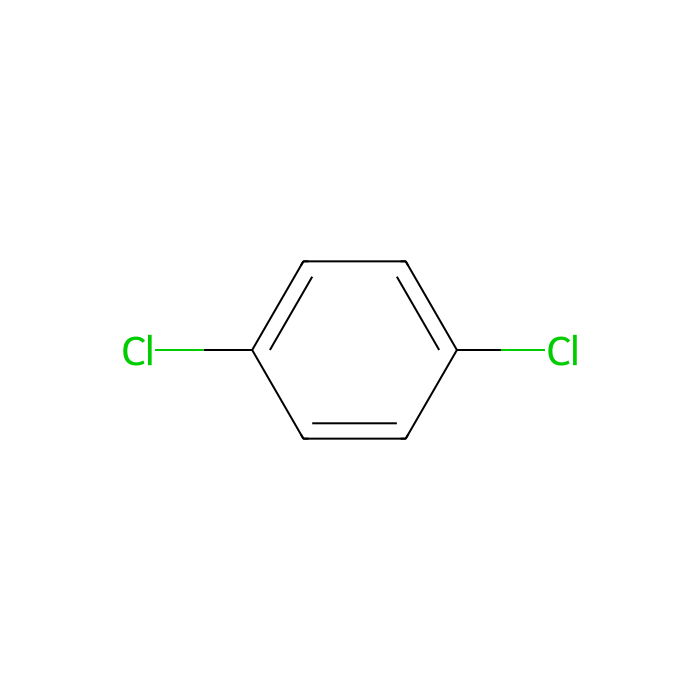
Brief description: 1,4-Dichlorobenzene (p-DCB) is a symmetric para-disubstituted chlorinated benzene; two chlorine atoms occupy para positions on a benzene ring.
Item-specific (from Product Data)
Literature/computed (non-item-specific)
Structural features (general)
Notes: Item-specific identifiers above reflect the provided Product Data; literature identifiers are supplied for context only.
Symmetry-enabled diversification
Key transformations (literature)
Retrosynthetic value
Practical points
Not applicable. This product is a small-molecule chemical, not a biological affinity reagent (e.g., antibody, enzyme inhibitor with defined biological target for this listing). No target, clone, isotype, or species reactivity information is relevant.