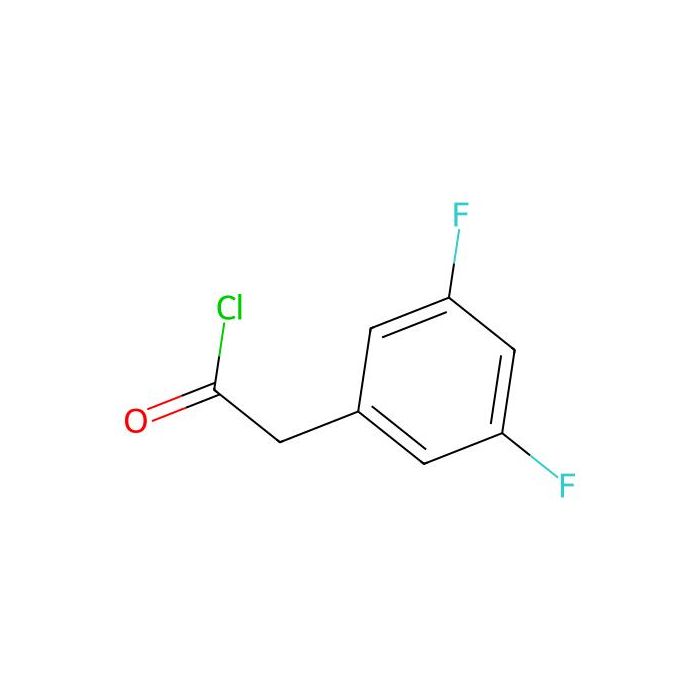
2-(3,5-Difluorophenyl)ethanoylchloride - ≥98% , CAS No.157033-24-4

CAS: 157033-24-4 Cat. No.: E701136 Formula: C8H5ClF2O Molecular Weight: 190.58 EC Number: 110-442-7 PubChem CID: 2782723
AVAILABLE TO ORDER
GRADE & PURITY ≥98%
Storage
Room temperature
★
Size
Germany (EU)
USA*
Price
Qty
25g
E701136-25g
Made to order · 8–12 wks

€388.66

€583.03
Save €194.37 (33.34%)
Enter a quantity for the sizes you want to add.
🧪
Why this grade

≥98% for sensitive chromatographic and analytical workflows requiring minimal baseline interference.

🌡

Storage & shipping

Room temperature Ships Check lot-specific COA for exact specifications.

📋

Quality documents

SDS, COA, datasheet, and spec sheet available for download. Lot-specific COA accessible via lot number lookup.

📚

Literature proof

Cited in 0 peer-reviewed publications across chromatography, organic synthesis, and cross-coupling reactions.

Specifications

Specifications & Purity
≥98%
Storage
Room temperature
Purity
≥98%
Names and Identifiers
Canonical Smiles
C1=C(C=C(C=C1F)F)CC(=O)Cl
IUPAC Name
2-(3,5-difluorophenyl)acetyl chloride
InChIKey
WMVPARKLYWQLNN-UHFFFAOYSA-N
INCHI
1S/C8H5ClF2O/c9-8(12)3-5-1-6(10)4-7(11)2-5/h1-2,4H,3H2
Isomeric SMILES
C1=C(C=C(C=C1F)F)CC(=O)Cl
PubChem CID
2782723
Molecular Weight
190.58

Documentation

📋 Safety Data Sheet (SDS)

Comprehensive hazard, handling, storage, and regulatory compliance document.

Download SDS →

✅ Certificate of Analysis (COA)

Lot-specific quality data. Enter your lot number to retrieve the exact COA.

Look up COA →

📊 Datasheet

Quick-reference summary of product specifications and applications.

View datasheet →

🔬 Specification Sheet

Full quality attributes and acceptance criteria for this grade.

View spec sheet →

Advanced Data

Taxonomic Classification

Taxonomy Tree

KingdomOrganic compounds
SuperclassBenzenoids
ClassBenzene and substituted derivatives
SubclassHalobenzenes
Intermediate Tree Nodes Not available
Direct ParentFluorobenzenes
Alternative Parents Aryl fluorides  Acyl chlorides  Organofluorides  Organochlorides  Organic oxides  Hydrocarbon derivatives  Carbonyl compounds  
Molecular FrameworkAromatic homomonocyclic compounds
Substituents Fluorobenzene - Aryl halide - Aryl fluoride - Acyl halide - Acyl chloride - Organic oxygen compound - Organic oxide - Hydrocarbon derivative - Organooxygen compound - Organofluoride - Organochloride - Organohalogen compound - Carbonyl group - Aromatic homomonocyclic compound
DescriptionThis compound belongs to the class of organic compounds known as fluorobenzenes. These are compounds containing one or more fluorine atoms attached to a benzene ring.
External Descriptors Not available
3D Structure
Interactive Chemical Structure Model


Certificates(CoA,COO,BSE/TSE and Analysis Chart)
C of A & Other Certificates(BSE/TSE, COO):
Analytical Chart:
Chemical and Physical Properties
Molecular Weight190.570 g/mol
XLogP32.600
Hydrogen Bond Donor Count0
Hydrogen Bond Acceptor Count3
Rotatable Bond Count2
Exact Mass190 Da
Monoisotopic Mass190 Da
Topological Polar Surface Area17.100 Ų
Heavy Atom Count12
Formal Charge0
Complexity164.000
Isotope Atom Count0
Defined Atom Stereocenter Count0
Undefined Atom Stereocenter Count0
Defined Bond Stereocenter Count0
Undefined Bond Stereocenter Count0
The total count of all stereochemical bonds0
Covalently-Bonded Unit Count1
Solution Calculators
Reviews

Customer Reviews

Application Protocols

Not applicable to biological assay formats (e.g., WB, IHC, IF, FC). This item is a synthetic reagent. For practical usage, see the Reaction Conditions and Reaction & Applications sections for general synthetic protocols and conditions.

Biological Roles

This compound is a synthetic aromatic acyl chloride without known natural biochemical function.

  • General context (literature/general)

    • Aromatic acyl chlorides are reactive intermediates and do not persist in biological systems due to rapid hydrolysis and acylation of nucleophiles.
    • The 3,5-difluorophenylacetyl motif can appear in medicinal chemistry intermediates; however, this product is intended solely as a laboratory reagent for chemical synthesis.
  • Implications for handling around biological materials

    • Strongly acylating and corrosive; rapidly inactivates proteins/enzymes by acylation; handle exclusively in chemical labs, not in biological culture environments.
    • Hydrolysis generates HCl and the corresponding acid, which can acidify media.

No clinical or therapeutic claims are made. This product is for research and laboratory use only.

Buffer Applications

Not typically applicable. 2-(3,5-Difluorophenyl)ethanoyl chloride is a moisture-sensitive acylating reagent that hydrolyzes in water and is not used to prepare or adjust aqueous buffers.

For laboratory work, refer instead to the sections on Reaction & Applications, Solvent Selection, and Reaction Conditions for its use in non-aqueous synthesis.

Green Alternatives

While acid chlorides are efficient acylating agents, they present hazards (HCl release, moisture reactivity) and often require chlorinated solvents. Consider greener routes/solvents when feasible.

  • Greener acyl donors (general comparison)

| Option | Advantages | Trade-offs | | --- | --- | --- | | Carboxylic acids + coupling reagents (e.g., EDC/HOBt alternatives) | Avoids acid chlorides/HCl; milder, often aqueous-compatible | Coupling waste; potential safety concerns with some additives | | Activated esters (e.g., pNP, OBt-free esters) | Stable, weighable solids; tunable reactivity | Preparation step; leaving-group waste | | Anhydrides (symmetric/mixed) | No chloride; often less fuming | Typically less reactive; can still be irritants |

  • Greener solvents for acylation (literature/general)

    • Replace DCM with toluene, EtOAc, 2-MeTHF, cyclopentyl methyl ether (CPME) when substrate solubility and selectivity permit.
    • For low-temperature organometallic steps, 2-MeTHF can substitute for THF with improved sustainability metrics and easier recovery.
  • Process intensification

    • Use continuous flow for hazardous steps (controlled HCl evolution, improved heat/mass transfer).
    • Solid-supported bases (polymer-bound DMAP or amines) can simplify workup and reduce aqueous salt waste.

Selection should be guided by LCA, solvent guides (e.g., CHEM21/ACS GCI), reaction performance, and EHS constraints.

Pharmaceutical Uses

No excipient or formulation roles are indicated for this item.

  • General context (literature/general)

    • Acid chlorides are commonly employed as synthetic intermediates to prepare amides, esters, ketones, and aldehydes en route to drug substance candidates.
    • The 3,5-difluorophenylacetyl fragment is a frequent motif in discovery chemistry owing to the tuning effects of ring fluorination on lipophilicity and metabolic stability; this material can be leveraged to introduce that fragment efficiently.
  • Manufacturing considerations

    • Due to corrosivity and HCl evolution, acyl chloride stages are typically contained and followed by quench and neutralization steps. Residual acid chloride is not carried into formulated products.

This product is supplied for research and process development use only; no therapeutic or clinical use is implied.

Physical Properties

Item-specific numeric specifications are not provided in the Product Data.

  • Item-specific values

    • Appearance: Not specified for this item; refer to CoA/Spec Sheet.
    • Molecular Formula: Not specified for this item; refer to CoA/Spec Sheet.
    • Molecular Weight: Not specified for this item; refer to CoA/Spec Sheet.
  • Literature/general properties for this class (arylacetyl chlorides; for planning only)

    • Phase at room temperature: Typically colorless to pale yellow liquids or low-melting solids (sensitive to moisture; fuming possible).
    • Boiling point: Often decomposes or distills under reduced pressure; specific BP for this compound is not widely reported (consult primary literature).
    • Melting point: Not widely reported.
    • Density/refractive index: Not widely reported; expect values similar to other arylacetyl chlorides (check CoA).
    • Solubility: Reacts with water; miscible with many anhydrous organic solvents (e.g., DCM, THF, toluene, EtOAc) [general behavior of acyl chlorides].
    • Stability: Hydrolyzes to the corresponding acid with evolution of HCl; sensitive to moisture, bases, and nucleophiles; stable when kept dry and sealed.

Practical implications

  • Handle and measure under dry conditions; use anhydrous solvents and inert atmosphere to minimize hydrolysis.
  • If distillation is required, perform under vacuum and strictly anhydrous conditions to limit decomposition.

Always refer to the CoA/SDS for authoritative item-specific physical data.

Quality & Grades
  • Item-specific quality information

    • Grade/Purity: Not specified for this item; refer to CoA/Spec Sheet.
    • Stabilizers/Inhibitors: Not specified for this item; refer to CoA/Spec Sheet.
    • UV cutoffs/trace impurities/metal limits: Not specified for this item; refer to CoA/Spec Sheet.
  • Interpreting grade (general guidance)

    • For moisture-sensitive acid chlorides, key quality determinants include hydrolyzable chloride content, acid content (resulting acid impurity), color, and GC purity. Low moisture headspace and low acid content correlate with reliable performance in acylations and low byproduct formation.
    • If HPLC/GC grade is indicated, expect low UV background and volatiles suited to analytical and preparative work. If “anhydrous” or “dry” is specified, Karl Fischer moisture control is critical.
  • Best practices to preserve quality (general)

    • Minimize atmospheric exposure; purge with inert gas after each use.
    • Use oven-dried or flame-dried glassware; dispense via dry syringe or cannula when possible.
    • For sensitive transformations (e.g., Weinreb amide formation, organometallic acylations), verify purity by GC or 1H/19F NMR; titrate acid chloride content when stoichiometry is critical.

Please refer to the product’s CoA for the definitive specification suite applicable to SKU E701136.

Reaction & Applications

Arylacetyl chlorides like 2-(3,5-difluorophenyl)ethanoyl chloride are versatile acylating agents used to introduce the 3,5-difluorophenylacetyl (–COCH2–C6H3F2) motif.

Key application families (general/literature)

  • Amide synthesis: Direct acylation of primary/secondary amines to give 3,5-difluorophenylacetamides. Use non-nucleophilic bases (Et3N/DIPEA) or pyridine; control exotherm with cooling. 19F NMR provides convenient product/impurity tracking.
  • Ester formation: Alcohol acylation under base/DMAP catalysis for 3,5-difluorophenylacetates. Useful for prodrug-like intermediates or protecting-group strategies in discovery chemistry.
  • Weinreb amide route: Coupling with N,O-dimethylhydroxylamine to give the Weinreb amide; subsequent reaction with organometallics affords ketones/aldehydes containing the 3,5-difluorobenzyl fragment with high control.
  • Organocuprate acylation: Reaction with Gilman reagents (R2CuLi) to furnish ketones selectively, preserving the acyl chloride’s carbonyl (minimal over-reaction vs Grignards).
  • Friedel–Crafts acylation: Installation of –COCH2–C6H3F2 onto activated aromatic rings with Lewis acid catalysts (e.g., AlCl3), enabling difluorobenzyl ketone scaffolds.
  • Reductions: Rosenmund reduction (Pd/BaSO4) or modified catalytic systems convert arylacetyl chlorides to the corresponding aldehyde (3,5-difluorophenylacetaldehyde) under controlled conditions.
  • Conversions to the acid/anhydride: Controlled hydrolysis gives 3,5-difluorophenylacetic acid; self- or mixed-anhydride formation expands coupling options.

Practical tips

  • Add the acid chloride to a cooled solution of nucleophile/base to control HCl evolution.
  • Monitor for hydrolysis by 1H/19F NMR or GC; water scavengers and dry glassware are essential.
  • For scale-up, employ calorimetry or staged addition to manage exotherms and gas evolution.
Reaction Conditions

Guidance below reflects general literature practices for arylacetyl chlorides and should be optimized per substrate. These are not item-specific specifications.

  • Amide formation

    • Solvent: DCM, THF, or toluene (anhydrous)
    • Base: Et3N or DIPEA (1.1–2.0 equiv); pyridine as alternative base/solvent
    • Temperature: 0–25 °C (cool addition to manage exotherm)
    • Catalyst: Optional DMAP (0.05–0.10 equiv) for hindered amines
    • Time: 0.5–4 h; monitor by TLC/GC/19F NMR
  • Esterification

    • Solvent: DCM or toluene; pyridine as base or catalytic DMAP
    • Alcohol: 1.1–2.0 equiv
    • Temperature: 0–25 °C; for sluggish cases, 40–60 °C in toluene
  • Weinreb amide formation

    • Reagents: N,O-dimethylhydroxylamine·HCl (1.1–1.5 equiv), base (Et3N/DIPEA)
    • Solvent: DCM or THF; 0–25 °C
  • Organocuprate acylation → ketones

    • Reagent: R2CuLi (1.1–1.5 equiv)
    • Solvent: THF or Et2O (dry)
    • Temperature: −78 to 0 °C; slow addition of acyl chloride
  • Friedel–Crafts acylation (install –COCH2–C6H3F2 on an arene)

    • Catalyst: AlCl3 or alternative Lewis acids (e.g., FeCl3, ZnCl2)
    • Solvent: DCM, nitrobenzene, or toluene (greener)
    • Temperature: 0–25 °C (exothermic)
  • Quench/workup

    • Cautiously quench into cold, dilute aqueous bicarbonate or saturated NH4Cl to neutralize HCl and destroy residual acyl chloride.
    • Separate organic layer, wash, dry (MgSO4/Na2SO4), and concentrate under reduced pressure.

Safety: Maintain anhydrous conditions; add acyl chloride last and slowly; provide adequate venting for HCl.

Safety & Handling
  • Product Data hazards

    • GHS Classification: Not specified for this item; refer to SDS.
    • Signal Word: Not specified for this item; refer to SDS.
    • H-Statements: Not specified for this item; refer to SDS.
    • Pictograms: Not specified for this item; refer to SDS.
  • General hazards (acyl chlorides; literature/general guidance)

    • Corrosive; causes severe burns to skin and eyes; strong respiratory irritant; may be a lachrymator due to HCl and acyl chloride vapors.
    • Reacts vigorously with water, alcohols, amines, and bases with heat and HCl evolution; exothermic acylation with nucleophiles.
    • Incompatible materials: Water, protic solvents, strong bases, strong oxidizers/reducers, azides without proper controls.
  • PPE and engineering controls

    • Use in a certified chemical fume hood.
    • Wear chemical-resistant gloves (e.g., butyl rubber or laminated barrier), lab coat, splash goggles/face shield.
    • Maintain spill control materials (sodium bicarbonate solution; inert absorbent) nearby.
  • First-aid overview (general)

    • Skin/eye contact: Immediate irrigation with copious water for at least 15 minutes; remove contaminated clothing; seek medical attention.
    • Inhalation: Move to fresh air; keep at rest; obtain medical attention.
    • Ingestion: Rinse mouth; do not induce vomiting; seek medical attention.
  • Handling/storage tips

    • Work anhydrously; keep container tightly sealed under dry inert gas when possible.
    • Add acyl chloride slowly to cold, stirred nucleophile/base to control exotherm.
    • Store segregated from bases and protic reagents; secondary containment recommended.

Always consult the product SDS for definitive hazard and response information.

Solvent Selection

This product is a moisture-sensitive acylation reagent rather than a solvent. Solvent choice affects reaction rate, selectivity, and side reactions during acylation.

  • Polarity/miscibility considerations (general)

    • Preferred media: Anhydrous, aprotic solvents such as dichloromethane (DCM), chloroform, toluene, diethyl ether, THF, MTBE, or acetonitrile, selected based on nucleophile and base.
    • Avoid: Water and protic alcohols unless deliberately performing esterification under controlled base scavenging (e.g., pyridine); otherwise hydrolysis occurs.
  • Typical pairings by transformation

    • Amide formation (amines): DCM or THF with an organic base (Et3N, DIPEA) or nucleophilic base (pyridine) to scavenge HCl.
    • Ester formation (alcohols): Pyridine or DCM with DMAP catalysis; alternatively toluene with base for less polar substrates.
    • Organocuprate acylation to ketones: THF or ether at low temperature (−78 to 0 °C).
    • Friedel–Crafts acylation (installing –COCH2–ArF2 on a second arene): DCM or CS2 historically; greener choices include toluene with solid Lewis acids.
  • Practical comparison (general)

    • DCM: Excellent control and solubility; non-green, halogenated.
    • THF/2-MeTHF: Good for low-temperature metalations; ethers are water-sensitive but more sustainable in the 2-MeTHF case.
    • Toluene: Good for high-temperature/less polar systems; greener than DCM.

Keep solvents rigorously dry; distill or use molecular sieves as appropriate.

Storage & Reconstitution
  • Item-specific storage (Product Data)

    • Storage Conditions: Room temperature.
  • General storage guidance for acyl chlorides

    • Keep tightly closed in the original container; protect from moisture and air.
    • For extended storage, consider blanketing headspace with dry nitrogen/argon and using a moisture-barrier septum cap.
    • Store in a cool, dry, well-ventilated area, segregated from bases, alcohols, amines, and oxidants. Secondary containment recommended.
    • Avoid repeated freeze–thaw; not required to freeze. Refrigeration is typically not necessary unless specified on the label/CoA.
  • Reconstitution/handling

    • Typically supplied neat; no reconstitution required.
    • If preparing stock solutions, use anhydrous solvents (e.g., DCM, THF, toluene, Et2O, MeCN). Prepare immediately before use; store short-term under inert atmosphere at low temperature when feasible.
    • Syringe or cannula transfer is recommended to limit moisture exposure; oven-dry glassware and use molecular sieves in solvents if needed.

Always prioritize the product label and SDS/CoA for definitive storage and handling instructions for SKU E701136.

Structure & Identity

Brief description: 2-(3,5-Difluorophenyl)ethanoyl chloride is an aromatic acyl chloride (arylacetyl chloride) bearing two ring fluorines at the 3- and 5-positions and a –CH2–COCl side chain.

  • Product Data (as provided)

    • SKU: E701136
    • CAS: 157033-24-4
    • CID: 2782723
    • InChIKey: 402548 (as provided)
    • Storage Conditions: Room temperature
    • Research Use: For research use only
  • Computed/Literature structural identity (for reference; not item-specific specs)

    • Common synonym: 3,5-Difluorophenylacetyl chloride
    • Core scaffold: monosubstituted phenyl ring (positions 3 and 5 fluoro) bearing a benzylic methylene linked to an acid chloride carbonyl
    • Functional groups: acyl chloride (–COCl), benzylic methylene (–CH2–), two aryl C–F bonds
    • 2D description: A benzene ring with F at C3 and C5; at C1 a –CH2–COCl substituent (para to neither F; F atoms meta to side chain and to each other)
    • Literature SMILES: O=C(Cl)CH2c1cc(F)cc(F)c1
    • Empirical formula (literature): C8H5ClF2O
    • Formula weight (literature): ~190.57 g/mol
  • Stereochemistry: None (achiral); no stereogenic centers.

Notes: Structural notations (SMILES/formula/MW) are literature/computed references for this chemical name; consult the Certificate of Analysis (CoA) for item-specific identity confirmation.

Synthetic Utility

Functional group repertoire and reactivity (general/literature)

  • Electrophile strength: The acyl chloride carbonyl is highly electrophilic, enabling rapid acylation of N/O nucleophiles.
  • Benzylic handle: The –CH2– adjacent to the aromatic ring allows downstream alpha-functionalization once converted to less reactive derivatives (e.g., amides/esters) for enolate chemistry.

Key transformations enabled

  • Amides and esters: Direct assembly of 3,5-difluorophenylacetamides/acetates under Schotten–Baumann or non-aqueous conditions.
  • Weinreb amide platform: Convergent access to aldehydes/ketones with defined substitution via organometallic addition.
  • Ketone formation via organocuprates: R2CuLi + acyl chloride → ketone selectively; useful to append alkyl/aryl groups without over-addition.
  • Aldehyde synthesis: Rosenmund reduction (Pd/BaSO4, H2) affords 3,5-difluorophenylacetaldehyde, a versatile intermediate for further elaboration (e.g., reductive amination, Wittig).
  • Acid/anhydride access: Hydrolysis to 3,5-difluorophenylacetic acid; coupling to mixed anhydrides for peptide or small-molecule assembly.
  • Friedel–Crafts acylation: Installation of the –COCH2–C6H3F2 moiety onto activated arenes under Lewis acid catalysis, expanding scaffold diversity.

Selectivity/tactics

  • Use bases to trap HCl and suppress N-acylation vs O-acylation when desired.
  • 19F NMR offers a powerful handle for monitoring conversions, regioisomers, and impurity profiles.
  • Protect sensitive nucleophiles (e.g., phenols) or employ catalysts (DMAP) to steer acylation site-selectivity.
Target Specificity

Not applicable. This product is a small-molecule chemical reagent (acyl chloride) and is not an antibody, enzyme, or biological binder. No target, epitope, clone, isotype, or species reactivity is associated with this item.

Shall we send you a message when we have discounts available?

Remind me later

Thank you! Please check your email inbox to confirm.

Oops! Notifications are disabled.