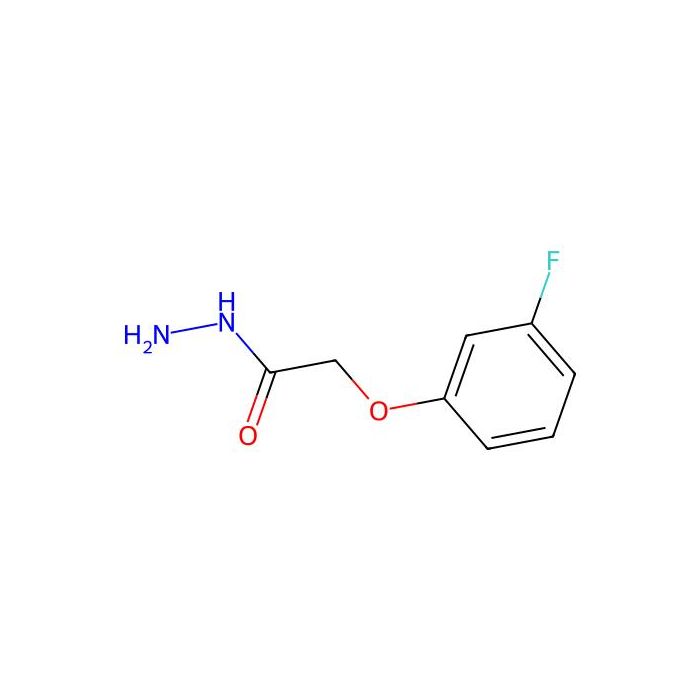
This compound belongs to the class of organic compounds known as phenol ethers. These are aromatic compounds containing an ether group substituted with a benzene ring.
External Descriptors
Not available
1. Djoumbou Feunang Y, Eisner R, Knox C, Chepelev L, Hastings J, Owen G, Fahy E, Steinbeck C, Subramanian S, Bolton E, Greiner R, and Wishart DS. ClassyFire: Automated Chemical Classification With A Comprehensive, Computable Taxonomy. Journal of Cheminformatics, 2016, 8:61.
Determine the necessary mass, volume, or concentration for preparing a solution.
Dilution Calculator
Determine the dilution needed to prepare a stock solution.
Reconstitution Calculator
Reviews
Customer Reviews
Application Protocols
Item-specific, validated protocols and tested applications: Not specified for this item; refer to CoA/Spec Sheet.
General example workflows (literature/guidance; adapt to your system)
Hydrazone ligation to an aldehyde-bearing biomolecule
Prepare 100 mM stock of 2-(3-fluorophenoxy)acetohydrazide in anhydrous DMSO.
In 100 mM sodium acetate buffer, pH 5.5, combine aldehyde partner (0.5–2 mM) with hydrazide (2–10 mM) and optional aniline catalyst (50 mM).
Incubate at 25–37°C for 0.5–4 h. Monitor by UV/LC-MS. Optionally reduce with NaBH3CN at pH 6.5 for stability.
Desalt or purify by dialysis/SPE as appropriate.
Synthesis of a 1,3,4-oxadiazole derivative (two-step outline)
Diacylation: To a cooled (0°C) solution of the hydrazide in DMF, add Et3N (2 equiv) and an acid chloride (1.2 equiv). Stir to rt 1–2 h.
Cyclodehydration: Concentrate, dissolve in 2-MeTHF, add T3P (50 wt% in EtOAc, 2–3 equiv), heat 80–100°C for 1–3 h. Work up and crystallize.
Analytical derivatization of aldehydes
Combine analyte (carbonyl) with hydrazide in MeOH containing 0.1% AcOH; allow 10–30 min at rt; analyze by LC-MS (hydrazone mass shift = + (hydrazide − H2O)).
Always perform small-scale trials and adjust stoichiometry, pH, and temperature for your system.
Biological Roles
This product is intended for research use only. No clinical or therapeutic claims are made.
General context (literature; not product-specific claims)
Acyl hydrazides are widely used as chemoselective partners for aldehydes/ketones to form hydrazones in biomolecular labeling and immobilization (e.g., coupling to oxidized glycans on glycoproteins).
Hydrazone linkages are dynamic/reversible under physiological to mildly acidic conditions; they can be stabilized by reduction (e.g., NaBH3CN) to secondary amines for longer-term stability.
Aryl fluorination can modulate lipophilicity and binding in screening libraries; the 3-fluorophenoxy moiety serves as a common fragment motif in medicinal chemistry SAR exploration.
As a small organic molecule, it does not have an intrinsic biological role (enzyme cofactor, metabolite) known in natural systems; it is best viewed as a synthetic probe or intermediate for generating bioactive analogs.
Use cases in biochemical workflows (general)
Preparation of hydrazide-functionalized surfaces or capture reagents.
Conjugation to carbonyl-bearing ligands for affinity matrices or analytical derivatization.
Note: For biological experiments, confirm solubility and compatibility with buffers and additives. Consult SDS and institutional guidelines for handling and disposal.
Buffer Applications
This compound is not a buffering agent and does not define a specific pH range like classical buffers (HEPES, phosphate, Tris). Therefore, “buffer applications” per se are not typically applicable.
Practical guidance related to buffers (general for hydrazone ligation chemistry)
Hydrazone formation proceeds well in mildly acidic buffers: acetate, citrate, or phosphate-citrate at pH 4.5–6.0 (literature). Aniline (10–100 mM) can be added as a nucleophilic catalyst to accelerate ligation at near-neutral pH if necessary.
Typical working concentrations: prepare 10–100 mM stock in DMSO, then dilute to 0.1–5 mM in buffer immediately before use to minimize background reactions and ensure solubility.
Avoid buffers containing reactive carbonyls or aldehyde contaminants; use freshly prepared buffers and carbonyl partners.
For experiments requiring true pH control, select an appropriate biological buffer and validate the reaction rate and stability under your specific conditions.
Green Alternatives
Solvent and process choices often dominate the environmental profile for hydrazide chemistry. Consider the following greener adjustments (general guidance):
Comparison (general; not item-specific specifications)
Traditional approach: DMF, DCM, POCl3/SOCl2 for dehydrations.
Greener alternative: 2-MeTHF or ethanol as reaction media when feasible; water/ethanol mixtures for hydrazone formation; catalytic dehydrations with T3P or CDI under milder conditions.
Hydrazone ligation media
Greener: Aqueous acetate or citrate buffers (pH 4.5–6.0) with 10–30% ethanol instead of neat organic solvents; eliminates halogenated waste.
Cyclodehydration to oxadiazoles
Replace POCl3/SOCl2 with T3P (propylphosphonic anhydride) in EtOAc or 2-MeTHF or with green carbodiimide protocols (e.g., EDC) when compatible; reduces corrosive byproducts.
Workup/purification
Favor crystallization from ethanol/water over column chromatography where possible. If chromatography required, consider heptane/EtOAc over hexane/DCM.
Energy and safety
Microwave-assisted cyclizations in ethanol or 2-MeTHF can reduce reaction times and energy consumption.
Trade-offs
Highly polar substrates like hydrazides may require DMF/DMSO for solubility; a mixed-solvent strategy (EtOH/DMSO) can balance solvency and greenness.
Some green reagents (e.g., EDC) introduce urea byproducts; plan for aqueous washes to remove them efficiently.
Pharmaceutical Uses
Item-specific pharmacopeial status and excipient roles: Not specified for this item; refer to CoA/Spec Sheet.
General context (non-clinical; research/manufacturing focus only)
Acyl hydrazides are common intermediates in medicinal chemistry campaigns for assembling heterocycles (e.g., 1,3,4-oxadiazoles) and for late-stage diversification via hydrazone formation/reduction.
The 3-fluorophenoxy motif is frequently employed to modulate metabolic stability and permeability in small-molecule leads; this compound can serve as a building block to introduce that fragment.
Potential roles in process development: starting material for libraries, fragment linking via hydrazide–carbonyl couplings, and pro-moiety in masked functionalities that can be unmasked or cyclized.
Compliance note
This product is sold for research use only and is not intended for use as an active pharmaceutical ingredient or as an excipient in human or veterinary products without appropriate qualification. No clinical performance or therapeutic claims are made.
Physical Properties
Item-specific specifications
Appearance: Not specified for this item; refer to CoA/Spec Sheet.
Grade/Purity: Not specified for this item; refer to CoA/Spec Sheet.
Molecular formula: Not specified for this item; refer to CoA/Spec Sheet. (Computed literature formula provided below.)
Molecular weight: Not specified for this item; refer to CoA/Spec Sheet. (Computed literature value provided below.)
Literature/computed (non-specification; typical reference values for the neat compound)
Formula (computed from structure): C8H9FN2O2
Formula mass (average, computed): ~184.17 g/mol
Physical state: typically a crystalline solid for analogous acyl hydrazides (literature/generic observation)
Polarity/proticity: polar, hydrogen-bond donor and acceptor; capable of multiple H-bonds (two nitrogens, one carbonyl oxygen)
Solubility profile (qualitative, literature):
Good: DMSO, DMF, NMP, hot ethanol/methanol, aqueous buffers at acidic to neutral pH (as hydrazide/amide)
Limited: acetone, acetonitrile (variable with temperature)
Poor/negligible: nonpolar hydrocarbons (hexanes, toluene) due to high polarity and H-bonding
pKa: hydrazide –NH– typically weakly acidic (pKa of conjugate acid ~3–4) and terminal –NH2 weakly basic (literature ranges for acyl hydrazides); exact values for this compound not established.
LogP: expected low to moderate lipophilicity due to phenyl/F plus polar hydrazide (literature expectation for phenoxyacyl hydrazides); exact value not established.
Refractive index, melting point, boiling point, density, UV cutoff, metal/peroxide/water limits: Not specified for this item; refer to CoA/Spec Sheet.
Quality & Grades
Item-specific quality information
Grade/Purity: Not specified for this item; refer to CoA/Spec Sheet.
Stabilizers/Inhibitors: Not specified for this item; refer to CoA/Spec Sheet.
Interpreting typical grades (general guidance)
Research grade: Suitable for most synthetic and screening applications. Actual assay, residual solvents, and chromatographic purity should be confirmed on the CoA for this SKU.
HPLC/LC-MS suitability: If low-UV and low-metal content are critical (e.g., for trace analyses or medicinal chemistry SAR), look for specifications such as UV cutoffs, metal limits, and residual water/solvent content. These are Not specified for this item; refer to CoA/Spec Sheet.
Impurity considerations for acyl hydrazides (general)
Likely impurities: residual starting acid derivatives (phenoxyacetic acid or esters), ureas/biurets from over-acylation, hydrazones (if exposed to aldehydes/ketones), and inorganic salts.
Water and residual solvent: Karl Fischer and GC–headspace are typical; values are Not specified for this item; refer to CoA/Spec Sheet.
Batch documentation
For regulated or critical research, request the lot-specific CoA detailing assay (%), identity (NMR/HRMS), and impurity profile. Match to your analytical acceptance criteria.
Reaction & Applications
This hydrazide is a versatile nucleophilic building block and ligation partner.
Carbonyl condensation (hydrazone formation)
Reacts with aldehydes and ketones to give hydrazones; typically acid-catalyzed (AcOH, anilinium catalysts) with maximal rates around pH 4.5–6.0 (literature). Useful for reversible covalent capture of carbonyls and for derivatization/analytical tagging.
Practical tip: Use aniline or p-phenylenediamine catalysts (10–100 mM) in aqueous buffer/MeOH to accelerate at neutral pH if biomolecule compatibility is required.
Acyl transfer and coupling
From the hydrazide, acyl azides (via nitrosylation) or activated acyl species can be formed and rearranged (Curtius-like chemistry when appropriate carboxyl precursor is available). Direct coupling to electrophiles (acid chlorides/anhydrides) extends the scaffold.
1,3,4-oxadiazoles: dehydrative cyclization with carboxylic acids or suitable dehydrants (e.g., POCl3, SOCl2, T3P) after acylation to diacyl hydrazides.
1,3,4-oxadiazol-2-ones and triazoles: cyclodehydration or cycloaddition sequences from hydrazide intermediates.
Bioconjugation/linking
Couples to oxidized glycans (aldehydes from periodate oxidation) or keto probes to form hydrazone linkages; can be driven to completion by removal of water or by using reactive aldehydes (e.g., benzaldehydes with electron-withdrawing groups).
Protecting group chemistry
Hydrazinolysis analogs: while this is a hydrazide (not hydrazine), its presence can participate in selective transformations; the acyl hydrazide motif can be converted to other amide derivatives via activation.
Tips
Maintain anhydrous conditions for acylation/cyclodehydration steps. For hydrazone ligations in water, buffer at pH ~5.5 and consider nucleophilic catalysts.
Reaction Conditions
General guidance from literature for reactions involving acyl hydrazides like 2-(3-fluorophenoxy)acetohydrazide. Optimize for your substrate and lab scale.
Hydrazone formation with aldehydes/ketones
Solvent: aqueous acetate/citrate buffer (pH 4.5–6.0) with 10–50% MeOH or EtOH; or MeOH/AcOH (0.1–1% v/v) for non-aqueous.
Catalyst: aniline (10–100 mM) can accelerate at pH 6–7.
Temperature/time: 20–37°C; minutes to hours depending on partner electrophilicity.
Workup: direct use or precipitation; optional reduction with NaBH3CN at pH 6–7 to stabilize.
Formation of diacyl hydrazides and 1,3,4-oxadiazoles
Step 1 (acylation): treat hydrazide with acid chloride (1.1–1.5 equiv) and base (Et3N or pyridine) in DCM/DMF at 0–25°C to form diacyl hydrazide.
Step 2 (cyclodehydration): heat with POCl3, SOCl2, or T3P in toluene/EtOAc/2-MeTHF at 60–110°C for 1–6 h. Microwave heating in EtOH can shorten times to 10–30 min (literature).
Urea/carbamate formation via acyl azide pathway
Convert to acyl azide under nitrosylation conditions (e.g., NaNO2/HCl at 0–5°C), then thermally rearrange and trap with nucleophiles (amine/alcohol). Exercise caution with azides; follow strict safety protocols.
Purification/analytics
Many intermediates are amenable to trituration or crystallization. Use LC-MS to monitor (M+H+ ~185 for parent hydrazide; literature) and HPLC to gauge conversion/purity.
Expected yields
Hydrazone formation: often 60–95% isolated for aromatic aldehydes (literature range).
Oxadiazole cyclizations: 50–85% depending on dehydrant and substitution (literature range).
Safety & Handling
Item-specific hazard information
GHS classification: Not specified for this item; refer to SDS.
Signal word: Not specified for this item; refer to SDS.
H-statements and pictograms: Not specified for this item; refer to SDS.
General safety guidance for acyl hydrazides (literature/good practice; not product specifications)
Potential hazards: May cause irritation to skin, eyes, and respiratory tract. Some hydrazides can be sensitizers. Avoid inhalation of dust and contact with skin/eyes.
PPE: Use lab coat, safety glasses or face shield, and appropriate chemical-resistant gloves (e.g., nitrile). Handle solids in a fume hood to avoid dust exposure.
Incompatibilities: Strong oxidizers; strong acids or dehydrating agents may promote undesired reactions (e.g., acylation, cyclization). Avoid nitrosating conditions (nitrites + strong acid) to prevent formation of N-nitroso species.
Thermal/chemical reactivity: Hydrazides can condense with aldehydes/ketones to form hydrazones; keep away from reactive carbonyls if not intended. Avoid prolonged heating under strongly acidic or dehydrating conditions that can form heterocycles (oxadiazoles, triazoles) from acyl hydrazides.
First aid (overview): If inhaled—move to fresh air; if on skin—wash with soap and water; if in eyes—rinse cautiously with water for several minutes; if swallowed—rinse mouth. Seek medical attention as needed. Always consult the SDS for authoritative instructions.
Fire safety: Use CO2, dry chemical, or foam. Combustion may produce NOx, HF (due to aromatic fluorine), and CO/CO2—use self-contained breathing apparatus in fires.
Storage: Store tightly closed at room temperature as provided in Product Data; protect from moisture and incompatible reagents. Consult SDS for detailed guidance.
Solvent Selection
Solvent behavior (general for acyl hydrazides)
Polarity: Polar, multiprotic (H-bond donor/acceptor). Often dissolves well in polar aprotic solvents (DMSO, DMF, NMP) and protic alcohols (MeOH, EtOH), with limited solubility in nonpolar solvents.
Aqueous handling: Limited baseline aqueous solubility near neutral pH, but improved in mildly acidic media due to protonation of hydrazide nitrogens. Salt formation is uncommon but acidification aids dissolution.
Practical selection by application
Stock solutions for screening/bioconjugation: DMSO (10–100 mM) is typical; dilute into buffer (pH 4.5–6.0 for hydrazone ligation) immediately before use.
Synthetic transformations: DMF, DCM/DMF mixtures, acetonitrile, or toluene/DMF for coupling and cyclization chemistry. Alcohols (MeOH/EtOH) for recrystallization.
Compatibility notes
Avoid aldehyde/ketone-containing solvents (e.g., wet acetone) for storage/long soaks—risk of hydrazone formation.
In water-rich systems, monitor for hydrolysis or transacylation under strong acid/base.
Quick comparison (general)
DMSO: maximal solubilization; high boiling; hygroscopic.
DMF/NMP: strong solvating power; higher bp; ensure low water for moisture-sensitive steps.
MeOH/EtOH: greener, easy removal; may participate in H-bonding networks affecting rates of condensation.
ACN: intermediate polarity; may require warming for full dissolution.
Storage & Reconstitution
Item-specific storage and shipping
Storage conditions: Room temperature (as provided in Product Data). Keep tightly closed, in a dry place, away from incompatible materials (strong oxidizers, nitrosating agents).
Shipped in: Not specified for this item; refer to CoA/Spec Sheet.
Shelf-life/stability
Exact shelf-life, assay retention, and impurity limits: Not specified for this item; refer to CoA/Spec Sheet.
General guidance: Store desiccated and protect from prolonged exposure to moisture and reactive carbonyl vapors to minimize hydrazone formation.
Reconstitution and stock solutions (general guidance)
For screening/bioconjugation: prepare 10–100 mM stocks in anhydrous DMSO or DMF. Filter if particulate is present (PTFE/PP, 0.2 µm).
For aqueous use: dilute DMSO stock into buffer immediately before use. Mild heating (25–37°C) and vortexing/sonication can aid dissolution. Target final organic cosolvent ≤10% v/v if working with biomolecules.
Avoid preparing stocks in aldehyde/ketone-rich solvents (e.g., acetone) to prevent adventitious hydrazone formation.
Freeze–thaw
If aqueous solutions are prepared, store aliquots at 2–8°C (short term) or −20°C (longer term) to minimize hydrolysis; avoid repeated freeze–thaw by aliquoting.
Disposal
Follow institutional and local regulations for disposal of nitrogen-containing organic compounds; consult SDS for details.
Structure & Identity
Brief overview: 2-(3-Fluorophenoxy)acetohydrazide is a small-molecule acyl hydrazide bearing a 3-fluorophenoxy substituent linked through a methylene to the carbonyl.
Item-specific (from Product Data)
Product name: 2-(3-Fluorophenoxy)acetohydrazide
CAS: 379255-56-8
InChIKey: 90282 (as provided)
Storage: Room temperature
Research use: For research use only
Literature/computed identity (non-specification; for reference)
Preferred IUPAC-style name (descriptive): 3-fluorophenoxyacetic acid hydrazide (positional isomer: F at ring 3)
Molecular formula (computed from structure): C8H9FN2O2
Structural description (2D): a 3-fluorophenyl ring bonded to oxygen (phenoxy), connected via –O–CH2– to an acyl carbonyl, which is bound to a terminal hydrazide –NH–NH2 chain. No stereocenters; planar amide/hydrazide segment conjugated with carbonyl.
Notes
Where exact identifiers for this specific catalog item are needed (e.g., canonical InChI, exact stereochemical descriptors), refer to the item’s CoA/Spec Sheet.
Synthetic Utility
Functional group reactivity
Hydrazide –CONH–NH2 offers nucleophilic nitrogens for condensation with aldehydes/ketones (hydrazones), acylation to diacyl hydrazides, and intramolecular cyclodehydrations to heterocycles.
Ether-linked 3-fluorophenoxy substituent provides an aryl fragment with defined electronics (para-/meta-directing profile for subsequent transformations on derivatives).
Diacylation → cyclodehydration: Convert to diacyl hydrazide then cyclize to 1,3,4-oxadiazoles (POCl3, SOCl2, PPA, T3P, CDI).
Acyl activation: Convert to acyl azide (via nitrosylation) then to ureas/carbamates or amines after Curtius-like rearrangement, when an appropriate precursor pathway is used.
Retrosynthetic value
Serves as a convergent point joining a fluorinated aryl ether fragment (from 3-fluorophenol + chloroacetic derivatives) with hydrazide chemistry, enabling rapid diversification at the acyl position.
Practical notes
Protecting groups: The terminal –NH2 may be transiently protected (e.g., Boc, Cbz on nitrogen after appropriate activation) if selective acylation is required.
Purification: Many acyl hydrazides crystallize well; hot ethanol or ethanol/water recrystallization can obviate chromatography.
Analysis: Distinct NH resonances (often broad) and methylene singlet around 4.4–4.7 ppm (literature) aid NMR confirmation.
Target Specificity
Not applicable. This product is a small-molecule reagent, not a biological targeting reagent (e.g., antibody, enzyme inhibitor with validated selectivity panel, or probe with defined target). No antigen, epitope, clone, isotype, or species reactivity information applies. For biochemical applications, see Reaction & Applications and Application Protocols for general usage contexts.
We use cookies to ensure the website functions properly and, where permitted, to improve your experience. You can manage your preferences at any time in Settings. Learn more in our Cookie Policy.
Shall we send you a message when we have discounts available?
Remind me later
Thank you! Please check your email inbox to confirm.
Products are supplied to verified businesses, institutions, and qualified professionals for research and development use only. Not for use in humans, animals, diagnosis, or therapy.