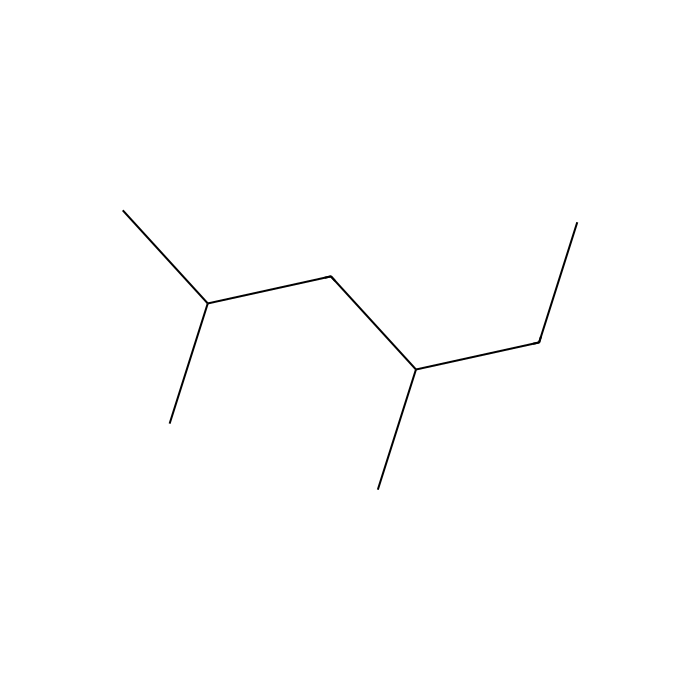
2,4-Dimethylhexane - ≥98%(GC) , CAS No.589-43-5

CAS: 589-43-5 Cat. No.: D155187 Formula: C8H18 Molecular Weight: 114.23 Beilstein Registry Number: 1718750 EC Number: 209-649-6
AVAILABLE TO ORDER
GRADE & PURITY ≥98%(GC)
Synonyms
2,4-Dimethyl hexane|2,4-DIMETHYLHEXANE|2,4-dimethyl-hexane|2-methyl-4-ethyl-pentane|(+/-)-2,4-DIMETHYLHEXANE|C8-9 isoparaffin|Hexane, 2,4-dimethyl-
Storage
Room temperature
Shipped In
FedEx DG Service
★
Size
Germany (EU)
USA*
Price
Qty
1ml
D155187-1ml
—
3 In stock
€28.55
Enter a quantity for the sizes you want to add.

Overview

2,4-Dimethylhexane can be gas chromatographically enantioseparated on different modified cyclodextrins.

Specifications

Synonyms
2,4-Dimethyl hexane | 2,4-DIMETHYLHEXANE | 2,4-dimethyl-hexane | 2-methyl-4-ethyl-pentane | (+/-)-2,4-DIMETHYLHEXANE | C8-9 isoparaffin | Hexane, 2,4-dimethyl-
Specifications & Purity
≥98%(GC)
Storage
Room temperature
Shipped In
FedEx DG Service
Purity
≥98%(GC)
Names and Identifiers
Pubchem Sid
Pubchem Sid Url
https://pubchem.ncbi.nlm.nih.gov/substance/504752144
SMILES
CCC(C)CC(C)C
IUPAC Name
2,4-dimethylhexane
InChIKey
HDGQICNBXPAKLR-UHFFFAOYSA-N
InChI
1S/C8H18/c1-5-8(4)6-7(2)3/h7-8H,5-6H2,1-4H3
Isomeric SMILES
CCC(C)CC(C)C
WGK Germany
2
Molecular Weight
114.23
Beilstein
1718750
Reaxys
1718748
Reaxys-RN_link_address
https://www.reaxys.com/reaxys/secured/hopinto.do?context=S&query=IDE.XRN=1718748&ln=

Advanced Data

Taxonomic Classification

Taxonomy Tree

KingdomOrganic compounds
SuperclassHydrocarbons
ClassSaturated hydrocarbons
SubclassAlkanes
Intermediate Tree Nodes Not available
Direct ParentBranched alkanes
Alternative Parents Not available
Molecular FrameworkAliphatic acyclic compounds
Substituents Branched alkane - Aliphatic acyclic compound
DescriptionThis compound belongs to the class of organic compounds known as branched alkanes. These are acyclic branched hydrocarbons having the general formula CnH2n+2.
External Descriptors Not available
3D Structure
Interactive Chemical Structure Model


Certificates (CoA,COO,BSE/TSE and Analysis Chart)
C of A & Other Certificates(BSE/TSE, COO):
Analytical Chart:

Find and download the COA for your product by matching the lot number on the packaging.

5 results found

Lot NumberCertificate TypeDateItem
C2604447C2604447Certificate of AnalysisJan 30, 2026 D155187
K2413262K2413262Certificate of AnalysisNov 05, 2024 D155187
C2420115C2420115Certificate of AnalysisFeb 19, 2024 D155187
K2322370K2322370Certificate of AnalysisNov 14, 2023 D155187
B2219386B2219386Certificate of AnalysisJan 18, 2022 D155187
Chemical and Physical Properties
Refractive Index1.395
Flash Point10 °C
Boil Point109 °C
Molecular Weight114.23
XLogP34.000
Hydrogen Bond Donor Count0
Hydrogen Bond Acceptor Count0
Rotatable Bond Count3
Exact Mass114.141 Da
Monoisotopic Mass114.141 Da
Topological Polar Surface Area0.000 Ų
Heavy Atom Count8
Formal Charge0
Complexity46.000
Isotope Atom Count0
Defined Atom Stereocenter Count0
Undefined Atom Stereocenter Count1
Defined Bond Stereocenter Count0
Undefined Bond Stereocenter Count0
The total count of all stereochemical bonds0
Covalently-Bonded Unit Count1
Safety and Hazards(GHS)
Pictogram(s)
GHS02,   GHS07,   GHS08,   GHS09
Signal
Danger
Hazard Statements

H224:Extremely flammable liquid and vapor

H225:Highly Flammable liquid and vapor

H304:May be fatal if swallowed and enters airways

H315:Causes skin irritation

H336:May cause drowsiness or dizziness

H400:Very toxic to aquatic life

H410:Very toxic to aquatic life with long lasting effects

H411:Toxic to aquatic life with long lasting effects

Precautionary Statements

P210:Keep away from heat, hot surface, sparks, open flames and other ignition sources. - No smoking.

P233:Keep container tightly closed.

P240:Ground/bond container and receiving equipment.

P241:Use explosion-proof [electrical/ventilating/lighting/.../] equipment.

P242:Use only non-sparking tools.

P243:Take precautionary measures against static discharge.

P261:Avoid breathing dust/fume/gas/mist/vapors/spray.

P264:Wash hands [and …] thoroughly after handling.

P271:Use only outdoors or in a well-ventilated area.

P273:Avoid release to the environment.

P280:Wear protective gloves/protective clothing/eye protection/face protection.

P321:Specific treatment (see ... on this label).

P331:Do NOT induce vomiting.

P391:Collect spillage.

P302+P352:IF ON SKIN: wash with plenty of water.

P303+P361+P353:IF ON SKIN (or hair): Take off Immediately all contaminated clothing. Rinse SKIN with water [or shower].

P304+P340:IF INHALED: Remove person to fresh air and keep comfortable for breathing.

P362+P364:Take off contaminated clothing and wash it before reuse.

P370+P378:In case of fire: Use ... to extinguish.

P405:Store locked up.

P403+P233:Store in a well-ventilated place. Keep container tightly closed.

P403+P235:Store in a well-ventilated place. Keep cool.

P501:Dispose of contents/container to an approved waste disposal plant.

P301+P316:IF SWALLOWED: Get emergency medical help immediately.

P332+P317:If skin irritation occurs: Get medical help.

P319:Get medical help if you feel unwell.

WGK Germany
2
Reaxys
1718748
Reaxys-RN_link_address
https://www.reaxys.com/reaxys/secured/hopinto.do?context=S&query=IDE.XRN=1718748&ln=
Solution Calculators
Reviews

Customer Reviews

Application Protocols

No standardized bioassay or immunoassay protocols apply to this hydrocarbon solvent. For chemical applications, consider the following general operating steps (adapt as needed to your SOPs):

  • Solvent drying and degassing (general):

    • Add activated 3Å molecular sieves (10–20% w/v) and allow to stand overnight. For moisture-/oxygen-sensitive work, sparge with nitrogen or argon for 20–30 minutes, or perform three freeze–pump–thaw cycles.
  • Use in hydrogenation (example framework):

    • Charge reactor with substrate and catalyst (e.g., 5 wt% Pd/C, 1–10 mol% metal relative to substrate), add 2,4-dimethylhexane to desired concentration (0.05–0.5 M), purge with H2, and stir under H2 at controlled temperature below solvent BP. Monitor by GC.
  • GC sample preparation (example framework):

    • Prepare analyte standard in 2,4-dimethylhexane at appropriate concentration. Use low-bleed vials/caps. Inject under conditions validated for nonpolar diluents.

Note: The above are general literature-style procedures, not validated protocols for this specific product. Always consult your institutional SOPs and risk assessments.

Biological Roles

This product is a synthetic, branched alkane with no intrinsic biological function; it is intended strictly for research and laboratory use.

  • General biochemical context (literature/general):

    • Saturated alkanes such as C8 isomers are not typical metabolic intermediates in most organisms; they are largely inert and hydrophobic, tending to partition into lipid phases.
    • Environmental/biodegradation: Certain microbes can oxidize alkanes via monooxygenase pathways, initiating terminal or subterminal oxidation to alcohols, then aldehydes and fatty acids. Rates depend strongly on chain length, branching, and bioavailability.
    • Toxicology perspective: Short-chain alkanes can exert narcotic effects at high vapor concentrations due to CNS depression (general solvent effect). Aspiration into lungs presents significant risk for chemical pneumonitis (general to hydrocarbons). Specific toxicokinetics for 2,4-dimethylhexane should be taken from the SDS.
  • Laboratory handling relevance:

    • Use in biological assays is uncommon due to immiscibility with aqueous systems; where biphasic extractions or hydrophobic partitioning studies are performed, ensure appropriate containment and ventilation.

No medical or clinical applications are implied; for research use only, as stated in the Product Data.

Buffer Applications

Not typically applicable. 2,4-Dimethylhexane is a nonpolar, water-immiscible hydrocarbon and is not used to prepare aqueous buffers or pH-controlled solutions.

  • Practical note: If your workflow involves buffers (biochemical assays, electrophoresis), employ appropriate aqueous buffering systems (e.g., phosphate, Tris, HEPES) and consult the dedicated buffer reagents. For steps requiring a nonpolar phase (extractions, phase-partitioning), 2,4-dimethylhexane may serve as an organic layer, but it will not contribute to buffering capacity or pH control.
Green Alternatives

Hydrocarbon solvents are often scrutinized for VOC emissions and flammability. Selection should balance performance, safety, and environmental impact.

  • General green chemistry perspective:

    • Nonpolar alkanes have low toxicity relative to many chlorinated solvents but are volatile and flammable. Heptane is frequently preferred over hexane due to reduced neurotoxicity concerns. Branching (as in 2,4-dimethylhexane) does not by itself confer a greener profile but can influence volatility and exposure potential.
  • Potential alternatives and tradeoffs (literature/general):

    • Heptane (n- or technical): Often listed as a greener hydrocarbon alternative to hexane; similar nonpolarity; slightly higher BP reduces evaporation losses but may slow drying.
    • Isooctane (2,2,4-trimethylpentane): Very low polarity; lower BP than many C8 isomers; common in chromatography; similar safety profile.
    • Cyclopentyl methyl ether (CPME): Greener ether with broad applicability; water-tolerant and less peroxide-prone than THF; more polar than alkanes, which can change selectivity.
    • 2-Methyltetrahydrofuran (2-MeTHF): Bio-based option; higher polarity, forms fewer peroxides than THF; may replace hydrocarbons in some reactions but can alter outcomes.
  • Selection guidance:

    • If strict nonpolarity is essential (e.g., suppressing ionic pathways), hydrocarbons remain appropriate; choose higher BP members to reduce VOC emissions where feasible.
    • For general synthesis where some polarity is acceptable, CPME or 2-MeTHF can improve sustainability metrics while maintaining performance.
  • Note: Verify regulatory and EHS requirements at your site; confirm any switch maintains reaction performance and product quality.

Pharmaceutical Uses

No excipient or therapeutic use is claimed for this product; it is sold for research use only.

  • General process chemistry context (literature/general):

    • Hydrocarbons (heptane, isooctane, to a lesser extent other C8 isomers) are sometimes used as process solvents or antisolvents in API crystallization and purification due to their low polarity and ease of removal. Whether 2,4-dimethylhexane is appropriate depends on process development data (solubility, impurity carryover, safety).
    • Regulatory considerations: Residual solvent limits (ICH Q3C) apply to hydrocarbons; selection often favors solvents with established toxicological profiles (e.g., heptane). Any pharmaceutical manufacturing use would require full validation; this listing provides no such certification.
  • Recommendation:

    • If considering this solvent for process screening, obtain detailed specifications (assay, UV absorbance, residue on evaporation, GC profile) from the CoA/Spec Sheet. Confirm compliance with site-specific quality systems and compendial expectations where applicable.
Physical Properties
  • From Product Data (item-specific):

    • Appearance: Not specified for this item; refer to CoA/Spec Sheet.
    • Molecular Formula: Not specified for this item; refer to CoA/Spec Sheet.
    • Molecular Weight: Not specified for this item; refer to CoA/Spec Sheet.
  • Literature/typical values for 2,4-dimethylhexane (reference only; not product specifications):

    • State at 20–25 °C: colorless, volatile liquid typical of C8 alkanes.
    • Boiling point: expected in the C8 isomer range (approximately 100–127 °C depending on branching; 2,2,4-trimethylpentane ~99 °C; n-octane ~126 °C) (literature context). The specific BP of 2,4-dimethylhexane is commonly reported around the middle of this range in data compilations; verify with CoA/SDS for exact value.
    • Melting point: below 0 °C (typical for C8 alkanes; exact value varies by isomer) (literature).
    • Density (20–25 °C): ~0.69–0.72 g/mL for C8 alkanes (literature). Exact value should be confirmed on the Spec Sheet.
    • Refractive index (n20 D): typically ~1.39 for C8 alkanes (literature).
    • LogP (octanol/water): high, indicative of strong hydrophobicity (literature, typical for alkanes).
    • Water solubility: practically insoluble; miscible with nonpolar organic solvents (literature).
  • General chemistry notes:

    • Volatile and hydrophobic; low dielectric constant characteristic of saturated hydrocarbons.
    • Nonpolar solvent behavior suitable for dissolving hydrophobic analytes, lipophilic reagents, and polymers.

Always treat the above as guidance; rely on the product’s CoA/SDS for authoritative numeric specifications.

Quality & Grades
  • From Product Data (item-specific):

    • Grade/Purity: Not specified for this item; refer to CoA/Spec Sheet.
  • What this means for users:

    • In the absence of an explicit grade (e.g., ACS, AR, HPLC, anhydrous), users should consult the CoA/Spec Sheet for assay, impurity profile (e.g., isomeric purity, residual aromatics), moisture content, and intended analytical suitability.
    • For hydrocarbon solvents, grade distinctions often relate to UV absorbance (critical for HPLC/UV detection), peroxides (typically not an issue for alkanes), residue after evaporation (precision cleaning/semiconductor uses), and trace oxygenates/aromatics.
  • Typical grades and implications (general guidance):

    • ACS/AR grade: Meets general laboratory reagent specifications.
    • HPLC grade: Low UV absorbance and minimal non-volatile residue for chromatographic work.
    • GC grade: Tight control of volatiles and isomeric composition; useful as a diluent or reference standard.
    • Anhydrous: Low moisture for water-sensitive chemistry (although alkanes dissolve minimal water, true anhydrous handling may still be important for organometallics).
  • Recommendation:

    • Verify the specific assay (wt%) and impurity limits on the Aladdin CoA prior to sensitive applications (spectroscopy, kinetic studies, or use as a GC diluent/standard). If low-UV work is planned, confirm UV cutoff/absorbance values on the Spec Sheet (Not specified for this item; refer to CoA/Spec Sheet.).
Reaction & Applications

As a saturated, nonpolar hydrocarbon, 2,4-dimethylhexane is largely chemically inert under many laboratory conditions and is used primarily as a solvent or medium rather than a reactant.

  • Typical applications (general):

    • Inert solvent for heterogeneous catalysis (e.g., hydrogenations with Pd/C, Ni), radical initiator studies (e.g., AIBN/thermal initiation) where solvent participation must be minimized.
    • Medium for organometallic handling where extremely low polarity is advantageous (e.g., certain Ziegler–Natta or metallocene polymerization trials), provided solubility is adequate.
    • Crystallization/recrystallization: branching can reduce solvency compared to linear analogs, aiding selective precipitation.
    • Analytical uses: hydrocarbon diluent for GC, fuel/additive model compound studies, and vapor–liquid equilibrium/reference data work.
  • Practical notes:

    • Drying: although alkanes absorb very little water, trace moisture and dissolved gases may matter in sensitive reactions; dry over molecular sieves or CaH2 and degas.
    • Temperature window: plan using the literature BP for C8 branched alkanes (mid-range between isooctane and n-octane); confirm the product-specific BP/range on the CoA.
    • Compatibility: generally compatible with common elastomers and PTFE; can swell some rubbers—test materials in contact.
    • Workup: evaporates relatively slowly vs. hexane if BP is higher; consider reduced pressure evaporation and cold traps for solvent recovery.
  • Limitations:

    • Poor solvent for polar reagents, salts, and many transition-metal complexes without additional ligands/co-solvents.
    • Not suitable where donor properties (coordination) or high dielectric constants are needed.
Reaction Conditions

The following guidance is general for using branched C8 hydrocarbons as solvents; consult the primary literature and your SDS/CoA for specifics.

  • Temperature:

    • Plan reaction temperatures below the solvent’s boiling point; C8 isomers span roughly 100–127 °C (literature). For reflux reactions, confirm this product’s specific BP/range on the CoA (Not specified for this item; refer to CoA/Spec Sheet.).
  • Atmosphere & degassing:

    • For oxygen- or moisture-sensitive chemistry, inert gas (N2/Ar) blanket recommended. Degas by freeze–pump–thaw cycling or inert sparging.
  • Drying:

    • Though water solubility is minimal, dry over activated 3Å molecular sieves or calcium hydride as compatible. Filter prior to use in air/moisture-sensitive reactions.
  • Catalysis examples (literature/general):

    • Heterogeneous hydrogenations (Pd/C, Raney Ni): 20–80 °C, 1–10 bar H2; monitor substrate solubility.
    • Radical initiations (AIBN, peroxides): 60–120 °C depending on initiator half-life; ensure strict control of ignition sources due to flammability.
    • Polymerization tests: Nonpolar medium for Ziegler–Natta or metallocene catalysts; temperatures commonly 0–80 °C depending on monomer/catalyst system.
  • Workup tips:

    • Separate from aqueous phases readily. Remove by rotary evaporation; use appropriate cold traps for VOC capture. Residual nonvolatile material should be minimal in high-purity grades—verify Spec Sheet if critical.
  • Expected outcomes:

    • Yields and kinetics are substrate- and catalyst-dependent; solvent effects in alkanes generally reflect low polarity and weak specific interactions.
Safety & Handling
  • From Product Data (item-specific):

    • Storage Conditions: Room temperature
    • Shipped In: FedEx DG Service (hazardous materials shipment)
    • GHS Classification, Signal Word, H-Statements, Pictograms: Not specified for this item; refer to SDS.
  • General safety information for branched C8 alkanes (literature/general):

    • Likely GHS hazards: Flammable liquid and vapor; may cause drowsiness or dizziness (narcotic effects) upon high vapor exposure; aspiration hazard if swallowed and enters airways. The definitive classification for this specific product must be obtained from the SDS.
    • PPE: Use chemical-resistant gloves (e.g., nitrile), safety goggles, lab coat. Employ adequate ventilation or fume hood to control vapors.
    • Handling: Keep away from heat/sparks/open flames. Ground/bond containers during transfer. Avoid inhalation of vapors and prolonged skin contact. Do not siphon by mouth.
    • Incompatibilities: Strong oxidizers (e.g., nitrates, peroxides), halogenating agents. Avoid contact with finely divided oxidizing metal powders.
    • First aid (overview; follow SDS/site procedures):
      • Inhalation: Move to fresh air; seek medical attention if symptoms persist.
      • Skin: Wash with soap and water; remove contaminated clothing.
      • Eyes: Rinse cautiously with water for several minutes; remove contact lenses if present and easy to do; seek medical attention if irritation persists.
      • Ingestion: Do NOT induce vomiting; immediately contact a poison center/physician (aspiration risk).
    • Fire-fighting: Use foam, dry chemical, or CO2. Cool containers with water spray from a safe distance. Vapors may travel to ignition sources.

Always consult the product’s SDS for authoritative hazard classification and response measures.

Solvent Selection

2,4-Dimethylhexane functions as a nonpolar, low-dielectric hydrocarbon solvent suitable for hydrophobic substrates.

  • Polarity & miscibility (literature/general):

    • Polarity: Nonpolar; dielectric constant very low (typical of alkanes).
    • Miscibility: Immiscible with water; miscible with other hydrocarbons (hexanes, heptane, isooctane), chlorinated solvents, and many ethers; poor solvent for polar/ionic compounds.
  • When to choose 2,4-dimethylhexane:

    • As an inert medium for radical reactions, hydrogenations (with heterogeneous catalysts), or thermal rearrangements where polarity must be minimized.
    • For solubility tuning vs. n-octane or hexanes: branching can slightly alter solvency and volatility; may assist in selective precipitation/crystallization.
    • As a GC diluent or matrix for hydrophobic analytes when minimal polarity is needed.
  • Alternatives and comparison (general):

    • n-Heptane: slightly higher bp than many C8 branched isomers; greener profile than hexane in some guides; good for recrystallizations.
    • Isooctane (2,2,4-trimethylpentane): lower bp and very low polarity; widely used as a reference fuel and in chromatography.
    • Cyclohexane: similar nonpolarity; different cohesive interactions due to cyclic structure; sometimes improved solubility for certain polymers.
    • 2-MeTHF/CPME: greener, more polar ethers; not direct replacements when strict nonpolarity is required but advantageous for many reactions.
  • Practical tips:

    • Ensure dryness if required (dry over activated 3Å molecular sieves or CaH2; verify compatibility). Degas by sparging N2/Ar for air-/oxygen-sensitive work.
    • Verify the exact boiling range on the Spec Sheet to plan reflux temperatures (Not specified for this item; refer to CoA/Spec Sheet.).
Storage & Reconstitution
  • From Product Data (item-specific):

    • Storage Conditions: Room temperature
    • Shipped In: FedEx DG Service
  • Storage guidance (general for hydrocarbon solvents):

    • Keep tightly closed in original container. Store in a cool, well-ventilated area away from ignition sources and oxidizers.
    • Use flammable-liquid cabinets compliant with local regulations. Ground/bond containers during transfer.
    • Protect from sunlight and static discharge. Label containers clearly; segregate from oxidizing agents.
  • Stability and reconstitution:

    • Ready-to-use liquid; no reconstitution required.
    • Alkanes do not typically form peroxides under normal storage (unlike ethers), but routine periodic checks for container integrity and clarity are prudent.
  • After opening:

    • If high-purity or low-moisture solvent is required, consider adding activated molecular sieves and storing under inert gas. Record the open date and track usage per lab SOPs.
  • Disposal:

    • Collect waste as flammable organic solvent; dispose of according to institutional and local environmental regulations.

For any numeric specifications (assay, water, residue, UV), and definitive hazard classifications, refer to the product’s CoA and SDS. Research use only, as noted in the Product Data.

Structure & Identity

Brief description: 2,4-Dimethylhexane is a branched C8 aliphatic hydrocarbon (an octane isomer) with two methyl substituents at C-2 and C-4 of a hexane backbone.

  • From Product Data (item-specific):

    • SKU: D155187
    • Product Name: 2,4-Dimethylhexane
    • CAS: 589-43-5
    • PubChem CID: 11511
    • InChIKey (as provided): 118482 (note: this is not in standard InChIKey format; refer to CoA/SDS for authoritative identifier)
    • SMILES: Not specified for this item; refer to CoA/Spec Sheet.
  • Literature/typical identifiers (for reference only; verify for regulated use):

    • Molecular formula: C8H18 (literature)
    • Molecular weight: ~114.23 g/mol (literature)
  • Structural features (general chemistry description):

    • Functional groups: saturated alkane (only C–C and C–H bonds; no heteroatoms).
    • Branching pattern: a linear six-carbon chain with methyl groups at C-2 and C-4, yielding a moderately branched octane isomer.
    • Stereochemistry: none (no stereogenic centers in the parent hydrocarbon as drawn), conformational flexibility typical of alkanes.
    • 2D depiction in words: CH3–CH(CH3)–CH2–CH(CH3)–CH2–CH3; both substituents are methyl groups located on the second and fourth carbons of a hexane chain.
  • InChI/SMILES note:

    • Exact canonical SMILES and InChIKey are not specified for this item; consult the Certificate of Analysis (CoA) or Specification Sheet for the exact strings used by this product listing.
Synthetic Utility

As a saturated, non-coordinating hydrocarbon, 2,4-dimethylhexane serves primarily as an inert reaction medium.

  • Utility highlights (general):

    • Nonpolar environment: Useful where low dielectric constants are desired to suppress ionic side reactions or stabilize low-polarity transition states.
    • Selective solubility: Its branched structure may reduce solvency relative to linear C8, aiding crystallizations/precipitations and phase separations.
    • Inertness: Resistant to bases, acids (non-oxidizing), and many reagents; compatible with strong reductants/oxidants only if they do not target C–H bonds under the conditions used.
  • Named/typical reaction contexts:

    • Hydrogenations and transfer hydrogenations (heterogeneous) where substrate solubility permits.
    • Radical reactions and thermal initiations where solvent H-abstraction is minimal under controlled conditions.
    • Polymerization studies (e.g., olefin polymerization catalyst testing) as a diluent for monomers/catalysts with very low polarity requirements.
  • Workup and purification:

    • Low polarity supports liquid–liquid extraction efficiency when paired with polar aqueous phases; evaporation aided by moderate volatility typical for C8 isomers.

Note: For reactions requiring donor solvents (e.g., coordination to metals), higher polarity, or hydrogen-bonding capability, choose ethers (2-MeTHF, CPME) or aromatics (toluene) instead.

Target Specificity

Not applicable. This product is a small-molecule hydrocarbon solvent, not an antibody, protein, or oligonucleotide. There are no targets, epitopes, or isotypes associated with this item.

Frequently Asked Questions

What is the purity of this product, and how is it determined?
This product is supplied at ≥98% purity, determined by gas chromatography (GC). Lot-specific values are stated on the Certificate of Analysis.
How should this product be stored?
Store at room temperature.
How is this product shipped?
This product is classified as dangerous goods and ships via FedEx DG Service. Ground and other economy services are not available, and delivery to some destinations or address types may be restricted.
What are the CAS number, molecular formula and molecular weight?
The CAS Number is 589-43-5, the molecular formula is C8H18, and the molecular weight is 114.23 g/mol. InChIKey HDGQICNBXPAKLR-UHFFFAOYSA-N.
What documentation is provided?
Available product documentation, including Certificates of Analysis (COA), Safety Data Sheets (SDS), and specification sheets, is shown in the product document area. Document availability and access follow the current site policy.

Shall we send you a message when we have discounts available?

Remind me later

Thank you! Please check your email inbox to confirm.

Oops! Notifications are disabled.