This compound belongs to the class of organic compounds known as polyhalopyridines. These are organic compounds containing a pyridine ring substituted at two or more positions by a halogen atom.
External Descriptors
Not available
1. Djoumbou Feunang Y, Eisner R, Knox C, Chepelev L, Hastings J, Owen G, Fahy E, Steinbeck C, Subramanian S, Bolton E, Greiner R, and Wishart DS. ClassyFire: Automated Chemical Classification With A Comprehensive, Computable Taxonomy. Journal of Cheminformatics, 2016, 8:61.
Determine the necessary mass, volume, or concentration for preparing a solution.
Dilution Calculator
Determine the dilution needed to prepare a stock solution.
Reconstitution Calculator
Reviews
Customer Reviews
Application Protocols
Not applicable. No tested bioassay or immunoassay protocols (WB, IHC, IF, FC, etc.) are relevant to this small-molecule building block. For synthetic applications, see the Reaction Conditions and Synthetic Utility sections for general laboratory guidance.
Biological Roles
This compound is a synthetic fluorinated heteroaromatic used as a chemical building block. It is not a natural metabolite, cofactor, or biopolymer component.
General context (literature)
Fluoropyridines are prevalent motifs in medicinal chemistry due to their tunable electronics, metabolic stability, and effects on binding interactions. However, 2,5-difluoropyridine itself is generally an intermediate rather than a final bioactive entity.
The pyridine ring is a core motif in numerous enzymes’ ligands and cofactors (e.g., NAD+/NADP+ feature a pyridinium); this is contextual background and not specific to this difluoro isomer.
Biotransformation expectations
As a small, lipophilic, weakly basic heteroarene, it may undergo oxidative metabolism at ring positions after initial activation in biological systems; specific pathways for this exact compound are not established here.
Use guidance
For laboratory research only; not intended for food, drug, cosmetic, or household use. No biological activity claims are made for this item.
Buffer Applications
Not typically applicable. 2,5-Difluoropyridine is a neutral organic building block and is not used as a buffering agent or buffer component.
Guidance
If reactions require controlled pH (e.g., aqueous workups or bioconjugation steps on products derived from this scaffold), choose conventional buffers (phosphate, acetate, citrate, HEPES) appropriate to the system. The compound itself is not employed to establish buffering capacity.
Green Alternatives
As a building block, 2,5-difluoropyridine itself is not readily replaced. Green chemistry opportunities lie in solvent/base choice and step economy.
Greener solvent choices for common steps (literature)
SNAr: Replace DMF/NMP with 2-MeTHF, CPME, or MeCN where feasible. Water–ethanol or water–acetone mixtures with phase-transfer catalysts have been reported for activated aryl fluorides, though conditions may be substrate-dependent.
Organolithium/metalation: 2-MeTHF can substitute for THF in many lithiation/boronation sequences, offering lower peroxide tendency and bio-based sourcing.
Energy and process intensification
Microwave heating or continuous flow can shorten SNAr times and reduce solvent volumes. Flow lithiation with in-line quench minimizes inventory of pyrophoric bases.
Waste and hazard reduction
Favor catalytic base systems (e.g., DBU with alcohol nucleophiles) or solid-supported bases to simplify workup.
Avoid halogen exchange steps where possible; leverage SNAr directly on the aryl fluoride to reduce halide waste.
Comparative snapshot (general)
DMF/NMP: High performance, reproductive toxin/regulatory concerns; difficult wastewater treatment.
2-MeTHF/CPME: Renewable or improved EHS profiles; may need higher T or stronger bases.
MeCN/EtOAc: Lower toxicity profiles; polarity may limit SNAr rates vs DMF.
Always confirm that greener substitutions maintain selectivity (especially for 2- vs 5-position reactions) before scale-up.
Pharmaceutical Uses
No therapeutic or clinical claims are made for this product. In pharmaceutical R&D and manufacturing, 2,5-difluoropyridine may serve as:
A building block/intermediate (literature) for the synthesis of fluorinated pyridine derivatives used in SAR campaigns, where C–F substitution modulates potency, lipophilicity, and metabolic stability.
A precursor to 2-amino-, 2-alkoxy-, or 2-thio-substituted pyridines via SNAr, subsequently diversified through cross-coupling or heteroatom elaboration.
A handle for introducing boronates/boronic acids at the 4-position via directed metalation then used in Suzuki couplings.
Formulation/excipient status: Not applicable; this is not an excipient and has no pharmacopoeial monograph noted here.
Process considerations (general)
For GMP pathways, control of residual solvents (DMF/NMP), elemental impurities (per ICH Q3D), and halogenated by-products is critical during scale-up of downstream derivatives.
Fluorinated intermediates can require special incineration/abatement of off-gases; plan EHS controls for thermal operations.
All uses are confined to laboratory research unless separately qualified through appropriate development and regulatory pathways.
Physical Properties
Note: No item-specific specifications were provided. Values below are general literature references only and should not be construed as product specifications.
Appearance: Not specified for this item; refer to CoA/Spec Sheet.
Molecular formula: C5H3F2N (literature)
Molecular weight: ~119.08 g/mol (literature)
Boiling point: Often reported in the ~115–125 °C range at 1 atm (literature). Consult primary sources for exact value under defined conditions.
Melting point: Liquid at ambient conditions; specific MP not typically reported (literature).
Density: Commonly expected to be greater than water due to two fluorines and an aza ring, but specific values vary by source (literature); Not specified for this item.
Refractive index: Not specified for this item; refer to CoA/Spec Sheet.
Vapor pressure: Not specified for this item; refer to CoA/Spec Sheet.
Solubility (qualitative, literature)
Water: Low to moderate due to ring basicity but overall hydrophobic character; expect limited aqueous solubility at neutral pH.
Organic: Miscible with common polar aprotic solvents (THF, Et2O, EtOAc, acetone, MeCN, DCM, DMF, DMSO). Good solubility in hydrocarbons may be moderate.
Acid–base properties (literature)
Ring nitrogen basicity is weaker than pyridine due to two electron-withdrawing F atoms; estimated pKaH of the conjugate acid is reduced relative to pyridine. Exact values vary by source.
Partitioning/logP: Not specified for this item; literature indicates increased lipophilicity vs pyridine due to fluorination.
Always verify operational parameters (bp, density, refractive index) with your lot-specific CoA/SDS before scale-up.
Quality & Grades
Item-specific grade/purity: Not specified for this item; refer to CoA/Spec Sheet.
Discussion of grades (general guidance)
Research/technical grade: Suitable for routine synthesis where trace impurities are tolerable.
High-purity/≥99% grade: Preferred for medicinal chemistry SAR, catalyst-sensitive transformations, or analytical studies.
Chromatography/UV grades: When relevant for analytical work, these ensure low UV background and restricted trace metals. No such specification is provided here.
Stabilizers/inhibitors
None specified for this item. In general, pyridines do not require added stabilizers; absence/presence of acid scavengers or amine inhibitors should be verified on the CoA.
Lot-specific documentation
For assay, GC purity profile, water content, residual solvents, and elemental impurities: Not specified for this item; refer to CoA/Spec Sheet.
Practical note
For base- or nucleophile-sensitive downstream steps (e.g., SNAr or metalation), trace water/base content can affect outcomes. Verify by Karl Fischer or titration as needed. If performing organometallic steps, consider drying or distilling under inert atmosphere, if appropriate for your application.
Reaction & Applications
2,5-Difluoropyridine is an electron-deficient heteroaromatic valued as a handle for regioselective substitution and metalation.
The 2-fluoro (ortho to N) is highly activated toward SNAr by amines, alkoxides, and thiolates. Typical bases: K2CO3/Cs2CO3, NaH, or t-BuOK; solvents: DMF, DMSO, MeCN; 60–140 °C depending on nucleophile strength.
The 5-fluoro (meta to N) is less activated; successful displacement often requires stronger nucleophiles, phase-transfer catalysis, or higher temperatures. Stepwise difunctionalization enables 2-selective substitution first, then 5-position under forcing conditions.
Fluorine and the ring N cooperate to direct lithiation at C4 (and/or C6 if not blocked) using sBuLi or LDA with TMEDA at −78 to −40 °C in THF, followed by quench with electrophiles (e.g., B(OMe)3, DMF, CO2, Me3SiCl). This offers access to 4-functionalized 2,5-disubstituted pyridines.
Cross-coupling via pre-activation (literature)
Convert a lithiated or magnesiated intermediate to a boronic ester (e.g., pinacol boronate), then apply Suzuki–Miyaura to diversify substitution. Direct Pd-catalyzed coupling of aryl fluoride is generally unreactive; SNAr or metalation routes are preferred.
Electrophilic/nucleophilic patterns (general)
The ring is overall π-deficient; electrophilic substitution is disfavored. N-oxidation (to the N-oxide) can modulate reactivity, enabling additional substitution patterns.
Applications
Intermediate in medicinal/agrochemical research libraries, fluorinated ligand scaffolds, materials and OLED/OPV heteroaromatics where C–F influences electronic properties. Used to build 2-amino- or 2-alkoxy-5-substituted pyridines and further elaborated aza-arenes.
Reaction Conditions
General literature guidance only; verify on your substrate set before scale-up.
SNAr (amine installation at C2)
Reagents: Amine (1.2–2.0 equiv), base (K2CO3/Cs2CO3 1.5–3.0 equiv; or NaH 1.2–1.5 equiv for weak nucleophiles).
Solvents: DMF, DMSO, NMP, MeCN; greener alternatives 2-MeTHF/CPME may work at higher T.
Conditions: 60–120 °C, 2–16 h; often complete within 4–8 h at 100 °C with Cs2CO3 in DMF.
Notes: Order of addition can matter; pre-forming the amine salt/base complex can boost rate. Monitor by GC or LC–MS.
SNAr (alkoxy/thiolate)
Reagents: ROH/RSH (1.5–3.0 equiv) with NaH, t-BuOK, or Cs2CO3; thiolates are more nucleophilic and may proceed at lower T.
Solvents: DMF, DMSO, MeCN; 80–140 °C depending on nucleophile strength.
Directed metalation/borylation at C4
Base: sBuLi (1.1–1.5 equiv) or LDA; additives: TMEDA.
Solvent: THF or 2-MeTHF; −78 to −40 °C, 0.5–2 h.
Trap: Trialkyl borates or iPrOB(pin) with catalytic CuI. Warm to 0–25 °C for quench.
Follow-up: Suzuki–Miyaura (Pd catalyst 0.5–2 mol%, base K3PO4/K2CO3, dioxane/H2O 80–100 °C) to append aryl/vinyl groups.
5-Position substitution
Often requires stronger nucleophiles, higher T, or activation (e.g., via N-oxide). Microwave heating (120–160 °C, 10–60 min) can assist.
Workup/purification
Aqueous quench then extraction with EtOAc or MTBE; wash with bicarbonate/brine. Silica gel chromatography; note that basic eluents (0.1–1% Et3N) can prevent tailing of pyridines.
Safety & Handling
Item-specific hazard fields (signal word, H-statements, GHS class, pictograms) are not provided in the Product Data for this SKU. Always consult the SDS for authoritative safety information.
GHS/Regulatory
Not specified for this item; refer to SDS for classification, signal word, hazard and precautionary statements.
General hazards of fluorinated pyridines (literature/good laboratory practice)
Flammable liquid and vapor is common for low–moderate boiling aromatic heterocycles.
Irritating to eyes, skin, and respiratory tract; may be harmful if inhaled or absorbed through skin.
Toxic combustion by-products can include HF and NOx; avoid heating in confined spaces.
PPE recommendations (good practice)
Use chemical-resistant gloves (e.g., nitrile), safety goggles/face shield, lab coat.
Handle in a fume hood; avoid inhalation and skin contact.
Handling and storage
Keep container tightly closed, in a well-ventilated place at room temperature (per Product Data).
Protect from ignition sources, moisture ingress, and prolonged air exposure.
Avoid contact with strong bases or nucleophiles unless under controlled reaction conditions; avoid strong oxidizers.
First aid overview (general)
Inhalation: Move to fresh air; seek medical advice. Skin/eye contact: Rinse with water for ≥15 min; remove contaminated clothing. Ingestion: Rinse mouth; do not induce vomiting; seek medical attention.
Spill/fire response (general)
Absorb small spills with inert material; collect in suitable container. For fires, use dry chemical, CO2, or alcohol-resistant foam; cool containers with water spray. Defer to SDS/emergency plan.
Solvent Selection
This product is a small-molecule building block rather than a working solvent. The following guidance concerns solvents commonly used to dissolve and react 2,5-difluoropyridine.
Polarity/miscibility (literature, general)
Readily soluble in polar aprotic media (THF, 2-MeTHF, CPME, DME, DMF, DMAc, DMSO, MeCN) and in ethyl acetate and chlorinated solvents (DCM, CHCl3). Solubility in nonpolar hydrocarbons (hexanes, toluene) is moderate.
Choosing a solvent by transformation
SNAr with amines/alkoxides/thiolates: DMF, DMSO, NMP, MeCN; greener options: 2-MeTHF or CPME at elevated temperature with strong bases.
Directed ortho/remote metalation (DoM): Anhydrous THF, 2-MeTHF, or Et2O at −78 to −40 °C for sBuLi/LDA/TMP bases.
Cross-coupling after halogen–metal exchange or metallation/quench (e.g., to boron): THF or 2-MeTHF; subsequent Suzuki in dioxane/water, MeTHF/water, or toluene/EtOH/water.
Practical tips
Dry, deoxygenate high-boiling dipolar aprotics before SNAr to minimize competitive hydrolysis and improve kinetics.
For scale, favor solvents with better EHS profiles (2-MeTHF, CPME) when compatible with base and nucleophile strength.
Monitor solubility vs base counterion; Cs+ often enhances SNAr in MeCN/DMF.
2-MeTHF/CPME: Greener, less polar; may require higher temperature/longer time.
THF: Versatile for organolithium steps; peroxide control not applicable to substrate but to solvent choice.
Storage & Reconstitution
Item-specific storage (from Product Data)
Store at room temperature.
Shipped under normal conditions.
General handling recommendations
Keep tightly closed in a dry, well-ventilated place. Minimize headspace exposure to moisture and air to preserve reactivity in SNAr/metalation steps.
If frequent air/moisture exposure is expected, consider storing under inert gas (N2/Ar) and using septum-capped bottles for syringe/needle transfers.
Stability considerations (general)
Aromatic fluorides are typically shelf-stable under ambient conditions. Avoid prolonged light/heat exposure, and keep away from strong oxidants and bases unless in a controlled reaction.
Reconstitution/dispensing
Liquid at ambient conditions; use as supplied. For solution standard preparation, dry solvent (e.g., anhydrous THF, MeCN, or DCM) is recommended; record exact concentration by weight or quantitative NMR if critical.
Freeze–thaw guidance
Not required. If crystallization occurs at low temperature, warm gently to ambient and homogenize before use.
Always consult the CoA and SDS for lot-specific stability and handling details before critical or regulated work.
Structure & Identity
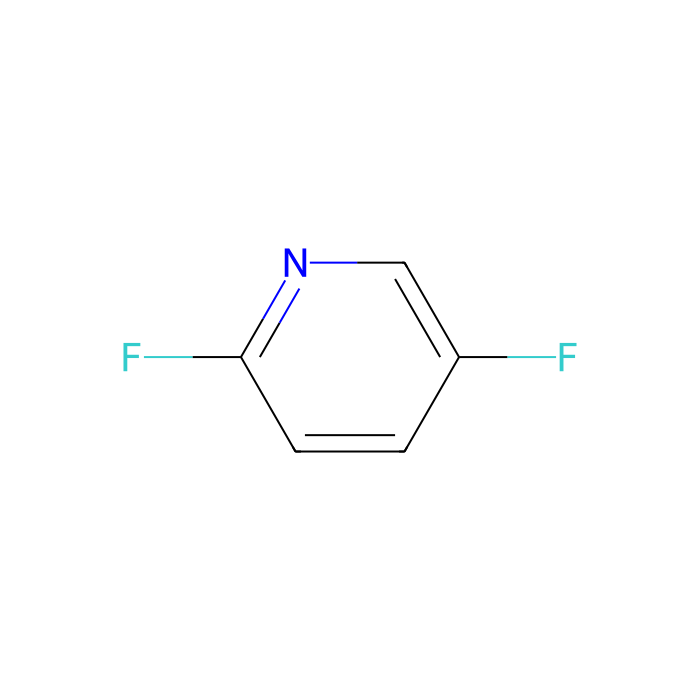
Brief description: 2,5-Difluoropyridine is a fluorinated aza-aromatic building block featuring two C–F substituents on a pyridine ring.
Item-specific (Product Data)
CAS: 84476-99-3
CID: 2762871
InChIKey: 416266 (as listed; see literature identifiers below)
Storage: Room temperature
Shipped: Normal
Research Use: For research use only
Literature/computed identifiers (general reference; not item-specific specs)
Molecular formula: C5H3F2N (literature)
Molecular weight: ~119.08 g/mol (literature)
Common SMILES (one of several equivalent forms): FC1=NC=C(C=C1)F (literature)
Structural features (general chemistry description)
Core ring system: 6-membered aromatic pyridine (one ring N at position 1).
Substitution pattern: Fluorine atoms at the 2- and 5-positions relative to the ring nitrogen.
Functional groups: Two aryl C–F bonds; one ring sp2 nitrogen (basic, π-acceptor/σ-donor).
2D structure in words: A planar pyridine ring with N at the top (position 1); a fluorine adjacent to N (position 2), and another fluorine meta to N (position 5); remaining ring positions unsubstituted hydrogen.
Stereochemistry
No stereogenic centers; achiral, rigid aromatic scaffold.
Electronic character (general)
Strong −I effect from F substituents and the ring N renders the ring electron-deficient, enabling nucleophilic aromatic substitution (particularly at C2) and directed metalation at positions not blocked by F.
Synthetic Utility
Key reactivity arises from the electron-withdrawing N and two F substituents, creating a strongly activated aryl fluoride at C2 and a less activated site at C5.
Functional group behavior (literature)
Aryl fluoride as a leaving group: F is a poor leaving group in general, but on an N-activated ring, SNAr proceeds readily at C2 with hard nucleophiles. The C5–F is more reluctant, enabling sequential, regioselective displacements.
Ring N: Weak base/ligand; participates in coordination to metals (e.g., in lithiation aggregates), assisting directed metalation.
Typical transformations
SNAr to introduce amines, alkoxides, thiolates at C2 (then at C5 under forcing conditions) producing 2,5-disubstituted pyridines.
Directed metalation at C4 (and/or C6 if accessible) with sBuLi or LDA/TMPMgCl·LiCl, followed by electrophile quench (formylation, carboxylation, silylation, borylation). Subsequent cross-coupling of the introduced handles (e.g., Bpin) expands diversity.
N-oxidation to pyridine N-oxide to further tune SNAr reactivity and regioselectivity; deoxygenation restores the pyridine post-functionalization.
Retrosynthetic value
Provides a convergent entry to 2,5-disubstituted aza-arenes where orthogonal reactivity (SNAr vs metalation) can be leveraged to control substitution order.
Practical notes
Control moisture strictly for organometallic steps; quench lithiates at low temperature to avoid rearrangements.
For SNAr, cesium bases and polar aprotic solvents accelerate rates; consider phase-transfer or ionic liquids for challenging 5-F displacement.
Target Specificity
Not applicable. This product is a small-molecule chemical building block, not a biological macromolecule or affinity reagent. No antigen/epitope, species reactivity, clone, or isotype information applies. Product Data provides no target-binding details.
We use cookies to ensure the website functions properly and, where permitted, to improve your experience. You can manage your preferences at any time in Settings. Learn more in our Cookie Policy.
Shall we send you a message when we have discounts available?
Remind me later
Thank you! Please check your email inbox to confirm.
Products are supplied to verified businesses, institutions, and qualified professionals for research and development use only. Not for use in humans, animals, diagnosis, or therapy.

 H1623066