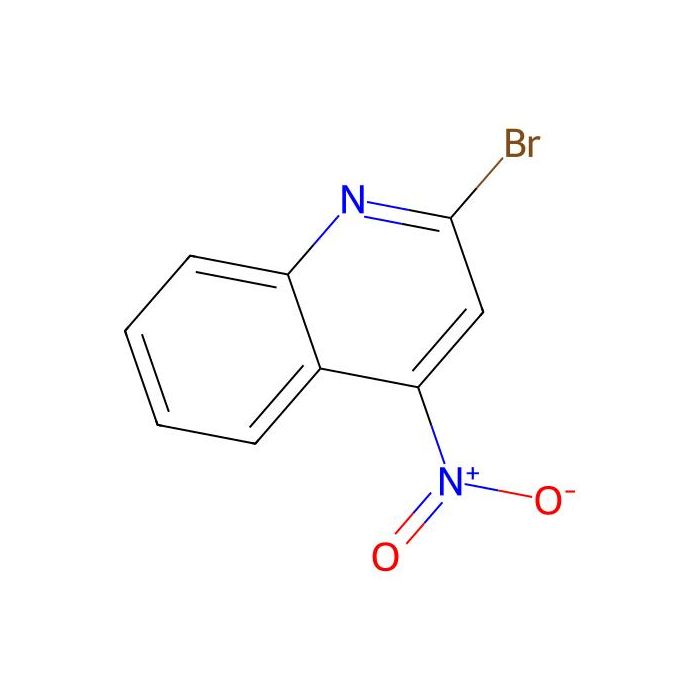
This compound belongs to the class of organic compounds known as nitroquinolines and derivatives. These are compounds containing a nitro group attached to a quinoline moiety.
External Descriptors
Not available
1. Djoumbou Feunang Y, Eisner R, Knox C, Chepelev L, Hastings J, Owen G, Fahy E, Steinbeck C, Subramanian S, Bolton E, Greiner R, and Wishart DS. ClassyFire: Automated Chemical Classification With A Comprehensive, Computable Taxonomy. Journal of Cheminformatics, 2016, 8:61.
Determine the necessary mass, volume, or concentration for preparing a solution.
Dilution Calculator
Determine the dilution needed to prepare a stock solution.
Reconstitution Calculator
Reviews
Customer Reviews
Application Protocols
Not applicable. No assay-specific or bioanalytical application protocols (e.g., WB, IHC, IF, FC) are provided for this small-molecule building block.
For synthetic use, refer to the Reaction Conditions and Synthetic Utility sections for general literature guidance on cross-couplings, reductions, and functional group interconversions.
Biological Roles
Item is provided for research use only. The compound itself is a synthetic heteroaromatic building block and does not have an established endogenous biological role.
General context (literature/general):
Quinoline scaffolds are widely explored in chemical biology and medicinal chemistry as privileged heteroaromatics capable of π–π stacking, metal coordination via the ring nitrogen, and participation in hydrogen-bonding as a weak base.
Nitro substitution influences redox behavior and electronic distribution across the ring; post-reduction to anilines often increases H-bond donor capacity and basicity, altering binding profiles.
The bromide handle enables rapid analogue generation through cross-couplings, facilitating SAR studies for enzyme or receptor ligands in discovery settings.
No claims are made regarding pharmacology, efficacy, or clinical utility. Any biological testing should be conducted under appropriate approvals, and compound identity/purity should be confirmed prior to use.
Buffer Applications
This product is a neutral, hydrophobic heteroaromatic solid and is not a buffering agent. It has no conventional role in preparing biochemical buffers or controlling pH.
Practical note: If solutions are required for assays, dissolve first in a suitable organic co-solvent (e.g., DMSO) before diluting into assay media as solubility permits. Ensure the final co-solvent percentage is compatible with your biological system.
For buffer preparation needs, consider dedicated buffering agents such as phosphate, HEPES, MOPS, or acetate systems.
Green Alternatives
Greener choices relate mainly to solvent/catalyst selection and process intensification rather than the substrate itself.
Solvent substitutions (literature/general):
Replace dioxane/toluene with 2-MeTHF or CPME for cross-couplings; these ethers have better safety and life-cycle metrics and are water-tolerant.
Consider EtOAc or propylene carbonate in place of chlorinated solvents for workup or crystallization where feasible.
Explore aqueous micellar catalysis (e.g., surfactant TPGS-750-M) for Suzuki or Buchwald–Hartwig couplings to reduce organic solvent use.
Base/catalyst considerations:
Use precatalysts with high turnover numbers (e.g., Pd-PEPPSI-type NHCs, modern Buchwald precatalysts) to minimize Pd loading and heavy-metal waste.
Employ heterogeneous hydrogenation (H2/Pd-C) in alcohol solvents to reduce the nitro group, avoiding stoichiometric tin or iron salts when appropriate.
Trade-offs (general):
Me-THF/CPME improve sustainability and workup but may reduce substrate solubility; modest temperature increases or co-solvents can compensate.
Micellar systems can be sensitive to substrate hydrophobicity and may need tailored surfactants; isolation may require salting-out or solvent switches.
Small comparison (general):
Dioxane (conventional): high coupling success; regulatory scrutiny, peroxide potential.
2-MeTHF (greener): bio-based, easy removal; sometimes slower rates.
DCM (workup): excellent extraction; high environmental burden → consider EtOAc.
Optimize with DoE to balance EHS metrics, yield, and throughput.
Pharmaceutical Uses
No pharmacopeial excipient role is indicated for this item. It is supplied for research and development use as a synthetic intermediate.
General R&D context (non-clinical):
The 2-bromo group enables convergent coupling to construct quinoline-containing frameworks frequently evaluated during lead discovery.
The 4-nitro group can be transformed into diversified functionalities (anilines, diazonium-derived substituents), supporting medicinal chemistry route scouting and library synthesis.
There are no therapeutic or clinical claims for this material. Any use in API development must follow applicable regulatory guidance, impurity controls, and phase-appropriate specifications developed by the user.
Physical Properties
Item-specific physical data
Appearance: Not specified for this item; refer to CoA/Spec Sheet.
Molecular formula: Not specified for this item; refer to CoA/Spec Sheet.
Molecular weight: Not specified for this item; refer to CoA/Spec Sheet.
State at ambient conditions: typically a crystalline solid (nitroquinoline derivatives are commonly solid).
Solubility: sparingly soluble in water; soluble in polar aprotic organic solvents (e.g., DMSO, DMF, NMP) and moderately soluble in chlorinated/ethyl acetate-type solvents; solubility in hexanes is usually low to moderate. Actual solubility should be verified experimentally.
Acid–base: weakly basic ring nitrogen (quinoline pKaH ~4.9, literature); compound is overall neutral under basic to neutral conditions.
Polarity/logP: nitro- and bromo-substituted quinolines typically show moderate lipophilicity (logP often in the 2–3.5 range, literature), aiding organic-solvent solubility and chromatographic handling.
UV–vis: quinoline chromophore exhibits strong UV absorption in the 240–360 nm range (literature), which can be useful for HPLC/UV detection.
No authoritative item-specific values (mp, bp, density, refractive index, UV cutoff, water/peroxide/metal content) are provided here. Where exact numbers are required for method development or safety assessment, please consult the item’s CoA and SDS and determine solvent-specific solubility empirically.
Quality & Grades
Item-specific quality information
Grade/purity: Not specified for this item; refer to CoA/Spec Sheet.
How to interpret common grades (general guidance)
Research/technical grade: suitable for most synthetic and discovery chemistry. Trace metal/UV specs are not typically guaranteed.
HPLC/LCMS grade (solids): when provided, implies tight control of inorganic/UV-absorbing impurities for analytical applications; not specified here.
Extra dry/anhydrous: indicates low residual water and moisture-protective packaging; not specified here.
Impurity considerations for this scaffold (general)
Typical process-related impurities may include regioisomeric bromo/nitro quinolines, debrominated quinoline, over-reduced/rearranged nitro derivatives, and residual halides or nitration byproducts.
For cross-coupling or metal-catalyzed chemistry, trace metal content in the starting material is usually non-limiting; however, downstream catalytic steps may be sensitive to halide-containing impurities and water.
Verification and documentation
For method development, request and review the batch CoA for: assay/purity method (e.g., HPLC/GC), residual solvents, and identity confirmation (NMR/HRMS). If UV critical, obtain UV spectra to understand background absorbance from the quinoline chromophore.
If a stabilizer or specific packaging is relevant, it will be noted on the product label/CoA; none is specified for this listing.
Reaction & Applications
This heteroaryl bromide is a versatile electrophile leveraging two orthogonal handles: an aryl–Br at C2 and a nitro group at C4.
Cross-coupling at C2 (literature):
Suzuki–Miyaura to install aryl/heteroaryl/alkenyl groups, enabling rapid diversification of quinoline libraries.
Buchwald–Hartwig C–N formation with amines/anilines to access 2-aminoquinolines; ligand tuning (e.g., XPhos/BrettPhos) can mitigate heteroatom coordination.
Kumada/Negishi/Stille couplings using Grignard, organozinc, or stannane partners for C–C bond formation.
Miyaura borylation (B2pin2) to form 2-boronate esters for subsequent cross-couplings.
Nitro group manipulations (literature):
Chemoselective reduction (H2/Pd–C, Fe/NH4Cl, SnCl2, or Zn/AcOH) to the corresponding 4-amino derivative, unlocking diazotization/Sandmeyer or acylation/sulfonylation pathways.
Nucleophilic aromatic substitution is not expected at the nitro-bearing carbon (–NO2 is not a leaving group) but the nitro group modulates electronic properties and can direct metalation.
Directed metallation (literature):
Temporary metal–halogen exchange at C2 (e.g., n-BuLi) to access lithiated quinoline intermediates for formylation, acylation, or electrophile trapping; requires low temperature and careful quench.
Applications in discovery chemistry:
Serves as a privileged quinoline scaffold for constructing kinase inhibitor-like, photophysical, and coordination ligands (general medicinal chemistry use; no therapeutic claims).
Practical notes: dry, oxygen-free conditions improve cross-coupling performance; use excess base and appropriate ligand to suppress catalyst deactivation by the quinoline nitrogen. Sequence planning commonly couples first at C2, then reduces/modifies the C4 nitro.
Reaction Conditions
The following are literature-style, non-binding condition ranges for common transformations of 2-bromo-4-nitroquinoline. Optimize for your system.
Suzuki–Miyaura coupling (C2):
Catalyst: Pd(PPh3)4 (1–3 mol%) or Pd(dppf)Cl2 (1–2 mol%).
Base: K2CO3 or Cs2CO3 (2–3 equiv).
Solvent: 1,4-dioxane/H2O (3:1) or toluene/H2O; 80–100 °C, 4–16 h.
Notes: Additive ligands (XPhos, SPhos) can boost rates with heteroaryl boronates.
Nucleophile/base: alcohol or amine with base (Et3N/DBU).
Solvent: DMF, MeOH, or toluene; 50–90 °C.
Nitro reduction (C4 → amine):
H2/Pd–C (5–10 wt% cat., 1–3 atm H2) in EtOH/EtOAc, rt–40 °C, 2–8 h; monitor for debromination.
Alternatively Fe/NH4Cl in EtOH/H2O (50–80 °C) or SnCl2·2H2O in EtOH/AcOH at reflux.
Metal–halogen exchange (C2):
n-BuLi (1.1–1.5 equiv) in anhydrous THF at −78 to −40 °C; quench with electrophile (e.g., DMF for formylation). Strictly anhydrous/inert.
Yields vary with substrate and partner; 60–90% is typical in optimized couplings (literature). Always perform small-scale scouting and apply rigorous exclusion of moisture/air.
Safety & Handling
GHS and hazard information (item-specific)
Signal word: Not specified for this item; refer to SDS.
Hazard statements (H-phrases): Not specified for this item; refer to SDS.
GHS classification and pictograms: Not specified for this item; refer to SDS.
General safety considerations for nitro- and halo-heteroaromatics (literature guidance; not a substitute for SDS)
Likely hazards: irritant to skin/eyes/respiratory tract; harmful if swallowed. Nitroaromatics may present environmental hazards; avoid release to the environment.
PPE: wear lab coat, chemical-resistant gloves (e.g., nitrile), and safety glasses/goggles. Use in a well-ventilated fume hood to avoid dust/vapor exposure.
Handling: minimize dust generation. Avoid contact with strong bases and strong nucleophiles that may induce undesired side reactions; avoid strong reducing agents unless intentionally performing nitro reductions. Keep away from strong oxidizers when using organic solvents for workup/cleanup.
First aid (overview): if inhaled, move to fresh air; if on skin, wash with soap and water; if in eyes, rinse cautiously with water for several minutes; if ingested, seek medical attention. Always follow site SOPs and consult the SDS for detailed measures.
Fire behavior: treated as combustible organic solid; in a fire, toxic fumes of NOx, HBr/Br-containing species may form. Use CO2, dry chemical, or foam; firefighters should wear SCBA.
Waste: collect organic-contaminated materials in halogenated organic waste streams. Nitro-containing residues should be managed per institutional hazardous waste procedures.
Always defer to the product SDS and institutional safety policies for authoritative guidance.
Solvent Selection
2-Bromo-4-nitroquinoline is a moderately lipophilic, polarizable heteroaromatic electrophile. It is typically processed in polar aprotic media.
Polarity/miscibility (literature/general):
Good solubility: DMSO, DMF, NMP; workable solubility in dioxane, THF, acetonitrile, ethyl acetate, and chlorinated solvents (e.g., DCM, chloroform).
Poor solubility: water and aliphatic hydrocarbons (hexanes/heptane), though mixed-solvent systems can aid crystallizations.
Cross-coupling media: dioxane/H2O, toluene, Me-THF, CPME, or DMAc are frequently used with suitable bases (K2CO3, Cs2CO3, KOAc). Water-tolerant micellar systems (e.g., TPGS-750-M in H2O) are increasingly viable under mild conditions (literature).
Reductive transformations (nitro to amine): EtOH, iPrOH, or AcOH mixtures for metal-mediated reductions; EtOH/EtOAc or THF for catalytic hydrogenations.
Lithiation/metal–halogen exchange: anhydrous THF or Et2O at low temperature (≤ −78 °C) under inert atmosphere.
Comparison notes (general):
DMSO/DMF maximize solubility but complicate workup; dioxane or Me-THF offer easier removal and greener profiles at some cost to solubility.
Chlorinated solvents often facilitate purification and crystallization but have higher environmental burdens; consider EtOAc/Me-THF as alternatives.
Select solvent based on step objective: coupling efficiency (polar aprotic), reduction safety (protic alcohols), or organometallic reactivity (ether solvents). Always verify solubility experimentally before scale-up.
Keep tightly closed in a dry container. Protect from prolonged exposure to ambient humidity; moisture can impact some downstream reactions (e.g., metal-catalyzed couplings, lithiation).
If long-term storage is planned, consider an inert-atmosphere desiccator or sealed vial with desiccant. Room-temperature stability is typically good for halo-nitro quinolines under dry conditions.
Solubility: dissolve in dry organic solvents such as DMSO, DMF, NMP, THF, dioxane, DCM, or EtOAc according to experimental needs. A brief gentle warming and sonication can aid dissolution.
For biological assays, prepare concentrated DMSO stocks (e.g., 10–50 mM) and dilute into assay media, ensuring the final DMSO content is acceptable for the system.
Avoid aqueous-only media due to low water solubility.
Always refer to the product CoA and SDS for batch-specific guidance, and minimize freeze–thaw or repeated solvent evaporation cycles to prevent degradation or contamination.
Structure & Identity
Item-specific identifiers (from Product Data)
SKU: B770450
CAS: 20146-63-8
PubChem CID: 581266
InChIKey (item): Not specified for this item; refer to CoA/Spec Sheet.
SMILES (item): Not specified for this item; refer to CoA/Spec Sheet.
Structural features: quinoline (benzopyridine) core bearing a bromine at the 2-position (alpha to ring nitrogen) and a nitro substituent at the 4-position on the fused aromatic system.
2D structure described in words (general)
The scaffold consists of a bicyclic, fully aromatic system: a pyridine ring fused to a benzene ring (quinoline). The ring nitrogen is at position 1. At position 2 (adjacent to the ring N), the aryl carbon carries a bromine atom, creating a strong C(sp2)–Br bond suitable for cross-coupling. At position 4 on the benzene portion, the ring carbon bears a nitro group (–NO2) with a characteristic planar N(=O)2 arrangement. No stereocenters or alkenyl E/Z elements are present; the compound is fully aromatic and achiral.
Notes: Literature identifiers and formulas are provided for scientific context and should not be construed as item-specific specifications. Always verify batch-specific identity with the product CoA/SDS.
Synthetic Utility
Functional group handles and their reactivity (literature/general):
C–Br (aryl bromide at C2):
Excellent electrophile for Pd-catalyzed couplings (Suzuki, Buchwald–Hartwig, Stille, Negishi, Kumada) and Ni-catalyzed variants.
Amenable to Miyaura borylation (B2pin2 → 2-quinolinyl boronate) and carbonylation (CO insertion → amides/esters via Pd catalysis).
Metal–halogen exchange (n-BuLi, iPrMgCl·LiCl) for ortholithiation/magnesiation under cryogenic conditions.
Nitro at C4:
Reduction to amine (H2/Pd, Fe/NH4Cl, SnCl2) followed by diversification: acylation, sulfonylation, urea/amide formation, diazotization/Sandmeyer.
Acts as a strong –I/–M substituent, tuning reactivity and regioselectivity for electrophilic/nucleophilic events on the quinoline.
Retrosynthetic value:
Enables late-stage diversification on a quinoline core: install C2 substituent by coupling, then reduce/transform C4 nitro to adjust polarity and H-bonding features. Alternatively, reduce first to 4-amino, then leverage directed metalation via the anilide.
Practical tips:
Use ligand sets that mitigate coordination of the ring N (e.g., BrettPhos/XPhos or bidentate phosphines like dppf); bases such as K2CO3, Cs2CO3, or NaOtBu are common.
Sequence planning should consider chemoselectivity: C–Br is typically more reactive than a nitro group toward cross-coupling; nitro reduction conditions should avoid debromination (control catalyst, pressure, and solvent).
Target Specificity
Not applicable. This product is a small-molecule heteroaromatic building block, not a biological reagent with defined target/epitope specificity. No antibody/oligonucleotide/ligand targeting information is provided in the Product Data.
We use cookies to ensure the website functions properly and, where permitted, to improve your experience. You can manage your preferences at any time in Settings. Learn more in our Cookie Policy.
Shall we send you a message when we have discounts available?
Remind me later
Thank you! Please check your email inbox to confirm.
Products are supplied to verified businesses, institutions, and qualified professionals for research and development use only. Not for use in humans, animals, diagnosis, or therapy.