This compound belongs to the class of organic compounds known as fluorenes. These are compounds containing a fluorene moiety, which consists of two benzene rings connected through either a cyclopentane, cyclopentene, or cyclopenta-1,3-diene.
External Descriptors
Not available
1. Djoumbou Feunang Y, Eisner R, Knox C, Chepelev L, Hastings J, Owen G, Fahy E, Steinbeck C, Subramanian S, Bolton E, Greiner R, and Wishart DS. ClassyFire: Automated Chemical Classification With A Comprehensive, Computable Taxonomy. Journal of Cheminformatics, 2016, 8:61.
Determine the necessary mass, volume, or concentration for preparing a solution.
Dilution Calculator
Determine the dilution needed to prepare a stock solution.
Reconstitution Calculator
Reviews
Customer Reviews
Application Protocols
No item-specific application protocols are provided for this small-molecule building block.
General usage examples (not item-specific specifications):
Cross-coupling setup: charge aryl boronic acid (1.2–1.5 equiv), base (2–3 equiv), Pd catalyst (0.5–2 mol%), and 2-bromo-9-fluorenone (1.0 equiv) in toluene/H2O or dioxane/H2O; heat 80–100 °C under N2 until consumption by TLC/HPLC.
Lithiation–trapping: cool anhydrous THF to −78 °C under N2; add n-BuLi (1.1 equiv) to a solution of 2-bromo-9-fluorenone; after 15–30 min, introduce electrophile (e.g., DMF or B(OMe)3); warm to 0–25 °C and work up.
Reduction to fluorenol: add NaBH4 portionwise to a methanolic solution at 0–5 °C; stir to completion, quench, and isolate.
These are illustrative, literature-style workflows. Optimize stoichiometry, ligand/base, and temperature for your system. Consult primary literature and your institution’s SOPs for detailed, validated methods.
Biological Roles
This product is an aromatic small-molecule building block without known physiological function.
Item-specific statements: None specified for biological activity.
General/literature context (not a claim for this item):
Fluorenone derivatives are widely used as photochemical probes and as components in organic electronic materials. Some fluorenones can photosensitize singlet oxygen under UV illumination due to their n→π* and π→π* transitions.
The compound is not a buffer or biochemical cofactor and has no established role in cellular metabolism.
Laboratory caution:
Aromatic ketones may exhibit phototoxicity under UV exposure; handle solutions with care in biological settings.
Research Use: For research use only; not for diagnostic, therapeutic, or clinical applications.
Buffer Applications
Not typically applicable. 2-Bromo-9-fluorenone is a neutral, hydrophobic organic building block and is not used to prepare aqueous buffer systems. For relevant guidance, see sections on Solvent Selection, Reaction & Applications, and Synthetic Utility.
Green Alternatives
Greener process design focuses on solvent, energy, and catalyst choices rather than on replacing the aryl bromide itself (which is often required synthetically).
Solvent substitutions (general guidance):
Replace CH2Cl2/CHCl3 with 2-MeTHF or cyclopentyl methyl ether (CPME) for workups and some couplings; these ethers have better safety and life-cycle profiles and allow phase separations.
Use toluene or anisole instead of DMF/DMA when feasible; they offer lower EHS concerns and are recyclable.
For Suzuki couplings, aqueous ethanol or water/2-MeTHF systems can be explored with micellar catalysis.
Energy/catalyst considerations:
Employ ligand-enabled, low-Pd loadings or Ni-catalyzed couplings under milder conditions to reduce metal usage.
Consider photoredox/nickel dual catalysis at ambient temperature for certain C–C/C–N formations, reducing energy input.
CH2Cl2 → 2-MeTHF: lower toxicity, similar solvency for aromatics, but different polarity (may affect rates/selectivity).
DMF → Cyrene or propylene carbonate: greener profiles; be mindful of base solubility and catalyst compatibility.
Toluene → Anisole: slightly higher boiling point may improve kinetics yet increases energy for solvent removal.
Trade-offs:
Solvent polarity and coordination can influence oxidative addition to aryl bromides; optimization is necessary when switching to greener media.
Pharmaceutical Uses
No item-specific pharmacopeial status or excipient role is provided for this product.
General notes (not a therapeutic claim):
Halogenated fluorenone derivatives may appear as synthetic intermediates en route to more complex molecules used in materials science or, less commonly, in discovery chemistry. However, 2-bromo-9-fluorenone itself is not an established excipient or processing aid.
If used in process R&D as an intermediate, ensure compliance with ICH guidelines for residual solvents and elemental impurities in the final API; such controls are process-dependent and not attributes of this catalog item.
Documentation:
For GMP-related inquiries, request detailed CoA/Spec Sheet and discuss supply chain, change control, and impurity profiles. This catalog listing is intended for research use only.
Physical Properties
Item-specific specifications:
Appearance: Not specified for this item; refer to CoA/Spec Sheet.
Grade/Purity: Not specified for this item; refer to CoA/Spec Sheet.
Storage and shipping (from Product Data):
Storage Conditions: Room temperature
Shipped In: Normal
Literature/typical reference values (not item-specific; for planning only):
Physical state: typically a yellow to orange crystalline solid (literature for halogenated fluorenones)
Solubility tendencies: soluble in chlorinated solvents (e.g., CH2Cl2, CHCl3), aromatics (toluene), and polar aprotics (THF, DMF, DMSO); sparingly soluble in alkanes and alcohols (literature, qualitative)
UV–Vis: strong absorption in near-UV due to conjugated fluorenone chromophore (literature, qualitative)
Not specified for this item; refer to CoA/Spec Sheet:
Melting point, boiling point, density, refractive index, logP, pKa, water content, residual solvents, metal content, stabilizers, UV cutoff.
Notes for users:
Always verify exact physical constants and solubility with the CoA/Spec Sheet for this specific lot before scale-up or method validation.
Halogenated polycyclic ketones may exhibit light sensitivity; consider handling under subdued light when conducting photochemical studies (general guidance).
Quality & Grades
Item-specific quality data:
Grade/Purity: Not specified for this item; refer to CoA/Spec Sheet.
Guidance on interpreting grades (general):
“Analytical/AR grade” indicates suitability for routine analytical work with controlled impurities.
“Reagent grade” is appropriate for most synthetic applications.
“HPLC grade” (primarily for solvents) targets low UV absorbance and minimal non-volatile residue; for solids like this, “>98%” or “>99%” assay is commonly reported instead of “HPLC grade.”
What to check on the CoA/Spec Sheet for this compound class:
Residual solvents and inorganic residues (ash) if relevant to your application.
Batch-to-batch consistency and lot traceability.
Stabilizers/additives:
Not specified for this item; refer to CoA/Spec Sheet.
Practical tip:
For cross-coupling or photochemical studies, trace metal content and halide purity can impact outcomes; request extended QC data if your process is metal-sensitive or requires ultra-low background signals (e.g., materials chemistry/OPV device fabrication).
Reaction & Applications
As a 2-brominated fluorenone, this compound is a versatile aryl electrophile on a conjugated, rigid scaffold. It serves both as a coupling partner and as a functional chromophore in materials-oriented syntheses.
Metal–halogen exchange: With n-BuLi or t-BuLi at −78 to −30 °C in THF to access 2-lithiofluorenone derivatives for electrophile trapping (formylation, acylation, borylation).
Carbonyl chemistry: Selective reductions (NaBH4, catalytic hydrogenation) to fluorenols; Baeyer–Villiger oxidation to lactones; oxime/hydrazone formation for further transformations.
Photochemistry and photoredox: The fluorenone chromophore participates in energy/electron transfer processes; the aryl bromide enables secondary functionalization.
Materials synthesis: Precursor to donor–acceptor functional materials, OLED/OPV components, and rigid linkers in porous frameworks via 2-position diversification.
Practical considerations:
Steric/electronic effects of the fluorenone core may necessitate more active catalysts/ligands in couplings (e.g., dialkylbiaryl phosphines, BrettPhos/XPhos).
Avoid strong bases at elevated temperature in protic media to limit undesired ketone side reactions.
For lithiations, ensure thorough cryogenic control and quench carefully to prevent over-reaction or pinacol-type couplings.
Reaction Conditions
General literature guidance for transforming aryl bromides on polycyclic ketones (optimize for your system):
Suzuki–Miyaura coupling (to 2-aryl fluorenones):
Catalyst: 0.5–2 mol% Pd(PPh3)4 or Pd2(dba)3 (1 mol% Pd) with SPhos/XPhos.
Base: K3PO4, K2CO3, or Cs2CO3 (2–3 equiv).
Solvent: toluene/H2O, dioxane/H2O, or 2-MeTHF/H2O.
Catalyst/ligand: Pd2(dba)3 (1 mol% Pd) with JohnPhos/BrettPhos; or Pd(OAc)2 with BINAP.
Base: NaOtBu or Cs2CO3; solvent: toluene or dioxane.
80–110 °C, 8–20 h.
Negishi/Kumada/Stille:
Typical Pd catalysts (1–2 mol%) in THF, toluene, or DMF; 25–80 °C depending on nucleophile.
Metal–halogen exchange:
n-BuLi (1.1–1.3 equiv) in anhydrous THF at −78 °C; quench with electrophile (e.g., DMF, B(OMe)3). Strictly anhydrous and inert atmosphere.
Carbonyl reductions:
NaBH4 or catalytic hydrogenation (Pd/C) in MeOH/THF at 0–25 °C to furnish the corresponding fluorenol.
Photoredox:
Ir(ppy)3 or Ru(bpy)3-based systems in MeCN or DMA under blue LEDs for radical couplings; oxygen exclusion required.
Notes:
These are literature-style starting points; actual conditions depend on substrates, scale, and equipment. Always run small-scale screens to identify optimal ligand/base/solvent combinations.
Safety & Handling
GHS/Regulatory (item-specific):
Signal Word: Not specified for this item; refer to SDS.
H-Statements: Not specified for this item; refer to SDS.
GHS Classification/Pictograms: Not specified for this item; refer to SDS.
General laboratory precautions (not item-specific; best practice):
Wear appropriate PPE: lab coat, safety glasses, and suitable gloves (e.g., nitrile). Use in a chemical fume hood to avoid inhalation of dust or solvent vapors.
Avoid contact with skin and eyes; prevent dust generation. Wash thoroughly after handling.
Incompatibilities: strong bases and nucleophiles may induce substitution; strong reducing agents can affect the aryl ketone; strong oxidizers may react with the aromatic system (general).
Thermal/photostability: aromatic ketones can be photosensitizers; minimize exposure to intense UV light during handling and storage of solutions (general).
First-aid overview (consult SDS for authoritative instructions):
Inhalation: move to fresh air; seek medical attention if symptoms persist.
Skin/eye contact: rinse with water for several minutes; remove contaminated clothing; get medical advice if irritation continues.
Ingestion: rinse mouth; do not induce vomiting; seek medical attention.
Spill & disposal (general):
Collect spills with inert absorbent (if in solution) or carefully sweep solids while minimizing dust. Dispose of waste via licensed chemical waste contractor according to local regulations.
Research Use Note: For research use only.
Solvent Selection
2-Bromo-9-fluorenone is a nonpolar-to-moderately polar aromatic ketone featuring an aryl bromide. Solvent choice should balance solubility of the rigid polycyclic core and compatibility with the intended transformation.
Polarity/miscibility (literature, qualitative):
Good solubility: CH2Cl2, CHCl3, toluene, xylenes, THF, dioxane, DMF, DMSO.
Cross-couplings (Suzuki, Buchwald–Hartwig): toluene, dioxane, or DMA/DMF; water co-solvent for Suzuki as needed. Base and ligand often dictate optimum solvent.
Lithium–halogen exchange/metal–halogen exchange: anhydrous THF or Et2O at low temperature.
Nucleophilic aromatic substitution (if applicable via activation): polar aprotics (DMF, DMSO) may be required but reactivity is limited without additional activation.
Reductions/photoredox of the ketone: MeCN, DMA, or alcohol/amine donors depending on catalyst system.
Practical tips:
Degas and dry solvents for moisture/air-sensitive steps (e.g., Pd-catalyzed couplings, organolithium chemistry).
For analytical prep and crystallizations, CH2Cl2/hexanes or toluene/hexanes mixtures often provide controlled precipitation of polycyclic aromatics (general observation).
Green considerations: See “Green Alternatives” for replacing chlorinated solvents with 2-MeTHF or CPME where compatible.
Storage & Reconstitution
Storage (from Product Data):
Store at room temperature.
Shipped under normal conditions.
General handling guidance (not item-specific):
Keep container tightly closed in a dry, well-ventilated place. Use a desiccator if ambient humidity is high to prevent clumping or hydrolysis of sensitive reagents.
Protect solutions from strong light, especially UV, to minimize photochemical changes inherent to aromatic ketones.
Reconstitution/Preparation of solutions (general suggestions):
Common solvents: dichloromethane, chloroform, toluene, THF, dioxane, DMF, or DMSO according to your application. Start at 10–50 mg/mL and adjust based on solubility and method requirements.
For air/moisture-sensitive reactions (e.g., organolithium chemistry), dry the solid under vacuum (ambient to 40 °C) prior to use and prepare solutions under inert atmosphere with anhydrous solvents.
Stability considerations:
Long-term stability is typically good for the dry solid at room temperature. Avoid prolonged exposure to heat and light. Refer to CoA/Spec Sheet for any item-specific stability data or recommended retest intervals.
Shelf life: Not specified for this item; refer to CoA/Spec Sheet.
Structure & Identity
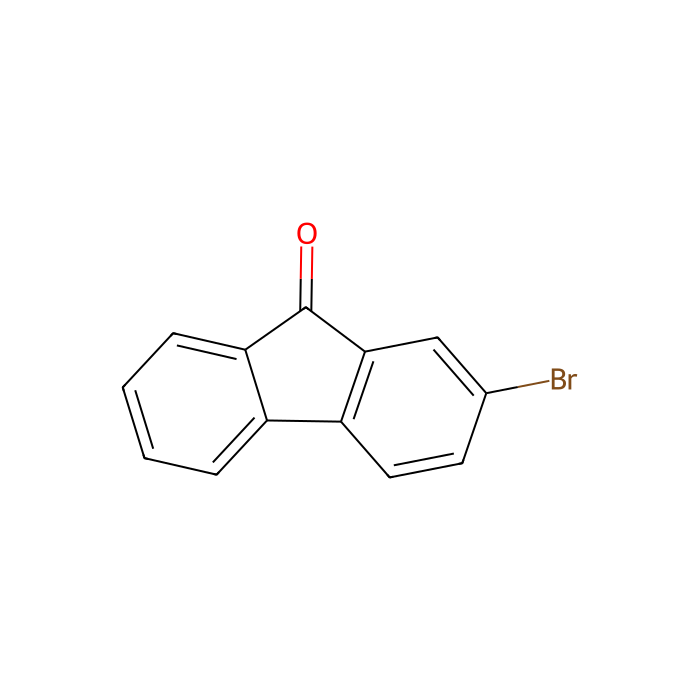
A halogenated polycyclic aromatic ketone derived from fluorenone, bearing a bromine at the 2-position.
Item-specific (from Product Data):
SKU: B117932
Product Name: 2-Bromo-9-fluorenone
CAS: 3096-56-8
CID: 725831
InChIKey: 227813 (as provided)
SMILES: Not specified for this item; refer to CoA/Spec Sheet.
Molecular formula: Not specified for this item; refer to CoA/Spec Sheet.
Molecular weight: Not specified for this item; refer to CoA/Spec Sheet.
Literature/Computed (for reference; not item-specific specs):
2D structural description: A tricyclic fluorenone core (fused biphenyl bridged by a carbonyl at C9) with a bromine substituent at the peri/ortho-like position (C2) on the outer benzene ring; contains one aryl bromide (C–Br) and one conjugated aryl ketone (C=O) functional group; planar, rigid aromatic framework with extended conjugation.
Key structural features (general):
Polycyclic aromatic system (fluorenone scaffold)
Electrophilic aryl bromide suitable for cross-coupling
Conjugated ketone enabling photochemical and redox transformations
Synthetic Utility
Key functional groups and reactivity make 2-bromo-9-fluorenone a powerful node in retrosynthesis.
Functional group leverage:
Aryl bromide at C2: enables C(sp2)–C(sp2/sp3) and C(sp2)–N/O/S bond formation via Pd/Ni catalysis.
Conjugated aryl ketone: amenable to reductions (selective to alcohol), nucleophilic additions (e.g., Grignard), imine/oxime formation, and oxidative rearrangements (Baeyer–Villiger).
Retrosynthetic strategies (literature/general):
Diversify at C2 via Suzuki/Stille/Negishi to install aryl, alkenyl, or heteroaryl groups, then manipulate the carbonyl for further elaboration to fluorenol-based architectures.
Use lithium–halogen exchange to introduce boron (via B(OMe)3 or iPrO–Bpin), silicon, or electrophiles, furnishing versatile handles (boronates, aldehydes, acids) on the fluorenone framework.
Sequential functionalization: first perform cross-coupling at C2, then reduce/functionalize the 9-ketone to tailor photophysical properties (e.g., for OLED precursors).
Scaffold advantages:
Rigid, planar core enhances crystallinity and π–π stacking, advantageous in materials applications.
The peri-like environment can modulate reactivity and selectivity in cross-couplings—ligand/catalyst tuning is often rewarded.
Purification:
Typically amenable to column chromatography (silica) using CH2Cl2/hexanes or toluene/EtOAc systems; recrystallization from aromatics/chlorinated solvents is common (general guidance).
Target Specificity
Not applicable. This product is a small-molecule chemical building block and does not have antibody/biologic target specificity. No antigen, epitope, clone, or isotype information applies.
Frequently Asked Questions
What documentation is provided?
Available product documentation, including Certificates of Analysis (COA), Safety Data Sheets (SDS), and specification sheets, is shown in the product document area. Document availability and access follow the current site policy.
What is the purity of this product?
This product is supplied at ≥96% purity (chemical assay). Lot-specific values are stated on the Certificate of Analysis.
How should this product be stored?
Store at room temperature.
How is this product shipped?
This product ships under standard ambient conditions. No temperature-controlled packaging is required.
What are the CAS number, molecular formula and molecular weight?
The CAS Number is 3096-56-8, the molecular formula is C13H7BrO, and the molecular weight is 259.1 g/mol. InChIKey MTCARZDHUIEYMB-UHFFFAOYSA-N.
We use cookies to ensure the website functions properly and, where permitted, to improve your experience. You can manage your preferences at any time in Settings. Learn more in our Cookie Policy.
Shall we send you a message when we have discounts available?
Remind me later
Thank you! Please check your email inbox to confirm.
Products are supplied to verified businesses, institutions, and qualified professionals for research and development use only. Not for use in humans, animals, diagnosis, or therapy.

 C2313558