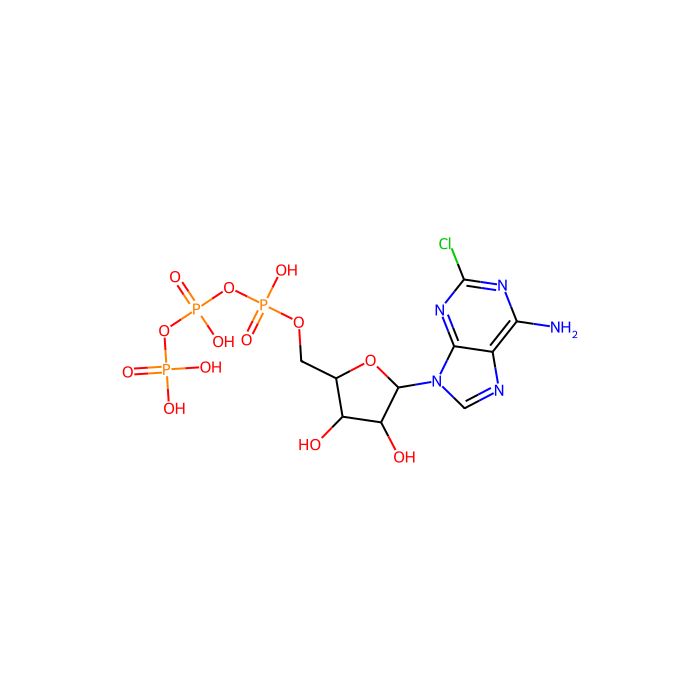
2-Chloroadenosine triphosphate sodium salt - Moligand™, ≥95%, 10 mM in water , Antagonist of P2Y 1 receptor, CAS No.49564-60-5, Antagonist of P2Y 1 receptor

CAS: 49564-60-5 Cat. No.: C336149 Formula: C₁₀H₁₅ClN₅O₁₃P₃・xNa
AVAILABLE TO ORDER
GRADE & PURITY Moligand™ ? Moligand™ — Aladdin's line of ligands and bioactive small molecules. Use for receptor, pathway, and binding studies needing defined small-molecule tools. ≥95% 10 mM in water
Synonyms
(((2R,3S,4R,5R)-5-(6-Amino-2-chloro-9H-purin-9-yl)-3,4-dihydroxytetrahydrofuran-2-yl)methyl)triphosphoric acid|(((2R,3S,4R,5R)-5-(6-Amino-2-chloro-9H-purin-9-yl)-3,4-dihydroxytetrahydrofuran-2-yl)methyl)triphosphoricacid|2-Chloro-Adenosinetriphosphate|2-chloroadenosine-5'-triphosphate|2-Chloroadenosine-5-triphosphate|2-Chloro-ATP|[[(2R,3S,4R,5R)-5-(6-amino-2-chloropurin-9-yl)-3,4-dihydroxyoxolan-2-yl]methoxy-hydroxyphosphoryl] phosphono hydrogen phosphate|[(2R,3S,4R,5R)-5-(6-amino-2-chloropurin-9-yl)-3,4-dihydroxyoxolan-2-yl]methyl (hydroxy-phosphonooxyphosphoryl) hydrogen phosphate|2-chloro-9-[5-O-(hydroxy{[hydroxy(phosphonooxy)phosphoryl]oxy}phosphoryl)pentofuranosyl]-9H-purin-6-amine|2-ClATP
Storage
Store at -20°C
Shipped In
Ice chest + Ice pads
★
Size
Germany (EU)
USA*
Price
Qty
5μmol
C336149-5μmol
Made to order · 8–12 wks
€242.88
Enter a quantity for the sizes you want to add.

Overview

2-Chloroadenosine triphosphate tetrasodium is a P2Y purinoceptor agonist and a Guanylate Cyclases inhibitor.

Specifications

Synonyms
(((2R,3S,4R,5R)-5-(6-Amino-2-chloro-9H-purin-9-yl)-3,4-dihydroxytetrahydrofuran-2-yl)methyl)triphosphoric acid | (((2R,3S,4R,5R)-5-(6-Amino-2-chloro-9H-purin-9-yl)-3,4-dihydroxytetrahydrofuran-2-yl)methyl)triphosphoricacid | 2-Chloro-Adenosinetriphosphate | 2-chloroadenosine-5'-triphosphate | 2-Chloroadenosine-5-triphosphate | 2-Chloro-AT Show more
Specifications & Purity
Moligand™, ≥95%, 10 mM in water
Storage
Store at -20°C
Shipped In
Ice chest + Ice pads
This product requires cold chain shipping. Ground and other economy services are not available.
Grade
Moligand™
Action Type
ANTAGONIST
Mechanism of action
Antagonist of P2Y 1 receptor
Purity
≥95%
Names and Identifiers
SMILES
C1=NC2=C(N=C(N=C2N1C3C(C(C(O3)COP(=O)(O)OP(=O)(O)OP(=O)(O)O)O)O)Cl)N
IUPAC Name
[[(2R,3S,4R,5R)-5-(6-amino-2-chloropurin-9-yl)-3,4-dihydroxyoxolan-2-yl]methoxy-hydroxyphosphoryl] phosphono hydrogen phosphate
InChIKey
RNGCVFCOKZEZFL-UUOKFMHZSA-N
InChI
1S/C10H15ClN5O13P3/c11-10-14-7(12)4-8(15-10)16(2-13-4)9-6(18)5(17)3(27-9)1-26-31(22,23)29-32(24,25)28-30(19,20)21/h2-3,5-6,9,17-18H,1H2,(H,22,23)(H,24,25)(H2,12,14,15)(H2,19,20,21)/t3-,5-,6-,9-/m1/s1
Isomeric SMILES
C1=NC2=C(N=C(N=C2N1[C@H]3[C@@H]([C@@H]([C@H](O3)COP(=O)(O)OP(=O)(O)OP(=O)(O)O)O)O)Cl)N
WGK Germany
3
Alternate CAS
49564-60-5
MeSH Entry Terms
2-chloro-ATP
Reaxy-Rn
24885314
Reaxys-RN_link_address
https://www.reaxys.com/reaxys/secured/hopinto.do?context=S&query=IDE.XRN=24885314&ln=

Advanced Data

Taxonomic Classification

Taxonomy Tree

KingdomOrganic compounds
SuperclassNucleosides, nucleotides, and analogues
ClassPurine nucleotides
SubclassPurine ribonucleotides
Intermediate Tree Nodes Not available
Direct ParentPurine ribonucleoside triphosphates
Alternative Parents Purine ribonucleoside monophosphates  Pentose phosphates  Glycosylamines  6-aminopurines  Monosaccharide phosphates  2-halopyrimidines  Aminopyrimidines and derivatives  Monoalkyl phosphates  Aryl chlorides  N-substituted imidazoles  Imidolactams  Tetrahydrofurans  Heteroaromatic compounds  Secondary alcohols  1,2-diols  Oxacyclic compounds  Azacyclic compounds  Organic oxides  Organochlorides  Organopnictogen compounds  Primary amines  Hydrocarbon derivatives  
Molecular FrameworkAromatic heteropolycyclic compounds
Substituents Purine ribonucleoside triphosphate - Purine ribonucleoside monophosphate - Pentose phosphate - Pentose-5-phosphate - Glycosyl compound - N-glycosyl compound - 6-aminopurine - Monosaccharide phosphate - Pentose monosaccharide - Imidazopyrimidine - Purine - Aminopyrimidine - Halopyrimidine - 2-halopyrimidine - Monoalkyl phosphate - Alkyl phosphate - Aryl chloride - Aryl halide - Monosaccharide - N-substituted imidazole - Organic phosphoric acid derivative - Phosphoric acid ester - Imidolactam - Pyrimidine - Azole - Tetrahydrofuran - Heteroaromatic compound - Imidazole - 1,2-diol - Secondary alcohol - Organoheterocyclic compound - Azacycle - Oxacycle - Organooxygen compound - Alcohol - Organic nitrogen compound - Organopnictogen compound - Organic oxygen compound - Hydrocarbon derivative - Organic oxide - Organohalogen compound - Amine - Primary amine - Organochloride - Organonitrogen compound - Aromatic heteropolycyclic compound
DescriptionThis compound belongs to the class of organic compounds known as purine ribonucleoside triphosphates. These are purine ribobucleotides with a triphosphate group linked to the ribose moiety.
External Descriptors Not available
3D Structure
Interactive Chemical Structure Model


Associated Targets(Human)
P2RY1 Tchem P2Y purinoceptor 1 (1 Activities)
Activity TypeActivity Value -log(M)Mechanism of ActionActivity ReferencePublications (PubMed IDs)
DRD1 Tclin Dopamine D1 receptor (9720 Activities)
Activity TypeRelationActivity valueUnitsAction TypeJournalPubMed IddoiAssay Aladdin ID
P2RY1 Tchem Purinergic receptor P2Y1 (1327 Activities)
Activity TypeRelationActivity valueUnitsAction TypeJournalPubMed IddoiAssay Aladdin ID
APP Tclin Amyloid-beta A4 protein (8510 Activities)
Activity TypeRelationActivity valueUnitsAction TypeJournalPubMed IddoiAssay Aladdin ID
P2RY2 Tclin Purinergic receptor P2Y2 (1109 Activities)
Activity TypeRelationActivity valueUnitsAction TypeJournalPubMed IddoiAssay Aladdin ID
PIN1 Tchem Peptidyl-prolyl cis-trans isomerase NIMA-interacting 1 (36611 Activities)
Activity TypeRelationActivity valueUnitsAction TypeJournalPubMed IddoiAssay Aladdin ID
EHMT2 Tchem Histone-lysine N-methyltransferase, H3 lysine-9 specific 3 (93046 Activities)
Activity TypeRelationActivity valueUnitsAction TypeJournalPubMed IddoiAssay Aladdin ID
SNCA Tchem Alpha-synuclein (10960 Activities)
Activity TypeRelationActivity valueUnitsAction TypeJournalPubMed IddoiAssay Aladdin ID
ATAD5 Tbio ATPase family AAA domain-containing protein 5 (122566 Activities)
Activity TypeRelationActivity valueUnitsAction TypeJournalPubMed IddoiAssay Aladdin ID
RGS4 Tchem Regulator of G-protein signaling 4 (13867 Activities)
Activity TypeRelationActivity valueUnitsAction TypeJournalPubMed IddoiAssay Aladdin ID
Associated Targets(non-human)
Saccharomyces cerevisiae (19171 Activities)
Activity TypeRelationActivity valueUnitsAction TypeJournalPubMed IddoiAssay Aladdin ID
Cavia porcellus (23802 Activities)
Activity TypeRelationActivity valueUnitsAction TypeJournalPubMed IddoiAssay Aladdin ID
Oryctolagus cuniculus (11301 Activities)
Activity TypeRelationActivity valueUnitsAction TypeJournalPubMed IddoiAssay Aladdin ID
pfk 6-phospho-1-fructokinase (7870 Activities)
Activity TypeRelationActivity valueUnitsAction TypeJournalPubMed IddoiAssay Aladdin ID
P2RY1 P2Y purinoceptor 1 (470 Activities)
Activity TypeRelationActivity valueUnitsAction TypeJournalPubMed IddoiAssay Aladdin ID
Mechanisms of Action
Certificates (CoA,COO,BSE/TSE and Analysis Chart)
C of A & Other Certificates(BSE/TSE, COO):
Analytical Chart:
Chemical and Physical Properties
SolubilitySoluble in water.pH'7.6
Molecular Weight541.620 g/mol
XLogP3-4.700
Hydrogen Bond Donor Count7
Hydrogen Bond Acceptor Count17
Rotatable Bond Count8
Exact Mass540.957 Da
Monoisotopic Mass540.957 Da
Topological Polar Surface Area279.000 Ų
Heavy Atom Count32
Formal Charge0
Complexity836.000
Isotope Atom Count0
Defined Atom Stereocenter Count4
Undefined Atom Stereocenter Count0
Defined Bond Stereocenter Count0
Undefined Bond Stereocenter Count0
The total count of all stereochemical bonds0
Covalently-Bonded Unit Count1
Solution Calculators
Reviews

Customer Reviews

Application Protocols

The following are illustrative, literature-based workflows for ATP analogs; they are not validated for this specific lot and should be optimized by the user.

  1. Kinase activity comparison (ATP vs 2-Cl-ATP):
  • Prepare reaction buffer: 50 mM HEPES pH 7.5, 10 mM MgCl2, 1 mM DTT.
  • Assemble reactions with substrate peptide/protein and varying nucleotide (0–1 mM ATP or 2-Cl-ATP).
  • Initiate with enzyme; incubate 30 min at 30°C.
  • Quench and quantify phosphate transfer (e.g., ADP-Glo, radiometric, or LC–MS). Compare kinetic parameters.
  1. ATPase steady-state assay:
  • Buffer: 25 mM Tris pH 7.5, 50 mM NaCl, 5 mM MgCl2.
  • Add enzyme and 0.1–2 mM nucleotide; incubate 10–30 min at 25–37°C.
  • Detect liberated Pi (malachite green) or ADP formation (HPLC). Assess whether 2-chloro substitution alters rate.
  1. In vitro transcription (partial substitution):
  • Standard T7 RNAP mix with NTPs at 2 mM each; substitute 0.2–1.0 mM of ATP with 2-Cl-ATP to test incorporation.
  • Incubate 2 h at 37°C; analyze transcripts by denaturing PAGE and enzymatic digestion followed by LC–MS for base identity.

Always include ATP controls, optimize Mg2+, and verify nucleotide concentration spectroscopically. Employ nuclease-free technique throughout.

Biological Roles

Context (literature; informational):

  • ATP is the universal cellular energy currency and phosphate donor. 2-Chloroadenosine triphosphate (2-Cl-ATP) preserves the triphosphate functionality while altering the adenine base electronics and hydrogen-bonding profile via a C2 chlorine substituent.
  • Enzyme recognition: Many ATP-dependent enzymes recognize both the triphosphate chain and the adenine pocket. The 2-chloro modification can modulate binding affinity and catalytic turnover, enabling mapping of base-specific contacts in kinases, helicases, polymerases, and ligases.
  • Nucleic acid synthesis: As an NTP, 2-Cl-ATP can be incorporated by some RNA polymerases into RNA, generating transcripts that carry 2-chloroadenosine at positions dictated by the template. These RNAs can be used to study base-stacking, duplex stability, or protein–RNA interfaces.
  • Signaling studies: Purinergic systems discriminate among nucleotides based on base and phosphate features. Base-chlorinated ATP analogs may display altered interactions in receptor-binding investigations in vitro; suitability is target-dependent and must be empirically assessed.

This section summarizes general biochemical roles reported for ATP analogs and is not a claim of biological efficacy for any therapeutic purpose. All uses are for research in controlled in vitro or cell-free systems unless the end user validates additional contexts.

Buffer Applications

This product is not a buffering agent in the conventional sense. However, it is frequently included in buffered solutions for biochemical assays.

Practical notes (literature; informational):

  • Typical working pH: 7.0–8.5 in Tris, HEPES, or phosphate buffers. Maintain near-neutral pH to minimize triphosphate hydrolysis.
  • Divalent cations: Mg2+ is often required for ATP-dependent enzymes; add MgCl2 in stoichiometric excess relative to total NTP concentration immediately before use.
  • Ionic strength: 50–150 mM monovalent salts (NaCl/KCl) are common; adjust per enzyme requirements.
  • Storage buffers: For stock solutions, nuclease-free water or low-ionic-strength buffers (e.g., 10 mM Tris, pH 7.5) are typical. Avoid prolonged storage with Mg2+ present.

Recipes are assay-specific; consult enzyme literature and optimize empirically. For this specific item’s buffer compatibility and stability, refer to the CoA/Spec Sheet.

Green Alternatives

While “green chemistry” typically focuses on solvents and energy use, nucleotide-based workflows can also be optimized for lower environmental impact.

Greener practice considerations (general):

  • Use aqueous buffers (nuclease-free water, Good’s buffers) as primary media—avoid organic solvents where possible.
  • Minimize heavy metal contaminants which catalyze nucleotide degradation and complicate waste handling.
  • Optimize reactions to lower NTP excess, reducing downstream neutralization and phosphate waste.
  • Employ cold-chain efficiency (reusable ice packs, insulated shippers) to minimize dry ice usage when feasible.

Comparison of ATP-family choices (literature; application-dependent):

| Option | Typical role | Environmental/practical note | |---|---|---| | 2-Chloro-ATP (this item) | Mechanistic probe for ATP-dependent enzymes and RNA synthesis | Aqueous handling; specialized utility can reduce trial-and-error experiments. | | ATP (native) | Universal substrate | Widely available; highest biological activity, baseline control. | | ATP-γ-S / AMP-PNP | Non/slowly hydrolyzable analogs | Reduce repeated runs by stabilizing complexes; may lower overall reagent consumption. | | 2-MeSATP, other base-modified ATPs | Receptor/enzyme selectivity probes | Choice guided by target; may avoid multiple screening rounds. |

Trade-offs: Modified NTPs may require higher concentrations for activity; balance experimental value against resource use. Employ microscale assays to reduce material consumption.

Pharmaceutical Uses

No clinical or therapeutic applications are claimed. This product is supplied strictly for research use only.

Formulation/manufacturing context (general, informational):

  • Specialized nucleotide analogs like 2-chloroadenosine triphosphate sodium salt are used in discovery-stage assays (e.g., target validation, enzyme profiling) but are not typical pharmaceutical excipients.
  • They may serve as positive/negative controls or mechanistic probes in high-throughput screening platforms for ATP-dependent targets (kinases, ATPases) to inform medicinal chemistry campaigns.
  • Any use in regulated manufacturing would require fit-for-purpose qualification, impurity profiling, and compliance with relevant pharmacopeial or internal specifications—Not applicable to this research-grade product.

For GMP or clinical development needs, users should source materials with appropriate regulatory grade and documentation.

Physical Properties

Item-specific specifications (for this catalog entry):

  • Appearance: Not specified for this item; refer to CoA/Spec Sheet.
  • Molecular weight: Not specified for this item; refer to CoA/Spec Sheet.

Literature/general properties for nucleotide triphosphate sodium salts (informational, not item-specific):

  • Physical state: typically a white to off-white hygroscopic solid or lyophilized powder.
  • Solubility: highly soluble in water and aqueous buffers; poorly soluble in most organic solvents (MeOH, ACN) absent ion-pairing.
  • pH behavior: aqueous solutions are acidic to near-neutral depending on counterions; often adjusted to pH ~7.0–8.0 for biochemical use.
  • UV absorbance: purine nucleotides show strong absorption near 260 nm; 2-chloro substitution can slightly shift λmax and extinction coefficients (literature trend), but exact values are sequence- and solvent-dependent.
  • Stability (general): triphosphates can undergo hydrolysis to di/monophosphates; stability increases at lower temperature, neutral pH, and in the absence of divalent metal contaminants.

Do not construe the above as product specifications. For precise numeric values (e.g., water content, λmax, extinction coefficient, counterion stoichiometry), consult the product CoA/Spec Sheet.

Quality & Grades
  • Grade/Purity designation: Moligand™.
  • What this means: Moligand™ is Aladdin’s internal designation used for research-grade small molecules/ligands suitable for biochemical and chemical biology workflows. It signals careful sourcing and handling for lab research. Specific acceptance criteria (purity %, counterion content, residual solvents, nuclease-free status) are Not specified for this item; refer to CoA/Spec Sheet.

Quality considerations for nucleotide triphosphates (general guidance):

  • Purity: functional assays (e.g., polymerase/kinase activity) are often sensitive to di-/mono-phosphate impurities and nucleoside contaminants.
  • Counterion/form: sodium salt stoichiometry and residual moisture influence mass-based dosing; confirm with CoA for exact MW to prepare molar solutions accurately.
  • Endotoxin/nuclease: for molecular biology, low nuclease and pyrogen levels are preferred; use nuclease-free water and sterile technique when reconstituting.
  • UV profile: low UV-absorbing impurities near 260 nm is desirable for spectrophotometric quantitation.

Documentation provided on request typically includes CoA, specification sheet, and SDS. For validated application data (e.g., incorporation efficiency in IVT), consult batch-specific CoA or perform small-scale pilot assays.

Reaction & Applications

Manufacturer note: For research use only. This nucleotide is commonly deployed as an ATP analog in biochemical and chemical biology experiments. Below are representative applications from the literature (informational; not product-validated):

  • Enzyme mechanistic studies: probe ATP-binding sites in kinases, ATPases, and ligases. The 2-chloro modification perturbs adenine base H-bonding/electronics, allowing dissection of binding interactions vs catalytic turnover.
  • Substrate tolerance screens: evaluate whether ATP-dependent enzymes accept modified NTPs and how base modification affects kcat/KM.
  • Nucleic acid synthesis: used as a ribonucleoside triphosphate in template-directed polymerase reactions (e.g., in vitro transcription) to incorporate 2-chloroadenosine into RNA for structure–function mapping.
  • Photo/chemical footprinting: altered base properties can modulate stacking and pairing, aiding studies of RNA folding or protein–RNA recognition.
  • Structural biology: co-crystallization or cryo-EM with enzymes to visualize binding of a modified ATP; Mg2+ coordination to phosphates maintained while base contacts differ.

Practical tips:

  • Prepare fresh aqueous stocks in nuclease-free water or buffer at pH ~7–8; aliquot and freeze to minimize hydrolysis.
  • Include Mg2+ only in the final reaction mixture; avoid Mg2+ during long-term storage.
  • Validate concentration by A260 where an extinction coefficient for 2-chloro-adenosine nucleotides is available (literature), or by phosphate assay.
  • Run side-by-side assays with ATP to quantify effects of the 2-chloro substitution on activity.
Reaction Conditions

General guidance from the literature (informational; optimize per system). Not product-validated conditions.

  • Enzyme assays (kinases/ATPases):

    • Buffer: 25–100 mM Tris or HEPES, pH 7.4–8.0.
    • Cofactors: 5–10 mM MgCl2 (or as required), optional 1 mM DTT.
    • Substrate (2-Cl-ATP): 0.05–2 mM typical screening range; compare side-by-side with ATP controls.
    • Temperature: 20–37°C; monitor time courses to detect any altered turnover.
  • In vitro transcription (IVT) with T7 RNA polymerase (when incorporation is tolerated):

    • Buffer: ~40 mM Tris-HCl pH 7.9–8.0, 6–10 mM MgCl2, 2 mM spermidine, 5–10 mM DTT.
    • NTPs: Replace part or all of ATP with 2-Cl-ATP; total NTPs commonly 1–5 mM each.
    • Enzyme: T7 RNAP at supplier-recommended units; 25–37°C, 1–4 h.
    • Workup: DNase I treatment, desalting; analyze incorporation by gel or LC–MS.
  • Binding/structural studies:

    • Use non-hydrolyzable analogs in parallel (ATP-γ-S, AMP-PNP) to stabilize complexes; include Mg2+ or Mn2+ as needed.

Notes:

  • Determine extinction coefficients experimentally for accurate A260 quantitation if literature values for 2-Cl-ATP are unavailable.
  • Avoid prolonged preincubation with Mg2+ before starting reactions to limit background hydrolysis.
Safety & Handling

GHS/SDS information for this specific item:

  • Signal word: Not specified for this item; refer to SDS.
  • Hazard statements (H-phrases): Not specified for this item; refer to SDS.
  • GHS classification and pictograms: Not specified for this item; refer to SDS.

General laboratory safety (nucleotide salts; informational):

  • Low volatility solid; avoid dust formation and inhalation. Handle solutions with standard good laboratory practice.
  • Personal protective equipment: lab coat, safety glasses, and appropriate gloves (e.g., nitrile). Work in a clean area to avoid nuclease contamination when preparing solutions for biochemical assays.
  • Incompatibilities: strong acids/bases can accelerate phosphate hydrolysis; avoid prolonged exposure to elevated temperature and divalent metal contaminants (can catalyze degradation). Store away from oxidizers.
  • First aid (general): upon skin or eye contact, rinse with water for several minutes. If inhaled, move to fresh air. If ingested, rinse mouth. Seek medical attention if symptoms persist. Always follow your institution’s EHS protocols.
  • Spills: collect solids with minimal dust; for solutions, absorb with inert material and clean with water. Dispose of waste according to local regulations.

Authoritative safety and regulatory guidance resides in the product SDS. This product is for research use only.

Solvent Selection

This compound is an inorganic-organic polyanion (nucleotide triphosphate sodium salt) and is used almost exclusively in aqueous media.

General solvent/miscibility profile (literature; not item-specific):

  • Primary solvent: water; excellent solubility at neutral pH.
  • Compatible buffers: Tris, HEPES, phosphate, and other Good’s buffers at pH ~7.0–8.5. Avoid strong acids/bases that promote hydrolysis.
  • Organic cosolvents: small fractions of DMSO or methanol can be tolerated in some assays, but solubility and enzyme activity can be affected; keep organic content minimal.
  • Ionic strength: moderate salt (NaCl, KCl, Mg2+) can be required for enzymatic activity; Mg2+ complexes with triphosphates and is often essential for catalysis.

When to choose this analog vs alternatives:

  • Choose aqueous buffers when preparing stock solutions for enzymology, kinase/ATPase assays, or in vitro transcription. For organic-phase chemistries, derivatization to ion-pair complexes or protected forms would be required (outside typical use).

Comparison (typical choices):

  • Water (nuclease-free) — default for storage stocks and reactions.
  • Tris or HEPES buffer — maintain pH stability during assays.
  • Avoid high percentages of ACN/MeOH — will precipitate the polyanionic nucleotide and can denature proteins.
Storage & Reconstitution

Item-specific conditions (from Product Data):

  • Storage temperature: Store at -20°C.
  • Shipping: Ice chest + ice pads.

General guidance for nucleotide triphosphates (informational; not item-specific specifications):

  • Solid form: Keep tightly closed, desiccated, and protected from light. Allow vial to equilibrate to room temperature in a desiccator before opening to avoid moisture condensation.
  • Reconstitution: Use nuclease-free water or a low-ionic-strength buffer (e.g., 10 mM Tris, pH 7.5–8.0). Typical stock concentrations are 10–100 mM depending on solubility and use.
  • Aliquoting: Dispense into single-use aliquots to minimize freeze–thaw cycles. Store aliquots at -20°C or -80°C for longer-term stability.
  • pH and metals: Adjust to near-neutral pH; avoid including Mg2+ in storage stocks. Add Mg2+ only in final reaction mixes.
  • Thawing: Thaw on ice, mix gently, and keep cold during setup. Discard aliquots showing precipitation, discoloration, or unexpected UV spectra.
  • Stability: Hydrolysis to di-/monophosphates can occur over time, especially at higher temperatures or extreme pH. Verify activity/concentration periodically (A260, HPLC, or functional assay).

For exact counterion content, concentration calculations (MW), and any stabilizers, Not specified for this item; refer to CoA/Spec Sheet.

Structure & Identity

High-purity research nucleotide analog: 2-Chloroadenosine triphosphate as a sodium salt, an ATP analog bearing a chlorine atom at the C2-position of the adenine base.

  • SKU: C336149
  • Product name: 2-Chloroadenosine triphosphate sodium salt
  • CAS: 49564-60-5
  • PubChem CID (literature): 162565
  • InChIKey: 320846 (as provided)
  • SMILES: Not specified for this item; refer to CoA/Spec Sheet.
  • Molecular formula: Not specified for this item; refer to CoA/Spec Sheet.
  • Molecular weight: Not specified for this item; refer to CoA/Spec Sheet.

Structural features (general description, literature):

  • Core scaffold is adenosine triphosphate (ATP): a ribose sugar (β-D-ribofuranose) glycosidically linked to a purine base and bearing a triphosphate chain at the 5′-hydroxyl.
  • Base modification: adenine is chlorinated at the C2 position (2-Cl–A), altering H-bonding and electronic properties of the purine ring.
  • Triphosphate chain: α–β–γ phosphates linked by phosphoanhydrides; typically isolated as a sodium counterion salt to neutralize phosphate charges.
  • Stereochemistry: ribose centers at 1′, 2′, 3′, 4′ are defined as in natural ribonucleotides (D-ribose); triphosphate prochiral phosphorus centers are not stereogenic in free nucleotide.

2D structure in words: a chlorinated adenine ring (fused 6-5 purine) attached N9→C1′ to a ribofuranose; the ribose 5′-O is substituted by a chain of three phosphate groups (terminal γ-phosphate). Sodium cations balance the anionic phosphate charges.

Synthetic Utility

From a synthetic and chemical biology viewpoint (literature; informational):

  • Building block for modified RNA: As a ribonucleoside triphosphate, 2-Cl-ATP can be used in enzymatic synthesis (e.g., T7 RNA polymerase in vitro transcription) to introduce 2-chloroadenosine residues, enabling structure–activity studies of RNAs with attenuated H-bonding at the adenine C2 position.
  • Probe for ATP-binding pockets: The base modification serves as a subtle steric/electronic perturbation, useful in mapping adenine-recognition determinants in kinases and ATPases. Comparing kinetics with ATP provides insight into binding vs catalytic steps.
  • Chemical derivatization: The polyanionic triphosphate can be engaged in coupling reactions through carbodiimide-activated phosphate chemistry (e.g., to form imidazolides) for transient activation studies; typically performed in aqueous buffers with Mg2+ or imidazole catalysis (advanced applications).
  • Retrosynthetic note: Preparation of such analogs generally proceeds from 2-chloro-adenosine followed by 5′-triphosphorylation (e.g., via phosphorimidazolide or salicyl phosphorochloridate routes) and neutralization with sodium—useful context if custom syntheses or analog panels are planned.

These utilities complement standard ATP-based workflows, allowing systematic perturbation of base-driven interactions without altering the high-energy phosphoanhydride moiety.

Target Specificity

Not applicable. This product is a small-molecule nucleotide analog, not an antibody, enzyme prep, or affinity reagent with defined biological target specificity. Any “specificity” arises from how individual enzymes or binding proteins tolerate the 2-chloro modification to ATP’s adenine base and must be determined empirically for each target.

Frequently Asked Questions

What is the purity of this product?
This product is supplied at ≥95% purity (chemical assay). Lot-specific values are stated on the Certificate of Analysis.
What is Moligand??
Moligand? is one of Aladdin Scientific's premium product lines, formulated for high-purity applications across multiple workflows. Compared to standard grades in the same workflow, Moligand? products typically offer tighter specifications, more rigorous QC, and stronger lot-to-lot consistency.
How should this product be stored?
Store at ?20 °C. Freezer storage is required to maintain the specified shelf life.
How is this product shipped?
This product ships in an insulated container with ice pads. Unpack on arrival and transfer it to the storage condition stated above.
What are the CAS number, molecular formula and molecular weight?
The CAS Number is 49564-60-5, the molecular formula is C10H15ClN5O13P3?xNa. InChIKey RNGCVFCOKZEZFL-UUOKFMHZSA-N.
What documentation is provided?
Available product documentation, including Certificates of Analysis (COA), Safety Data Sheets (SDS), and specification sheets, is shown in the product document area. Document availability and access follow the current site policy.

Need help choosing the grade?

Our grade selection guide covers purity, stabilizer status, and application suitability for all variants in our catalog.

View Moligand™ grade guide →

Shall we send you a message when we have discounts available?

Remind me later

Thank you! Please check your email inbox to confirm.

Oops! Notifications are disabled.