Determine the necessary mass, volume, or concentration for preparing a solution.
Taxonomy Tree
| Kingdom | Organic compounds |
|---|---|
| Superclass | Organic nitrogen compounds |
| Class | Organonitrogen compounds |
| Subclass | Isocyanates |
| Intermediate Tree Nodes | Not available |
| Direct Parent | Isocyanates |
| Alternative Parents | Propargyl-type 1,3-dipolar organic compounds Organic oxides Hydrocarbon derivatives Carbonyl compounds |
| Molecular Framework | Aliphatic acyclic compounds |
| Substituents | Isocyanate - Organic 1,3-dipolar compound - Propargyl-type 1,3-dipolar organic compound - Organic oxygen compound - Organic oxide - Hydrocarbon derivative - Organooxygen compound - Carbonyl group - Aliphatic acyclic compound |
| Description | This compound belongs to the class of organic compounds known as isocyanates. These are organic compounds containing the isocyanic acid tautomer, HN=C=O, of cyanic acid, HOC#N or its hydrocarbyl derivatives RN=C=O. |
| External Descriptors | Not available |
| Sensitivity | Moisture sensitive |
|---|---|
| Refractive Index | n20/D 1.4320 (lit.) |
| Flash Point | 158 °F |
| Flash Point | 70 °C |
| Boil Point | 190 °C (lit.) |
| Molecular Weight | 155.24 |
| XLogP3 | 4.100 |
| Hydrogen Bond Donor Count | 0 |
| Hydrogen Bond Acceptor Count | 2 |
| Rotatable Bond Count | 6 |
| Exact Mass | 155.131 Da |
| Monoisotopic Mass | 155.131 Da |
| Topological Polar Surface Area | 29.400 Ų |
| Heavy Atom Count | 11 |
| Formal Charge | 0 |
| Complexity | 128.000 |
| Isotope Atom Count | 0 |
| Defined Atom Stereocenter Count | 0 |
| Undefined Atom Stereocenter Count | 1 |
| Defined Bond Stereocenter Count | 0 |
| Undefined Bond Stereocenter Count | 0 |
| The total count of all stereochemical bonds | 0 |
| Covalently-Bonded Unit Count | 1 |
H315:Causes skin irritation
H319:Causes serious eye irritation
H334:May cause allergy or asthma symptoms or breathing difficulties if inhaled
H335:May cause respiratory irritation
H302+H312+H332:Harmful if swallowed, in contact with skin or if inhaled
P261:Avoid breathing dust/fume/gas/mist/vapors/spray.
P264:Wash hands [and …] thoroughly after handling.
P270:Do not eat, drink or smoke when using this product.
P271:Use only outdoors or in a well-ventilated area.
P280:Wear protective gloves/protective clothing/eye protection/face protection.
P284:[In case of inadequate ventilation] Wear respiratory protection.
P321:Specific treatment (see ... on this label).
P330:Rinse mouth.
P302+P352:IF ON SKIN: wash with plenty of water.
P304+P340:IF INHALED: Remove person to fresh air and keep comfortable for breathing.
P305+P351+P338:IF IN EYES: Rinse cautiously with water for several minutes. Remove contact lenses if present and easy to do - continue rinsing.
P362+P364:Take off contaminated clothing and wash it before reuse.
P405:Store locked up.
P403+P233:Store in a well-ventilated place. Keep container tightly closed.
P501:Dispose of contents/container to an approved waste disposal plant.
P264+P265:Wash hands [and …] thoroughly after handling. Do not touch eyes.
P301+P317:IF SWALLOWED: Get medical help.
P317:Get emergency medical help.
P337+P317:If eye irritation persists: Get medical help.
P332+P317:If skin irritation occurs: Get medical help.
P319:Get medical help if you feel unwell.
P342+P316:If experiencing respiratory symptoms: Get emergence medical help immediately.
Not applicable for assay protocols (e.g., WB, IHC, IF, FC). This is a synthetic reagent. For practical laboratory use, see Reaction Conditions, Synthetic Utility, and Safety & Handling for detailed operational guidance (dry handling, inert atmosphere, solvent choice, and quenching).
This product is a synthetic, non-natural small molecule with no known endogenous biological role. The following notes describe general chemical biology considerations for aliphatic isocyanates.
No medical or clinical applications are implied. For all experimental use with biomolecules, maintain anhydrous conditions and validate selectivity on small scale.
Not typically applicable. 2‑Ethylhexyl isocyanate is moisture‑sensitive and reacts with water and protic buffers, generating CO2 and urea/carbamate byproducts. It is not used to prepare or stabilize aqueous buffers. For relevant guidance, see Reaction & Applications, Synthetic Utility, and Reaction Conditions for nonaqueous transformations.
While 2‑ethylhexyl isocyanate is effective for forming carbamates/ureas, isocyanates pose sensitization hazards. Consider greener or safer strategies when feasible.
Comparison (general):
Sustainability notes
No therapeutic or clinical claims. The compound is not an excipient. The following comments reflect general process/CMC considerations in research and development settings.
Only general/literature values are provided below for context; these are not item-specific specifications. Always consult the CoA/Spec Sheet for this lot.
Interpretation and guidance (general):
2‑Ethylhexyl isocyanate is a monofunctional aliphatic isocyanate used to install the sterically bulky, hydrophobic 2‑ethylhexyl carbamate/urea motif.
General, literature-based guidance for typical transformations with 2‑ethylhexyl isocyanate. Optimize for your substrate.
Alcohol → 2‑ethylhexyl carbamate (urethane)
Amine → urea
Thiol → thiocarbamate
Monitoring and endpoints
Workup and purification
Authoritative safety information resides in the SDS for this product; consult it before use. The following are general precautions for aliphatic isocyanates.
This compound is a reactive reagent rather than a working solvent. Solvent choice refers to media used for its reactions and handling.
Item-specific storage (from Product Data)
General handling
Stability considerations (general)
Reconstitution
Container and compatibility
Disposal
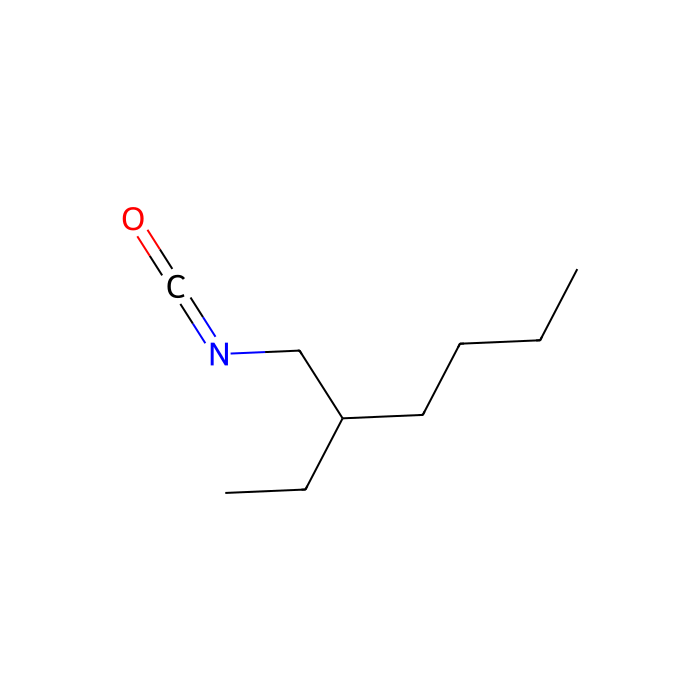
Brief description: 2‑Ethylhexyl isocyanate is a branched, monofunctional aliphatic isocyanate (R–N=C=O) bearing a hydrophobic 2‑ethylhexyl group; it is a moisture‑sensitive electrophile useful for forming carbamates (urethanes) and ureas.
Item-specific identifiers (from Product Data)
Structure features (general/literature)
Molecular identifiers (literature/computed; not item-specific specifications)
2D structure (verbal)
The isocyanate functionality (–N=C=O) in 2‑ethylhexyl isocyanate is a versatile handle for constructing nitrogen–carbonyl frameworks.
Not applicable. This product is a small-molecule reagent, not a biological targeting agent or antibody. No antigen, epitope, clone, isotype, or species reactivity data are relevant.