This compound belongs to the class of organic compounds known as dialkyl ethers. These are organic compounds containing the dialkyl ether functional group, with the formula ROR', where R and R' are alkyl groups.
External Descriptors
polyether
1. Djoumbou Feunang Y, Eisner R, Knox C, Chepelev L, Hastings J, Owen G, Fahy E, Steinbeck C, Subramanian S, Bolton E, Greiner R, and Wishart DS. ClassyFire: Automated Chemical Classification With A Comprehensive, Computable Taxonomy. Journal of Cheminformatics, 2016, 8:61.
Determine the necessary mass, volume, or concentration for preparing a solution.
Dilution Calculator
Determine the dilution needed to prepare a stock solution.
Reconstitution Calculator
Reviews
Customer Reviews
Application Protocols
No antibody/assay protocols apply to this small-molecule solvent. For synthetic or electrochemical applications, see Reaction Conditions and Synthetic Utility sections for general procedural guidance. Always adapt solvent handling (drying, degassing, peroxide testing) to your specific method and consult primary literature.
Biological Roles
This product is a synthetic glycol ether solvent without intrinsic biological function.
General context (literature)
Not a metabolite or signaling molecule; lacks defined roles in cellular pathways.
Glycol ethers can undergo oxidative metabolism (e.g., O-dealkylation) in vivo, but diglyme is primarily of toxicological interest rather than biological utility.
Laboratory interface with biology
Occasionally used to solubilize polar organic intermediates in the preparation of biochemical reagents or polymers; however, its water miscibility and donor strength, not biological activity, motivate selection.
Caution
Given reproductive toxicity concerns attributed to certain glycol ethers, minimize exposure in biological laboratories and avoid use in vivo. For research use only (per Product Data).
Buffer Applications
Not typically applicable. As an organic ether solvent, diglyme is not used to prepare aqueous pH buffers or biological buffer systems. For biochemical work requiring polar aprotic media, consider mixed-solvent systems and consult solvent compatibility with your target biomolecules.
Green Alternatives
Greenness considerations must balance performance (donor strength, bp) with safety and environmental impact.
Issues with diglyme (literature)
Ether peroxide former; periodic testing required.
Glycol ether toxicological concerns, including reproductive toxicity classifications in several jurisdictions.
Petroleum-derived; moderate biodegradability.
Potential alternatives and trade-offs
| Solvent | Pros | Cons |
| --- | --- | --- |
| 2-Methyltetrahydrofuran (2-MeTHF) | Bio-based, lower peroxide tendency than many ethers, good for organometallics | Lower dielectric constant; less effective salt solubilization; bp 80 °C limits high-T work |
| Cyclopentyl methyl ether (CPME) | Wider liquid range, good stability, hydrophobic, lower peroxide tendency | Poor water miscibility; weaker cation coordination |
| Propylene carbonate | High bp (242 °C), non-ether, non-peroxide former, strong polarity | Poor compatibility with strong bases/nucleophiles; viscosity; sometimes reactive |
| Dimethyl carbonate (DMC) | Low toxicity profile, green synthesis routes | Lower donor strength; limited solubility for salts; low bp (90 °C) |
Practical guidance
For salt-heavy or strongly cation-activated processes, the donor strength of glymes is hard to replace; consider monoglyme or crown ethers in greener solvents.
For general-purpose ether needs, 2-MeTHF/CPME may substitute if high donor number is not essential.
Pharmaceutical Uses
Formulation/manufacturing context (general)
Diglyme has been explored as a processing solvent due to its coordinating ability and high boiling point; however, glycol ethers can raise significant toxicological concerns, and diglyme is generally disfavored in pharmaceutical manufacture compared with established pharmacopeial solvents.
Regulatory note
No pharmacopeial monograph is typically assigned to diglyme; it is not among the commonly recommended ICH residual solvent classes for routine use. When used in route scouting, robust purge studies and analytical controls are essential.
Practical guidance
Prefer alternative solvents with well-characterized safety profiles (e.g., ethanol, isopropanol, acetone, ethyl acetate, 2-MeTHF) when feasible.
No therapeutic or clinical claims are made. For research use only (per Product Data).
Physical Properties
Note: Values below are literature/general references for diglyme (CAS 111-96-6). They are not item-specific specifications.
Appearance: Not specified for this item; refer to CoA/Spec Sheet.
Purity/Grade: Not specified for this item; refer to CoA/Spec Sheet.
Boiling point: ~162–163 °C at 1 atm (literature)
Melting point: ~−64 °C (literature)
Density: ~0.942–0.946 g/mL at 20–25 °C (literature)
Refractive index: n20/D ~1.401–1.403 (literature)
Viscosity: ~1.7–2.0 mPa·s at 25 °C (literature)
Vapor pressure: ~0.3–0.5 mmHg at 25 °C (literature)
Solubility: Miscible with water and common organic solvents (ethers, alcohols, aromatics) (literature)
LogP (estimated): −0.1 to −0.3 (literature/estimates)
UV cut-off: Not specified for this item; refer to CoA/Spec Sheet.
Peroxide formation: Ether-type peroxide former on air/oxygen exposure (literature caution).
Always verify critical parameters for your application using the product’s CoA/SDS.
Quality & Grades
Item-specific grade/purity: Not specified for this item; refer to CoA/Spec Sheet.
Typical grades available for glycol ethers (general guidance)
Anhydrous/“sure-seal” grades: Minimizes water for moisture-sensitive reactions (e.g., organometallics). Often supplied under inert gas; aligns with this item’s Argon-charged storage.
HPLC/UV-Vis grades: Controlled UV absorbance and low nonvolatile residue for chromatographic or spectroscopic applications.
ACS/AR grades: Meet general analytical specifications for impurities.
Stabilizers/inhibitors
Some ethers may be treated with peroxide inhibitors. For diglyme, inhibitor presence is product-specific. If critical, confirm by CoA; otherwise, assume periodic peroxide testing is necessary.
Water and trace metals
Water content, peroxides, and metal limits are application-critical but are Not specified for this item; refer to CoA/Spec Sheet for actual values and recommended test methods (e.g., Karl Fischer for water, iodometric for peroxides, ICP for metals).
Practical note
If using for organometallic chemistry, confirm dryness (e.g., molecular sieves, distillation under inert atmosphere) and verify peroxide level before use.
Reaction & Applications
Coordination-driven rate enhancement
Diglyme chelates alkali and alkaline-earth cations, often increasing nucleophile reactivity in SN2 substitutions, Williamson ether synthesis, and displacement reactions on activated substrates.
Organometallic chemistry
Frequently used with sodium/potassium dispersions, sodium naphthalenide, and organolithium chemistry where stronger cation solvation is desired compared to THF or diethyl ether.
Facilitates formation and stabilization of Grignard reagents and complex hydrides (e.g., NaBH4 modifications), though THF/Et2O remain common defaults.
Reductive and coupling processes
Employed in dissolving-metal reductions (e.g., in the presence of alkali metals) and in Wurtz-type couplings due to enhanced metal–substrate contact.
Serves as solvent for phase-transfer-like behavior without added crown ethers; sometimes used alongside catalytic 18-crown-6 for further activation.
Polymerization and electrochemistry
Solvent for anionic polymerizations and battery/electrolyte studies where high donor number and moderate dielectric constant support ion transport.
Practical tips
Drying: Distill from sodium/benzophenone or treat over 3 Å molecular sieves; verify KF water content prior to sensitive reactions.
Degassing: Freeze–pump–thaw or sparge with argon. Product is supplied argon charged; still degas for air-sensitive catalysis.
Peroxides: Test and remove (e.g., alumina/peroxide scavengers) before concentration or distillation; never distill to dryness.
Reaction Conditions
General literature guidance for diglyme as solvent; adapt to your substrate/catalyst system.
Typical operating ranges
Temperature: −20 °C (for sensitive anionic chemistry) up to ~150 °C (reflux ~162–163 °C). Use appropriate pressure equipment above ambient bp.
Concentration: 0.1–2 M for many substitutions/couplings; higher concentrations possible due to good solvation.
Drying/degassing
Dry over 3 Å molecular sieves or distill from sodium/benzophenone under argon. Degas by freeze–pump–thaw or argon sparge.
Common pairings
Bases: NaH, KH, t-BuOK; N-heterocyclic bases where cation solvation is beneficial.
Nucleophiles: Alkoxides, thiolates, cyanide, malonates, and enolates.
Metals/reductants: Li, Na/K alloy, sodium naphthalenide; Grignard and organolithium reagents (verify stability of substrate).
Time/yield expectations (literature, indicative)
SN2 displacements on activated halides/tosylates: 1–12 h at 25–100 °C; often improved rates vs less coordinating ethers.
Metal-mediated couplings: 2–24 h depending on substrate/equivalents; careful quench and peroxide testing required before workup.
Workup tips
Quench reactive metals at 0–10 °C with protic quench (iPrOH/H2O) under stirring.
Remove solvent under reduced pressure below 60–70 °C when possible; pass through peroxide scavenger if any concentration/distillation is needed.
Safety & Handling
Item-specific hazard fields are not provided in the Product Data. The following are general, literature-based cautions for diglyme; consult the product SDS for authoritative classification.
General GHS considerations (literature)
May be harmful if swallowed, inhaled, or in contact with skin.
Suspected/known reproductive toxicity for some glycol ethers; diglyme is commonly classified as Repr. 1B in many jurisdictions. Check SDS and local regulations.
Combustible liquid; flash point typically ~85 °C (closed cup). Not highly volatile but can form flammable vapors at elevated temperature.
Peroxide former: Periodically test for peroxides and never distill to dryness.
PPE and handling
Use in a fume hood. Wear lab coat, safety glasses, and appropriate chemical-resistant gloves (e.g., nitrile). Avoid breathing vapors/aerosols and skin contact.
Keep away from heat, sparks, and open flames. Ground/bond containers when transferring large volumes.
Storage incompatibilities and precautions
Store tightly closed under inert gas (Product Data: Argon charged) at room temperature, away from light and air to limit peroxide formation.
Incompatible with strong oxidizers, strong acids, strong bases, and alkali metals unless rigorously anhydrous/controlled.
First aid (overview; see SDS)
Inhalation: Move to fresh air; seek medical attention if symptoms persist.
Skin/eye contact: Rinse with water for at least 15 minutes; remove contaminated clothing; seek medical attention as needed.
Ingestion: Rinse mouth; do NOT induce vomiting; seek medical attention promptly.
Solvent Selection
Solvent class and polarity
Diglyme is a polar, aprotic ether with moderate dielectric constant (~7.2), miscible with water and most organics.
Strong cation-solvating ability via multiple ether oxygens; enhances solubility of salts and organoalkali reagents.
When to choose diglyme
Favorable for reactions requiring tight cation coordination (e.g., reactions of alkali metals, Na/K-mediated couplings, Wurtz-type, Birch-type with donors) and for high-boiling polar ether media (bp ~162–163 °C).
Useful for electrochemistry and as a high-permittivity medium for polyanion/cation conduction.
Alternatives and comparisons
THF (bp 66 °C): Lower bp, more volatile; excellent general ether, but less salt-solubilizing.
DME/monoglyme (bp ~85 °C): More volatile; good for low-temperature organometallic work.
Dioxane (bp 101 °C): Less coordinating; miscible with water but with different hazard profile.
2-MeTHF/CPME: Greener ethers with reduced peroxide tendency; lower water miscibility and different coordination behavior.
Practical selection tips
Choose diglyme when higher temperature and stronger cation coordination are advantageous (e.g., driving sluggish SN2 or anionic polymerizations).
For air-/moisture-sensitive work, ensure solvent is dry and oxygen-free; the product’s inert-argon packing is beneficial, but verify before critical use.
Storage & Reconstitution
Storage (from Product Data)
Store at room temperature under inert gas: Argon charged.
Shipped in: Normal conditions.
General storage guidance (literature)
Keep container tightly closed, under argon or nitrogen, in a cool, well-ventilated area away from light and ignition sources.
Minimize air/oxygen exposure to reduce peroxide formation. Label with date opened and test for peroxides periodically.
Reconstitution
Not applicable; supplied as a liquid solvent. If drying is required, treat with 3 Å molecular sieves (activated) or distill under inert atmosphere.
Freeze–thaw
Not applicable. Avoid freezing moisture-laden samples; water uptake can occur due to water miscibility.
Compatibility note
Use only dry, oxygen-free techniques for air-/moisture-sensitive chemistry. Verify water content and peroxide level prior to critical applications.
Structure & Identity
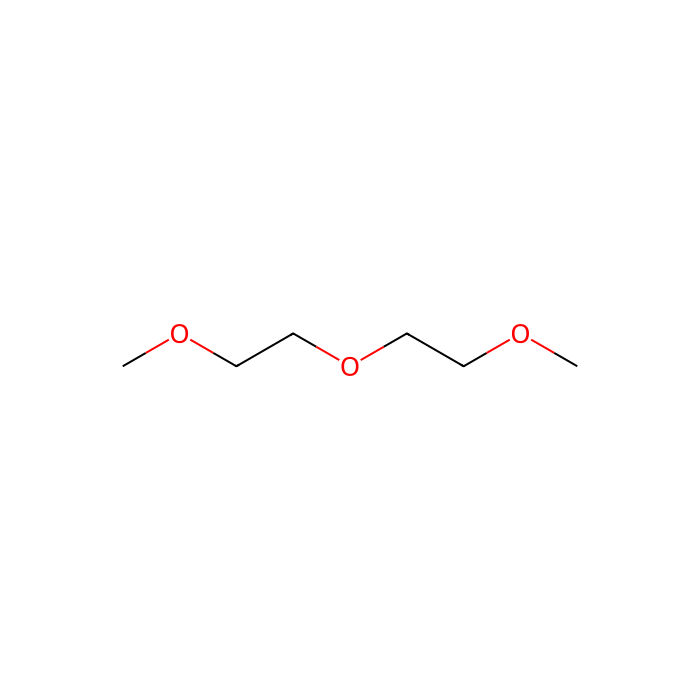
Brief overview: This product is the glycol ether commonly known as diglyme (bis(2-methoxyethyl) ether), a polar, coordinating, aprotic solvent favored for organometallic and high-ionic-strength chemistry.
InChIKey: Usually reported as ZAFNJMIOTHYJRK-UHFFFAOYSA-N for diglyme (literature)
Structural features (description)
Linear ether containing three ether oxygens in the sequence CH3–O–CH2–CH2–O–CH2–CH2–O–CH3.
Functions as a bidentate/tridentate donor toward hard cations (e.g., Li+, Na+, K+, Mg2+) via its multiple ether oxygens.
No stereocenters; flexible chain enabling chelation-like coordination.
2D structure in words
Two terminal methoxy groups connected by an ethylene–oxy–ethylene spacer: Me–O–CH2–CH2–O–CH2–CH2–O–Me.
Synthetic Utility
Functional group interactions
Multiple ether oxygens provide strong solvation of cationic species, effectively increasing nucleophilicity of anions and enabling challenging displacements and condensations.
Named/representative uses (literature)
Williamson ether syntheses under phase-transfer or glyme-coordinated conditions.
Wurtz-type and other alkali metal mediated couplings where solvation of M+ enhances electron transfer and promotes radical/anionic pathways.
Reductive conditions with sodium naphthalenide or lithium metal where glyme stabilizes solvated electrons and radical anions.
Support medium for hydride reagents or complex borohydrides/aluminates where enhanced solubility improves kinetics.
Retrosynthetic value
As a solvent/ligand rather than a reagent, diglyme expands the workable space for polar, high-temperature, or salt-rich transformations without introducing protic reactivity.
Practical considerations
Its high bp allows reactions above 100 °C without pressure equipment.
Ensure dryness (molecular sieves, distillation) and oxygen exclusion; verify peroxide levels before scale-up.
Target Specificity
Not applicable. This product is a small-molecule solvent and does not possess biological target specificity (no antigen/epitope, isotype, or species reactivity).
We use cookies to ensure the website functions properly and, where permitted, to improve your experience. You can manage your preferences at any time in Settings. Learn more in our Cookie Policy.
Shall we send you a message when we have discounts available?
Remind me later
Thank you! Please check your email inbox to confirm.
Products are supplied to verified businesses, institutions, and qualified professionals for research and development use only. Not for use in humans, animals, diagnosis, or therapy.

 J2609257