2-METHYLCYCLOPENTANOL - ≥95% , CAS No.24070-77-7

CAS: 24070-77-7 Cat. No.: B300625 Formula: C6H12O Molecular Weight: 100.16 EC Number: 607-314-2
AVAILABLE TO ORDER
GRADE & PURITY ≥95%
Synonyms
2-METHYLCYCLOPENTANOL|24070-77-7|2-methylcyclopentan-1-ol|2-Methyl cyclopentanol|Cyclopentanol, 2-methyl-|2-Methylcyclopentyl alcohol|2-Methycyclopentanol|2-methyl-1-cyclopentanol|SCHEMBL317096|DTXSID20865133|2-Methylcyclopentanol, AldrichCPR|2-Methylcycl
Storage
Room temperature
Shipped In
Normal
★
Size
Germany (EU)
USA*
Price
Qty
250mg
B300625-250mg
—
7 In stock

€31.15

€46.77
Save €15.62 (33.40%)
1g
B300625-1g
—
5 In stock

€97.97

€147.43
Save €49.46 (33.55%)
5g
B300625-5g
Made to order · 8–12 wks

€388.66

€583.03
Save €194.37 (33.34%)
Enter a quantity for the sizes you want to add.
🧪
Why this grade

≥95% for sensitive chromatographic and analytical workflows requiring minimal baseline interference.

🌡

Storage & shipping

Room temperature Ships Normal Check lot-specific COA for exact specifications.

📋

Quality documents

SDS, COA, datasheet, and spec sheet available for download. Lot-specific COA accessible via lot number lookup.

📚

Literature proof

Cited in 0 peer-reviewed publications across chromatography, organic synthesis, and cross-coupling reactions.

Specifications

Synonyms
2-METHYLCYCLOPENTANOL | 24070-77-7 | 2-methylcyclopentan-1-ol | 2-Methyl cyclopentanol | Cyclopentanol, 2-methyl- | 2-Methylcyclopentyl alcohol | 2-Methycyclopentanol | 2-methyl-1-cyclopentanol | SCHEMBL317096 | DTXSID20865133 | 2-Methylcyclopentanol, AldrichCPR | 2-Methylcycl
Specifications & Purity
≥95%
Storage
Room temperature
Shipped In
Normal
Purity
≥95%
Names and Identifiers
Pubchem Sid
Pubchem Sid Url
https://pubchem.ncbi.nlm.nih.gov/substance/504753486
Canonical Smiles
CC1CCCC1O
IUPAC Name
2-methylcyclopentan-1-ol
InChIKey
BVIJQMCYYASIFP-UHFFFAOYSA-N
INCHI
1S/C6H12O/c1-5-3-2-4-6(5)7/h5-7H,2-4H2,1H3
Isomeric SMILES
CC1CCCC1O
Molecular Weight
100.16
Reaxy-Rn
2203040
Reaxys-RN_link_address
https://www.reaxys.com/reaxys/secured/hopinto.do?context=S&query=IDE.XRN=2203040&ln=

Documentation

📋 Safety Data Sheet (SDS)

Comprehensive hazard, handling, storage, and regulatory compliance document.

Download SDS →

✅ Certificate of Analysis (COA)

Lot-specific quality data. Enter your lot number to retrieve the exact COA.

Look up COA →

📊 Datasheet

Quick-reference summary of product specifications and applications.

View datasheet →

🔬 Specification Sheet

Full quality attributes and acceptance criteria for this grade.

View spec sheet →

Advanced Data

Taxonomic Classification

Taxonomy Tree

KingdomOrganic compounds
SuperclassOrganic oxygen compounds
ClassOrganooxygen compounds
SubclassAlcohols and polyols
Intermediate Tree Nodes Secondary alcohols
Direct ParentCyclopentanols
Alternative Parents Cyclic alcohols and derivatives  Hydrocarbon derivatives  
Molecular FrameworkAliphatic homomonocyclic compounds
Substituents Cyclopentanol - Cyclic alcohol - Hydrocarbon derivative - Aliphatic homomonocyclic compound
DescriptionThis compound belongs to the class of organic compounds known as cyclopentanols. These are compounds containing a cyclopentane ring that carries an alcohol group.
External Descriptors Not available
Certificates(CoA,COO,BSE/TSE and Analysis Chart)
C of A & Other Certificates(BSE/TSE, COO):
Analytical Chart:

Find and download the COA for your product by matching the lot number on the packaging.

8 results found

Lot NumberCertificate TypeDateItem
G2128076Certificate of AnalysisMay 12, 2025 B300625
G2128075Certificate of AnalysisMay 09, 2025 B300625
C2214041Certificate of AnalysisFeb 12, 2022 B300625
C2214057Certificate of AnalysisFeb 12, 2022 B300625
C2214058Certificate of AnalysisFeb 12, 2022 B300625
C2528260Certificate of AnalysisFeb 12, 2022 B300625
F23021170Certificate of AnalysisFeb 12, 2022 B300625
F23021171Certificate of AnalysisFeb 12, 2022 B300625
Chemical and Physical Properties
Molecular Weight100.160 g/mol
XLogP31.200
Hydrogen Bond Donor Count1
Hydrogen Bond Acceptor Count1
Rotatable Bond Count0
Exact Mass100.089 Da
Monoisotopic Mass100.089 Da
Topological Polar Surface Area20.200 Ų
Heavy Atom Count7
Formal Charge0
Complexity61.200
Isotope Atom Count0
Defined Atom Stereocenter Count0
Undefined Atom Stereocenter Count2
Defined Bond Stereocenter Count0
Undefined Bond Stereocenter Count0
The total count of all stereochemical bonds0
Covalently-Bonded Unit Count1
Solution Calculators
Reviews

Customer Reviews

Application Protocols

No item-specific tested biological application protocols are provided. As a general laboratory reagent/intermediate:

  • Use neat or in an appropriate organic solvent (e.g., CH2Cl2, THF, toluene) depending on reaction requirements.
  • For oxidation/dehydration/derivatization protocols, see the Reaction Conditions tab for representative setups.
  • For analytical control, GC-FID/GC–MS and 1H/13C NMR are standard for assessing purity and isomer ratios.

Refer to your internal SOPs and reaction- or analysis-specific literature for detailed step-by-step instructions.

Biological Roles

This compound is a synthetic aliphatic secondary alcohol; it is not a recognized endogenous metabolite.

  • Biological function: None established in natural pathways. Aliphatic cycloalkanols may be metabolized by oxidative pathways (alcohol dehydrogenases to ketones, then further oxidation), but such behavior is generalized for alcohols and not specific to this molecule.
  • Biodegradation: Secondary alkanols are typically biodegradable under aerobic conditions via microbial oxidation (literature/general), though ring structures can affect rates.
  • Cytotoxicity/biocompatibility: No item-specific data provided; evaluate in context of your system. For research use only.

For biochemical or cellular studies, treat primarily as a small-molecule organic substrate/solvent impurity rather than a buffer or biochemical reagent.

Buffer Applications

Not typically used as a buffering agent. As a secondary alcohol without acid/base functionality in the physiological pH range, it does not form a conventional buffer system. If used in biochemical assays, it would be as a cosolvent at low percentages to aid solubility of hydrophobic substrates. Select appropriate biological buffers (e.g., phosphate, HEPES, Tris) for pH control.

Green Alternatives

As a reactive substrate, 2-methylcyclopentanol is not typically replaced on “green solvent” grounds, but solvent/media choices around its use can be optimized.

Greener media choices (literature/general)

  • For reactions using this alcohol as solvent/cosolvent: consider bio-based ethanol or isopropanol when lower bp is acceptable; for higher bp, 2-MeTHF or CPME offer improved safety and life-cycle metrics versus toluene/DMF in many transformations.
  • Oxidations: Choose catalytic, non-chromium systems (e.g., TEMPO/bleach, O2 with Cu/NHPI, or IBX/DMP under minimal waste) instead of stoichiometric chromium(VI).
  • Dehydrations: Solid acid catalysts (Amberlyst, heteropolyacids) can reduce corrosive mineral acid waste.

| Aspect | Conventional option | Greener alternative | Trade-offs | |---|---|---|---| | Oxidation to ketone | Jones (Cr(VI)) | TEMPO/NaOCl or O2-catalysis | Selectivity control; halogen handling | | Solvent (high bp) | Toluene/xylene | 2-MeTHF, CPME | Peroxide management for ethers; different polarity | | Acid dehydration | H2SO4, POCl3 | Solid acids (Amberlyst), supported acids | Catalyst recovery needed |

Note: Selection should be guided by reaction performance, safety, and waste minimization metrics (E-factor, PMI).

Pharmaceutical Uses

No item-specific pharmacopeial status or excipient role is provided for this product. This compound is primarily a synthetic intermediate.

  • Potential roles (general/non-clinical):
    • Process intermediate in the preparation of cyclopentyl-containing APIs or auxiliaries.
    • Occasional use as a process solvent/cosolvent in route scouting where a higher-boiling protic medium is required; however, established pharmacopeial solvents (e.g., ethanol, IPA) are typically preferred.
  • Regulatory notes: Not listed here as USP/Ph.Eur. grade; any use in pharmaceutical manufacturing would require appropriate qualification and control of residual levels per ICH guidelines.

No medical or therapeutic claims are made. For research and process development use only.

Physical Properties

Item-specific (from Product Data)

  • Appearance: Not specified for this item; refer to CoA/Spec Sheet.
  • Grade/Purity: Not specified for this item; refer to CoA/Spec Sheet.

Computed/Literature values (for reference; not product specifications)

  • Phase at RT: typically liquid (literature, secondary C5 ring alcohols are liquids at ambient conditions)
  • Boiling point: ~160–170 °C (literature range for 2-methylcyclopentanol isomers)
  • Melting point: generally below 0 °C (literature; secondary cycloalkanols of this size are often low-melting)
  • Density (20–25 °C): ~0.90–0.93 g/mL (literature estimates for C6 secondary cycloalkanols)
  • Refractive index n20/D: ~1.44–1.46 (literature for related cycloalkanols)
  • LogP (octanol/water): expected moderate, ~1.2–1.8 (literature/estimated)
  • Aqueous solubility: limited; miscible with many organic solvents (literature for secondary alkanols)
  • pKa (ROH): ~16–18 in water (very weak acid; literature for aliphatic alcohols)

Note: Exact values and isomer composition can vary; consult the CoA/Spec Sheet for item-specific specifications.

Quality & Grades

Item-specific (from Product Data)

  • Grade/Purity: Not specified for this item; refer to CoA/Spec Sheet.

Guidance on grades (general information)

  • If offered in technical or reagent grade, typical expectations include identity confirmation (GC/IR) and assay by GC area%. Water and volatile impurity levels may be controlled; exact limits are item-specific (see CoA).
  • For GC, HPLC, or spectrophotometric applications, higher grades often specify low UV absorbance and narrow impurity profiles; stabilizers are uncommon for this class.
  • Isomer composition: 2-methylcyclopentanol can exist as a mixture of cis/trans diastereomers and enantiomers. Some grades may specify isomeric ratio or enantiomeric excess if relevant to chiral synthesis; if not specified, assume racemic/mixture.
  • Trace metals/acid value/peroxide value: Not specified for this item; refer to CoA/Spec Sheet.

Always consult the lot-specific Certificate of Analysis for assay, impurity profile, water content, and any isomeric composition statements.

Reaction & Applications

2-Methylcyclopentanol is a versatile secondary aliphatic alcohol on a constrained ring, useful as both a substrate and a building block.

Typical transformations (literature/general)

  • Oxidation to ketone: Gives 2-methylcyclopentanone or regioisomeric ketones depending on exact hydroxyl position/isomer; reagents include PCC, PDC, Dess–Martin periodinane, Swern, TEMPO/bleach, or Jones (chromic acid) under controlled conditions.
  • Dehydration/elimination: Acid-catalyzed dehydration (H2SO4, POCl3/pyridine, or Amberlyst) affords methylcyclopentenes; ring constraint influences E1/E2 and rearrangement propensities.
  • Substitution via activated derivatives: Conversion to tosylate/mesylate or halides (PBr3, SOCl2) enables SN1/SN2 reactions to form C–N, C–S, C–X bonds.
  • Esterification/Carbamate formation: Fischer esterification with carboxylic acids or coupling with chloroformates.
  • Protection chemistry: Formation of silyl ethers (TBS, TBDPS) or carbonates for downstream transformations.
  • Catalytic oxidation to lactones: Sequential oxidation/isomerization of cycloalkanols can access oxygenated ring systems.

Use cases (literature/general)

  • Intermediate in fragrance and agrochemical scaffolds where a methylated cyclopentyl motif is required.
  • Chiral pool/auxiliary studies: diastereomerically enriched materials can transmit stereochemical information in subsequent steps.

Practical notes: Control water content for dehydrations; avoid strong acids/bases if preserving configuration is important; monitor isomer ratios (cis/trans) where stereochemistry impacts downstream properties.

Reaction Conditions

Representative literature-style conditions for common transformations of 2-methylcyclopentanol (guidance only; optimize for your system):

  • Oxidation to ketone:
    • PCC in CH2Cl2, 0–25 °C, 1–3 h; typical isolated yields 70–90% for secondary alcohols.
    • Swern (oxalyl chloride/DMSO, −78 to 0 °C; then Et3N), 70–90%.
    • TEMPO/NaOCl in biphasic CH2Cl2/H2O with buffer (pH ~8.6), 0–25 °C, 1–4 h; often 80–95%.
  • Dehydration to alkenes:
    • H2SO4 (conc.) or p-TsOH, 80–120 °C (neat or toluene with Dean–Stark), 2–6 h; mixture of methylcyclopentene isomers; employ solid acids (Amberlyst-15) at 60–100 °C for greener processing.
  • Halide formation:
    • PBr3 (1.1–1.5 equiv) in Et2O/THF, 0–25 °C, 1–2 h → secondary bromide; retain inversion where SN2 is operative.
    • SOCl2 (with catalytic DMF) in CH2Cl2, 0–25 °C, 1–3 h → chloride.
  • Tosylation/mesylation:
    • TsCl (1.1–1.5 equiv), pyridine or NEt3, 0–25 °C, 2–4 h; follow with nucleophilic displacement.
  • Silyl protection:
    • TBSCl (1.2–1.5 equiv), imidazole in DMF or CH2Cl2, 0–25 °C, 2–6 h → TBS ether; stable to base and mild oxidants.

Monitoring by GC or 1H NMR is recommended given potential isomerization and formation of multiple alkene isomers upon dehydration.

Safety & Handling

Item-specific (from Product Data)

  • Storage conditions: Room temperature
  • Shipped: Normal
  • GHS/Signal word/H-statements/Pictograms: Not specified for this item; refer to SDS.

General safety guidance (literature/standard practice; defer to SDS for authoritative data)

  • Hazard overview: Secondary aliphatic alcohols are combustible liquids and can cause eye/skin irritation. Vapor may cause respiratory irritation at high concentrations.
  • Incompatibilities: Strong oxidizers (e.g., chromates, permanganates), strong acids (risk of dehydration to alkenes), acid chlorides/anhydrides (esterification), alkali metals and strong bases (formation of alkoxides), and heat sources/ignition.
  • PPE: Use chemical-resistant gloves (e.g., nitrile), lab coat, safety goggles; handle in a fume hood to control vapors.
  • First aid (general):
    • Inhalation: Move to fresh air; seek medical attention if symptoms persist.
    • Skin contact: Wash with soap and water; remove contaminated clothing.
    • Eye contact: Rinse cautiously with water for several minutes; seek medical advice.
    • Ingestion: Rinse mouth; do not induce vomiting; seek medical attention.
  • Fire-fighting: Use alcohol-resistant foam, dry chemical, CO2. Cool containers with water spray. Vapors may form combustible mixtures with air at elevated temperatures.
  • Stability notes: Does not form peroxides readily (unlike ethers), but can undergo oxidation on prolonged air exposure; keep containers tightly closed.
Solvent Selection

This product is primarily a reactive alcohol/intermediate rather than a general-purpose solvent. Limited use as a specialty solvent/co-solvent is possible.

Polarity/miscibility (literature/general)

  • Polarity: Protic, moderately polar (secondary alkanol)
  • Miscibility: Miscible with many organics (ethers, aromatics, chlorinated, lower alcohols); limited miscibility with water.
  • Hydrogen bonding: Donor and acceptor; can disrupt H-bonding networks (useful as cosolvent).

When to use

  • As a medium- to high-boiling protic cosolvent (~160–170 °C bp, literature) in reactions that benefit from an alcohol medium (e.g., solvolysis, ion-exchange resin swelling) where ethanol/IPA are too volatile.
  • As a substrate-solvent combination to streamline telescoped steps (e.g., in situ formation of alkoxides followed by substitution).

Comparison (literature/general)

  • Versus isopropanol: higher bp, lower volatility; stronger hydrophobic character.
  • Versus tert-butanol: less steric hindrance; more nucleophilic as an alcohol; higher boiling.

Note: For chromatographic or spectroscopic applications, choose established solvent grades (e.g., MeOH, ACN) unless a process specifically requires this alcohol.

Storage & Reconstitution

Item-specific (from Product Data)

  • Storage conditions: Room temperature
  • Shipping: Normal

General guidance (literature/standard practice)

  • Keep container tightly closed in a dry, well-ventilated area. Protect from excessive heat and strong oxidizing agents.
  • If long-term storage is planned, minimize headspace oxygen to reduce slow oxidative discoloration; amber glass is recommended to limit light exposure.
  • No reconstitution required; use as supplied. If solidification or phase separation occurs at low temperatures, warm gently to ambient and mix thoroughly before use.
  • After opening, consider blanketing with inert gas for sensitive applications and record the opening date for inventory control.

Research Use Only: Not for human or animal diagnostic or therapeutic use.

Structure & Identity

Item-specific (from Product Data)

  • SKU: B300625
  • Product name: 2-METHYLCYCLOPENTANOL
  • CAS: 24070-77-7
  • PubChem CID: 32205
  • InChIKey: 35296 (as provided)
  • SMILES: Not specified for this item; refer to CoA/Spec Sheet.

Computed/Literature (clearly labeled; not product specifications)

  • Molecular formula (literature for 2-methylcyclopentanol): C6H12O
  • Molecular weight (literature): 100.16 g/mol
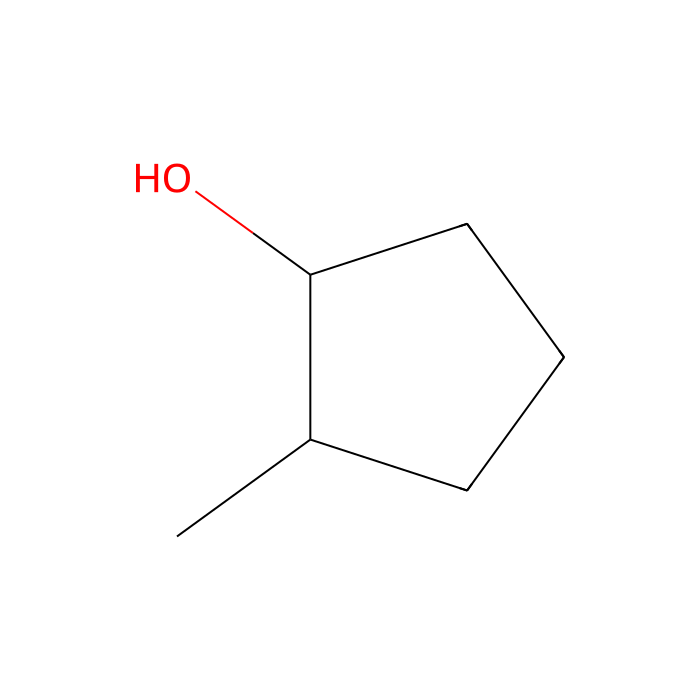
  • Structural features: secondary aliphatic alcohol on a cyclopentane ring bearing an adjacent methyl substituent (1-hydroxy-2-methylcyclopentane framework). Two stereocenters are possible (at C1 and C2), giving cis/trans diastereomers and enantiomers; commercial material is commonly a mixture unless otherwise specified.
  • 2D description: a five-membered saturated ring; the OH substituent on one carbon and a methyl group on the adjacent ring carbon (vicinal substitution). No aromaticity; one hydroxyl functional group; no additional heteroatoms.
Synthetic Utility

Key functional group: a secondary alcohol embedded in a cyclopentane ring with an adjacent methyl substituent, enabling both functional-group and stereochemical manipulations.

  • Oxidation state adjustments: Access to the corresponding ketone (2-methylcyclopentanone) provides a gateway to enolization, aldol-type chemistry, Baeyer–Villiger oxidation (to lactones), and reductive amination to amines.
  • Leaving group installation: Conversion to tosylate/mesylate enables displacement with heteroatom nucleophiles (SN2) when stereochemistry permits; PBr3 or SOCl2 give alkyl halides, useful for cross-coupling after halogen−metal exchange.
  • Elimination/rearrangements: Acid-mediated dehydration affords methylcyclopentene isomers; subsequent hydrofunctionalizations (epoxidation, hydroboration–oxidation) diversify substitution patterns.
  • Protection/inversion: Silyl ether protection allows base-/oxidation-sensitive sequences; Mitsunobu reaction can invert configuration at C1 where a primary/secondary alcohol participates and suitable nucleophile is chosen.
  • Reductive routes: Conversion to alkoxide followed by Williamson-type etherification creates cyclopentyl ethers; hydrogenolysis of derivatives provides deoxygenated motifs in total syntheses.

Stereochemical note: Control of cis/trans relationship between OH and Me substituents can influence reactivity and selectivity; consider diastereomeric enrichment when stereochemical outcomes are critical.

Target Specificity

Not applicable. This product is a small-molecule chemical, not a biological targeting reagent (e.g., antibody, ligand with defined biomolecular target). No antigen/epitope/clone/isotype data are relevant.

Shall we send you a message when we have discounts available?

Remind me later

Thank you! Please check your email inbox to confirm.

Oops! Notifications are disabled.