
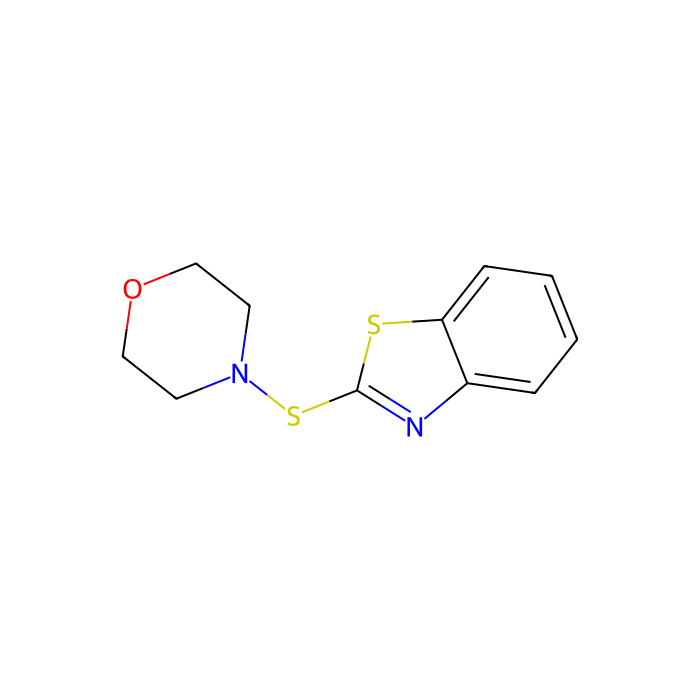
Determine the necessary mass, volume, or concentration for preparing a solution.
| Activity Type | Relation | Activity value | Units | Action Type | Journal | PubMed Id | doi | Assay Aladdin ID |
|---|
Taxonomy Tree
| Kingdom | Organic compounds |
|---|---|
| Superclass | Organoheterocyclic compounds |
| Class | Benzothiazoles |
| Subclass | Not available |
| Intermediate Tree Nodes | Not available |
| Direct Parent | Benzothiazoles |
| Alternative Parents | Morpholines Benzenoids Thiazoles Heteroaromatic compounds Sulfenyl compounds Oxacyclic compounds Organosulfenic acid amides Dialkyl ethers Azacyclic compounds Organopnictogen compounds Organonitrogen compounds Hydrocarbon derivatives |
| Molecular Framework | Aromatic heteropolycyclic compounds |
| Substituents | 1,3-benzothiazole - Morpholine - Oxazinane - Benzenoid - Azole - Heteroaromatic compound - Thiazole - Dialkyl ether - Ether - Organosulfenic acid amide - Oxacycle - Sulfenyl compound - Azacycle - Organooxygen compound - Organonitrogen compound - Organosulfur compound - Hydrocarbon derivative - Organic oxygen compound - Organic nitrogen compound - Organopnictogen compound - Aromatic heteropolycyclic compound |
| Description | This compound belongs to the class of organic compounds known as benzothiazoles. These are organic compounds containing a benzene fused to a thiazole ring (a five-membered ring with four carbon atoms, one nitrogen atom and one sulfur atom). |
| External Descriptors | Not available |
| Activity Type | Relation | Activity value | Units | Action Type | Journal | PubMed Id | doi | Assay Aladdin ID |
|---|
| Activity Type | Relation | Activity value | Units | Action Type | Journal | PubMed Id | doi | Assay Aladdin ID |
|---|
| Activity Type | Relation | Activity value | Units | Action Type | Journal | PubMed Id | doi | Assay Aladdin ID |
|---|
| Activity Type | Relation | Activity value | Units | Action Type | Journal | PubMed Id | doi | Assay Aladdin ID |
|---|
| Activity Type | Relation | Activity value | Units | Action Type | Journal | PubMed Id | doi | Assay Aladdin ID |
|---|
| Activity Type | Relation | Activity value | Units | Action Type | Journal | PubMed Id | doi | Assay Aladdin ID |
|---|
| Activity Type | Relation | Activity value | Units | Action Type | Journal | PubMed Id | doi | Assay Aladdin ID |
|---|
| Activity Type | Relation | Activity value | Units | Action Type | Journal | PubMed Id | doi | Assay Aladdin ID |
|---|
| Activity Type | Relation | Activity value | Units | Action Type | Journal | PubMed Id | doi | Assay Aladdin ID |
|---|
| Activity Type | Relation | Activity value | Units | Action Type | Journal | PubMed Id | doi | Assay Aladdin ID |
|---|
| Activity Type | Relation | Activity value | Units | Action Type | Journal | PubMed Id | doi | Assay Aladdin ID |
|---|
| Activity Type | Relation | Activity value | Units | Action Type | Journal | PubMed Id | doi | Assay Aladdin ID |
|---|
| Activity Type | Relation | Activity value | Units | Action Type | Journal | PubMed Id | doi | Assay Aladdin ID |
|---|
| Activity Type | Relation | Activity value | Units | Action Type | Journal | PubMed Id | doi | Assay Aladdin ID |
|---|
| Activity Type | Relation | Activity value | Units | Action Type | Journal | PubMed Id | doi | Assay Aladdin ID |
|---|
| Activity Type | Relation | Activity value | Units | Action Type | Journal | PubMed Id | doi | Assay Aladdin ID |
|---|
| Activity Type | Relation | Activity value | Units | Action Type | Journal | PubMed Id | doi | Assay Aladdin ID |
|---|
| Activity Type | Relation | Activity value | Units | Action Type | Journal | PubMed Id | doi | Assay Aladdin ID |
|---|
| Activity Type | Relation | Activity value | Units | Action Type | Journal | PubMed Id | doi | Assay Aladdin ID |
|---|
| Activity Type | Relation | Activity value | Units | Action Type | Journal | PubMed Id | doi | Assay Aladdin ID |
|---|
| Activity Type | Relation | Activity value | Units | Action Type | Journal | PubMed Id | doi | Assay Aladdin ID |
|---|
| Activity Type | Relation | Activity value | Units | Action Type | Journal | PubMed Id | doi | Assay Aladdin ID |
|---|
| Activity Type | Relation | Activity value | Units | Action Type | Journal | PubMed Id | doi | Assay Aladdin ID |
|---|
| Activity Type | Relation | Activity value | Units | Action Type | Journal | PubMed Id | doi | Assay Aladdin ID |
|---|
| Activity Type | Relation | Activity value | Units | Action Type | Journal | PubMed Id | doi | Assay Aladdin ID |
|---|
Find and download the COA for your product by matching the lot number on the packaging.
| Lot Number | Certificate Type | Date | Item |
|---|---|---|---|
 G2614042 | Certificate of Analysis | Jul 24, 2026 | M158491 |
| L2031490 | Certificate of Analysis | Oct 12, 2024 | M158491 |
| L2031489 | Certificate of Analysis | Oct 12, 2024 | M158491 |
| H2401030 | Certificate of Analysis | Aug 13, 2024 | M158491 |
| Solubility | Practically insoluble in water ;soluble in Acetone,Chloroform,Toluene,Benzene |
|---|---|
| Melt Point(°C) | 84.0 - 88.0 °C |
| Molecular Weight | 252.400 g/mol |
| XLogP3 | 2.700 |
| Hydrogen Bond Donor Count | 0 |
| Hydrogen Bond Acceptor Count | 5 |
| Rotatable Bond Count | 2 |
| Exact Mass | 252.039 Da |
| Monoisotopic Mass | 252.039 Da |
| Topological Polar Surface Area | 78.900 Ų |
| Heavy Atom Count | 16 |
| Formal Charge | 0 |
| Complexity | 236.000 |
| Isotope Atom Count | 0 |
| Defined Atom Stereocenter Count | 0 |
| Undefined Atom Stereocenter Count | 0 |
| Defined Bond Stereocenter Count | 0 |
| Undefined Bond Stereocenter Count | 0 |
| The total count of all stereochemical bonds | 0 |
| Covalently-Bonded Unit Count | 1 |
Not applicable. No validated bioassay protocols (e.g., WB, IHC, IF, FC) are associated with this small-molecule reagent. For synthetic use, refer to the Reaction Conditions and Synthetic Utility tabs for general procedural guidance and then tailor to your substrate and setup.
This compound is a synthetic organic sulfenamide and does not have a native biological role. Any interactions with biological systems are incidental to its chemical functionality.
General/literature context (non-clinical, research-only):
Conclusion: Use is confined to chemical/materials research. For any work near biological systems, perform thorough compatibility and toxicity assessments and adhere strictly to institutional EHS policies. No medical or clinical uses are implied.
Not typically applicable. 2-(Morpholinothio)benzothiazole is not a buffering agent and is poorly soluble in water. For aqueous work, consider using it only as a reagent in biphasic systems or after organic stock solution preparation, and consult the Solvent Selection and Reaction & Applications tabs for relevant guidance.
Perspective: Selection of greener options focuses on solvent choice and, where applicable, the choice of sulfenylating reagent that minimizes hazardous byproducts while maintaining performance.
Greener solvent choices (general guidance):
Comparison snapshot (literature/general; not product specs):
Alternative sulfenylating reagents:
Trade-offs:
No pharmacopeial or excipient role is indicated for this item.
General notes (non-therapeutic, research-only):
Compliance reminder: This product is for research use only. It is not manufactured, tested, or qualified for human or veterinary use, drug substance, or excipient applications.
Item-specific values (from Product Data):
General/literature characteristics (reference only; not item specifications):
For authoritative numerical constants (mp, bp, density, refractive index, pKa/logP), consult literature databases (e.g., PubChem CID 7619) and the CoA; do not treat literature values as product specifications.
Item-specific (from Product Data):
Guidance on interpreting grade (general information):
What to check on the CoA/Spec Sheet:
Recommendation: Align grade selection with your application—e.g., higher purity for fine chemical synthesis or mechanistic studies; technical grade may suffice for materials screening—verify by CoA.
Overview: As a benzothiazole-based sulfenamide, 2-(Morpholinothio)benzothiazole serves both as a functional accelerator in sulfur vulcanization chemistry and as a versatile electrophilic benzothiazolylsulfenyl-transfer reagent in organic synthesis.
Representative applications (literature/general):
Practical considerations:
General literature guidance (optimize for your substrate; not product specifications):
Electrophilic sulfenylation of enolates/silyl enol ethers:
Sulfenylation of electron-rich heteroarenes (e.g., indole):
Formation of mixed disulfides via trans-sulfenylation:
Workup/purification tips:
Expected outcomes: High chemoselectivity for C–S bond formation under mild conditions; yields commonly moderate to high in literature, substrate-dependent. Always verify compatibility for base/acid-sensitive substrates.
Item-specific hazard information (from Product Data):
General safety profile for benzothiazole sulfenamides (literature/analog-based; consult SDS for authoritative guidance):
Always defer to the current Aladdin Scientific SDS for this specific SKU for exact classifications, limits, and handling recommendations.
Context: 2-(Morpholinothio)benzothiazole is an organic, moderately polar, heteroatom-rich sulfenamide. Solvent choice should balance solubility, reaction compatibility with the S–N linkage, and downstream workup.
General solubility/miscibility (literature/general):
Selection guidance:
Practical tips:
Item-specific (from Product Data):
General storage guidance (for sulfenamides; supplement to item data):
Reconstitution/use:
Always consult the CoA and SDS for batch-specific guidance and shelf-life information.
Brief overview: 2-(Morpholinothio)benzothiazole is a benzothiazole-based sulfenamide bearing a morpholine substituent through an S–N linkage. It is widely known in rubber chemistry as a sulfenamide accelerator (often abbreviated MOR) and in synthesis as an electrophilic benzothiazolylsulfenyl donor.
Item-specific (from Product Data):
Computed/Literature identity (for reference; not item-specific specs):
Note: Where the Product Data differ or are incomplete (e.g., SMILES/InChIKey format), consult the CoA/Spec Sheet or authoritative databases for definitive string identifiers.
Key reactivity features (general/literature):
Named/representative transformations:
Practical advantages:
Considerations:
Not applicable. This product is a small-molecule chemical reagent, not a biological targeting agent or antibody. No antigen/epitope, clone, isotype, or species reactivity information applies.