This compound belongs to the class of organic compounds known as morpholines. These are organic compounds containing a morpholine moiety, which consists of a six-member aliphatic saturated ring with the formula C4H9NO, where the oxygen and nitrogen atoms lie at positions 1 and 4, respectively.
1. Djoumbou Feunang Y, Eisner R, Knox C, Chepelev L, Hastings J, Owen G, Fahy E, Steinbeck C, Subramanian S, Bolton E, Greiner R, and Wishart DS. ClassyFire: Automated Chemical Classification With A Comprehensive, Computable Taxonomy. Journal of Cheminformatics, 2016, 8:61.
Determine the necessary mass, volume, or concentration for preparing a solution.
Dilution Calculator
Determine the dilution needed to prepare a stock solution.
Reconstitution Calculator
Reviews
Customer Reviews
Application Protocols
No tested bioassay protocols (e.g., WB, IHC, IF, FC) are applicable to this small-molecule reagent. For synthetic applications, see the Reaction & Applications and Reaction Conditions sections for general literature guidance.
Biological Roles
This material is a synthetic small molecule and not a known endogenous metabolite.
General biochemistry context (literature/general):
Protonatable amine: At physiological pH ranges, the tertiary amine (in the morpholine ring for the N-substituted structure) can be partially protonated, facilitating ionic interactions with biomacromolecules and acids. This is exploited in ion-pairing and as a transient pH adjuster in biochemical preparations.
Hydrogen bonding: The primary alcohol and ring heteroatoms can act as hydrogen-bond donors/acceptors, influencing solubilization of peptides, oligonucleotides, and polar small molecules.
Buffering capacity: The conjugate acid pKa of morpholine derivatives typically lies near 8–9 (medium-dependent), enabling limited buffering near neutral-to-alkaline pH, though it is not a standardized biological buffer like HEPES or MOPS.
Derivatization handle: Often used as a precursor to morpholinium salts and cationic surfactants that can interact with membranes and nucleic acids in formulated systems (research context).
Note: Any references to biological interactions here are provided as general background. This product is provided for research use only and is not intended for use in humans or diagnostics.
Buffer Applications
Not a Good’s buffer per se, but morpholine-based amino alcohols can provide limited buffering capacity in the mildly basic range.
General guidance (literature/general):
Relevant pKa: The conjugate acid of morpholine derivatives commonly has pKa ~8.3–8.7 (solvent and ionic strength dependent). Working buffer range typically spans pKa ±1, i.e., pH ~7.3–9.7.
Practical use: Can serve as an ad hoc buffering base or pH adjuster in organic–aqueous media, especially where a basic, water-miscible component is beneficial. Not recommended for precise biochemical assays that require well-characterized, low-UV buffers.
Ionic strength/compatibility: Forms salts readily with mineral or organic acids (e.g., acetate, chloride). Such salts can increase ionic strength and alter protein solubility—evaluate empirically.
Recipes/parameters:
Because lot-specific acid–base parameters and impurities are not specified, no standardized buffer recipe is provided. For critical applications, select a validated buffer system (e.g., HEPES, MOPS, TRIS) and use this compound only as a process aid or for exploratory work.
Green Alternatives
Assessment (general, literature-based):
The compound is a low-volatility, water-miscible amino alcohol. Relative to volatile amines (e.g., morpholine), it may reduce VOC emissions in open operations. Biodegradability is typical of short-chain alkanolamines, but aquatic toxicity and amine nitrosation risks require consideration.
Comparison to common alternatives:
Target function: basic reagent / co-solvent
This product: high polarity, low vapor pressure; doubles as nucleophile and base; miscible with water.
Morpholine: more volatile (higher VOC), lacks –OH; easier removal but more odor/emissions.
Ethanolamine (MEA): higher hydrophilicity; stronger hydrogen bonding; more corrosive and can form stable salts—harder to remove.
2-MeTHF (as a green solvent alternative when reagent role isn’t needed): bio-based option with lower toxicity profile; immiscible with water; not basic.
Tradeoffs:
Pros: reduced flammability concerns vs low-boiling amines; dual functionality can lower additive count in a process (fewer chemicals).
Cons: High water miscibility complicates separation; salt formation generates aqueous waste; potential for nitrosation under nitrosating conditions (avoid nitrite contamination and control pH).
Greener practice tips:
Use minimal excess; recover via aqueous workup and re-use when feasible.
Avoid chlorinated solvents; pair with bio-based solvents (2-MeTHF, EtOAc) where compatible.
Implement closed handling to minimize amine emissions; treat amine-bearing effluents by appropriate neutralization/biological treatment.
Pharmaceutical Uses
For research and process development use only; not for human or veterinary use.
Ion-pairing and pH adjustment: As a water-miscible tertiary amine alcohol, it can function as a processing base to solubilize acidic APIs during crystallization screening or as a transient counterion in salt selection studies.
Intermediate/excipients: Quaternized morpholinium derivatives derived from this amino alcohol are used industrially as phase-transfer agents or antistatic agents; such transformations may be explored in route scouting (not a claim about this specific item’s use as an excipient).
Co-solvent: Its high polarity and hydrogen-bonding ability can assist in dissolving polar intermediates during synthesis steps.
Regulatory notes:
No pharmacopeial monograph is referenced for this item. Any pharmaceutical application would require independent qualification, impurity profiling, and toxicological assessment.
Avoid nitrosating conditions (e.g., nitrite under acidic conditions) during processing with amines.
Removal/cleanup strategies:
Acidic aqueous washes (to form water-soluble salts), followed by basification and extraction if recovery is desired.
Monitor residual levels by GC or LC–MS; establish acceptable carryover limits as per internal QA protocols.
Physical Properties
Item-specific specifications (this lot):
Appearance: Not specified for this item; refer to CoA/Spec Sheet.
Grade/Purity: Not specified for this item; refer to CoA/Spec Sheet.
Computed/literature values (for reference only; not item specifications):
Molecular formula: C6H13NO2 (literature)
Molecular weight: ~131.17 g/mol (literature)
Common synonyms: 2-(Morpholin-4-yl)ethanol; N-(2-hydroxyethyl)morpholine (literature)
Acid–base: tertiary amine (basic); conjugate acid pKa typically around 8.3–8.7 (literature, varies with medium)
Polarity: highly polar, hydrogen-bond donor (via –OH) and acceptor (N and O) (general chemistry)
Miscibility: expected miscible with water and many polar organics (alcohols, ketones); limited solubility in nonpolar hydrocarbons (general chemistry)
Notes:
Due to both amine and alcohol functionalities, the compound exhibits strong hydrogen bonding and high boiling behavior relative to morpholine (literature trend). Specific values such as boiling point, melting point, density, refractive index, and UV cutoff are Not specified for this item; consult primary literature or the CoA/SDS for authoritative numbers.
Quality & Grades
Item-specific grade/purity and appearance are not provided in the Product Data. For concrete acceptance criteria (assay, residual solvents, water, metals, UV cutoff, stabilizers), refer to the product CoA/Spec Sheet.
Guidance on typical grades (general):
Research grade: Suitable for routine synthesis and process development; assay and common impurities are controlled to internal specs (consult CoA).
HPLC/spectrophotometric grade: If offered for amine-containing solvents/reagents, these emphasize low UV absorbance and low nonvolatile residue; not specified for this item.
Anhydrous/low-water variants: For moisture-sensitive transformations, some suppliers offer low-water specifications and package under inert gas; this item is supplied argon charged and shipped on wet ice, consistent with moisture- and CO2-sensitive handling.
What to look for on the CoA:
Assay (GC/1H NMR), identity (GC–MS/IR), water content (Karl Fischer), amine value, color (APHA), and residual solvents.
Stabilizers: Not specified for this item; refer to CoA/Spec Sheet. Amino alcohols are typically shipped without stabilizers but under inert gas to limit CO2 uptake.
Reaction & Applications
As a morpholine-based amino alcohol, 4-(2-hydroxyethyl)morpholine (literature synonym: 2-(morpholin-4-yl)ethanol) is a versatile nucleophile, base, and building block.
Representative applications (literature/general):
Nucleophilic trapping of activated electrophiles: Acyl chlorides/anhydrides (to carbamates or amides, depending on site selectivity), sulfonyl chlorides (tosylates/mesylates), and isocyanates (urethanes). The amine typically reacts faster than the alcohol.
Quaternization/alkylation: Formation of morpholinium salts via alkyl halides, dialkyl sulfates, or benzyl halides—useful for ionic liquids, phase-transfer agents, or ion-pairing reagents.
Carbonate/urethane synthesis: With phosgene equivalents (triphosgene) or chloroformates to afford protected derivatives; careful base control required.
Catalyst/ligand environment: The polar amino alcohol can act as a ligand/accelerant in certain metal-catalyzed couplings or as a nucleophilic catalyst in acyl transfer (context dependent, literature precedents).
Polymer modification: Introduction of morpholine functionality onto polymers by ring-opening or post-functionalization (e.g., epoxy resins), imparting hydrophilicity and basic sites.
Reductive amination and substitution: The alcohol can be converted to a leaving group (e.g., mesylate) and displaced intramolecularly or by external nucleophiles; conversely, the amine can undergo reductive alkylation with aldehydes/ketones.
Practical tips:
Maintain anhydrous, CO2-free conditions when base strength or precise stoichiometry matters; amino alcohols absorb moisture/CO2.
For selective O- vs N-acylation, control base, solvent, and acylation reagent; N-acylation generally predominates under kinetic conditions.
Remove excess reagent by aqueous acid/base washes leveraging its protonation behavior.
Reaction Conditions
General, literature-based guidance for typical transformations involving 4-(2-hydroxyethyl)morpholine (2-(morpholin-4-yl)ethanol). Actual conditions should be optimized for each substrate.
N-Acylation/Carbamoylation:
Solvents: DCM, THF, MeCN, or EtOAc; add non-nucleophilic base if needed (DIPEA, triethylamine) to control HCl.
Reagents: acyl chlorides/anhydrides (0–25°C), chloroformates (0–10°C) for urethanes.
Typical times: 0.5–4 h; monitor by TLC/LC.
Quaternization (alkyl halides):
Solvents: MeCN, acetone, or neat.
Temperatures: 25–80°C depending on electrophile; use sealed vessel for higher temperatures.
Notes: Control exotherm and salt precipitation; choose counterion for downstream isolation.
O-Sulfonylation (to make leaving groups):
Reagents: MsCl or TsCl with base (Et3N, pyridine) at 0–25°C.
Follow with SN2 displacement by appropriate nucleophiles in polar aprotic solvents.
Reductive alkylation (on N, if appropriate derivative):
Carbonyl partner with NaBH3CN or catalytic hydrogenation.
Solvents: MeOH/MeCN/THF; pH control 5–7.
Workup tips:
Leverage protonation: acidify to transfer amine-containing species to aqueous; basify to recover free base.
Due to water miscibility, use salting-out (NaCl/Na2SO4) or extract with chlorinated solvents where appropriate.
All values above are general literature guidance; no yields or item-specific performance claims are made.
Safety & Handling
Authoritative safety data must be taken from the SDS for this product/lot.
Item-specific hazard data:
Signal Word: Not specified for this item; refer to SDS.
H-Statements / GHS Classification / Pictograms: Not specified for this item; refer to SDS.
General safety considerations for morpholine-based alkanolamines (literature/general):
Hazards: Can cause skin/eye irritation; vapors/mists may irritate respiratory tract. Amines may be harmful if swallowed. Avoid inhalation of aerosols.
Peroxide formation: Not typically a peroxide-forming solvent; however, standard good practice applies.
Reactivity/incompatibilities: Avoid strong oxidizers, acylating agents, acid chlorides/anhydrides (exothermic acylation), isocyanates (rapid urethane formation), and strong acids (salt formation with heat evolution). Absorbs CO2 from air to form carbamates; also hygroscopic.
PPE: Use lab coat, safety glasses/goggles, and appropriate chemical-resistant gloves (e.g., nitrile). Employ local exhaust/chemical fume hood to minimize exposure.
First aid (overview): Skin/eye contact—immediately flush with water for ≥15 minutes; remove contaminated clothing; seek medical attention as needed. Inhalation—move to fresh air; support breathing. Ingestion—rinse mouth; do not induce vomiting; obtain medical attention.
Storage and handling notes (item-specific):
Store at 2–8°C, under argon (inert). Ship on wet ice.
Keep container tightly closed to minimize moisture and CO2 uptake. If low water content is critical for your process, consider handling under inert atmosphere and drying over activated 3Å/4Å molecular sieves (process control; not a product specification).
Solvent Selection
This compound is primarily a multifunctional reagent/base rather than a bulk solvent. However, it can serve as a polar, high–boiling co-solvent or additive.
General solvent characteristics (literature/general):
Polarity: High (amine + alcohol functionalities); capable of both H-bond donation (–OH) and acceptance (N, O).
Miscibility: Expected fully miscible with water, alcohols (MeOH, EtOH, i-PrOH), ketones (acetone, MEK), and many polar aprotics (DMF, DMSO, acetonitrile). Limited miscibility in aliphatic hydrocarbons.
Dielectric behavior: Elevated relative permittivity typical of alkanolamines; exact dielectric constant Not specified for this item.
When to choose it:
As a basic co-solvent/additive to enhance solubility of polar/ionic substrates or in situ salt formation.
In phase-transfer-like scenarios where a polar, protonatable amine with low volatility is advantageous.
To moderate acylation, alkylation, or carbonyl activation steps where a built-in nucleophilic amine and alcohol can participate or scavenge electrophiles.
Alternatives to consider:
Morpholine (less polar, lower bp) when an amine without an extra –OH is desired.
Ethanolamine/diethanolamine when stronger hydrogen bonding or higher hydrophilicity is needed, albeit with different basicity profiles.
2-MeTHF, acetonitrile, or isopropanol as conventional solvents when the reagent role of the amine/alcohol is not required.
Storage & Reconstitution
Item-specific instructions:
Storage: Store at 2–8°C, argon charged (inert atmosphere).
Shipping: Shipped on wet ice to maintain cool temperature and minimize vapor-phase oxidation/CO2 uptake.
General handling guidance:
Keep container tightly sealed to limit moisture and carbon dioxide uptake; amino alcohols are hygroscopic and can absorb CO2 to form carbamate species.
If low water content is critical to your application, handle under inert gas and consider drying over activated 3Å/4Å molecular sieves. Verify dryness by Karl Fischer before use (process control; not a product specification).
No reconstitution is required; the product is supplied neat (appearance not specified—consult CoA). Warm to ambient temperature before opening to avoid condensation ingress. If solidification/crystallization occurs at low temperature, gently warm in a closed container to redissolve, then mix thoroughly.
Avoid repeated freeze–thaw. Dispense into inert-gas–flushed aliquots for long-term storage.
Safety note: Always consult the SDS for definitive storage incompatibilities and stability information. Use only for research purposes.
Structure & Identity
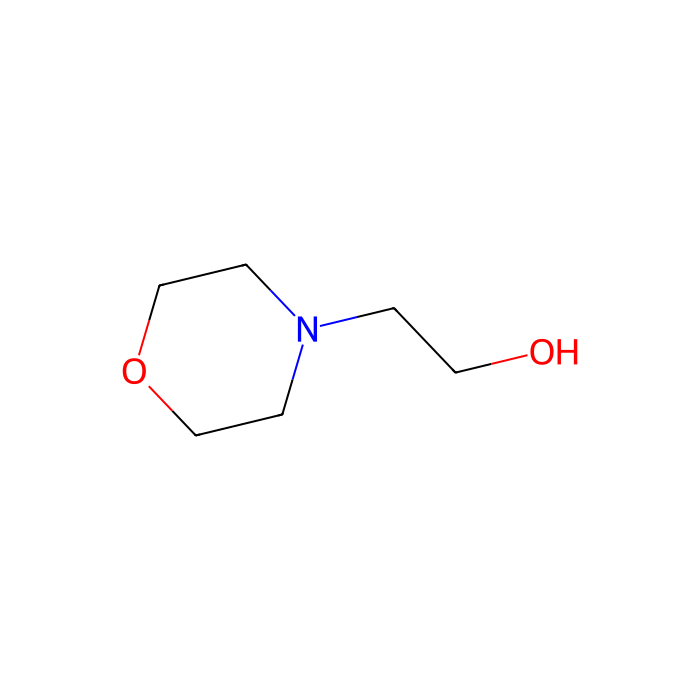
A morpholine derivative bearing a 2-hydroxyethyl substituent; a bifunctional molecule combining a tertiary ether ring (morpholine), a secondary amine (at ring nitrogen if unsubstituted), and a primary alcohol.
SKU: H100457
Product Name: 4-(2-Hydroxyethyl)morpholine
CAS: 622-40-2 (literature: commonly indexed for 2-(morpholin-4-yl)ethanol / N-(2-hydroxyethyl)morpholine)
Six heavy atoms in the morpholine ring (five atoms plus one heteroatom pair: one N and one O) arranged as a saturated 1,4-oxazinane (morpholine) ring.
The 2-hydroxyethyl substituent is attached to the ring nitrogen in the literature-preferred structure (2-(morpholin-4-yl)ethanol), yielding a tertiary amine (no N–H) and a terminal primary alcohol (–CH2–CH2–OH).
Functional groups: cyclic ether (–O– in ring), tertiary amine (in ring), primary alcohol (–CH2–CH2–OH). No stereocenters; expected to be achiral.
2D description: a six-membered saturated ring containing opposite heteroatoms (O and N); the nitrogen bears a two-carbon side chain terminating in –OH.
Synthetic Utility
Key functional elements: a tertiary amine center in a morpholine ring and a terminal primary alcohol. This combination enables orthogonal reactivity and intramolecular anchoring strategies.
Transformations (literature/general):
N-Acylation/Carbamoylation: Rapid formation of amides/carbamates with acyl chlorides, anhydrides, chloroformates; base control tunes selectivity. Useful for preparing protected derivatives or ionic liquids (upon subsequent quaternization).
Alkylation/Quaternization: Alkyl halides (e.g., MeI, BnBr) produce morpholinium salts; counterion can be exchanged (metathesis) for desired properties.
O-Functionalization: Convert –CH2CH2OH to mesylate/tosylate and perform subsequent substitutions (SN2) or intramolecular cyclizations. Mitsunobu conditions can install less nucleophilic groups with inversion at the alcohol carbon.
Carbonyl chemistry: Acts as a nucleophilic catalyst/base in acyl transfer; participates in reductive amination when pre-oxidized to the corresponding aldehyde or with external carbonyl partners.
Polymer/Surface grafting: Reaction of the alcohol with activated esters/epoxides introduces morpholine motifs onto macromolecules, enhancing hydrophilicity and ionic interactions.
Retrosynthetic value:
Serves as a convergent handle to introduce morpholine substitution late-stage via N-alkylation of morpholine with 2-haloethanol or, inversely, ring construction from diethanolamine derivatives by cyclodehydration (route design considerations).
Target Specificity
Not applicable. This product is a small-molecule chemical reagent, not a biological targeting agent (e.g., no antigen/epitope, clone, or species reactivity). No item-specific target data are provided.
Frequently Asked Questions
What is the purity of this product?
This product is supplied at ≥99% purity (chemical assay). Lot-specific values are stated on the Certificate of Analysis.
How should this product be stored?
Store at 2–8 °C under argon. It is supplied under an argon blanket; reseal under inert gas after each use.
How is this product shipped?
This product ships chilled on wet ice. Unpack on arrival and transfer it to the storage condition stated above.
What are the CAS number, molecular formula and molecular weight?
The CAS Number is 622-40-2, the molecular formula is C6H13NO2, and the molecular weight is 131.17 g/mol. InChIKey KKFDCBRMNNSAAW-UHFFFAOYSA-N.
What documentation is provided?
Available product documentation, including Certificates of Analysis (COA), Safety Data Sheets (SDS), and specification sheets, is shown in the product document area. Document availability and access follow the current site policy.
We use cookies to ensure the website functions properly and, where permitted, to improve your experience. You can manage your preferences at any time in Settings. Learn more in our Cookie Policy.
Shall we send you a message when we have discounts available?
Remind me later
Thank you! Please check your email inbox to confirm.
Products are supplied to verified businesses, institutions, and qualified professionals for research and development use only. Not for use in humans, animals, diagnosis, or therapy.

 F2623119