This compound belongs to the class of organic compounds known as coumaric acids and derivatives. These are aromatic compounds containing Aromatic compounds containing a cinnamic acid moiety (or a derivative thereof) hydroxylated at the C2 (ortho-), C3 (meta-), or C4 (para-) carbon atom of the benzene ring.
1. Djoumbou Feunang Y, Eisner R, Knox C, Chepelev L, Hastings J, Owen G, Fahy E, Steinbeck C, Subramanian S, Bolton E, Greiner R, and Wishart DS. ClassyFire: Automated Chemical Classification With A Comprehensive, Computable Taxonomy. Journal of Cheminformatics, 2016, 8:61.
Determine the necessary mass, volume, or concentration for preparing a solution.
Dilution Calculator
Determine the dilution needed to prepare a stock solution.
Reconstitution Calculator
Reviews
Customer Reviews
Application Protocols
No assay-specific protocols are provided for this item. As a small-molecule building block, usage protocols depend on the transformation or assay context.
General guidance examples
Preparing stock solutions: dissolve at 10–100 mM in anhydrous DMSO; vortex and sonicate if needed; filter (0.22 µm PTFE) for analytical use.
Deprotection to ferulic acid: stir with K2CO3 in MeOH at room temperature; monitor by TLC/HPLC; neutralize and isolate by acidification/extraction.
Amide coupling: activate with HATU/DIPEA in DMF, add amine partner dropwise at 0–5 C, then warm to ambient; quench and purify by column chromatography.
Analytical monitoring: HPLC-UV at 300–330 nm often affords good sensitivity for cinnamates; confirm identity with MS and NMR.
For detailed, application-specific conditions, consult primary literature and adapt to your lab’s equipment and safety procedures. Always refer to the product’s SDS for safe handling during protocol execution.
Biological Roles
General biological context (literature; not product-specific and not a medical claim)
4-Acetoxy-3-methoxycinnamic acid is the acetyl-protected form of ferulic acid (4-hydroxy-3-methoxycinnamic acid), a ubiquitous plant phenylpropanoid derived from the phenylalanine/tyrosine shikimate pathway. Ferulic acid occurs in plant cell walls as ester linkages to polysaccharides and lignin precursors.
The acetyl mask modulates polarity and hydrogen-bonding compared to the parent phenol, which can influence membrane partitioning and enzymatic susceptibility in biochemical studies. However, enzymatic hydrolysis of aryl acetates is generally slower than for alkyl esters; deprotection typically requires chemical conditions.
Cinnamic acid derivatives exhibit characteristic UV absorption due to conjugation; this property is utilized in analytical detection (HPLC-UV) and in studying phenylpropanoid metabolism.
In biochemical assays, the carboxylate ionization state (pH-dependent) strongly affects solubility and binding interactions with proteins. The methoxy substituent is electron-donating, stabilizing the conjugated system and altering acidity and redox behavior relative to unsubstituted cinnamic acid.
Practical note for researchers
When using this compound as a surrogate or protected analog of ferulic acid in biological models, consider that the aryl acetate is comparatively stable toward common esterases; pre- or post-assay deprotection may be necessary if free phenol is required. Always design controls that distinguish effects of the protecting group from the phenolic parent.
Buffer Applications
This compound is not a conventional buffering agent. As a weak aromatic carboxylic acid, it does not form a widely used buffer system in biochemical practice.
Guidance
If dissolution in aqueous buffers is required, prepare a DMSO or ethanol stock, then dilute into the target buffer while keeping final organic content low (e.g., ≤1–2%) to avoid precipitation.
Alternatively, dissolve by forming the sodium or potassium carboxylate in situ: adjust the solution to basic pH (e.g., pH > 8) to increase solubility, understanding that ionization may alter biological interactions.
For true buffering needs, select established systems (e.g., phosphate, HEPES, Tris) in the appropriate pH range. Refer instead to Solvent Selection and Storage sections for practical handling in aqueous contexts.
Green Alternatives
Greener choices focus on solvent selection and process conditions, as the structure is fixed.
Preferable solvents for workup/reaction (literature/practice)
Replace chlorinated solvents with ethyl acetate, 2-MeTHF, Me-THF/water biphasic systems, or acetone when feasible.
For amide couplings, consider MeCN or 2-MeTHF instead of DMF/NMP; employ catalytic coupling strategies (e.g., DIC + catalytic DMAP) to reduce additive load.
Energy and protection economy
Conduct esterifications/couplings at ambient temperature under catalytic conditions where possible. If the phenolic protection is not required downstream, consider starting from ferulic acid directly to avoid protection/deprotection steps.
Comparison snapshot (general)
Greener choice vs conventional
Ethyl acetate vs DCM: similar extraction efficiency for cinnamates; EtOAc has better environmental profile and lower toxicity.
2-MeTHF vs THF: comparable polarity; 2-MeTHF is biomass-derived and forms fewer peroxides, but has stronger odor and sometimes higher impurity profile.
MeCN vs DMF: MeCN is easier to remove and generally lower toxicity; DMF offers higher solubilizing power but is reproductive toxin classified in some regions.
Waste and hazard minimization
Use carbonate bases in alcoholic solvents for deacetylation instead of strong hydroxides to limit corrosivity.
Implement light shielding to prevent photoisomerization, reducing byproduct formation and reprocessing.
Adopt a solvent selection guide (e.g., CHEM21/ACS GCI) to tailor greener choices to your specific transformation.
Pharmaceutical Uses
Item-specific regulatory status: Not specified for this item; refer to CoA/Spec Sheet. No pharmacopeial monograph is indicated in the provided data.
General, non-clinical context (no therapeutic claims)
Role as a synthetic intermediate: The aryl acetate protects the phenolic OH of ferulic acid during downstream derivatizations (e.g., ester/amide formation at the carboxylate, or modifications at the alkene). This can be useful in preparing ferulate-based excipients, pro-moieties, or polymer modifiers for research-scale formulation studies.
Analytical reference: Conjugated cinnamates are UV-active and may serve as reference standards for method development in HPLC/UPLC under research use.
Materials applications: Phenylpropanoid derivatives are explored as UV-absorbing or antioxidant-related motifs in materials research; the acetylated phenol can modulate solubility and processability compared with the parent phenol.
Solubility management: typically formulated via organic cosolvents or as salts of the carboxylic acid; aryl acetate is relatively stable during typical processing but can hydrolyze under basic aqueous conditions.
Impurity control: monitor for deacetylated ferulic acid, E/Z isomerization products, and residual coupling reagents if used in synthesis.
This product is supplied for research use only and is not intended for human or veterinary use or for use in diagnostic procedures.
Physical Properties
Item-specific specifications
Appearance: Not specified for this item; refer to CoA/Spec Sheet.
Grade/Purity: Not specified for this item; refer to CoA/Spec Sheet.
Literature/computed values and general expectations (non-binding; for planning only)
Physical state: typically an off-white to beige crystalline solid for related cinnamic acid derivatives bearing aryl acetates.
Molecular formula and weight (literature): C12H12O5; ~236.22 g/mol (calculated).
Acidity: carboxylic acid pKa typically ~4–5 for substituted cinnamic acids (literature; substituents can shift this slightly).
Solubility profile (qualitative, literature): low solubility in water at neutral pH; increased solubility in polar organic solvents such as methanol, ethanol, acetone, acetonitrile, ethyl acetate; highly soluble in DMSO and DMF. Solubility in aqueous media improves at basic pH via carboxylate formation.
Partitioning: conjugated aromatic acid with one masked phenol (acetate) and one methoxy; expected moderate hydrophobicity with ionizable acid—thus pH-dependent apparent logD (literature trend for cinnamates).
UV/Vis: strong π→π* absorption in near-UV due to the aryl–alkenyl–carbonyl conjugation; specific λmax values depend on solvent and are not specified for this item.
Thermal behavior: many cinnamic acid derivatives show melting points in the 150–200 C range, but exact MP/thermal data are not specified here; consult CoA/SDS for item-specific data.
Note: For quantitative property needs (mp, bp, density, UV cutoff, water/peroxide content), refer to the item CoA/Spec Sheet—these are not specified for this product listing.
Quality & Grades
Item-specific grade/purity: Not specified for this item; refer to CoA/Spec Sheet.
Interpreting common grades for this compound class (general guidance)
Research grade: suitable for synthetic and analytical research. May have broader impurity limits than analytical reagent (AR) or HPLC grades.
AR grade: tighter control of inorganic residues; useful when downstream spectroscopic analyses are sensitive to trace metals or ions.
HPLC grade (for solvents) does not apply directly to this solid; however, “HPLC tested” or “LC-MS qualified” designations for solids typically indicate low UV-active impurities and suitability for analytical calibration or reference uses.
Stabilizers: none are typically required for this class; however, the aryl acetate can slowly hydrolyze under moist/basic conditions. No stabilizer is specified for this item.
What to check on the CoA for your lot
Identity confirmation: NMR (1H/13C), IR (ester/carboxyl bands), HRMS. If applicable, E/Z ratio of the cinnamate.
Purity assay: HPLC area % with specified method, residual solvent levels, and water content (Karl Fischer) if reported.
Impurities of interest: deacetylated ferulic acid, trans/cis isomers, and any over-acylation or oligomerization byproducts.
For regulated workflows or sensitive applications, request the current CoA/Spec Sheet to confirm exact specifications for your lot.
Reaction & Applications
This molecule serves both as a protected phenolic cinnamic acid derivative (acetyl ferulic acid) and as a conjugated aryl carboxylic acid building block.
Protection/deprotection chemistry
The 4-acetoxy group is a classic protecting group for the phenolic OH of ferulic acid. It can be removed under mild basic conditions (e.g., K2CO3/MeOH) or by transesterification, revealing 4-hydroxy-3-methoxycinnamic acid (ferulic acid).
Carboxylate derivatization
Esterification: Fischer esterification in alcohols with catalytic acid; or Steglich esterification (EDCI/DCC + DMAP) for sensitive substrates.
Amide coupling: EDCI/HOBt, HATU, or PyBOP in DMF/MeCN affords cinnamamide derivatives while retaining the aryl acetate if bases are controlled.
Alkene manipulations (cinnamate motif)
Selective hydrogenation of the C=C (H2, Pd/C) to yield dihydro derivatives.
Epoxidation (e.g., peracids) and subsequent ring-opening to access β-substituted products.
Photochemical E↔Z isomerization under UV; manage light exposure accordingly.
Aryl–OAc reactivity (advanced, literature)
Aryl acetates can act as electrophiles in nickel-catalyzed C–O activation cross-couplings, enabling C–C or C–N bond formation; such methods may require rigorous conditions and are substrate- and catalyst-dependent.
Applications context
Useful intermediate for preparing functionalized ferulate esters/amides, prodrugs, polymer conjugates, and UV-absorbing materials. The acetyl mask can modulate polarity and reactivity during multistep synthesis.
General tip: control base strength and temperature to prevent undesired deacetylation or double-bond isomerization during transformations.
Reaction Conditions
General conditions below are literature-style guidance for cinnamic acid derivatives and aryl acetates; optimize for your substrate and scale. They are not item-specific specifications.
Deprotection (aryl acetate → phenol)
K2CO3 (1–2 equiv) in MeOH or MeOH/THF at 0–25 C, 0.5–4 h, typically affords quantitative deacetylation to ferulic acid derivative. Alternatively, NaOMe (0.1–0.5 equiv) in MeOH at 0–25 C; quench with acetic acid.
Esterification (carboxylic acid → alkyl ester)
Fischer: ROH (excess), catalytic H2SO4 or p-TsOH, reflux 2–24 h; use Dean–Stark for azeotropic water removal if in toluene/benzene alternatives (prefer toluene/2-MeTHF for greener practice).
Steglich/EDC: DCC or EDCI (1.1–1.5 equiv) + catalytic DMAP in DCM/DMF/MeCN at 0–25 C, 2–16 h; filter urea byproduct.
Amide coupling
HATU (1.1–1.5 equiv), DIPEA (2–3 equiv) in DMF/MeCN at 0–25 C, 1–6 h. Monitor to avoid base-promoted deacetylation; aprotic solvents preferred.
Hydrogenation of C=C
H2 (1–3 atm), 5–10% Pd/C (5–10 wt%), EtOAc/EtOH at 20–40 C, 1–6 h to reduce the double bond selectively, usually preserving the aryl acetate under mild conditions.
Epoxidation
mCPBA (1.1 equiv) in DCM at 0–25 C, 1–3 h; buffer with NaHCO3 to control acidity. Epoxide opening can be directed with nucleophiles to install β-substituents.
Photochemistry
Protect from UV to avoid E→Z isomerization; if isomerization is desired, irradiate with near-UV and separate isomers chromatographically.
Yields depend on substrate, stoichiometry, and workup. Always run small-scale trials and employ anhydrous, oxygen-minimized conditions for sensitive steps.
Safety & Handling
Item-specific hazard information
Signal word: Not specified for this item; refer to SDS.
GHS classification and pictograms: Not specified for this item; refer to SDS.
H-statements: Not specified for this item; refer to SDS.
General safety guidance for aromatic carboxylic acids and aryl acetates (literature/industry practice)
Expected hazards: may cause skin and eye irritation; dust can irritate respiratory tract. Avoid inhalation of dust and contact with eyes/skin.
PPE: lab coat, safety glasses or chemical splash goggles, and appropriate chemical-resistant gloves (e.g., nitrile). Use in a fume hood to minimize dust exposure.
Handling: avoid generating dust; use dedicated spatulas/scoops. For solutions, ensure proper labeling and pH awareness (deprotonated carboxylates can enhance skin penetration). Avoid strong bases/acids when acetyl protection must be retained or when not desired.
Incompatibilities: strong bases and nucleophiles can hydrolyze the aryl acetate; strong acids or Lewis acids can promote rearrangements; strong oxidants may affect the aromatic side chain. Protect from prolonged UV light to minimize E/Z isomerization of the cinnamate double bond.
First aid (overview; see SDS for authoritative instructions): rinse eyes with water for at least 15 minutes; wash skin with soap and water; move affected person to fresh air if dust inhaled; if ingested, rinse mouth and seek medical advice. Provide SDS to medical personnel.
Spill/cleanup: avoid dust; sweep with minimal disturbance or use HEPA vacuum; dispose according to local regulations.
Always consult the product SDS for definitive hazard classification and response procedures.
Solvent Selection
4-Acetoxy-3-methoxycinnamic acid is a moderately hydrophobic, weakly acidic aromatic compound with a conjugated system.
Polarity and miscibility (literature/general)
Poorly soluble in water at neutral pH; solubility improves in basic aqueous media via carboxylate formation.
Readily soluble in polar organics: DMSO, DMF, acetone, ethyl acetate, acetonitrile, methanol, ethanol. Limited solubility in nonpolar hydrocarbons unless warmed or with cosolvents.
Practical solvent choices by use case
Stock solutions for screening/biochemical assays: DMSO (10–100 mM typical), then dilute into buffer containing acceptable cosolvent fraction; pre-neutralize if needed to avoid precipitation.
Preparative workup/crystallization: ethyl acetate/hexanes or ethyl acetate/heptane systems often provide good control; isopropanol or ethanol can act as antisolvents for crystallization.
Reactions retaining the acetate: avoid strong basic alcoholic media (NaOMe/MeOH) to prevent deacetylation. Use aprotic solvents (DCM, THF, MeCN, DMF) depending on the transformation.
Saponification/deprotection: use MeOH, EtOH, or THF/H2O with mild base (K2CO3, Na2CO3) to selectively cleave the aryl acetate.
Quick comparison (general)
DMSO vs DMF: DMSO gives broader solubility and is easier to remove at small scale; DMF can be preferable for amide coupling homogeneity.
EtOAc vs DCM for extractions: EtOAc is greener and efficiently extracts cinnamic acids; DCM may provide faster phase separation but is less preferred environmentally.
Always confirm actual solubility for your lot and conditions; adjust pH to manage ionization/partitioning.
General best practices for this class of compounds
Keep container tightly closed in a dry, well-ventilated place. Minimize exposure to moisture and basic vapors to prevent aryl acetate hydrolysis.
Protect from prolonged light/UV to avoid potential E/Z isomerization of the cinnamate double bond.
If long-term storage is planned, consider desiccation and amber glass to further mitigate hydrolysis and photochemical changes.
Reconstitution guidance (for lab use)
Prepare concentrated stocks in dry DMSO, DMF, ethanol, or methanol. Typical research stocks: 10–100 mM in DMSO.
For aqueous use, dilute organic stocks into buffer with mixing; maintain final organic content as low as feasible to avoid precipitation. Adjust pH if necessary to keep the carboxylate in solution.
Filter solutions for analytical applications (0.22 µm PTFE or PVDF) and use freshly prepared solutions when possible to limit hydrolysis of the aryl acetate.
Note: No item-specific limits on water content, residual solvents, or stabilizers are provided here. For lot-specific stability and solution shelf-life, consult the CoA/Spec Sheet and SDS. Research use only.
Structure & Identity
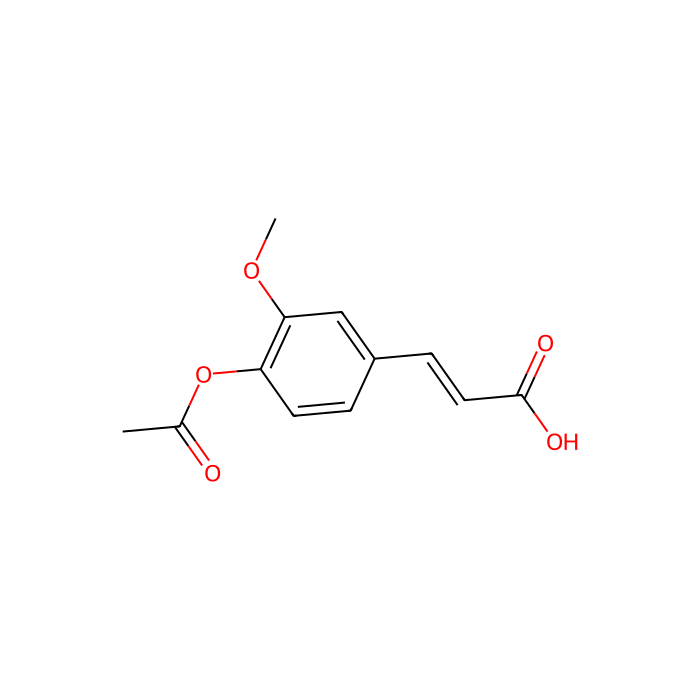
4-Acetoxy-3-methoxycinnamic acid is an aromatic phenylpropanoid bearing a conjugated trans-alkenyl carboxylic acid side chain and two oxygenated aryl substituents (para-acetoxy and meta-methoxy).
Item-specific identifiers (from Product Data)
CAS: 2596-47-6
CID: 5354677
InChIKey: 141020 (as provided)
SMILES: Not specified for this item; refer to CoA/Spec Sheet.
Storage conditions: Room temperature; shipped under normal conditions.
Literature/computed identity details (general; not item-specific specifications)
2D structural description: A substituted cinnamate where the benzene ring carries a meta-methoxy (3-OMe) and a para-phenyl acetate (4-OAc, i.e., –O–C(O)CH3). The side chain is an E-alkene (–CH=CH–) connecting the ring to a terminal carboxylic acid (–C(O)OH). Overall, the scaffold is an anisole-like ring with one phenolic oxygen masked as an acetate.
Extended aromatic–alkenyl–carbonyl conjugation that impacts UV absorption and reactivity.
Synthetic Utility
The molecule integrates three strategically useful features: an aryl acetate (masked phenol), an electron-rich anisole ring, and a conjugated cinnamic acid.
Protecting-group strategy
The 4-acetoxy group is removable under mild basic or transesterification conditions, enabling late-stage unveiling of the phenol without affecting many ester/amide derivatives of the carboxylate.
Carboxylic acid handle
Readily engaged in esterification (Fischer/Steglich), amidation (EDCI/HATU), and coupling to alcohol- or amine-terminated polymers to create conjugates. Ferulate esters/amides are common motifs in materials and agrochemical research.
Alkene chemistry
The conjugated C=C permits selective hydrogenation, epoxidation, and photocycloaddition. E/Z isomer control is crucial; protect from UV to preserve the E-isomer.
Aryl–OAc as a leaving group (literature, advanced)
Under Ni- or Pd-catalyzed conditions that activate C–O bonds, aryl acetates can undergo cross-coupling with organometallic partners or amines, enabling diversification without pre-halogenation. Reaction scope is method- and ligand-dependent; optimization is often required.
Electronic effects
The meta-OMe and para-OAc render the ring moderately electron-rich, influencing electrophilic substitution and directing patterns. After deprotection to the phenol, classical phenolic transformations (aryl ether formation, Mitsunobu reactions, carbonate/carbamate formation) become accessible.
Overall, this reagent is a versatile, protection-enabled entry to ferulate-derived architectures while offering orthogonal reactivity at the acid and alkene.
Target Specificity
Not applicable. This product is a small-molecule research reagent (an aromatic carboxylic acid), not a biological targeting reagent (e.g., antibody, ligand-defined probe). No antigen/epitope, clone, isotype, or species reactivity information is relevant. For intended uses, see Reaction & Applications and Synthetic Utility.
Frequently Asked Questions
What is the purity of this product?
This product is supplied at ≥97% purity (chemical assay). Lot-specific values are stated on the Certificate of Analysis.
How should this product be stored?
Store at room temperature.
How is this product shipped?
This product ships under standard ambient conditions. No temperature-controlled packaging is required.
What are the CAS number, molecular formula and molecular weight?
The CAS Number is 2596-47-6, the molecular formula is C12H12O5, and the molecular weight is 236.226 g/mol. InChIKey IHKNVZISLLDMOR-GQCTYLIASA-N.
What documentation is provided?
Available product documentation, including Certificates of Analysis (COA), Safety Data Sheets (SDS), and specification sheets, is shown in the product document area. Document availability and access follow the current site policy.
We use cookies to ensure the website functions properly and, where permitted, to improve your experience. You can manage your preferences at any time in Settings. Learn more in our Cookie Policy.
Shall we send you a message when we have discounts available?
Remind me later
Thank you! Please check your email inbox to confirm.
Products are supplied to verified businesses, institutions, and qualified professionals for research and development use only. Not for use in humans, animals, diagnosis, or therapy.

 J2330142