This compound belongs to the class of organic compounds known as pyridinecarboxylic acids. These are compounds containing a pyridine ring bearing a carboxylic acid group.
External Descriptors
Not available
1. Djoumbou Feunang Y, Eisner R, Knox C, Chepelev L, Hastings J, Owen G, Fahy E, Steinbeck C, Subramanian S, Bolton E, Greiner R, and Wishart DS. ClassyFire: Automated Chemical Classification With A Comprehensive, Computable Taxonomy. Journal of Cheminformatics, 2016, 8:61.
Determine the necessary mass, volume, or concentration for preparing a solution.
Dilution Calculator
Determine the dilution needed to prepare a stock solution.
Reconstitution Calculator
Reviews
Customer Reviews
Application Protocols
No vendor-tested biological assay protocols are provided for this item.
General laboratory usage suggestions (non-validated, for guidance only)
Stock solution preparation: Dissolve in DMSO (10–100 mM). If aqueous use is required, adjust to pH ≥8 with NaOH to form the sodium carboxylate, then dilute into buffer.
Amide coupling setup: Dry solvent and glassware; pre-activate the acid (e.g., with HATU/EDC) before adding amine to minimize side reactions. Maintain inert atmosphere for moisture-sensitive reagents.
For validated, application-specific protocols, please consult primary literature or develop method suitability in your laboratory.
Biological Roles
Item-specific biological activity data are not provided for this product.
General context (literature; not product-specific)
Nicotinic acid framework: The pyridine-3-carboxylate motif appears in numerous metabolites, cofactors, and ligands; however, 5-methoxy substitution is a synthetic modification rather than a common natural product residue.
Functional features: The ring nitrogen acts as a hydrogen-bond acceptor; the carboxyl group is an acid/base handle. The 5-methoxy group modulates electronics and lipophilicity, often tuning binding in SAR studies.
Bioconjugation role: As an acid, it can be coupled to amines (peptides, linkers) to probe biological targets in chemical biology experiments.
Note: No claims are made regarding biological efficacy or clinical use. This product is supplied strictly for research use only.
Buffer Applications
This compound is not a standard buffering agent. As a monocarboxylic acid, it does not provide a well-defined, high-capacity buffering range like dedicated buffers (e.g., acetate, phosphate, Tris).
Practical notes (if used incidentally)
pH adjustment: The conjugate base (nicotinate) can transiently buffer near its pKa, but capacity and compatibility are inferior to conventional buffers.
Recommendation: Use established buffer systems for pH control and reserve 5-methoxynicotinic acid as a reactant or analyte. If solubilization in aqueous media is required, dissolve as its sodium/potassium salt prepared with equimolar base and back-adjust pH as needed.
Green Alternatives
Greener choices focus on solvent and coupling chemistry, as the intrinsic substrate is fixed.
Solvent selection (comparison)
Conventional: DCM, DMF, NMP are effective but pose environmental/health concerns.
Greener alternatives:
2-MeTHF or CPME in place of DCM/THF for esterifications and acid chloride formations.
MeCN or EtOAc as medium-polarity replacements for DCM in many acylations.
Water/EtOH biphasic systems with phase-transfer or EDC·HCl for amide couplings when feasible.
Coupling reagent choices
Carbodiimides (EDC) with catalytic NHS or HOAt/HOBt alternatives, or T3P (propylphosphonic anhydride) offer improved atom economy and easier workup vs DCC.
Enzymatic esterifications (lipase-catalyzed) in green solvents can be viable for simple esters.
Small comparison table (general)
DCM vs 2-MeTHF: 2-MeTHF is bio-based, higher boiling, less volatile; may require longer reaction times but often similar outcomes in acylations.
DMF/NMP vs Cyrene or GBL: Cyrene and GBL can substitute in some coupling protocols; verify solubility and reagent compatibility.
Waste minimization
Employ acid-base extraction to crystallize the free acid from aqueous media, reducing chromatographic purification.
Use catalytic activation strategies (e.g., mixed anhydrides formed in situ) to limit stoichiometric waste.
Pharmaceutical Uses
No excipient or pharmacopeial status is specified for this item; refer to CoA/Spec Sheet.
General non-clinical context (literature; not product-specific)
Synthetic intermediate: Frequently employed as a building block for heteroaromatic amides/esters in medicinal chemistry campaigns (lead optimization, fragment growth).
Prodrug strategies: Ester derivatives of nicotinic acids can modulate permeability and release profiles in preclinical research. The 5-methoxy substituent is used to adjust pKa and lipophilicity.
Salt forms: Nicotinate salts (e.g., sodium, tromethamine) may be prepared to enhance aqueous processability; suitability depends on downstream synthetic steps.
No therapeutic claims are made. This product is offered strictly for research and process development use.
Physical Properties
Item-specific specifications
Appearance: Not specified for this item; refer to CoA/Spec Sheet.
Grade/Purity: Not specified for this item; refer to CoA/Spec Sheet.
Molecular weight: ~153.14 g/mol (from formula C7H7NO3)
Acidic functionality: Carboxylic acid (expected pKa for nicotinic acid analogs typically in the range pKa1 ~2–5; exact pKa for 5-methoxy analog not confirmed in-hand literature)
LogP/logD: 5-methoxy substitution increases lipophilicity vs nicotinic acid; expected modest aqueous solubility at neutral pH with increased solubility in basic media due to carboxylate formation (qualitative guidance).
Solubility trends (qualitative):
Water: low at neutral pH; higher as sodium/potassium salt.
Polar organics: soluble to sparingly soluble in methanol, ethanol, DMSO, DMF.
Nonpolar solvents: poor solubility.
General notes for handling solids of this class
Hygroscopicity: Typically low-to-moderate for aryl carboxylic acids; minimize moisture uptake to preserve weigh accuracy.
Thermal behavior: Aromatic carboxylic acids generally show sharp melting points; decomposition may occur on prolonged heating above mp.
Always verify exact physical constants and solubility for your lot on the CoA/SDS; do not treat literature values as item specifications.
Quality & Grades
Item-specific quality details
Grade/Purity: Not specified for this item; refer to CoA/Spec Sheet.
Stabilizers/Inhibitors: Not specified for this item; refer to CoA/Spec Sheet.
Guidance on grades for this compound class (general)
Research grade: Suitable for most synthetic and screening applications where trace-level impurities do not critically impact outcomes.
High-purity/assay grade (when offered): Preferred for sensitive applications (e.g., structure–activity relationship studies, analytical standards) due to tighter impurity control and narrower melting range.
Chromatography considerations: For HPLC or LC–MS reference uses, low nonvolatile residue and defined water content are important; check UV cutoff and baseline behavior if using as standard (carboxylic acids and pyridines exhibit UV absorbance in the near-UV range).
Impurity considerations (general for 5-substituted nicotinic acids)
Likely related impurities: Positional isomers (e.g., 6-methoxynicotinic acid), O-demethylated (hydroxy) nicotinic acid, residual starting materials or reagents from esterification/oxidation sequences.
Control strategies: 1H/13C NMR for positional confirmation, HPLC assay with gradient capable of resolving regioisomers, HRMS for MW confirmation.
Recommendation: Consult the product-specific CoA for assay, water content, residual solvent profile, and identification data (NMR/IR/LC).
Reaction & Applications
This heteroaromatic carboxylic acid is a versatile building block for medicinal and materials chemistry.
Representative applications (general literature)
Amide coupling: Formation of 5-methoxynicotinamides with EDC/HOBt, HATU, T3P, or acid chloride routes. The electron-deficient ring typically tolerates standard peptide coupling conditions.
Esterification/transesterification: Fischer esterification (MeOH/EtOH, catalytic acid) or Steglich esterification (DCC/DMAP) to deliver aryl esters for prodrugs or protecting group strategies.
Decarboxylative cross-coupling: Conversion to redox-active esters (e.g., N-hydroxyphthalimide esters) enables Ni- or Cu-catalyzed decarboxylative arylation/alkylation to access 5-methoxy-3-substituted pyridines.
Halogenation and further elaboration: Electrophilic substitution on the ring is subdued; directed metalation adjacent to N can be possible under strong base at low temperature (e.g., LiTMP)—subsequent trapping introduces diversity.
Late-stage diversification: The methoxy can be demethylated (e.g., BBr3) to 5-hydroxynicotinic acid, enabling ether formation or sulfation.
Use cases
Fragment incorporation: 5-OMe nicotinoyl moiety is a common fragment for kinase inhibitor and GPCR ligand series (as a heteroaromatic acid or amide analog), providing HBA (ring N, carbonyl) and conformational bias.
Linker chemistry: Carboxylate serves as an anchor to polymers, resins, or bioconjugation handles via amide/ester linkages.
Practical notes
Activate the acid under dry conditions; pyridine N can coordinate bases/coupling reagents—use slight excess of base and catalytic DMAP to drive acylation.
For aqueous-phase couplings, form the water-soluble carboxylate (Na+/K+) prior to carbodiimide-mediated activation to improve kinetics.
Reaction Conditions
General conditions from literature (guidance; not item-specific)
Amide coupling: HATU (1.1–1.5 eq), DIPEA (2–3 eq) in DMF or MeCN, 0–25 °C, 1–16 h. Alternatively, EDC·HCl (1.2 eq) with catalytic DMAP/NHS in DMF or DCM/MeCN.
Esterification: Fischer conditions (ROH as solvent, catalytic H2SO4 or p-TsOH, reflux, 2–24 h). For base-sensitive partners, use DCC/DMAP in DCM/2-MeTHF at 0–25 °C.
Acid chloride formation: SOCl2 (2–4 eq) or Ghosez reagent in DCM/toluene with catalytic DMF, 0–reflux, followed by amine or alcohol addition.
Demethylation: BBr3 (1–3 eq) in DCM at −78 to 0 °C, then warm to rt; quench carefully to furnish 5-hydroxynicotinic acid.
Reduction of acid: BH3·THF (3–4 eq) or LiAlH4 (2–3 eq) in THF/Et2O, 0 °C to reflux, 1–6 h to give benzyl alcohol analogs; employ protective groups if other reducible sites present.
Decarboxylative activation: Convert to N-hydroxyphthalimide ester (DIC/DMAP or EDC) then couple under Ni catalysis (e.g., NiCl2·dme, bipyridine, Zn/Mn reductant) in DMA/DMF at 25–60 °C.
Analytical/processing
Monitor by HPLC/LC–MS; acid-base extraction simplifies isolation (carbonate wash to remove unreacted acid, re-acidify to precipitate product where applicable).
Note: Optimize equivalents and temperatures for your substrate combination. Verify compatibility of bases/reagents with the pyridine N and methoxy group.
Safety & Handling
Item-specific hazard information
GHS Classification: Not specified for this item; refer to SDS.
Signal Word: Not specified for this item; refer to SDS.
Hazard (H) statements: Not specified for this item; refer to SDS.
Pictograms: Not specified for this item; refer to SDS.
General safety guidance for aromatic carboxylic acids and heteroaromatics (literature-based; not item-specific)
Expected hazards: May cause irritation to eyes, skin, and respiratory tract. Dust may be irritating.
PPE: Wear lab coat, safety glasses, and suitable gloves (e.g., nitrile). Use in a fume hood to avoid inhalation of dust/aerosols.
First aid overview: If inhaled, move to fresh air; if on skin, wash with soap and water; if in eyes, rinse cautiously with water for several minutes; if ingested, rinse mouth—seek medical attention in all cases as per SDS guidance.
Incompatibilities: Strong bases (will form carboxylate salts), strong oxidizers (general caution), acylating agents (may react at the phenolic-ether oxygen under forcing conditions), and strong dehydrating agents.
Fire safety: Organic solid; use CO2, dry chemical, or foam. Combustion can produce CO/CO2 and NOx.
Handling: Avoid dust generation, ensure proper housekeeping. For analytical work, dry glassware and minimize moisture if performing coupling/activation chemistry.
Authoritative information: Always consult the product’s SDS for definitive classification, exposure limits, and emergency procedures.
Solvent Selection
Solvent behavior (general for 5-methoxynicotinic acid)
Polarity class: Moderately polar aromatic carboxylic acid; heteroaromatic base functionality (pyridine N) is deactivated by the electron-withdrawing carboxyl but modulated by 5-OMe.
Ionization: Carboxylate formation above pH ~5–6 greatly increases aqueous solubility. Free acid is better handled in polar aprotic organics.
Practical solvent choices
Stock solutions for screening: DMSO or DMF (10–100 mM) with subsequent dilution into assay media; add base if precipitation occurs in aqueous buffers.
Preparative transformations: MeOH, EtOH, i-PrOH for esterifications; MeCN, DCM, THF, 2-MeTHF, CPME for coupling after activation (e.g., acid chloride, anhydride, mixed carbonates).
Workup/partitioning: At the end of reactions, acid-base extraction is effective (extract into aqueous bicarbonate as carboxylate, then re-acidify to precipitate the free acid).
Comparison (general)
Versus nicotinic acid: 5-OMe increases lipophilicity; slightly reduced water solubility at neutral pH; improved solubility in less polar organics.
Versus hydroxy analogs: O-methyl ether avoids strong H-bond donation, often improving chromatographic behavior and organic solubility.
Tip: For analytical HPLC, mobile phase acidifiers (0.1% formic or phosphoric acid) sharpen peaks for the free acid; for LC–MS, volatile acids/bases are preferred.
Storage & Reconstitution
Item-specific
Storage conditions: Room temperature (per Product Data).
Shipped: Normal (per Product Data).
General guidance for this compound class
Container: Store in a tightly closed, clean, dry container. Protect from prolonged exposure to light and ambient moisture.
Stability: Aromatic carboxylic acids and aryl methyl ethers are typically stable at room temperature for extended periods when dry and protected from contaminants. Avoid strong acids/bases and oxidizers during storage.
Reconstitution: For stock solutions, use anhydrous DMSO, DMF, MeOH, or MeCN. For aqueous work, dissolve by forming the sodium/potassium salt with equimolar base, then adjust to desired pH.
Solution storage: If solutions are prepared, store at 2–8 °C for short term or at −20 °C for longer term, protected from light; allow to equilibrate to room temperature before opening to minimize moisture ingress. Avoid repeated freeze–thaw cycles by aliquoting.
Note: For any item-specific limits (water content, residual solvents, assay), consult the product CoA/Spec Sheet. Research use only.
Structure & Identity
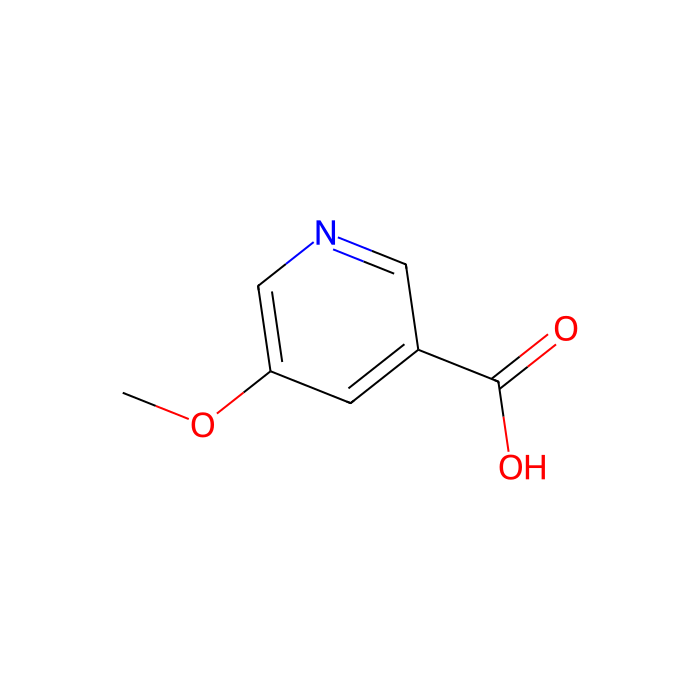
Overview: 5-Methoxynicotinic acid is a substituted pyridine-3-carboxylic acid (nicotinic acid) bearing a methoxy group at the 5-position on the heteroaromatic ring.
Item-specific (from Product Data)
SKU: M133272
CAS: 20826-03-3
Storage: Room temperature
Shipping: Normal
InChIKey: Provided as "376602" in Product Data (appears truncated/non-standard); refer to CoA/SDS for definitive identifier.
Other identifiers: CID 4738390 (PubChem)
Literature/Computed (general reference; not item-specific specs)
Preferred IUPAC name (literature): 5-methoxy-3-pyridinecarboxylic acid
2D description: A six-membered aromatic ring containing one ring nitrogen; positions 3 and 5 bear –CO2H and –OCH3, respectively; remaining ring positions are protonated carbons.
Notes
For definitive structural identifiers tied to this specific lot/item, consult the CoA/Spec Sheet.
Synthetic Utility
Reactivity map (general)
Carboxylic acid: Amenable to activation (acid chloride, mixed anhydride, anhydride, CDI) for amide/ester formation; can be reduced to alcohols (e.g., via borane or LiAlH4) or to aldehydes (Rosenmund-type from acyl chloride, or DIBAL-H of activated derivatives).
Methoxy group: Can be demethylated (BBr3, BCl3) to phenolic OH enabling further etherification, sulfonylation, or phosphorylation.
Pyridine ring: Capable of N-oxidation (mCPBA) leading to N-oxide chemistry (Meerwein rearrangements, directed functionalization); can form pyridinium salts (quaternization) for phase-transfer or leaving group strategies.
Retrosynthetic value
Back-constructs to 5-substituted nicotinic acid cores accessible from 5-hydroxynicotinic acid O-alkylation, electrophilic methoxylation of nicotinates, or from halogenated nicotinic esters followed by methoxylation and saponification.
Named/representative transformations
Steglich esterification (DCC/DMAP) and HATU/T3P amide couplings.
Decarboxylative cross-couplings from NHP esters under Ni catalysis to install alkyl/aryl substituents at C-3 (after conversion to suitable intermediates) or to elaborate side chains from the acid group.
Curtius rearrangement from acyl azide to isocyanate, then capture to ureas/carbamates—enables diversified amide libraries.
Practical tip
For selective ring functionalization, consider N-oxide-directed substitution then reduction back to the pyridine.
Target Specificity
Not applicable. This product is a small-molecule building block, not a biological macromolecule or affinity reagent. No target specificity, epitope, or isotype information is provided or expected.
Frequently Asked Questions
What is the purity of this product?
This product is supplied at ≥97% purity (chemical assay). Lot-specific values are stated on the Certificate of Analysis.
How should this product be stored?
Store at room temperature.
How is this product shipped?
This product ships under standard ambient conditions. No temperature-controlled packaging is required.
What are the CAS number, molecular formula and molecular weight?
The CAS Number is 20826-03-3, the molecular formula is C7H7NO3, and the molecular weight is 153.14 g/mol. InChIKey VDZUWTLBWRZRTR-UHFFFAOYSA-N.
What documentation is provided?
Available product documentation, including Certificates of Analysis (COA), Safety Data Sheets (SDS), and specification sheets, is shown in the product document area. Document availability and access follow the current site policy.
We use cookies to ensure the website functions properly and, where permitted, to improve your experience. You can manage your preferences at any time in Settings. Learn more in our Cookie Policy.
Shall we send you a message when we have discounts available?
Remind me later
Thank you! Please check your email inbox to confirm.
Products are supplied to verified businesses, institutions, and qualified professionals for research and development use only. Not for use in humans, animals, diagnosis, or therapy.

 L2115689