GRADE & PURITYSublimed grade?Sublimed grade — purified by sublimation, giving very low non-volatile impurities. Use for electronics and applications needing high chemical purity.≥95%
Thin-film via thermal evaporation: Load sublimed material into a cleaned Mo/Al2O3 crucible; pump to ≤1×10⁻⁶ mbar; ramp temperature gradually; monitor quartz crystal microbalance (QCM) for 0.1–0.5 Å/s; deposit on preheated substrates (e.g., 80 C) inside N2 glovebox-connected evaporator.
Spin-coating from solution: Prepare 5 mg/mL in hot chlorobenzene or o-DCB; heat/stir 80–120 C until dissolved; 0.2 μm PTFE filter hot; spin at 2000 rpm for 60 s; soft-bake 100 C, 10 min, under N2. Optimize concentration/ramp for desired thickness.
Purification by resublimation: Spread as a thin layer in a sublimation boat; apply high vacuum; heat 200–350 C as needed with cold finger at 30–60 C; collect shiny crystalline sublimate.
These are general guidelines; adjust to your equipment and safety protocols. Always work in inert atmosphere to minimize oxidation and in a fume hood when using chlorinated solvents.
Biological Roles
This compound is an organic semiconductor/halogenated polycyclic aromatic and is not designed for biological systems.
General considerations (literature; not product claims)
Polycyclic aromatic hydrocarbons (PAHs) can interact with lipid membranes due to hydrophobicity; however, 6,13-dichloropentacene lacks known physiological roles.
Some PAHs undergo metabolic activation in organisms; the presence of chlorine can alter reactivity and persistence. No specific metabolic pathways for 6,13-dichloropentacene are established in biochemical literature.
Laboratory implications
Avoid biological exposure; handle as potentially bioaccumulative and harmful to aquatic organisms.
For any biointerface studies (e.g., biosensors with organic semiconductors), ensure proper surface immobilization and perform rigorous extraction controls to prevent leaching.
Conclusion
No inherent biological function is associated with this material; its relevance is in materials science and synthetic chemistry. Use strictly for research purposes and outside living systems unless properly contained and approved under institutional safety protocols.
Buffer Applications
Not typically applicable. 6,13-Dichloropentacene is a hydrophobic organic semiconductor and is not used to prepare aqueous buffers or biological buffer systems. For practical lab use, focus on organic solvent systems and thin-film processing as discussed in Solvent Selection and Storage & Reconstitution.
Green Alternatives
While halogenated aromatics (e.g., chlorobenzene, o-dichlorobenzene) are often used to process acenes, greener strategies can reduce environmental and health impacts.
Use toluene or xylene instead of chlorobenzene/o-DCB when solubility allows; these have comparatively better environmental profiles and lower persistence.
Consider 2-methyltetrahydrofuran (2-MeTHF) or cyclopentyl methyl ether (CPME) for certain coupling reactions—reduced toxicity and biorenewable origin (2-MeTHF). Verify solubility and reaction compatibility for this hydrophobic, planar PAH.
Employ solvent-minimized processing: thermal vacuum deposition (no solvent in film formation), or slot-die/inkjet with concentrated inks to reduce waste.
Comparison snapshot (qualitative)
Chlorobenzene/o-DCB: high solubility and film order; higher toxicity and halogenated waste burden.
2-MeTHF/CPME: greener; may require optimization of catalysts/ligands and temperature to match kinetics of aryl chloride activation.
Additional measures
Recycle solvents via distillation; use closed capture during spin coating.
Choose low-Pd-loading or Ni-catalyzed couplings for aryl chlorides to reduce precious metal footprint.
Replace tin reagents (Stille) with Suzuki or Negishi to avoid organotin waste.
Pharmaceutical Uses
Not applicable as an active pharmaceutical ingredient. As a hydrophobic polycyclic aromatic semiconductor, 6,13-dichloropentacene does not serve common excipient or formulation roles.
Context (general)
Its utility lies in materials science (organic electronics) and as a synthetic intermediate to functionalized acenes. Any pharmaceutical-related handling would be limited to analytical standards or materials research, not clinical use.
Compliance note
No pharmacopeia monograph is known for this compound. Use is restricted to research and development under appropriate laboratory safety standards.
Physical Properties
Item-specific (from Product Data)
Appearance: Not specified for this item; refer to CoA/Spec Sheet.
Grade/Purity: Sublimed grade (see Quality & Grades tab for context)
Storage conditions: Room temperature
Shipping: Not specified for this item; refer to CoA/Spec Sheet.
Literature/typical values and qualitative behavior (not item specifications)
Physical state: crystalline solid; dark-colored due to extended conjugation (typical for acenes and their dihalo derivatives).
Thermal behavior: high thermal stability relative to pentacene; tends to sublime rather than melt cleanly; decomposition can occur before an observable melt for many PAHs. Reported handling typically avoids high bulk melt temperatures; thin-film sublimation is routine.
Solubility profile: sparingly soluble in nonpolar solvents at ambient temperature; improved solubility in aromatic/chlorinated aromatics (e.g., toluene, chlorobenzene, o-dichlorobenzene) upon heating; often processed via hot solutions or vacuum sublimation.
UV–Vis: strong π–π* absorption typical of pentacene derivatives (bathochromically shifted vs smaller acenes). Exact maxima depend on environment and are not specified here.
Density, refractive index, logP, pKa, MP/BP: Not widely established for bulk solid; consult primary literature if needed for modeling.
Practical notes
Thin-film deposition commonly accomplished by thermal evaporation (high vacuum) or hot-solution spin casting using high-boiling aromatic solvents.
Protect from prolonged light exposure to minimize photooxidation and formation of endoperoxides on acenes (less pronounced for the dichloro derivative but still a consideration).
Quality & Grades
Item-specific (from Product Data)
Grade/Purity: Sublimed grade.
What “Sublimed grade” implies (general context)
Sublimation purification targets removal of nonvolatile organic/metallic impurities and oligomers, yielding high chemical purity and low trap densities—critical for organic electronics (e.g., OFETs, OLEDs, photovoltaics).
Advantages: reduced scattering/trap states in thin films, improved reproducibility of charge transport, fewer growth nucleation defects during vacuum deposition.
Considerations: Sublimation does not define absolute assay (%); residual inorganic particulates and isomeric/halogenated byproducts are typically low but should be verified via your QC (e.g., HRMS, 1H/13C NMR, XPS on films).
Documentation and verification
Item-specific assay, trace metals, residual solvents, and UV-cutoff: Not specified for this item; refer to CoA/Spec Sheet.
For device work, users often perform: TGA/DSC (thermal profile), UPS/XPS (work function/surface composition), GIWAXS/AFM (film order/roughness), and HPLC-GPC (oligomer content).
Practical guidance
If vacuum deposition is planned, an additional in-situ resublimation in the evaporation crucible can further improve film quality.
If solution-processing, pass your solution through 0.2 μm PTFE filters; consider alumina plug to remove polar degradants. Use anhydrous, degassed solvents.
Reaction & Applications
Materials applications (literature)
6,13-Dichloropentacene is a key precursor to functionalized pentacenes used in organic electronics (OFETs, OPVs, photodetectors). The 6,13 positions govern charge transport and stability; chloro substituents both stabilize the backbone and serve as reactive handles.
Transformations enabled by the 6,13-dichloro motif (literature examples)
Cross-coupling: Pd-catalyzed Suzuki–Miyaura, Stille, Negishi, and Kumada reactions can replace Cl with aryl, vinyl, or alkyl groups using aryl chlorides activation strategies (e.g., bulky electron-rich phosphines).
Nucleophilic substitutions: 6,13-Cl can undergo substitution by strong nucleophiles (e.g., thiolates, alkoxides, amides) under SNAr-like conditions on the acene core.
Metal–halogen exchange: Treatment with organolithiums or Grignards at low temperature followed by electrophiles installs 6,13-disubstituted derivatives (e.g., silyl, aryl, alkynyl). Caution: control over over-reduction/addition to the acene core.
Reductive dechlorination: Access to parent pentacene (or dihydro intermediates) via Zn or other reducing conditions, useful in on-surface synthesis or device patterning.
Practical tips
Maintain rigorously anhydrous, oxygen-free conditions to avoid acene photooxidation (endoperoxides) and to preserve catalyst activity.
Use high-boiling, anhydrous aromatic solvents for couplings; degas thoroughly (freeze–pump–thaw or sparging). Protect from light during extended reactions.
For device films, prefer vacuum deposition or post-reaction resublimation to remove catalytic residues that degrade charge mobility.
Reaction Conditions
Guidance below reflects general literature practices for aryl chloride functionalization on acenes; optimize per substrate and scale. Values are examples, not item specifications.
Thermal evaporation: 10−6–10−7 mbar; deposition rates 0.1–1 Å/s onto heated substrates (50–100 C) to tune morphology.
Solution spin-coating: 1–10 mg/mL in CB or o-DCB; 1000–3000 rpm; post-anneal 80–150 C under N2.
All parameters should be validated at small scale; monitor by TLC/HPLC/UPLC and characterize by NMR/MS/UV–Vis/AFM as appropriate.
Safety & Handling
Item-specific (from Product Data)
GHS classification / pictograms / H-statements / signal word: Not specified for this item; refer to SDS.
Storage: Room temperature (per Product Data).
Research use note: For research use only.
General safety considerations for halogenated polycyclic aromatics (literature; not product-specific classification)
Hazards: May cause irritation to skin/eyes/respiratory tract as nuisance dust. Polycyclic aromatics can be harmful if inhaled or ingested; handle as potentially toxic to aquatic life. Avoid generating dust and aerosols.
Photosensitivity: Acenes can undergo photooxidation; minimize exposure to strong light and oxygen during handling to limit degradation byproducts.
Incompatibilities: Strong oxidizers; strong electrophiles; avoid reactive metals in the presence of halogenated aromatics at elevated temperatures. Prevent contact with peroxides/ozone.
PPE and engineering controls
Use gloves (nitrile recommended), lab coat, and eye protection; handle powders in a fume hood.
Employ inert-gas glovebox or Schlenk techniques for moisture/oxygen-sensitive device fabrication steps.
First-aid overview (consult SDS for authoritative guidance)
Inhalation: Move to fresh air; seek medical attention if symptoms persist.
Skin/eye contact: Rinse with water for several minutes; remove contaminated clothing; seek medical advice if irritation continues.
Ingestion: Rinse mouth; do not induce vomiting; obtain medical attention.
Waste
Collect as halogenated organic waste; prevent environmental release. Follow institutional and local regulations.
Solvent Selection
This product is a solid organic semiconductor/building block rather than a solvent. Solvent choice here refers to dissolving/processing 6,13-dichloropentacene for synthesis or thin-film deposition.
Polarity and miscibility considerations (literature)
The acene core is highly hydrophobic; choose aromatic and/or chlorinated aromatic solvents.
Better dissolution typically achieved in high-boiling aromatics: chlorobenzene (CB), o-dichlorobenzene (o-DCB), 1,2,4-trichlorobenzene (TCB). Limited solubility in toluene at RT; improves on heating.
Polar aprotic high-boilers (e.g., NMP, DMF) are sometimes used for coupling chemistry but are less common for device films due to residue concerns.
Practical selection by application
Solution processing (spin/dip-casting): o-DCB or TCB for higher solubility and slower evaporation to promote crystallinity; CB or toluene for finer-grained films and faster drying.
Cross-coupling chemistry: anhydrous toluene, dioxane, THF, or DMAc/NMP with suitable catalysts/ligands (see Reaction Conditions tab).
Purification: hot filtration from CB/o-DCB; final purification by vacuum sublimation for device use.
Small comparison (literature; qualitative)
Toluene: low toxicity relative to chlorinated aromatics; lower solubility at RT; fast drying.
Chlorobenzene: balance of solubility and processability; common in OSC community.
o-DCB/TCB: highest solubility and film ordering potential; higher boiling points and stronger health/environmental considerations—use in hood and manage waste properly.
Storage & Reconstitution
Item-specific (from Product Data)
Storage conditions: Room temperature.
Recommended handling/storage (literature-based best practice for acenes)
Protect from light and air: store in amber glass or foil-wrapped container under inert gas (N2/Ar) to suppress photooxidation and trace endoperoxide formation.
Keep container tightly closed in a dry place; consider desiccant. For long-term storage, inert-atmosphere glovebox is ideal.
Reconstitution and solution prep (for processing)
Solvents: chlorobenzene, o-dichlorobenzene, or toluene. Use anhydrous, oxygen-free grades; degas by sparging or freeze–pump–thaw.
Concentrations: 1–10 mg/mL for spin/dip-coating; higher (up to solubility limit) for drop-casting or single-crystal growth. Heat (80–120 C) with stirring to dissolve; filter hot through 0.2 μm PTFE.
For coupling reactions: prepare solutions under N2; dry glassware; use molecular sieves when compatible.
Freeze–thaw guidance
Not required for solids. If preparing stock solutions, aliquot under inert gas, store in amber vials at RT or 4 C (depending on solvent), and avoid repeated heating–cooling cycles.
Stability checks
Monitor by UV–Vis (absorption profile), TLC/HPLC for degradation. If discoloration or insoluble residues appear after storage, repurify by sublimation.
All storage/use is for research only; consult SDS for full safety information.
Structure & Identity
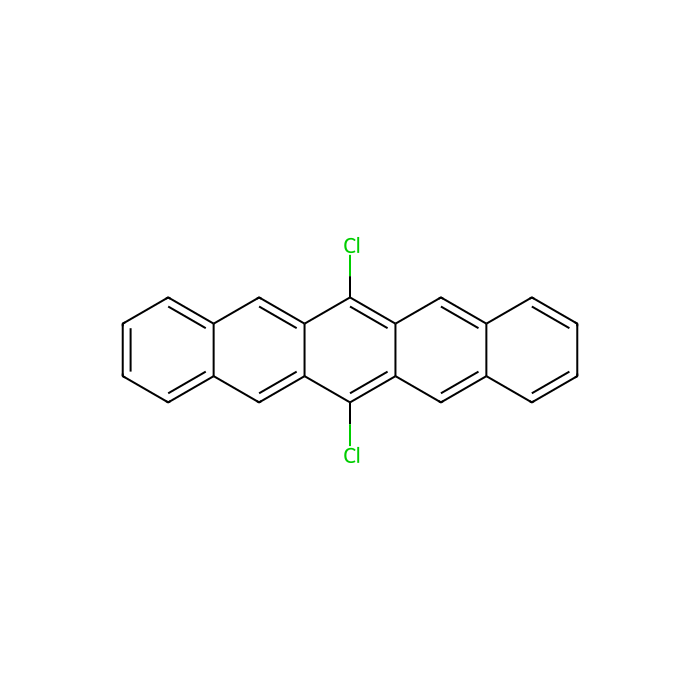
Brief: 6,13-Dichloropentacene is a halogenated acene (pentacene core) bearing chlorine substituents at the central 6 and 13 positions, widely used as a precursor/intermediate in organic electronics and acene functionalization.
Item-specific (from Product Data)
SKU: D290273
Product name: 6,13-Dichloropentacene
CAS: 59156-92-2
CID: 12643839
InChIKey: 250518 (as provided)
SMILES: Not specified for this item; refer to CoA/Spec Sheet.
Molecular formula: Not specified for this item; refer to CoA/Spec Sheet.
Molecular weight: Not specified for this item; refer to CoA/Spec Sheet.
Literature/typical identity data (for reference only; not item specification)
Expected empirical formula (literature): C22H12Cl2 (pentacene core C22H14 with two H replaced by Cl at 6,13)
Calculated formula weight (literature): ~347.24 g/mol
Core structure: five linearly fused benzene rings (acene). Substituents at the central ring carbons C6 and C13 are chlorine atoms.
2D description: A planar, extended π-conjugated system with D2h-like symmetry of the pentacene backbone; chlorines reside para to each other across the central ring, decreasing HOMO level and increasing stability vs parent pentacene.
Stereochemistry: none (achiral, no stereocenters).
Synthetic Utility
Functional handles and reactivity (literature)
Two aryl chloride positions at 6 and 13 enable diverse derivatizations: cross-coupling (Suzuki, Stille, Negishi, Kumada), nucleophilic substitutions (thiolates/alkoxides/amides), and metal–halogen exchange followed by electrophile trapping.
Electron-withdrawing chlorine substituents modulate the acene’s frontier orbitals, often increasing oxidative stability while slightly reducing HOMO energy—useful for tuning device energetics.
Representative transformations
Bis-silylation: Exchange with alkyllithium/Grignard → quench with trialkylsilyl chlorides to access 6,13-bis(trialkylsilyl)pentacenes (widely used soluble semiconductors).
Arylation/alkynylation: Pd-catalyzed couplings to install conjugated substituents for bandgap and packing control.
Reductive dechlorination: Regeneration of pentacene under mild conditions, facilitating on-surface synthesis or patterning via selective dehalogenation.
Retrosynthetic value
Serves as a central bifunctional platform for symmetrical 6,13-disubstitution, simplifying library synthesis of acene derivatives with controlled symmetry and regiochemistry.
Practical notes
Use oxygen-free, anhydrous conditions; light shielding reduces side reactions (photooxidation) of the acene core.
For aryl chloride activation, employ modern ligand sets (e.g., BrettPhos, XPhos) or Ni catalysts to improve coupling rates at lower temperatures.
Purify sensitive derivatives by quick column under subdued light or by recrystallization/sublimation to avoid degradation.
Target Specificity
Not applicable. This product is a small-molecule organic semiconductor, not a biological targeting reagent or antibody. No antigen/epitope specificity, clone, or isotype data are relevant.
Frequently Asked Questions
What is the purity of this product?
This product is supplied at ≥95% purity (chemical assay). Lot-specific values are stated on the Certificate of Analysis.
What does sublimed grade mean?
sublimed grade indicates that the material has been processed and tested for specialty industrial processing. Specifications focus on the impurities that affect performance in that application — for example, metal content for electronics, particle size for batteries, refractive index for optics, or moisture content for moisture-sensitive processes.
How should this product be stored?
Store at room temperature.
What are the CAS number, molecular formula and molecular weight?
The CAS Number is 59156-92-2, the molecular formula is C22H12Cl2, and the molecular weight is 347.2 g/mol. InChIKey NXOXWZMIZVDFKE-UHFFFAOYSA-N.
What documentation is provided?
Available product documentation, including Certificates of Analysis (COA), Safety Data Sheets (SDS), and specification sheets, is shown in the product document area. Document availability and access follow the current site policy.
Need help choosing the grade?
Our grade selection guide covers purity, stabilizer status, and application suitability for all variants in our catalog.
We use cookies to ensure the website functions properly and, where permitted, to improve your experience. You can manage your preferences at any time in Settings. Learn more in our Cookie Policy.
Shall we send you a message when we have discounts available?
Remind me later
Thank you! Please check your email inbox to confirm.
Products are supplied to verified businesses, institutions, and qualified professionals for research and development use only. Not for use in humans, animals, diagnosis, or therapy.