Description
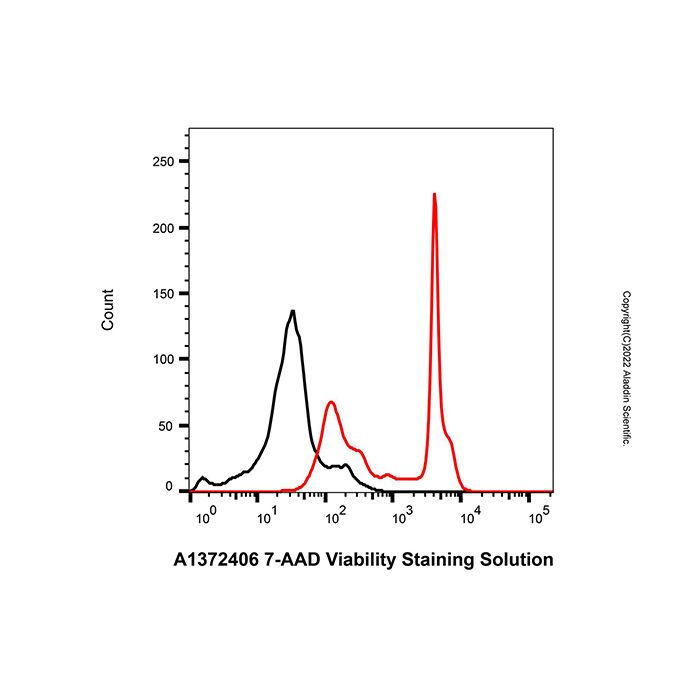
7-AAD (7-amino-actinomycin D) is a fluorescent dye that intercalates into double-stranded DNA (GC rich regions). It is excluded from viable cells, but can penetrate cell membranes of dead or dying cells. Therefore, it can be used instead of propidium iodide (PI) for the evaluation of cell death and apoptosis.
7-AAD can be excited at 488 nm with an argon laser. It has a relatively large Stokes shift, emitting at a maximum wavelength of 647 nm. Because of these spectral characteristics, 7-AAD can be used in combination with other fluorochromes excited at 488 nm such as fluorescein isothiocyanate (FITC) and phycoerythrin (PE).
7-AAD Viability Staining Solution is a ready-to-use reagent suitable for the evaluation of cell viability in mono- or multiparametric analyses of flow cytometry.
Instruction for use
This reagent has been pre-diluted for use at the recommended Volume per Test. We typically use 1 × 10^6 cells in a 100-µl experimental sample (a test). It is recommended to use 7-AAD Viability Staining Solution at 2.5-5 μl per test and incubate for 10 minutes in the dark at room temperature before analysis.
Precautions
1. Bacterial or fungal contamination may severely compromise assay performance.
2. Samples should be analyzed promptly after staining, as prolonged incubation may increase necrotic cell populations.
3. 7-AAD can be utilized for cell cycle analysis following fixation, permeabilization, and RNase treatment, though propidium iodide (PI) remains more routinely employed for this application.
4. All fluorochromes undergo photobleaching; minimize light exposure to retard fluorescence decay.
5. Wear protecting clothing, gloves to ensure personal safety and health protection.

 ZJ25F0927762