This compound belongs to the class of organic compounds known as medium-chain aldehydes. These are an aldehyde with a chain length containing between 6 and 12 carbon atoms.
External Descriptors
Not available
1. Djoumbou Feunang Y, Eisner R, Knox C, Chepelev L, Hastings J, Owen G, Fahy E, Steinbeck C, Subramanian S, Bolton E, Greiner R, and Wishart DS. ClassyFire: Automated Chemical Classification With A Comprehensive, Computable Taxonomy. Journal of Cheminformatics, 2016, 8:61.
Determine the necessary mass, volume, or concentration for preparing a solution.
Dilution Calculator
Determine the dilution needed to prepare a stock solution.
Reconstitution Calculator
Reviews
Customer Reviews
Application Protocols
Not applicable. This product is not validated for immunoassays or similar bioanalytical applications (e.g., WB, IHC, IF, FC). For synthetic and analytical chemistry workflows, refer to the Reaction Conditions and Solvent Selection sections for general guidance.
Biological Roles
This section provides contextual, literature-based background on saturated aliphatic aldehydes; it is not specific to the supplied lot and does not imply biological/clinical use.
Endogenous/biogenic occurrence (literature)
Medium-chain aldehydes (C7–C10) can arise from lipid peroxidation and fatty acid oxidative pathways, and some are reported as volatile constituents in plant and food aromas.
Branched aldehydes may occur as minor components in natural mixtures, though 7‑methyloctanal itself has limited specific documentation compared to straight-chain analogs (e.g., nonanal).
Reactivity with biomolecules (literature)
Aldehydes form reversible Schiff bases with primary amines (e.g., lysine residues) and can participate in Michael-type additions if α,β‑unsaturation is present (not the case here). Such reactions can modulate protein function or lead to adduct formation in vitro.
Biochemical handling (literature)
In biological systems, aldehydes are typically metabolized by aldehyde dehydrogenases to carboxylic acids or reduced to alcohols by aldo‑keto reductases.
Research-only note: Any experimental work involving biological matrices should be conducted under appropriate approvals and containment; this product is supplied strictly for research use and not for diagnostic or therapeutic applications.
Buffer Applications
7‑Methyloctanal is a hydrophobic, reactive aldehyde and is not used as a buffering agent. It does not provide acid/base conjugate pairs in the physiological pH range and is poorly soluble in water.
Practical note
When conducting aqueous or biphasic reactions (e.g., Pinnick oxidations), employ appropriate buffers (e.g., phosphate for pH ~6–7) to control reaction pH, but the aldehyde itself does not function as a buffer component.
For buffer formulations, consider standard buffering systems (phosphate, acetate, HEPES, etc.) independent of this substrate.
Green Alternatives
While 7‑methyloctanal is a substrate rather than a solvent, greener choices can often be made for the media and reagents used in its transformations and handling. Below are literature-based considerations.
Greener solvent replacements (general guidance)
Replace DCM/chloroform with ethyl acetate, 2‑MeTHF, CPME, or toluene where compatible.
Substitute THF with 2‑MeTHF or CPME for Grignard/organolithium chemistry (better air stability, higher boiling point, bio‑sourced options).
Use EtOH/MeOH or isopropanol for imine/oxime formation when water removal is manageable.
Oxidation choices
Favor TEMPO/bleach or Pinnick (NaClO2, buffer) over chromium(VI) reagents to minimize hazardous waste.
Workup/waste reduction
Employ solid drying agents (MgSO4, Na2SO4) judiciously; consider azeotropic removal to reduce salt waste.
Inline or micro-scale distillation and short-path purification can reduce solvent volumes.
Comparison snapshot (literature)
THF vs 2‑MeTHF: similar nucleophilicity support; 2‑MeTHF is partially bio‑renewable and less miscible with water, aiding separations.
DCM vs EtOAc: EtOAc is less toxic and biodegradable; boiling point is higher, which may affect concentration steps.
Tradeoffs should be evaluated against reaction performance, selectivity, and safety. Validate any substitution on small scale before process adoption.
Pharmaceutical Uses
No item-specific pharmacopeial status or excipient role is provided for this product; refer to CoA/Spec Sheet. The notes below are general, literature-based considerations for aliphatic aldehydes in pharmaceutical research contexts (not clinical use).
Role in research and process chemistry (general)
As a reactive carbonyl building block, 7‑methyloctanal can serve as an intermediate to prepare branched alkanols, amines, acids, and alkenes incorporated into small-molecule leads or process intermediates.
Aldehyde-to-amine conversions via reductive amination are widely used to access lipophilic amine fragments for SAR exploration.
Formulation considerations
Aldehydes are rarely used as excipients due to reactivity with amines and nucleophiles present in formulations. They may require protection (acetals) if carried through multistep sequences prior to API elaboration.
Quality expectations (general)
Process-grade materials typically emphasize GC assay, residual solvents, carbonyl purity, and control of oxidation products. Where relevant, impurity profiles should comply with ICH limits for intermediates.
This product is supplied strictly for research and laboratory use only; it is not intended for human or veterinary drug use or for clinical applications.
Physical Properties
Item-specific specifications are not provided. The following values are general literature expectations for branched C9 aliphatic aldehydes like 7‑methyloctanal and are not guaranteed for this item.
Phase/appearance: Not specified for this item; refer to CoA/Spec Sheet. (Typical: colorless to pale yellow liquid, literature.)
Molecular weight: ~142.24 g/mol (literature for C9 aliphatic aldehydes)
Boiling point: Typically in the range of ~180–195 °C at 1 atm (literature, branched C9 aldehydes often boil slightly below nonanal ~191 °C)
Melting point: Often below 0 °C (literature; many C9 aldehydes are liquids at room temperature)
Density (20–25 °C): Approx. 0.82–0.84 g/mL (literature range for C9 aliphatic aldehydes)
Refractive index (nD 20): Typically ~1.425–1.440 (literature)
Vapor pressure: Low to moderate at 25 °C (literature; increases with temperature)
Water solubility: Very low (immiscible or sparingly soluble; literature)
Organic solvent solubility: Miscible with common organics (hexanes, toluene, diethyl ether, THF, DCM, EtOAc; literature)
UV cutoff: Not specified for this item; refer to CoA/Spec Sheet.
Acid/base properties: No titratable basic center; aldehyde carbonyl can hydrate weakly in water (literature). pKa of conjugate acids not commonly reported for simple aldehydes.
Always consult the item’s CoA/Spec Sheet for definitive specifications relevant to method development or QC acceptance criteria.
Quality & Grades
Item-specific grade/purity: Not specified for this item; refer to CoA/Spec Sheet.
Interpreting grade (general guidance)
For small-molecule building blocks like aliphatic aldehydes, common commercial grades include: synthetic grade (general laboratory use), analytical grade (tighter impurity/metals control), and GC/HPCL-assay grades. When selecting a grade, consider sensitivity of the downstream step (e.g., organometallic additions, enantioselective catalysis) to trace water/acid.
Aldehyde quality is often judged by assay (GC), carbonyl content, and levels of oxidized acid impurity and self-aldol condensation products. If optical or chiral outcomes are critical, further purification (short-path distillation under inert atmosphere) may be advisable.
Stabilizers/inhibitors
No stabilizer is specified for this item; refer to CoA/Spec Sheet. In general, many aliphatic aldehydes are shipped without stabilizers but under inert gas to limit oxidation.
Practical QC considerations (general)
Inspect by GC or GC–MS for acid formation and higher oligomers; acid number titration can be informative.
If extremely low UV background is needed (e.g., optical detection methods), verify UV absorbance specifications on the CoA.
Water content and residual solvents can influence reactivity in moisture-sensitive steps; if critical, determine by KF and purge/dry as needed.
For definitive acceptance criteria and batch-specific data, consult the CoA/Spec Sheet for SKU M333901.
Reaction & Applications
7‑Methyloctanal is a versatile aliphatic aldehyde building block suited for synthesis of branched C9 motifs. Typical research applications (literature/general) include:
Nucleophilic additions to the carbonyl
Grignard/organolithium additions to furnish secondary alcohols bearing the 7‑methyl octyl fragment. Control temperature (−78 to 0 °C) in dry ether/THF and quench carefully to avoid overreaction.
Imines and reductive amination
Condensation with primary amines to form imines/Schiff bases; reduction with NaBH3CN, NaBH(OAc)3, or catalytic hydrogenation provides secondary amines. Buffer near pH 5–6 to balance rate vs aldehyde stability.
Aldol and related condensations
Base- or acid-catalyzed self-/cross-aldol gives higher carbon frameworks. To minimize self-aldol, use enolate donors with controlled addition, low temperature, and an excess of the aldehyde acceptor.
Oxidation and reduction
Oxidation to 7‑methyloctanoic acid (e.g., Pinnick, TEMPO/NaOCl). Reduction to 7‑methyloctanol via NaBH4 or catalytic hydrogenation.
Carbon–carbon bond-forming olefination
Wittig/Horner–Wadsworth–Emmons to access branched C9 alkenes; choice of ylide/phosphonate and conditions tunes E/Z outcome.
Protection chemistry
Formation of acetals/ketals with diols (e.g., ethylene glycol) under acid catalysis to mask the aldehyde during multistep sequences.
Practical notes
Work under inert gas, cold-store, and limit basic conditions/time to suppress aldol/polymerization.
Monitor by GC/GC–MS due to volatility and to quantify acid byproduct formation.
All uses are for research and laboratory synthesis; not for human or veterinary applications.
Reaction Conditions
The following are general literature conditions for common aldehyde transformations; optimize per substrate and scale.
Grignard addition (to form secondary alcohols)
Solvent: Dry THF or Et2O. Atmosphere: N2/Ar. Temperature: −78 to 0 °C (start cold, warm as needed). Typical time: 0.5–4 h. Quench: sat. NH4Cl. Expected yields: often 70–95% for unhindered reagents.
Organolithium addition
Solvent: Dry THF/Et2O. Temperature: −100 to −78 °C for highly reactive RLi. Short contact times (minutes to 1 h). Quench cautiously; avoid over‑reduction.
Reductive amination
Solvent: MeOH, EtOH, or DCE/MeCN; additive: AcOH (pH ~5–6). Reductant: NaBH3CN (rt to 40 °C) or NaBH(OAc)3 (rt). Typical time: 2–16 h. Yields: 60–90%.
Oxime formation
Solvent: EtOH/MeOH or toluene with Dean–Stark. Reagents: NH2OH·HCl + base or catalytic acid. Temp: rt to reflux. Time: 1–6 h. Yields: high (70–95%).
Oxidation to carboxylic acid (Pinnick)
NaClO2 (1.5–2.0 eq), NaH2PO4 buffer (pH ~6.5), co-oxidant: NaOCl or 2‑methyl‑2‑butene scavenger; solvent: t‑BuOH/H2O. Temp: 0–25 °C. Time: 1–4 h. Yields: 70–90%.
TEMPO/bleach oxidation to acid
TEMPO (1–5 mol%), NaOCl (household bleach), NaBr (co‑catalyst), pH 8–9 (NaHCO3/Na2CO3). 0–25 °C. Time: 1–3 h.
Wittig olefination
Solvent: THF or toluene. Base: n‑BuLi (for ylide generation). Temp: −78 to rt. Time: 1–16 h. E/Z selectivity depends on ylide and conditions.
Acetalization (protection)
Diol (e.g., ethylene glycol), catalytic p‑TsOH, solvent: toluene or benzene with Dean–Stark. Reflux 2–6 h.
These parameters are indicative; confirm compatibility with the branched substrate and scale, and monitor for self‑aldol or over‑oxidation.
Safety & Handling
Item-specific GHS details (from Product Data)
Signal word: Not specified for this item; refer to SDS.
Hazard statements (H-): Not specified for this item; refer to SDS.
GHS classification/pictograms: Not specified for this item; refer to SDS.
General safety profile (literature/general guidance for aliphatic aldehydes)
Irritation/Sensitization: Aliphatic aldehydes are typically skin/eye irritants and may cause respiratory irritation; some can cause skin sensitization upon repeated exposure.
Flammability: Many C9 aldehydes have moderate flash points; treat as a combustible liquid. Keep away from ignition sources and hot surfaces.
Reactivity: Prone to air oxidation to the corresponding carboxylic acid; can undergo self-aldol under basic conditions. Forms imines/Schiff bases with amines.
Handling recommendations
Use in a fume hood with appropriate PPE: lab coat, safety glasses, and compatible gloves (e.g., nitrile). Avoid inhalation of vapors and skin contact.
Minimize exposure to air and moisture; the product is supplied argon charged and should be kept under inert gas during use and storage.
Avoid contact with strong oxidizers, strong bases, amines, and reducing agents unless used intentionally in controlled reactions.
First-aid overview (general)
Inhalation: Move to fresh air; seek medical attention if symptoms persist.
Skin/eye contact: Rinse with water for at least 15 minutes; remove contaminated clothing; seek medical advice as needed.
Ingestion: Rinse mouth; do not induce vomiting; obtain medical attention.
Always refer to the product’s SDS for authoritative safety information and emergency procedures.
Solvent Selection
This product is a reactive aldehyde building block and is not itself used as a bulk solvent. The following guidance pertains to choosing compatible diluents and media for handling and reactions involving 7‑methyloctanal.
Polarity and miscibility (literature/general)
Moderately nonpolar; well soluble in nonpolar and moderately polar organic solvents (hexanes/heptane, toluene, Et2O, THF, DCM, EtOAc). Very low solubility in water.
Choosing a solvent by application
Analytical (GC): n‑hexane, isooctane, DCM, or EtOAc are common; select based on detector, resolution, and sample stability.
Nucleophilic additions (e.g., Grignard, organolithium): Use rigorously dry ethereal solvents (diethyl ether, THF) under inert gas; avoid alcohols/water.
Reductive amination/imines: Alcoholic solvents (MeOH, EtOH) or aprotic polar media (MeCN, toluene with azeotropic water removal); acid buffer (AcOH) as needed.
Oxime/hydrazone formation: EtOH, MeOH, or toluene with Dean–Stark to remove water.
Oxidation to acid: Aqueous biphasic (Pinnick) or DCM/MeCN for anhydrous variants (e.g., Swern to acid via further steps).
Practical tips
Remove dissolved oxygen when feasible (sparging, freeze–pump–thaw) to limit oxidation.
Add 3Å molecular sieves for condensation chemistry to drive equilibria.
Comparison (general)
For greener handling, 2‑MeTHF or CPME can often replace THF/Et2O in nucleophilic additions; EtOAc can displace DCM in many workups. Balance reactivity and selectivity needs against green metrics and safety.
General handling and stability (literature/good practice)
Keep tightly closed under inert gas (Ar/N2) to minimize oxidation to the corresponding acid and to suppress aldol condensation. Limit headspace oxygen and minimize repeated warm/cold cycles.
For frequent use, consider aliquoting into amber vials under inert atmosphere; use septum caps to enable syringe transfers under inert gas.
Avoid prolonged exposure to bases and amines unless intended; moisture and acid/base catalysis can promote side reactions.
If dryness is critical for a planned reaction, pass through a short plug of basic alumina or store over activated 3Å molecular sieves in a separate container to avoid contact during long storage.
Reconstitution
Not applicable; product is supplied neat. If a working solution is desired, prepare in a compatible anhydrous solvent (e.g., hexane, toluene, THF, Et2O, DCM, or EtOAc) immediately before use.
Shelf-life considerations
Monitor by GC for formation of carboxylic acid or higher-boiling aldol products over time. If significant degradation is detected, repurify by short-path distillation under reduced pressure and inert gas.
Always refer to the product label and CoA for any lot-specific storage recommendations.
Structure & Identity
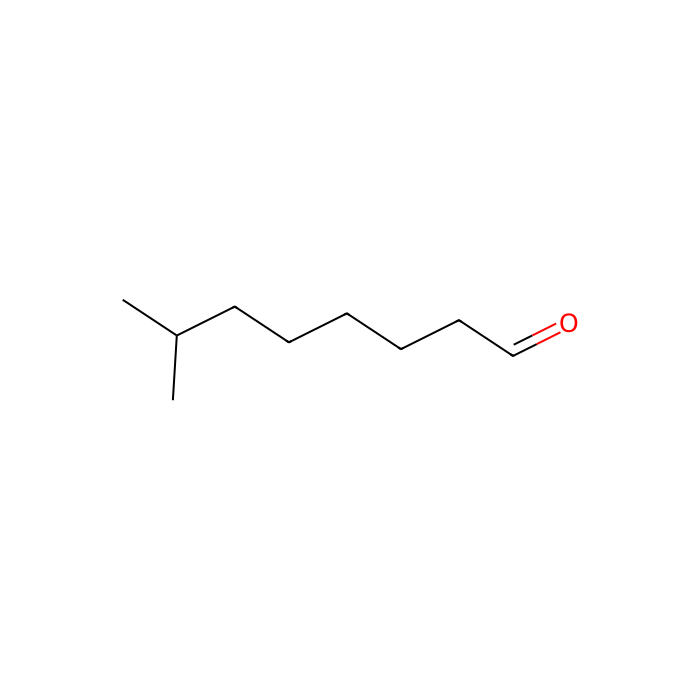
7-Methyloctanal is a branched aliphatic aldehyde (C9 backbone) featuring a terminal formyl group and a single methyl substituent near the ω-end of the chain.
Item-specific identifiers (from Product Data)
CAS: 49824-43-3
PubChem CID: 169665
InChIKey: Not specified for this item; refer to CoA/Spec Sheet.
SMILES: Not specified for this item; refer to CoA/Spec Sheet.
Structural features (general/literature description)
Functional group: Terminal aldehyde (–CHO) at C1.
Substitution pattern: Methyl group at C7 (relative to the aldehyde carbon), yielding a branched nonanal isomer.
Saturation: Fully saturated (no C=C), purely aliphatic.
Stereochemistry: None (no stereogenic centers in the parent structure).
Molecular formula and mass (literature)
Molecular formula (literature for C9 aliphatic aldehydes): C9H18O
Molecular weight (literature): ~142.24 g/mol
2D structural description (verbal)
A linear chain beginning with a terminal aldehyde carbonyl (O=CH–), followed by five methylene units, then a methine bearing a methyl branch (–CH(CH3)–), and a terminal methyl group at the chain end. This places the branching remote from the aldehyde, modestly altering physical properties versus the straight-chain nonanal isomer.
Note: Structural identifiers not explicitly listed in Product Data should be confirmed against the Certificate of Analysis (CoA) for this specific SKU.
Synthetic Utility
From a retrosynthetic and functional-group perspective, 7‑methyloctanal provides a branched C9 synthon with a terminal electrophilic handle.
Key reactivity elements (literature)
Electrophilic carbonyl at C1 enables additions (organometallics, cyanide, enolates), condensations (imines/oximes/hydrazones), and olefinations (Wittig/HWE, Julia–Kocienski).
Remote methyl branch influences sterics/hydrophobicity without complicating chemoselectivity at the aldehyde.
Strategic transformations
One-carbon state changes: reduction to alcohol (NaBH4, catalytic H2) or oxidation to acid (Pinnick, TEMPO/bleach). Conversion to acid chloride or amide extends diversification.
Protection: Acetals (ethylene glycol, 2,2‑dimethoxypropane) to carry the branched chain through basic/nucleophilic steps.
Homologation/olefination: Wittig/HWE to access terminal or internal alkenes, then hydrogenation, hydroboration–oxidation, or epoxidation for further elaboration.
Utility in fragment design
The lipophilic 7‑methyl substituent can modulate membrane affinity and metabolic stability when embedded in larger scaffolds.
Practical: Conduct moisture/oxygen‑sensitive steps under inert atmosphere, limit base exposure time to avoid self‑aldol, and monitor reactions by GC or TLC with appropriate stains (e.g., DNPH for carbonyls).
Target Specificity
Not applicable. 7‑Methyloctanal is a small-molecule aldehyde building block, not a biological targeting reagent (e.g., antibody, ligand with defined biomolecular target). No antigen/epitope, clone, isotype, or species reactivity applies.
We use cookies to ensure the website functions properly and, where permitted, to improve your experience. You can manage your preferences at any time in Settings. Learn more in our Cookie Policy.
Shall we send you a message when we have discounts available?
Remind me later
Thank you! Please check your email inbox to confirm.
Products are supplied to verified businesses, institutions, and qualified professionals for research and development use only. Not for use in humans, animals, diagnosis, or therapy.

 I2319578