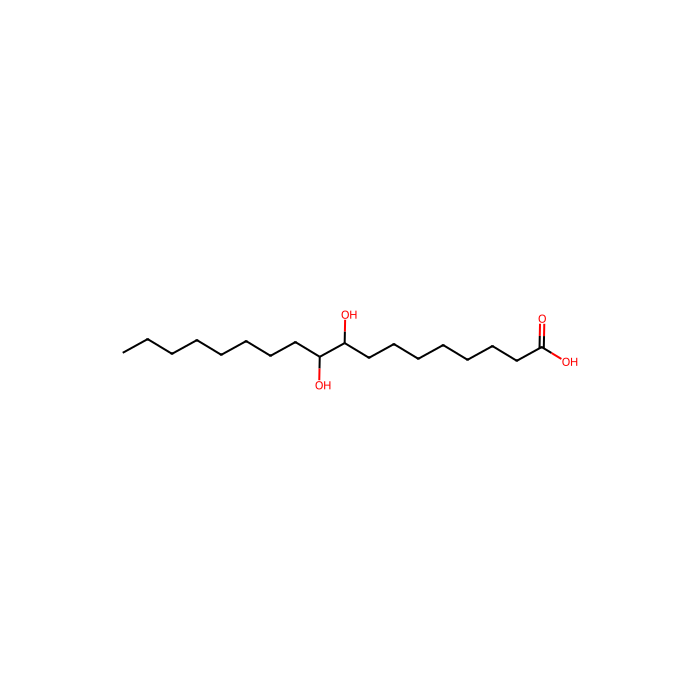
This compound belongs to the class of organic compounds known as long-chain fatty acids. These are fatty acids with an aliphatic tail that contains between 13 and 21 carbon atoms.
External Descriptors
Other Octadecanoids
1. Djoumbou Feunang Y, Eisner R, Knox C, Chepelev L, Hastings J, Owen G, Fahy E, Steinbeck C, Subramanian S, Bolton E, Greiner R, and Wishart DS. ClassyFire: Automated Chemical Classification With A Comprehensive, Computable Taxonomy. Journal of Cheminformatics, 2016, 8:61.
Determine the necessary mass, volume, or concentration for preparing a solution.
Dilution Calculator
Determine the dilution needed to prepare a stock solution.
Reconstitution Calculator
Reviews
Customer Reviews
Application Protocols
No item-specific validated application protocols are provided for this product. The following general research-use guidelines may help establish working procedures:
Stock solution preparation:
DMSO stocks: 10–100 mM. Warm gently (≤50 °C) and vortex to dissolve; filter (0.22 µm PTFE) if particulate persists.
Alcoholic stocks: 10–100 mM in methanol or ethanol; avoid long-term storage in alcohols to minimize esterification.
Aqueous dispersions: Neutralize to sodium/potassium salt with equimolar base (NaOH/KOH) in water/ethanol, or incorporate a non-ionic surfactant (e.g., Tween 80) to aid dispersion.
Derivatization for analytics:
Prepare methyl esters (BF3–MeOH or HCl–MeOH) for GC; silylate diols (BSTFA + 1% TMCS) to improve volatility/detection.
Thin-film hydration (lipid studies): Dissolve in CHCl3/MeOH (2:1), evaporate to a film, dry under vacuum, then hydrate with buffer at ≥Tm while vortexing; inclusion of helper lipids/surfactants may be required due to high polarity of the diol.
Always verify solubility and stability under your specific conditions. This product is for research use only.
Biological Roles
General, literature-based context (not item-specific; no clinical claims):
Chemical class: Saturated C18 fatty acid derivative with a vicinal diol at C9–C10.
Origin and metabolism:
Can arise from dihydroxylation of oleic acid (via epoxidation and hydrolysis) in biological and industrial contexts.
Enzymatic and non-enzymatic oxidation pathways of unsaturated fatty acids in plants, microbes, and animals can yield vicinal dihydroxy derivatives.
Biophysical properties:
The additional hydroxyl groups increase hydrogen-bonding capacity and reduce hydrophobicity relative to stearic acid, altering membrane insertion, micellization, and phase behavior in model lipid systems.
Analytical relevance:
Serves as a reference compound in lipidomics for characterizing oxygenated fatty acid species and for method validation in GC/MS or LC/MS after appropriate derivatization (e.g., methyl esterification, silylation of hydroxyls).
Enzyme interactions (conceptual):
Substrate for esterifying enzymes (e.g., acyltransferases, lipases) and for dehydrogenases/oxidases that act on secondary alcohols, though specific kinetics are system-dependent.
Note: Any biological studies should be performed under research-use-only conditions. For biochemical pathway mapping or standards preparation, verify stereochemistry when relevant, as biological systems can display enantioselectivity at C9/C10.
Buffer Applications
Not typically applicable. 9,10-Dihydroxystearic acid is not used as a buffering agent and lacks a conjugate acid/base pair in the physiological pH range suitable for precise buffering. For aqueous work, it can be dispersed as its sodium/potassium salt (soap) or with surfactants, but this is for solubilization rather than pH control. Refer instead to the Solvent Selection and Application Protocols sections for dispersion and stock preparation guidance.
Green Alternatives
Context: 9,10-Dihydroxystearic acid is often produced by epoxidation of oleic acid followed by acid-catalyzed hydrolysis of the 9,10-epoxide. Green considerations pertain to both synthesis and solvent/process choices.
Greener synthesis options (literature):
Oxidant choice:
Use of in situ peracetic acid from H2O2/acetic acid or catalytic systems (e.g., tungsten or Ti–silicalite) instead of mCPBA reduces halogenated waste.
Biocatalytic epoxidation (lipase-mediated perhydrolysis) followed by mild hydrolysis offers high selectivity with benign reagents.
Hydrolysis step:
Aqueous, near-neutral ring opening with solid acid catalysts (e.g., sulfonated resins) avoids mineral acids and simplifies workup.
Process and solvent selection:
Prefer bio-based or low-toxicity solvents where feasible (ethyl acetate, 2-MeTHF) over chlorinated solvents; use solvent recycling.
For esterifications, consider enzyme-catalyzed routes in solvent-free or solvent-minimized systems at moderate temperatures.
Comparison highlights:
Conventional vs greener route:
mCPBA/CH2Cl2 epoxidation: High efficacy; generates chlorinated and peracid waste; more hazardous.
H2O2 (catalyzed) in EtOAc/MeCN or solvent-free: Comparable selectivity with reduced E-factor and better safety.
Trade-offs:
Greener catalytic systems may require longer reaction times or tighter control of water content. Solvent switches can influence crystallinity and isolation of the waxy product; pilot small-scale trials are recommended.
Pharmaceutical Uses
Formulation context (general; no therapeutic claims):
Excipient potential: As a long-chain fatty acid derivative with additional hydroxyls, 9,10-dihydroxystearic acid can function as a structurant, viscosity modifier, or co-emulsifier in semi-solid and lipid-based matrices. The vicinal diol enhances hydrogen bonding, potentially increasing gel strength compared to stearic acid derivatives.
Prodrug/derivatization platform: The carboxylate can be esterified to form lipidic pro-moieties or delivery excipients in exploratory research; the diol allows further tuning of polarity and crystallinity.
Solid-state behavior: The presence of two hydroxyls may produce distinct polymorphs or co-crystal opportunities with API candidates through hydrogen-bond networks, relevant to preformulation screening.
Regulatory status: No pharmacopeial monograph is indicated for this specific dihydroxy derivative; use is research-only unless otherwise validated.
Practical considerations:
Verify residual solvent levels, acid value, and hydroxyl value on a per-lot basis, as these impact compatibility with actives and excipients.
For aqueous formulations, prepare as salts (Na+/K+/TEA) to improve dispersibility; incorporate surfactants if needed.
Avoid extreme pH and high temperatures that promote undesired esterification or oxidation. Always confirm excipient suitability per ICH/QbD workflows.
Physical Properties
Item-specific specifications (this lot):
Appearance, BP/MP, density, refractive index, water/peroxide/metal limits, UV cutoff: Not specified for this item; refer to CoA/Spec Sheet.
General/literature properties (for context; not item specifications):
Physical state: Typically a waxy solid or low-melting solid fatty acid derivative.
Solubility profile: Poorly soluble in water; soluble in polar organic solvents capable of hydrogen bonding (e.g., methanol, ethanol, isopropanol), and in strong hydrogen-bonding aprotic media (e.g., DMSO, DMF). Solubility is lower in nonpolar alkanes compared to stearic acid due to the vicinal diol increasing polarity; moderate in chlorinated solvents or ethyl acetate.
Acid–base: Monoprotic carboxylic acid; forms soaps with bases (Na+, K+, TEA) that are water-dispersible.
Partitioning: Expected higher polarity and lower logP than stearic acid owing to two additional hydroxyl groups (qualitative, literature rationale).
Thermal behavior: Like many long-chain fatty acids/diols, it can show broadened or multiple thermal transitions (solid–solid and melting) depending on crystal form and hydration; exact transition temperatures vary by sample history.
Practical notes (general):
For analytical work, prepare stock solutions in dry DMSO or alcohols; gentle warming (40–50 °C) may aid dissolution.
Avoid prolonged heating above melting to limit discoloration or esterification in alcoholic media.
Quality & Grades
Item-specific quality details:
Grade/Purity: Not specified for this item; refer to CoA/Spec Sheet.
Appearance: Not specified for this item; refer to CoA/Spec Sheet.
Guidance on grades and implications (general information for this compound class):
Research grade: Suitable for most synthetic, formulation, and materials studies. Trace impurities (e.g., mono-hydroxystearates, esters, or residual solvents) can affect crystallinity and phase behavior.
High-purity or GC/HPLC-assayed lots: Preferred for quantitative studies (e.g., phase diagrams, calorimetry, NMR quantitation) or when diol content/positional isomer ratio matters.
Stabilizers: Not typically required for saturated fatty acids; however, storage under inert atmosphere and desiccation can minimize slow changes (e.g., esterification in alcoholic solvents). If any stabilizer is used in a specific lot, consult CoA.
UV background: Not typically used as a chromatographic solvent; low UV transparency considerations are generally irrelevant. For HPLC analyte use, verify purity profile and detector response.
What to check on the CoA/Spec Sheet for this item:
Assay (%), positional isomer content (9,10 vs others if applicable), residual solvents, water (Karl Fischer), acid value, hydroxyl value, and GC purity. These parameters influence reactivity in esterification/amide formation and reproducibility of physical measurements.
Category path (catalog): 全部 / 可售 / 小分子和化合物库.
Reaction & Applications
This molecule’s combination of a carboxylic acid and a vicinal 9,10-diol enables diverse transformations and materials applications.
Representative applications (literature/general):
Monomer/building block:
Diester formation with diols yields flexible polyesters or plasticizers; the vicinal diol can be further functionalized, enabling branched architectures.
Amide/diamide preparation with diamines for polyamide or ionomer studies.
Selective derivatization:
Orthogonal protection of the diol (e.g., acetonide, cyclic carbonate) allows stepwise modification of one hydroxyl followed by the other.
Esterification of the acid (Me, Et, or bulky esters) tunes solubility and crystallinity for lipid-phase studies.
Oxidation/cleavage chemistry:
Periodate cleavage of the 9,10-diol affords C–C scission to the classic C9 fragments corresponding to ozonolysis products of oleic acid (e.g., nonanal/nonanoic acid and azelaic acid derivatives under appropriate conditions), providing a mild route from saturated feedstocks.
Surface/colloid science:
As the sodium/potassium salt, acts as a surfactant/structurant with unique rheology vs stearate due to additional H-bonding from the diol.
Analytical standards:
Useful as a reference standard for the ring-opening products of 9,10-epoxystearic acid in oxidative lipidomics and for tracking hydrogenation/dihydroxylation pathways of unsaturated C18 fatty acids.
Practical tips:
Use dry, oxygen-free conditions for moisture-sensitive couplings (DCC/EDC); include catalytic DMAP for sluggish acylations.
Diol protection improves selectivity in subsequent acylations/alkylations and simplifies purification.
Reaction Conditions
General literature guidance (typical conditions; adjust per system):
Fischer esterification (carboxyl group): Alcohol (3–10 equiv or solvent), catalytic p-TsOH or H2SO4, 60–120 °C with Dean–Stark or mol. sieves; hours to overnight; remove water to drive to completion.
Steglich esterification: Carboxylic acid (1.0 equiv), ROH (1.2–3.0 equiv), DCC or DIC (1.1–1.5 equiv), catalytic DMAP (0.05–0.2 equiv), CH2Cl2 or DMF, 0 °C to rt to 40 °C, 2–24 h; filter DCU; typical yields 70–95% (literature ranges).
Amidation via acid chloride: Convert to acid chloride (SOCl2, reflux 1–3 h, catalytic DMF), then react with amine (1.1–2.0 equiv) and base (Et3N, 2–3 equiv) in CH2Cl2/THF, 0–25 °C; 1–12 h.
Diol protection (acetonide): Acetone (solvent), catalytic p-TsOH (1–5 mol%), 25–50 °C, 2–24 h; drive water removal with sieves; quench base; typical yields 60–90% depending on selectivity.
Tosylation/mesylation (mono-selective): TsCl or MsCl (0.9–1.0 equiv), pyridine or Et3N (2–3 equiv), CH2Cl2, 0–5 °C then rt, 1–6 h; careful control to avoid ditosylation.
Periodate cleavage of 9,10-diol: NaIO4 (1.1–2.2 equiv), aqueous THF or aqueous acetone, 0–25 °C, 0.5–6 h; buffers near neutral; downstream oxidation (e.g., NaClO2 or H2O2) can convert aldehydes to acids. Monitor by TLC/GC/MS.
Workup/purification tips:
Waxy solids often benefit from trituration (cold Et2O/hexane) or precipitation from alcohols.
For high MW lipids, flash chromatography with gradient hexane/EtOAc or toluene/EtOAc and 1–2% acetic acid can suppress tailing.
Safety & Handling
Item-specific GHS information:
Signal word, H-statements, pictograms, formal GHS classification: Not specified for this item; refer to SDS.
General safety considerations for long-chain fatty acids/diols (literature/standard practice):
Expected hazards: Low acute toxicity but may cause skin/eye irritation, especially in concentrated solutions or upon prolonged contact. Dust from finely powdered material may cause mechanical irritation.
PPE: Use lab coat, safety glasses or goggles, and appropriate chemical-resistant gloves (e.g., nitrile). Avoid inhalation of dust/aerosols.
Engineering controls: Handle powders in a fume hood or with local exhaust to minimize dust. Use heat only as needed to aid dissolution.
Incompatibilities: Strong oxidizers (risk of exothermic reaction); strong bases will form soaps and can dramatically change solubility/foaming; acid chlorides/anhydrides will acylate the diol under catalysis.
First aid (overview; consult SDS):
Skin: Wash with soap and water; remove contaminated clothing.
Eyes: Rinse cautiously with water for several minutes; remove contact lenses if present and easy to do.
Ingestion/Inhalation: Rinse mouth; move to fresh air; seek medical advice if symptoms persist.
Storage conditions: Store tightly closed at room temperature as provided; protect from moisture and strong light to minimize oxidation or hydrolysis of derivatives.
Waste: Dispose according to local regulations; neutral non-halogenated organic waste if uncontaminated; avoid drain release.
Solvent Selection
Applicability: As a solid fatty-acid diol building block, solvent choice is primarily for dissolution, reaction media, or analytical sample prep rather than as a solvent itself.
General solvent behavior (literature-based):
Polarity class: Amphiphilic solid; significantly more polar than stearic acid due to vicinal diol.
DMSO vs methanol: DMSO offers highest solvating power and compatibility with coupling reagents; methanol provides protic environment but may transesterify under acidic/basic conditions.
Ethyl acetate vs dichloromethane: EtOAc is greener and often adequate; CH2Cl2 can improve solubility at lower temperatures but with higher environmental burden.
Storage & Reconstitution
Item-specific storage and shipping:
Storage Conditions: Room temperature (per Product Data).
Shipped In: Normal conditions (per Product Data).
General best practices (supplementary guidance):
Container: Store in a tightly sealed, inert container (glass with PTFE-lined cap) to minimize moisture uptake and contamination. Consider desiccant in secondary containment.
Atmosphere/light: Protect from excessive light and prolonged air exposure; optional nitrogen/argon blanket for long-term storage.
Stability: Saturated backbone confers good oxidative stability vs unsaturated analogs; nevertheless, avoid elevated temperatures over extended times.
Reconstitution/preparation notes:
Non-aqueous stocks: Prepare fresh DMSO or ethanol solutions as needed. For long-term stock (weeks), prefer DMSO in amber vials at 2–8 °C; bring to room temperature before opening to avoid moisture ingress.
Aqueous use: Convert to sodium/potassium salt by neutralizing with equimolar base; or disperse with surfactants/cosolvents. Adjust pH carefully to avoid over-neutralization.
Freeze–thaw: For solutions, aliquot to avoid repeated freeze–thaw cycles that can alter concentration via adsorption/precipitation.
Refer to the product’s CoA/Spec Sheet and SDS for item-specific stability, purity, and safety details not provided here.
Structure & Identity
Brief description: 9,10-Dihydroxystearic acid is a saturated C18 fatty acid bearing a terminal carboxylic acid and a vicinal 9,10-diol along the aliphatic chain. It is commonly referred to as 9,10-dihydroxyoctadecanoic acid.
Item-specific (from Product Data):
CAS: 120-87-6
CID: 89377
InChIKey: 373733 (as provided)
Storage: Room temperature; shipped under normal conditions
Research use: For research use only
Literature/Computed identifiers (general reference; not item-specific):
2D description: HOOC–(CH2)7–CH(OH)–CH(OH)–(CH2)7–CH3; both hydroxyls are secondary and adjacent on the chain.
Synthetic Utility
Functional group leverage:
Carboxylic acid: Amenable to esterification (Fischer, Steglich/DCC, EDCI), amidation (via acid chlorides or carbodiimides), and activation (mixed anhydrides, NHS esters).
Vicinal diol (secondary–secondary): Allows protection (acetonide, benzylidene), selective mono-functionalization (acylation, sulfonylation), oxidation (to diketone/alpha-hydroxyketone), and periodate cleavage to C9 fragments.
Strategic uses (literature/general):
Access to C9 platform chemicals: Periodate cleavage of the 9,10-diol yields fragments corresponding to those from oleic acid ozonolysis (e.g., nonanals/nonanoates and azelate derivatives after further oxidation), enabling modular synthesis of diacids, aldehydes, and ω-functionalized chains.
Branched architectures: Sequential protection–deprotection enables installation of distinct substituents at C9 and C10, creating amphiphiles or chiral auxiliaries (if resolved).
Polymer precursors: Diesterification with diols or carbonates affords bio-based polyesters/polycarbonates; the pendant diol sites can be utilized for cross-linking or urethane formation (with diisocyanates) to tune mechanical properties.
Surface modification: The acid enables grafting to inorganic/organic surfaces, while the diol modulates hydrophilicity and adhesion.
Tips:
For selective monoacylation of the diol, use stoichiometry <1 equiv acyl donor with DMAP in CH2Cl2 or pyridine at 0–25 °C; monitor by TLC/GC.
For acid chloride formation, SOCl2 or oxalyl chloride with catalytic DMF; keep temperature controlled to minimize side reactions at the diol.
Target Specificity
Not applicable. This product is a small-molecule fatty acid derivative, not a biological macromolecule or affinity reagent. No antigen, epitope, clone, isotype, or species reactivity applies. For intended laboratory use, see Reaction & Applications and Synthetic Utility.
Frequently Asked Questions
What is the purity of this product?
This product is supplied at ≥98% purity (chemical assay). Lot-specific values are stated on the Certificate of Analysis.
How should this product be stored?
Store at room temperature.
How is this product shipped?
This product ships under standard ambient conditions. No temperature-controlled packaging is required.
What are the CAS number, molecular formula and molecular weight?
The CAS Number is 120-87-6, the molecular formula is C18H36O4, and the molecular weight is 316.48 g/mol. InChIKey VACHUYIREGFMSP-UHFFFAOYSA-N.
What documentation is provided?
Available product documentation, including Certificates of Analysis (COA), Safety Data Sheets (SDS), and specification sheets, is shown in the product document area. Document availability and access follow the current site policy.
We use cookies to ensure the website functions properly and, where permitted, to improve your experience. You can manage your preferences at any time in Settings. Learn more in our Cookie Policy.
Shall we send you a message when we have discounts available?
Remind me later
Thank you! Please check your email inbox to confirm.
Products are supplied to verified businesses, institutions, and qualified professionals for research and development use only. Not for use in humans, animals, diagnosis, or therapy.