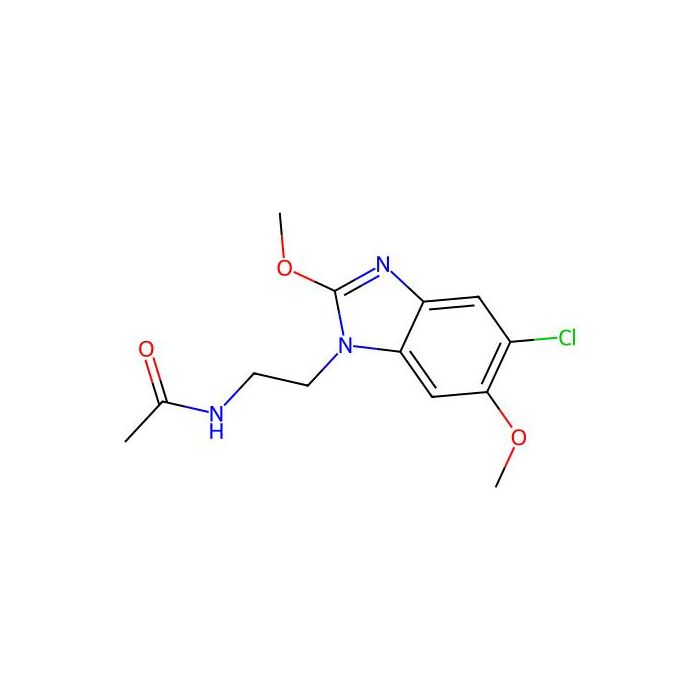
10mM in DMSO for sensitive chromatographic and analytical workflows requiring minimal baseline interference.
🌡
Storage & shipping
Protected from light,Store at -80°C Ships Dry ice packs + Cold packs Check lot-specific COA for exact specifications.
📋
Quality documents
SDS, COA, datasheet, and spec sheet available for download. Lot-specific COA accessible via lot number lookup.
📚
Literature proof
Cited in 0 peer-reviewed publications across chromatography, organic synthesis, and cross-coupling reactions.
Overview
ACH-000143 is a potent and orally active melatonin receptor agonist, with EC 50 values of 0.06 nM and 0.32 nM for MT1 and MT2 , respectively
In Vivo
ACH-000143 reduces liver triglycerides and steatosis in diet-Induced obese rats . ACH-000143 is devoid of hERG binding, genotoxicity, and behavioral alterations at doses up to 100 mg/kg p.o., supporting further investigation of this compound as a drug candidate . ACH-000143 significantly reduces plasma glucose at 10 mg/kg (−16.4%, p < 0.05) and 30 mg/kg (−16.9%, p < 0.01) . MCE has not independently confirmed the accuracy of these methods. They are for reference only. Animal Model: High-fat diet rats . Dosage: 10 and 30 mg/kg. Administration: Orally, once daily for two months. Result: Significantly reduced the weekly BW gain on weeks.
Determine the necessary mass, volume, or concentration for preparing a solution.
Dilution Calculator
Determine the dilution needed to prepare a stock solution.
Reconstitution Calculator
Reviews
Customer Reviews
Application Protocols
No tested applications are provided for this item. The following is a general, non-item-specific workflow commonly used for small-molecule screening compounds.
General assay preparation (example protocol):
Stock solution: Prepare in anhydrous DMSO at an empirically supported concentration (commonly 10–50 mM; general practice). Protect from light and store at −80°C in small aliquots.
Working dilutions: Prepare serial dilutions in DMSO (e.g., 3-fold or 10-fold) to create a dilution series. Transfer into assay buffer or media to achieve desired final concentrations, keeping final DMSO ≤0.1–1% v/v.
Controls: Include vehicle-only controls and, where applicable, a known positive control compound.
Plate handling: Use low-bind plates for hydrophobic compounds. Mix thoroughly after addition to minimize precipitation.
Verification: Confirm final assay concentrations by LC–MS or UV where feasible. Inspect wells for precipitation or turbidity.
These steps are provided as general guidance only and are not validated for this item. Always adapt to your assay system and consult the CoA/SDS.
Biological Roles
Item-specific biological roles, targets, or pathways are not provided in the Product Data. No endogenous or organismal role can be inferred without structural/target information.
General guidance for users:
Treat ACH-000143 as an investigational research compound with unknown mechanism of action pending your own data or information from the CoA/Spec Sheet.
If you intend to use this material as a tool compound, verify purity/identity and perform orthogonal assays to confirm on-target effects versus assay interference (e.g., aggregation, redox cycling, fluorescence quenching). Assess PAINS/IMPACTS flags only after structural data are available.
Compliance note:
For research use only; not intended for diagnostic, therapeutic, or any clinical application.
Buffer Applications
This product is not a buffering reagent. However, small-molecule dosing into buffers is common in biochemical and cell-based assays.
General practical notes:
Aqueous compatibility: Many hydrophobic compounds require a cosolvent. DMSO is commonly used for a concentrated stock that is then diluted into buffer (e.g., PBS, HEPES, Tris) to a final DMSO concentration of ≤0.1–1% v/v.
Order of addition: Add the compound stock last, with rapid mixing, to minimize local supersaturation and precipitation. Consider using surfactants (e.g., 0.01–0.05% Tween-20) only if compatible with the assay.
Adsorption: Some scaffolds adsorb to plastics; verify recovery from polypropylene vs. glass and consider low-bind plates/tubes.
pH effects: Unknown for this item. If the compound is ionizable, solution pH can strongly affect solubility and potency; perform pH scouting if feasible.
Item-specific buffer capacity, pKa, and recipes are Not specified for this item; refer to CoA/Spec Sheet.
Green Alternatives
Without structure-specific solvent or reagent requirements, greener choices pertain mainly to dissolution vehicles and operational practices.
Greener solvent choices for stock/dose preparation (general guidance):
Consider ethanol or aqueous cosolvent systems (e.g., 10–20% ethanol or 10–30% PEG-400 in buffer) if the compound is sufficiently soluble and bioassay-compatible.
Where DMSO is necessary, minimize final assay concentration (≤0.1–0.5%) and use small aliquots to reduce waste.
Illustrative comparison (general; not item-specific):
DMSO: High solvency; widely used; moderate EHS concerns; disposal as organic waste.
PEG-400: Low volatility; good solvency for some hydrophobes; viscosity complicates pipetting; potential biological effects at higher %.
Cyrene (dihydrolevoglucosenone): Emerging bio-based dipolar aprotic alternative to DMF/NCMe in synthesis; limited biocompatibility data in cell assays—pilot testing required.
Operational green practices:
Use micro-aliquoting to avoid repeated thaw/freeze and product loss.
Right-size reaction/assay volumes; adopt 96/384-well formats to reduce solvent consumption.
Implement analytical screening (LC–UV/MS) to confirm stability, avoiding repeated re-synthesis or re-ordering due to degradation.
Pharmaceutical Uses
No pharmacopeial status, excipient function, or formulation role is provided for this item.
Regulatory/compliance: For research use only. Not for human or veterinary use, not for clinical or diagnostic applications.
Discovery context (general): Compounds like ACH-000143 are commonly used in preclinical research for screening, SAR development, and as internal standards or reference materials after identity/purity verification.
Formulation screening (general): If exploring preformulation for in vitro studies, assess solubility in vehicles such as DMSO, ethanol, PEG-400, Captisol, or lipid-based systems. All such work remains nonclinical and investigational.
Item-specific pharmaceutical applications: Not specified for this item; refer to CoA/Spec Sheet.
Physical Properties
Item-specific specifications are not provided in the Product Data. Where values are critical for your workflow, consult the lot-specific CoA/Spec Sheet.
Appearance: Not specified for this item; refer to CoA/Spec Sheet.
Molecular weight: Not specified for this item; refer to CoA/Spec Sheet.
Melting point: Not specified for this item; refer to CoA/Spec Sheet.
Boiling point: Not specified for this item; refer to CoA/Spec Sheet.
Density: Not specified for this item; refer to CoA/Spec Sheet.
Solubility: Not specified for this item; refer to CoA/Spec Sheet.
LogP/logD: Not specified for this item; refer to CoA/Spec Sheet.
pKa(s): Not specified for this item; refer to CoA/Spec Sheet.
Refractive index (if liquid): Not specified for this item; refer to CoA/Spec Sheet.
Handling-relevant notes (general guidance):
Storage guidance indicates light sensitivity and a preference for ultra-low temperature, suggesting the compound may be photo- and/or thermally labile in solution. Keep solutions protected from light (amber vials, foil-wrapped) and cold whenever feasible.
For small-molecule library members, DMSO stock solutions are commonly used. If you prepare DMSO stocks, record concentration, date, and number of freeze–thaw cycles.
All quantitative physical property values that are critical to your method should be confirmed experimentally or from the SDS/CoA.
Quality & Grades
Item-specific grade, purity, and QC metrics are not included in the Product Data and should be confirmed on the lot-specific CoA/Spec Sheet.
Grade/purity: Not specified for this item; refer to CoA/Spec Sheet.
Stabilizers/additives: Not specified for this item; refer to CoA/Spec Sheet.
Context and expectations for small-molecule library members (general information; not item-specific):
Discovery library compounds are commonly quality-controlled by LC–MS (identity and purity), and often by 1H NMR. HPLC purity ≥95% is typical for screening collections, but this is not guaranteed for this item unless stated on the CoA.
Water/peroxide/metal specifications and UV cutoffs are not applicable unless explicitly reported; for this item, they are Not specified.
If you require enhanced purity (e.g., for SAR or in vivo tool development), consider in-house repurification (prep HPLC) and full characterization (1H/13C NMR, HRMS), and request batch analytics in advance.
Research use only:
As noted, this product is for research use only and not for human or veterinary use, diagnostic procedures, or consumption.
Reaction & Applications
Intended use (per category): ACH-000143 is listed under small molecules/compound libraries and is commonly used as a screening tool compound in discovery workflows. It is not primarily offered as a synthetic reagent.
Biochemical and cell-based screening: Use as part of primary/secondary screening, target deconvolution, or phenotypic assays. Establish concentration–response curves (e.g., 10-point half-log dilutions) to derive potency metrics.
Analytical reference: May serve as a reference standard in method development (LC–MS/MS), once identity/purity are verified from CoA.
Chemical biology: Probe feasibility studies (target engagement assays such as CETSA, DARTS, or biophysical binding) when compatible with the assay system.
Practical notes:
Light sensitivity is implied by storage conditions. Conduct manipulations under subdued light or with amberware/foil.
Pre-screen solubility and stability in your assay media; monitor for precipitation and adsorption to plastics. Use low-bind plastics or glass as appropriate.
For kinetic/enzymology assays, confirm solvent tolerance and include matched vehicle controls.
Not applicable to this item:
Named organic reactions or reagent-specific transformations are not detailed because the chemical structure and functional groups are not provided.
Reaction Conditions
Reaction conditions are not applicable without knowledge of the compound’s reactive functional groups. This product is not primarily offered as a synthetic reagent.
General, non-item-specific guidance (if performing characterization or stability work):
Stability studies: Evaluate compound stability across pH 2–10, with/without light exposure, and at elevated temperature (40–60°C) to inform storage/assay handling. Use LC–MS to track degradants.
Photostability: Given the “protect from light” instruction, conduct manipulations under subdued light; perform ICH Q1B-style light stress only if necessary and with appropriate controls.
Stock solution preparation: Many research compounds are prepared at 10–50 mM in anhydrous DMSO (general practice). Verify solubility empirically and adjust concentration to avoid precipitation upon dilution.
For any true synthetic use, obtain functional group–specific literature and confirm identity/purity via CoA and in-house analytics before proceeding.
Safety & Handling
Authoritative safety information is provided in the product SDS. The following summarizes what is known and offers general laboratory best practices.
Item-specific hazard information:
Signal word: Not specified for this item; refer to SDS.
GHS hazard statements: Not specified for this item; refer to SDS.
GHS classification and pictograms: Not specified for this item; refer to SDS.
General laboratory precautions (good practice):
Wear appropriate PPE: lab coat, safety glasses, and nitrile gloves; use additional protection (face shield, double-gloving) if aerosol/splash risk exists.
Work in a chemical fume hood when weighing, dissolving, or transferring organic research compounds, especially powders or volatile solvents.
Avoid inhalation, ingestion, and skin contact. Wash hands thoroughly after handling.
Since storage requires −80°C and light protection, limit exposure to room temperature and light; use amber vials and minimize bench time.
Solvent handling: If using DMSO, note it enhances dermal absorption of solutes; avoid skin contact with solutions.
First-aid overview (general):
Inhalation: Move to fresh air; seek medical attention if symptoms persist.
Skin contact: Remove contaminated clothing; wash with soap and water for at least 15 minutes.
Eye contact: Rinse cautiously with water for several minutes; remove contacts if present and easy; seek medical advice.
Ingestion: Rinse mouth; do not induce vomiting unless directed by medical personnel; seek medical attention.
Incompatibilities/disposal (general):
Avoid strong oxidizers and reactive reagents until compatibility is known.
Dispose of waste solutions and materials as organic chemical waste per institutional and regulatory requirements.
Solvent Selection
Because the detailed structure is not disclosed here, initial dissolution should follow conservative best practices for small-molecule screening compounds.
General solvent strategy:
Primary stock solvent: DMSO is typically preferred for library compounds due to broad solvency and assay compatibility at low final percentages (≤0.1–1% v/v).
Alternative solvents: Depending on functional groups, DMF, ethanol, methanol, or acetonitrile may dissolve the compound; subsequent dilution into aqueous buffers generally requires a cosolvent approach and/or surfactant.
Water miscibility: Without structural data, do not assume aqueous solubility. Pretest solubility at target concentrations in your chosen medium.
Comparison (general guidance):
DMSO: Very broad solvency; biocompatible at low %; hygroscopic and increases dermal absorption risk; can oxidize light-/air-sensitive analytes over time.
DMF: Good solvency; higher toxicity profile; often avoided in biochemical assays.
Ethanol/methanol: Lower toxicity than DMF; limited solubility for highly lipophilic scaffolds; assay limits typically ≤0.5–1%.
Acetonitrile: Useful for analytical work; limited biocompatibility in cells at >0.1–0.5%.
Practical tips:
Prepare small, single-use DMSO aliquots to minimize freeze–thaw.
Filter sterile (0.22 µm PTFE) only if analytically required; many small molecules adsorb to filters—verify recovery.
Validate the final vehicle (e.g., 0.1% DMSO in PBS) with vehicle-only controls in your assay.
Storage & Reconstitution
Item-specific storage and shipping (from Product Data):
Storage conditions: Protect from light; store at −80°C.
Shipping: Shipped on dry ice packs + cold packs.
Item-specific appearance, solvent, concentration, and reconstitution details: Not specified for this item; refer to CoA/Spec Sheet.
General best practices for small-molecule library compounds (non-item-specific):
Upon receipt: Verify package integrity and temperature. Transfer immediately to a −80°C freezer, protected from light (amber secondary containment or foil wrap).
Aliquoting: If supplied as solid, pre-chill a desiccated workspace; if supplied as solution, thaw on ice in the dark, mix gently, and partition into single-use aliquots to minimize freeze–thaw cycles.
Reconstitution: If required, dissolve in anhydrous DMSO to an empirically supported concentration (commonly 10–50 mM in general practice). Vortex/sonicate briefly if needed; avoid prolonged exposure to light/heat.
Handling: Keep thawed aliquots at 0–4°C during use; return unused portions to −80°C promptly. Record number of freeze–thaw events; discard aliquots after a predefined limit (e.g., ≤3), per your QC policy.
Light protection: Use amber vials/microtubes and minimize light exposure during weighing, dissolution, and transfers.
Stability checks: Periodically assess purity by LC–MS/HPLC after storage to confirm integrity.
For exact, lot-specific instructions (including any stabilizers, counterions, or solvent content), refer to the CoA/Spec Sheet and SDS.
Structure & Identity
Brief overview: ACH-000143 is listed as a small-molecule library member intended for research screening. The detailed chemical identity is not disclosed in the provided Product Data.
SKU: A656329
Product code/name: ACH-000143
CAS: 2225836-30-4 (from Product Data)
PubChem CID: 139451790 (from Product Data)
Molecular formula: Not specified for this item; refer to CoA/Spec Sheet.
Molecular weight: Not specified for this item; refer to CoA/Spec Sheet.
SMILES: Not specified for this item; refer to CoA/Spec Sheet.
InChIKey: Not specified for this item; refer to CoA/Spec Sheet.
Structural features (general note):
The 2D/3D structure, ring systems, and functional groups are not disclosed in the Product Data. No stereochemical information is available. Any assertions about scaffold class or functional groups would be speculative and are therefore not provided here.
Context for users:
Use the CAS or CID to retrieve public database records if needed, and always reconcile with the Aladdin CoA to ensure you are working with the exact cataloged substance and lot.
Synthetic Utility
Because the molecular structure and functional groups are not disclosed in the Product Data, specific synthetic transformations or reagent roles cannot be described for this item.
General considerations (if using as a building block or reference; not item-specific):
Verify functional group compatibility before planning derivatization; consult the CoA or obtain full spectral data (1H/13C NMR, HRMS, IR) to identify reactive handles.
If photosensitivity is implied by storage, avoid UV/strong visible light during manipulations; use amberware and mild conditions when attempting any derivatization.
For analytical development, establish robust LC–MS methods (two orthogonal methods if possible) to monitor stability and to detect potential degradants under stress (light, heat, oxidative, and pH stress tests).
If your intended use is synthetic, please request structure-disclosing documentation or select a reagent-grade compound with defined identity and specifications.
Target Specificity
Target/epitope: Not specified for this item; refer to CoA/Spec Sheet.
Species reactivity: Not applicable; this is a small molecule, not an antibody or protein reagent.
Isotype/clone: Not applicable.
Note: If using ACH-000143 as a putative tool compound, any target specificity must be established experimentally (e.g., binding assays, enzymatic inhibition, chemoproteomics) and confirmed with orthogonal methods.
Frequently Asked Questions
How should this product be stored?
Store at ?80 °C, protected from light. The material is light-sensitive — keep it in its original opaque or amber container.
How is this product shipped?
This product ships frozen with dry ice and cold packs. Unpack on arrival and transfer it to the storage condition stated above; handle dry ice with insulated gloves in a ventilated area.
What are the CAS number, molecular formula and molecular weight?
The CAS Number is 2225836-30-4, the molecular formula is C13H16ClN3O3, and the molecular weight is 297.74 g/mol.
What documentation is provided?
Available product documentation, including Certificates of Analysis (COA), Safety Data Sheets (SDS), and specification sheets, is shown in the product document area. Document availability and access follow the current site policy.
We use cookies to ensure the website functions properly and, where permitted, to improve your experience. You can manage your preferences at any time in Settings. Learn more in our Cookie Policy.
Shall we send you a message when we have discounts available?
Remind me later
Thank you! Please check your email inbox to confirm.
Products are supplied to verified businesses, institutions, and qualified professionals for research and development use only. Not for use in humans, animals, diagnosis, or therapy.