
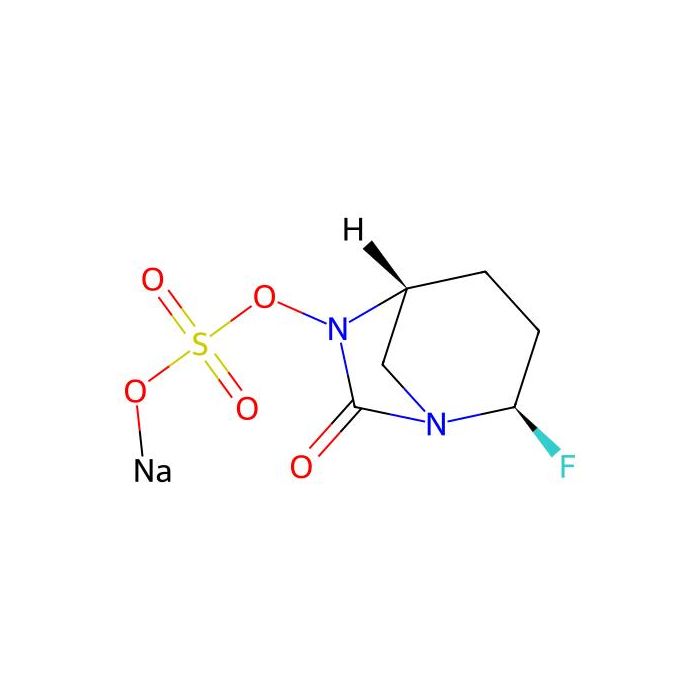
Determine the necessary mass, volume, or concentration for preparing a solution.
ANT3310 sodium - ≥99% , CAS No.2410688-61-6
AVAILABLE TO ORDER
GRADE & PURITY ≥99%
Storage
Store at -20°C
Shipped In
Ice chest + Ice pads
≥99% for sensitive chromatographic and analytical workflows requiring minimal baseline interference.
Store at -20°C Ships Ice chest + Ice pads Check lot-specific COA for exact specifications.
SDS, COA, datasheet, and spec sheet available for download. Lot-specific COA accessible via lot number lookup.
Cited in 0 peer-reviewed publications across chromatography, organic synthesis, and cross-coupling reactions.
ANT3310 sodium is a broad-spectrum covalent Serine β-Lactamase inhibitor, with IC 50 values ranging from 1 nM to 175 nM (a panel of Serine β-Lactamase). ANT3310 sodium potentiates activity of β-lactam antibiotics against Carbapenem-Resistant Enterobacterales (CRE) and Acinetobacter baumannii (CRAB). ANT3310 sodium can be used in the research of bacterial infection.
In Vitro
ANT3310 sodium (Compound 21, 0.006 to 3 000 nM, 10 min) inhibits a series of Serine β-Lactamase (AmpC, CTX-M-15, TEM-1, OXA-48, OXA-23, and KPC-2), with IC <>50 values ranging from 1 nM to 175 nM. ANT3310 sodium shows a low in vitro cytotoxicity (IC <>50 : > 100 μM) in HepG2 cell, cardiotoxicity (inhibition of the hERG potassium ion channel), and genotoxicity (Ames test). MCE has not independently confirmed the accuracy of these methods. They are for reference only.
In Vivo
ANT3310 sodium (intravenous injection, 25-100 mg/kg, at 1, 3, 5, and 7 h postinfection) reduces bacterial burdens in murine thigh infection model . ANT3310 sodium (intravenous injection, 1 mg/kg, Male Swiss albino mice) shows a T 1/2 value of 0.64 h, AUC value of 412 ng•h/mL, and Cl value of 40 mL/min/kg (pharmacokinetic assay) . MCE has not independently confirmed the accuracy of these methods. They are for reference only. Animal Model: Murine thigh infection model Dosage: 25, 50, and 100 mg/kg Administration: Intravenous injection, at 1, 3, 5, and 7 h postinfection Result: Reduced bacterial burdens (colony forming units, CFU) in a dose-dependent manner to levels below that of the initial starting inoculum at the highest dose, when treated with the combination of MEM.
Form:Solid
Comprehensive hazard, handling, storage, and regulatory compliance document.
Download SDS →Lot-specific quality data. Enter your lot number to retrieve the exact COA.
Look up COA →Full quality attributes and acceptance criteria for this grade.
View spec sheet →| Solubility | DMSO : 250 mg/mL (953.51 mM; Need ultrasonic) |
|---|
No tested applications or validated protocols are provided in the Product Data for ANT3310 sodium. The following general practices apply to small-molecule library compounds (not item-specific):
For any application requiring validated conditions (e.g., enzymatic IC50 determination), develop and qualify protocols internally with proper controls. This product is supplied for research use only.
Item-specific biological function, targets, or pathway roles are not specified for ANT3310 sodium. No claims of biological activity are made in this catalog entry. For research use only.
General notes for small-molecule library members (not item-specific):
Researchers should consult the CoA/Spec Sheet and conduct pilot studies to define any specific biological role or mechanism for this item.
This product is a discrete small molecule and is not a classical buffer component. Specific buffer system usage and pKa values are not specified for this item.
General guidance (not item-specific):
For actual buffer formulation data (pKa, buffering ranges), consult the specific compound’s structural information when available; not specified for this item.
This listing is a discrete small-molecule entity rather than a process solvent or bulk reagent. As such, “green alternative” selection centers on the workup and analytical context rather than replacement of the compound itself.
Comparison (general; not item-specific)
Given the unknown structure, any greener substitution must be validated experimentally for solubility, stability, and assay performance.
No pharmacopeial grade or excipient role is specified for ANT3310 sodium. This product is supplied strictly for research use only and is not intended for human or veterinary use, diagnostic procedures, or as an active pharmaceutical ingredient (API).
General formulation context for small molecules (not item-specific):
No claims are made regarding compendial compliance (USP/EP/JP), residual solvent classes, elemental impurities, or endotoxin/bioburden for this item. Refer to the CoA/Spec Sheet for any available quality attributes.
Item-specific specifications
Literature/general guidance (not item-specific)
Always verify item-specific physical properties using the product CoA/Spec Sheet when available; do not substitute general trends for specifications.
Item-specific grade/purity
How to interpret grades (general guidance)
Recommended quality controls (practical tips)
Note: Stabilizers, residual solvents, metal limits, and UV cutoffs are not specified for this item; consult the CoA/SDS for details if applicable.
Manufacturer Applications
Discovery and screening use (general, not item-specific)
Practical workflow tips
Synthetic/reagent use
Item-specific reaction conditions, catalysts, or yields are not specified for ANT3310 sodium. No particular reactivity profile is claimed in this listing.
General laboratory handling for small-molecule salts (not item-specific):
Any concrete reaction planning should be deferred until structural and stability details are available from the CoA/Spec Sheet.
GHS and hazard information (item-specific)
Always consult the latest SDS for authoritative safety information before use.
General laboratory precautions (not item-specific)
Storage and incompatibilities
First-aid overview (general)
Spill response: Avoid raising dust; collect with non-sparking tools into compatible container for disposal per local regulations.
Item-specific solubility
General selection strategy for small-molecule sodium salts (literature/practice, not item-specific)
Polarity and miscibility (general notes)
Because the exact structure is not provided, finalize solvent choice empirically using a small-scale solubility screen and stability checks (LC-MS, HPLC peak shape) before committing to large-scale use.
Storage (item-specific)
Reconstitution (general guidance; not item-specific)
Aliquoting and stability (general)
Item-specific details such as hydrate state, water content, and exact solubility are not specified for this item; refer to CoA/Spec Sheet.
Overview
Identifiers
Structural Features (general chemistry notes)
2D Structure (descriptive)
Specific synthetic reactivity and functional group profile for ANT3310 sodium are not specified. Without a defined structure, this product should not be assumed to function as a general reagent, catalyst, or building block.
General considerations (not item-specific):
In the absence of structural information, ANT3310 sodium should be treated primarily as a library compound for screening rather than a synthetic reagent.
Target, pathway, or enzyme specificity for ANT3310 sodium is not specified in the Product Data. No claims are made regarding biochemical targets, binding constants, or selectivity profiles.
Guidance for researchers (general, not item-specific):
Consult the CoA/Spec Sheet and your internal screening data to define any target-related attributes for this compound.