Bendamustine Hydrochloride is a small molecule bifunctional DNA alkylating agent, combining a nitrogen mustard functionality with a purine-analog structure. The dense DNA-damaging functionality of Bendamustine differentiates it from other compounds used a
Storage
Room temperature
Shipped In
Normal
Action Type
INHIBITOR
Mechanism of action
DNA inhibitor
Note
Wherever possible, you should prepare and use solutions on the same day. However, if you need to make up stock solutions in advance, we recommend that you store the solution as aliquots in tightly sealed vials at -20°C. Generally, these will be useable for up to one month. Before use, and prior to opening the vial we recommend that you allow your product to equilibrate to room temperature for at least 1 hour. Need more advice on solubility, usage and handling? Please visit our frequently asked questions (FAQ) page for more details.
This compound belongs to the class of organic compounds known as benzimidazoles. These are organic compounds containing a benzene ring fused to an imidazole ring (five member ring containing a nitrogen atom, 4 carbon atoms, and two double bonds).
External Descriptors
Not available
1. Djoumbou Feunang Y, Eisner R, Knox C, Chepelev L, Hastings J, Owen G, Fahy E, Steinbeck C, Subramanian S, Bolton E, Greiner R, and Wishart DS. ClassyFire: Automated Chemical Classification With A Comprehensive, Computable Taxonomy. Journal of Cheminformatics, 2016, 8:61.
Determine the necessary mass, volume, or concentration for preparing a solution.
Dilution Calculator
Determine the dilution needed to prepare a stock solution.
Reconstitution Calculator
Reviews
Customer Reviews
Application Protocols
Item-specific tested applications and dilutions: Not specified for this item; refer to CoA/Spec Sheet and SDS. The following general protocols are provided for research use only.
Preparation of stock solutions (general):
DMSO stock: Dissolve compound to a convenient concentration (e.g., 10–50 mM depending on solubility). Vortex to clarity, filter if needed (PTFE/nylon, 0.2 μm), and aliquot. Store aliquots to avoid repeated freeze–thaw.
Aqueous stock: Dissolve in water acidified with dilute HCl to aid solubility. Prepare immediately before use; avoid long storage due to hydrolysis of mustard groups.
LC–UV/LC–MS method development (illustrative):
Column: C18, 2.1 × 100 mm, sub-2–3 μm.
Mobile phase A: Water + 0.1% formic acid; B: Acetonitrile or methanol + 0.1% formic acid.
Gradient: 5% to 60% B over 8–10 min; adjust to resolve related substances.
Detection: UV 230–280 nm and/or ESI+ MS (monitor [M+H]+ of the HCl salt’s free base).
Handling precautions:
Prepare working solutions immediately before experiments; limit exposure to basic pH and elevated temperature.
Use appropriate containment and PPE for cytotoxic/alkylating agents.
Note: Optimize concentrations and conditions empirically for your specific assay system; the above are starting points only.
Biological Roles
General biochemical context (literature; no medical or clinical claims):
Mechanism class: Bendamustine is a bifunctional alkylating agent (nitrogen mustard). Upon activation in aqueous environments, the 2-chloroethyl substituents can form aziridinium ions capable of alkylating nucleophilic sites (e.g., N7 of guanine) on DNA.
Consequences at the molecular level: DNA monoalkylation and interstrand or intrastrand crosslink formation can impede replication and transcription, triggering DNA damage responses (e.g., double-strand break signaling, cell-cycle checkpoints) and ultimately cytotoxicity in proliferating cells.
Structural features relevant to biology: The benzimidazole ring contributes to physicochemical properties (e.g., aromatic stacking potential, basicity) and may influence DNA association and distribution. The carboxylic acid side chain modulates solubility and ionization state; the hydrochloride salt enhances aqueous solubility and uptake in certain in vitro systems.
Metabolic/chemical lability: Hydrolysis of chloroethyl groups yields hydroxyethyl derivatives with reduced alkylating potential; oxidative metabolism (e.g., N-dealkylation) and conjugation pathways are reported in literature for nitrogen mustards.
Experimental usage: Frequently employed as a benchmark DNA-alkylating agent in cell-free assays (e.g., plasmid crosslinking), biochemical studies of repair pathways (BER/NER), and in vitro cytotoxicity panels.
Caveat: Specific biological parameters (e.g., IC50 values, uptake kinetics) are system-dependent and should be determined empirically under the exact conditions of use.
Buffer Applications
This compound is not a buffer or buffering reagent and is not typically used to prepare defined pH buffer systems.
Practical guidance (if your workflow involves aqueous media):
For dissolution, mildly acidic aqueous solutions (e.g., addition of dilute HCl) can aid solubility of the hydrochloride salt; prepare immediately before use to limit hydrolysis.
For analytical separations, standard buffers/modifiers (e.g., formic acid or ammonium formate in water/MeOH or water/ACN) can improve chromatographic performance for protonated analytes.
If you require a buffering system for your assay (e.g., pH stability studies), select an appropriate buffer (phosphate, acetate, citrate, HEPES) based on target pH and ionic strength, and evaluate compound stability at that pH empirically.
Green Alternatives
Bendamustine HCl is a specialized research compound; there is no direct "green" substitute for its unique structure/chemistry. However, greener choices can be made in solvents and workflows when preparing and analyzing it.
Greener solvent choices (general guidance):
Prefer water or aqueous buffers (acidified as needed) for short-term handling and dilutions; minimize organic solvent volumes.
Where organic solvent is required, ethanol or methanol are generally considered greener than acetonitrile or halogenated solvents. Balance with solubility and stability considerations.
Avoid chlorinated solvents for routine prep; reserve for specific analytical needs only.
Process considerations:
Prepare high-concentration stock solutions to reduce total solvent usage; aliquot to avoid repeated freeze–thaw and waste.
Use UHPLC methods with shorter columns and higher efficiency to cut mobile-phase consumption and energy use.
Implement microscale assays for cytotoxic compound handling to lower exposure risk and waste generation.
Tradeoffs:
Aqueous media are greener but can accelerate hydrolysis of chloroethyl groups; DMSO provides stability but is less benign and harder to dispose of. Choose case-by-case.
Illustrative comparison (general):
Water (acidified): highest EHS profile; may reduce chemical stability over time.
Note: These are workflow-level green choices; there is no alternative molecule that replicates bendamustine HCl’s research utility while inherently "greener."
Pharmaceutical Uses
No therapeutic or clinical claims are made for this catalog item. The following describes research/formulation roles applicable to laboratory and pharmaceutical development contexts.
Reference standard: Suitable for developing and validating analytical methods (e.g., LC–UV/LC–MS) for identification, assay, related substances, and stability-indicating profiles of bendamustine hydrochloride in research settings.
Formulation research: Used to explore solubilization strategies (e.g., salt forms, co-solvents) and to study compatibility with excipients in pre-formulation research. The hydrochloride salt improves aqueous solubility relative to the free base.
Impurity profiling: Benchmark for synthesis/degradation impurities tracking, including hydroxyethyl derivatives from mustard hydrolysis.
System suitability/retention marker: In LC systems targeting alkylating agents and benzimidazole-containing compounds.
Regulatory note: If your application requires pharmacopeial conformity (e.g., USP/EP reference standards) or GMP-grade materials, verify and source appropriate certified materials. This listing is for research use only, as stated in Product Data.
Physical Properties
Item-specific (from Product Data):
Appearance: Not specified for this item; refer to CoA/Spec Sheet.
Storage Conditions: Room temperature
Shipped In: Normal
Literature/typical properties for Bendamustine HCl (reference only, not item specifications):
State: Solid, typically crystalline; color may vary from off-white to light yellow depending on form and trace impurities.
Melting point: Reported to decompose on heating; literature often cites ~225–230 °C (dec.).
Boiling point: Not applicable (decomposes before boiling at atmospheric pressure).
Solubility: Freely soluble in water (as hydrochloride); soluble in polar organics such as methanol, ethanol, and DMSO; sparingly soluble in nonpolar solvents. Aqueous solubility increases under acidic conditions due to protonation of the tertiary amine.
pKa (qualitative): The tertiary amine forms a stable hydrochloride salt; in neutral to mildly acidic water the amine is largely protonated. Exact numeric pKa values vary in literature and can depend on ionic strength; consult primary references if needed.
LogP/logD: The HCl salt demonstrates enhanced aqueous solubility and reduced apparent logD at physiological pH compared to the free base; numeric values vary across reports.
Hygroscopicity: The hydrochloride salt may exhibit some moisture affinity; store tightly closed to limit hydration and hydrolysis.
General notes for handling solutions (literature guidance): Prepare concentrated stocks in DMSO or water (acidified if needed) and dilute into assay buffers shortly before use. Avoid prolonged exposure to elevated temperature, high pH, or strong nucleophiles that can accelerate mustard hydrolysis.
Quality & Grades
Grade/Purity (item-specific): Not specified for this item; refer to CoA/Spec Sheet.
Interpretive guidance for this compound class (general):
Reference standard vs. research grade: For small-molecule libraries, materials may be provided as research-grade solids suitable for screening, method development, or reference purposes. If a certified reference material (CRM) or pharmacopeial standard is required (e.g., for regulated QC), verify certification and traceability.
Purity metrics: Common assays include HPLC/UPLC area % purity, residual solvent content (GC), water content (Karl Fischer), and identity confirmation by NMR and MS. Because this compound contains labile chloroethyl groups, monitoring for hydrolysis byproducts (e.g., hydroxyethyl derivatives) is prudent.
Counterion and form: Hydrochloride salt improves aqueous solubility and handling. If your application requires the free base or a specific solvate/hydrate state, confirm form and counterion on the CoA and request matching material.
UV profile: Nitrogen mustards attached to benzimidazole rings absorb in the UV; if using for chromatographic detection, validate wavelength and extinction empirically. Low-UV-absorbing grades ("HPLC grade") pertain to solvents rather than solids; for analytes, select clean diluents and filters.
Stabilizers: Not specified for this item; if present, stabilizers should be disclosed on the CoA. For sensitive assays, confirm absence of excipients.
Recommendation: Align the required documentation (CoA, SDS, analytical data) with your intended use and regulatory context before deployment.
Reaction & Applications
Manufacturer Applications (catalog): Not specified beyond category listing. The following expands typical research uses for this compound class (literature-based, no clinical claims).
Research applications:
Reference/positive-control alkylating agent in chemical biology and mechanistic studies of DNA alkylation and crosslinking.
Analytical reference standard for method development and stability-indicating assays (LC–UV/LC–MS) including forced degradation (acid/base hydrolysis, oxidative, thermal) to characterize degradation pathways of nitrogen mustards.
Small-molecule library member for SAR benchmarking of benzimidazole–mustard scaffolds.
Reaction chemistry considerations (for derivatization, not therapeutic use):
Carboxylic acid handle enables classical transformations (esterification, amidation) under mild conditions; protect the mustard functionality by controlling pH and temperature to limit hydrolysis.
The benzimidazole ring can undergo N-alkylation or acylation under carefully controlled conditions; risk of side reactions increases in strongly basic media.
The tertiary amine hydrochloride salt may be converted to the free base for non-aqueous derivatizations (e.g., with organic bases), but exposure to nucleophiles promotes substitution of chloroethyl groups.
Practical tips:
Maintain low temperatures and short exposure to aqueous/basic conditions during manipulations.
Use anhydrous, oxygen-free conditions if long handling times are required; while oxygen is not a primary reactant, limiting water is critical to suppress SN1/SN2 hydrolysis of the mustard arms.
Monitor by LC–MS to detect early formation of hydroxyethyl byproducts.
Reaction Conditions
General conditions (literature guidance) applicable to manipulations and derivatizations of bendamustine HCl; these are not specifications for this item:
Esterification of the carboxylic acid:
Solvents: Anhydrous dichloromethane, DMF, or THF; alcoholic solvents for Fischer conditions.
Reagents: DCC/DMAP, EDCI/NHS or uronium reagents (e.g., HATU) for mild coupling; acid catalysis (p-TsOH) for Fischer esters.
Temperature: 0–25 °C for coupling; reflux for Fischer as needed.
Notes: Exclude water; avoid strong base. Monitor by LC–MS for hydrolysis of chloroethyl arms.
Amidation (to form amides from the acid):
Solvents: DMF, DCM, NMP.
Reagents: EDCI/HOBt, HATU, or T3P with tertiary amine bases (DIPEA).
Temperature: 0–25 °C.
Notes: Minimize reaction time; maintain mildly basic organic phase only (aqueous base accelerates mustard degradation).
Salt exchange/free base generation:
Conditions: Partition with organic solvent after basification of an aqueous solution using a mild base (e.g., NaHCO3); immediately dry and proceed to downstream steps.
Notes: Work rapidly at low temperature; the free base is less stable in aqueous media.
Stability testing (forced degradation):
Acid/base hydrolysis: Aqueous acid or base at elevated temperature shows characteristic hydrolysis products; use to qualify stability-indicating methods.
Oxidative stress: Dilute H2O2 in water/methanol mixtures; monitor for N-oxide or other oxidative products.
Always validate conditions on small scale and confirm product integrity using orthogonal analyses (LC–MS, NMR).
Safety & Handling
Authoritative safety data for this specific item are provided in the product SDS. The following are general laboratory precautions for nitrogen mustard–containing small molecules and hydrochloride salts.
GHS classification, signal word, hazard statements, pictograms (item-specific): Not specified for this item; refer to SDS.
General hazards (literature/chemical class): Bifunctional alkylating agents are typically acutely toxic and can be mutagenic; dusts and solutions may be harmful by inhalation, ingestion, or skin contact. The hydrochloride salt is corrosive/irritating in many cases due to acidity.
PPE: Wear lab coat, appropriate chemically resistant gloves (e.g., disposable nitrile; consider double-gloving for cytotoxic agents), splash goggles, and use within a certified chemical fume hood.
Engineering controls: Handle powders in a hood or ventilated enclosure; use closed containers and secondary containment for transport within the lab.
Incompatibilities: Avoid strong bases, strong nucleophiles, and prolonged exposure to aqueous conditions at elevated temperature (can promote hydrolysis of chloroethyl groups). Avoid oxidizers for organic solids.
First aid (general):
Inhalation: Move to fresh air; seek medical attention. Provide SDS to responders.
Skin contact: Remove contaminated clothing, wash skin with soap/water for ≥15 minutes.
Eye contact: Rinse cautiously with water for several minutes; remove contact lenses if present and easy to do; continue rinsing; obtain medical attention.
Ingestion: Rinse mouth; do not induce vomiting; seek medical attention.
Waste: Collect contaminated disposables and solutions as hazardous chemical waste (cytotoxic/antineoplastic class where applicable) following institutional and regulatory guidelines.
Always defer to the item’s SDS and your institution’s EHS policies for definitive guidance.
Solvent Selection
As a polar, ionizable small molecule (hydrochloride salt), Bendamustine HCl dissolves best in polar protic solvents or highly polar aprotics.
Water or buffer: High solubility when the amine is protonated; mildly acidic water (e.g., 0.01–0.1 M HCl) can aid dissolution for concentrated stocks.
DMSO: Excellent solvent for preparing concentrated analytical or screening stocks; miscible with water for subsequent dilutions.
Alcohols (MeOH, EtOH): Moderate to good solubility; commonly used for HPLC sample prep and reference solutions.
Nonpolar solvents (e.g., hexanes, toluene): Poor solubility and generally not recommended.
Polarity/dielectric context (general):
DMSO (ε ~47) and water (ε ~80) effectively solvate the ionic form; methanol (ε ~33) can be suitable for moderate concentrations.
Selection tips:
Bioassays: Prepare a DMSO stock and dilute into aqueous media immediately prior to use to minimize hydrolysis of the chloroethyl groups. Keep final DMSO content low to maintain cell compatibility, if applicable to your workflow.
Analytical chemistry: For LC-UV/LC–MS, water/MeOH or water/ACN mobile phases with acidic modifiers (e.g., formic acid) can improve peak shape for the protonated analyte; ensure compatibility with your detector.
Derivatization or salt exchange: Use polar organics and controlled pH to avoid premature hydrolysis.
Small comparison (general):
DMSO: maximal solubility/stability for stocks; high viscosity.
Water (acidified): green and compatible; can accelerate hydrolysis over time.
Methanol/ethanol: good compromise for analytics; flammable, lower solubility than DMSO.
Storage & Reconstitution
Item-specific (from Product Data):
Storage Conditions: Room temperature
Shipped In: Normal
General best practices (research use only):
Container: Store in the original, tightly closed container with desiccant if available. Protect from ambient moisture and prolonged light exposure to minimize hydrolysis and degradation.
Secondary containment: Recommended for cytotoxic/alkylating materials; label clearly.
Reconstitution guidelines (literature-based):
DMSO stock solutions: Prepare concentrated stocks (e.g., 10–50 mM, as solubility allows) in anhydrous DMSO. Aliquot into small, single-use vials or cryovials. For medium-term storage, keep at ≤−20 °C, protected from light. Thaw quickly and use immediately; avoid repeated freeze–thaw cycles.
Aqueous solutions: If dissolution in water is required, use acidified water (e.g., 0.01–0.1 M HCl) to assist solubility. Prepare immediately before use and discard remaining solution after the experiment to avoid using hydrolyzed material.
Filtration: If particulate is present, filter through a compatible low-binding membrane (PTFE or nylon, 0.2 μm). Avoid cellulose acetate with aggressive organic modifiers.
Stability notes:
The hydrochloride salt improves solid-state handling but the mustard moieties are moisture/temperature sensitive in solution. Stability in DMSO is generally superior to aqueous media, but long-term solution storage is not recommended without verification.
Always consult the product’s CoA and SDS for authoritative storage and handling instructions specific to the supplied lot.
Structure & Identity
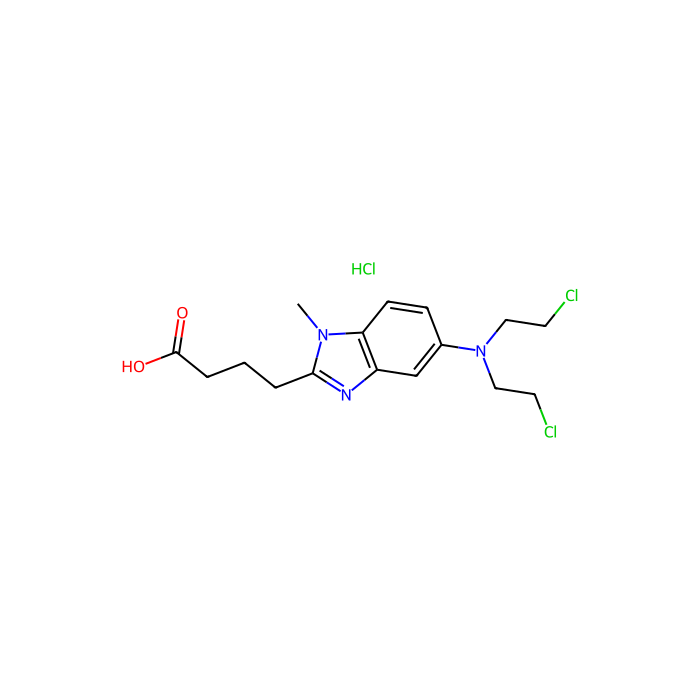
Bendamustine HCl is a bifunctional nitrogen mustard bearing a benzimidazole moiety; supplied here as the hydrochloride salt for research use only.
Item-specific (from Product Data):
SKU: B124707
Product Name: Bendamustine HCl
CAS: 3543-75-7
PubChem CID: 77082
InChIKey (as provided): 457363
SMILES: Not specified for this item; refer to CoA/Spec Sheet.
Molecular Formula: Not specified for this item; refer to CoA/Spec Sheet.
Molecular Weight: Not specified for this item; refer to CoA/Spec Sheet.
Commonly represented as the hydrochloride salt of bendamustine (free base formula often cited as C16H21Cl2N3O2; HCl salt adds one equivalent of HCl).
Approximate formula for the HCl salt (literature): C16H22Cl3N3O2· (as an ion pair).
Approximate molecular weight (literature): ~394.7 g/mol for the HCl salt.
2D structure description: A benzimidazole ring substituted at C-5 with a tertiary amino group bearing two 2-chloroethyl substituents (bis(2-chloroethyl)amino, i.e., nitrogen mustard), and at N-1 with a butyric acid side chain (carboxylic acid terminus). The hydrochloride manifests as protonation of the tertiary amine, paired with chloride.
Key functional groups: benzimidazole heteroaromatic, tertiary amine mustard [N(CH2CH2Cl)2], carboxylic acid (in the side chain), and the hydrochloride counterion.
Stereochemistry: None (achiral small molecule).
Notes: Structural identifiers above labeled as literature are for contextual understanding only; consult the item’s CoA/SDS for definitive identifiers used for this lot.
Synthetic Utility
Bendamustine HCl is a finished, multifunctional small molecule rather than a general-purpose building block; nonetheless, its functional groups enable targeted derivatization for probe or SAR work (literature guidance):
Carboxylic acid side chain: Amenable to esterification (Fischer, Steglich) and amidation (carbodiimide coupling with HOBt/HOAt or modern uronium reagents). These transformations allow prodrug-like esters or conjugates to be prepared for mechanistic studies.
Tertiary amine/mustard: Highly reactive toward nucleophiles; typically preserved rather than modified. Converting the HCl salt to the free base can facilitate non-aqueous transformations elsewhere in the molecule; avoid conditions that would substitute the chloroethyl groups with solvent or nucleophile.
Benzimidazole core: Potential for N-alkylation or acylation under carefully controlled conditions; electrophilic aromatic substitution is less favored without activation.
Salt/form switching: Ion-exchange or basification can generate the free base for partitioning or further chemistry; re-salting to the HCl improves handling and solubility.
Retrosynthetic/analytical utility:
Serves as a benchmark scaffold when evaluating synthetic routes to benzimidazole–mustard hybrids, enabling comparison of reaction efficiency and impurity profiles.
Useful as a co-analyzed standard when validating derivatization chemistries that must preserve labile chloroethyl groups (confirming minimal side reactions by LC–MS).
Caution: All derivatizations should be performed under conditions that minimize aqueous/basic exposure and elevated temperatures to avoid mustard hydrolysis.
Target Specificity
Not applicable for this product category. This item is a small-molecule compound, not an antibody or affinity reagent.
General biochemical context (literature, for orientation only): Bendamustine is a non-selective, DNA-alkylating nitrogen mustard; its "target" at the molecular level is nucleophilic sites on DNA (e.g., guanine N7), leading to adducts and crosslinks. No antigen/epitope, species reactivity, clone, or isotype information applies.
Frequently Asked Questions
What is the purity of this product, and how is it determined?
This product is supplied at ≥98% purity, determined by HPLC. Lot-specific values are stated on the Certificate of Analysis.
How should this product be stored?
Store at room temperature.
How is this product shipped?
This product ships under standard ambient conditions. No temperature-controlled packaging is required.
What are the CAS number, molecular formula and molecular weight?
The CAS Number is 3543-75-7, the molecular formula is C16H22Cl3N3O2, and the molecular weight is 394.72 g/mol. InChIKey ZHSKUOZOLHMKEA-UHFFFAOYSA-N.
What documentation is provided?
Available product documentation, including Certificates of Analysis (COA), Safety Data Sheets (SDS), and specification sheets, is shown in the product document area. Document availability and access follow the current site policy.
We use cookies to ensure the website functions properly and, where permitted, to improve your experience. You can manage your preferences at any time in Settings. Learn more in our Cookie Policy.
Shall we send you a message when we have discounts available?
Remind me later
Thank you! Please check your email inbox to confirm.
Products are supplied to verified businesses, institutions, and qualified professionals for research and development use only. Not for use in humans, animals, diagnosis, or therapy.

 K2125694