Determine the necessary mass, volume, or concentration for preparing a solution.
Dilution Calculator
Determine the dilution needed to prepare a stock solution.
Reconstitution Calculator
Reviews
Customer Reviews
Application Protocols
No vendor-tested protocols are provided in the Product Data. The following is general guidance for using Bosutinib-d8 as an LC–MS/MS internal standard (research use only):
Stock solution:
Weigh an appropriate amount quickly in a fume hood.
Dissolve in anhydrous DMSO to prepare a 1–10 mM primary stock. Vortex and, if needed, sonicate briefly.
Aliquot into amber vials; purge headspace with inert gas; store at −20 °C.
Intermediate/working solutions:
Prepare daily or weekly in MeOH or ACN (±0.1% formic acid) at 0.1–10 µg/mL, depending on method sensitivity. Keep in autosampler at 4–8 °C.
Sample spiking:
Add a fixed volume of the internal standard solution to each sample, calibration standard, and QC prior to extraction (PPT, LLE, or SPE) to compensate for recovery and matrix effects.
LC–MS/MS method development tips:
Optimize source parameters with the d8 standard; select precursor [M+H]+ at +8 Da over the unlabeled analyte and confirm product ions that retain the deuterium shift.
Evaluate isotopic interference by checking unlabeled bosutinib’s natural isotope cluster and the d8 material’s isotopic impurity (d0–d7 fractions from CoA).
Documentation:
Record preparation details (weights, solvents, lot numbers, dates). Assess short-/long-term stability and autosampler stability as part of method validation.
Adjust concentrations and volumes to fit your instrument response and regulatory framework.
Biological Roles
Context (literature; not item-specific): Bosutinib is a small-molecule ATP-competitive tyrosine kinase inhibitor with activity primarily reported against Src-family kinases and Abl family kinases. It interacts with the ATP-binding site of the kinase domain, stabilizing inactive conformations in some cases.
Relevance of the deuterated analog:
Functional parity: Deuteration (d8) typically does not materially alter binding mode or potency because it replaces protium with deuterium at non-exchangeable positions; electronic effects are minimal. Thus, Bosutinib-d8 serves as an excellent stable-isotope internal standard for quantifying the non-labeled analyte in biochemical assays and complex matrices.
Mass spectrometry behavior: The +8 Da mass shift cleanly separates the labeled internal standard’s precursor/product ions from those of bosutinib, minimizing interference and enabling accurate isotope-dilution quantification.
Metabolism and KIE: Incorporation of deuterium at metabolically labile positions can slightly reduce specific oxidative biotransformations (primary kinetic isotope effect) in enzyme systems; however, this effect is context- and position-dependent and is not relied upon in internal-standard applications.
Use cases (research only):
Quantitative bioanalysis: Calibration, QC, and incurred sample reanalysis in ADME/DMPK workflows.
Mechanistic enzymology: Probe position-dependent hydrogen abstraction steps where applicable.
Note: No clinical or therapeutic claims are made here; this product is for research use only, as indicated in the Product Data.
Buffer Applications
This compound is not used as a buffering agent. It has no defined acid/base pair suitable for maintaining a specific pH range in biochemical buffers. For experimental work, focus instead on solvent preparation and LC–MS mobile phase composition, as outlined in the Solvent Selection and Application Protocols sections.
Green Alternatives
Although Bosutinib-d8 itself is not replaceable for isotope-dilution quantitation, you can optimize surrounding method choices with greener options.
Greener solvent choices for stocks and LC:
Prefer methanol over acetonitrile when chromatographic performance allows; MeOH is biodegradable, renewable (bio-methanol), and has lower supply risk.
Use water-rich mobile phases and shallow organic gradients to reduce organic solvent consumption.
Consider ethanol as a diluent for intermediate steps if compound solubility permits; confirm MS compatibility and background.
Comparison (general guidance):
DMSO vs DMF for stock solutions:
DMSO: Lower toxicity profile, excellent solvating power, and favorable EHS profile relative to DMF.
DMF: Effective solvent but classified with higher reproductive toxicity concerns; avoid when possible.
ACN vs MeOH in LC–MS:
ACN: Often delivers lower backpressure and sharper peaks but is petrochemical-derived and supply sensitive.
MeOH: Greener alternative; may require method adjustments (column temperature, flow rate) to match resolution.
Operational sustainability:
Miniaturize assays (96/384-well formats) to cut solvent waste.
Employ solvent-capture/recycling systems on preparative LC; for analytical LC, adopt reduced-flow UHPLC methods and narrow-bore columns.
Use amber autosampler vials and minimize repeat injections to reduce compound waste due to photodegradation or carryover-driven reruns.
Pharmaceutical Uses
No excipient or therapeutic use is claimed or implied for this product. For research and quality-control laboratories, Bosutinib-d8 is typically employed as:
Stable-isotope internal standard for quantitative analysis of bosutinib in drug-substance and drug-product testing (e.g., assay, dissolution, content uniformity) under analytical methods such as LC–MS/MS.
Reference material in method development/validation per ICH Q2(R2)/Q14 principles (selectivity, linearity, accuracy, precision, robustness) to correct for matrix effects and process variability.
Tracer in in vitro ADME studies (e.g., microsomal stability, plasma protein binding) to normalize recovery and instrument response.
Regulatory/compendial context (general):
Deuterated internal standards are common in GMP QC and GLP bioanalytical laboratories; however, compendial monographs typically address the non-labeled API. Ensure internal qualification of the labeled standard (identity, purity, isotopic distribution) per your quality system.
Documentation:
Maintain certificates (CoA), vendor SDS, and characterization data.
Verify mass spectrum (exact mass shift, isotopic distribution) upon receipt, especially when transferring validated methods between sites or instruments.
Physical Properties
Item-specific specifications provided: none beyond storage. Do not treat the following as item specifications; they are general/literature guidance for the bosutinib scaffold and may differ for this deuterated lot.
Appearance: Not specified for this item; refer to CoA/Spec Sheet.
Melting point (literature, bosutinib free base or salt varies): commonly reported in the 100–150 °C range depending on form; exact value is formulation- and hydrate-dependent.
Boiling point: Not applicable for this high-MW, thermally labile solid (decomposes before boiling; literature generalization).
Density: Not specified for this item; refer to CoA/Spec Sheet.
Solubility (literature/guidance):
DMSO: high solubility, typically ≥10 mM achievable for analytical stocks.
Methanol, acetonitrile: moderate; often used for LC–MS/MS working solutions, sometimes with 0.1% formic acid to aid handling.
Water: very low at neutral pH; solubility increases in acidic aqueous media due to protonation of the basic amine(s).
pKa (literature, bosutinib): multiple basic centers; representative pKa for the most basic nitrogen often ~6.5–8.5; exact values vary by source and form.
LogP/logD (literature): lipophilic; cLogP typically in the 3–5 range.
UV–vis (literature): strong absorption in the UV due to conjugated quinoline/anilide; common analytical wavelengths 250–320 nm; exact λmax depends on solvent and form.
Important: For reportable QC values (mp, water content, residual solvents, assay), consult the item’s CoA/Spec Sheet.
Quality & Grades
Item-specific grade/purity: Not specified for this item; refer to CoA/Spec Sheet for assay, impurity profile, and residual solvents.
Guidance on typical expectations for deuterated analytical standards:
Isotopic enrichment: Suppliers commonly specify ≥98 atom % D at labeled positions and a defined pattern (d8). Verify the enrichment and labeling map on the CoA, especially for quantitative LC–MS/MS.
Chemical purity vs isotopic purity: Both impact analytical performance. Chemical impurities can co-elute; isotopic impurities (d0–d7) can overlap with analyte MRM channels. Review exact isotopologue distribution on the CoA.
Form: Free base vs salt (e.g., monohydrochloride) influences solubility and mass. Confirm the provided form to correctly calculate stock concentrations and transitions.
Trace UV/background: For LC–UV workflows, low baseline absorbance in solvents and absence of UV-active impurities enhances S/N. For LC–MS, emphasis is on low metal/ion contaminants to minimize adducting. If HPLC grade or LC–MS grade is indicated, expect strict control of these properties. For this item, no such grade is specified in the Product Data.
Documentation: Request or download CoA/Spec Sheet for batch-specific assay, water content (KF), residual solvents (GC), and stability data. These are essential for validated analytical methods and for assigning reference standard status internally.
Reaction & Applications
Primary applications (non-clinical):
Stable-isotope internal standard (SIS) for LC–MS/MS quantification of bosutinib in complex matrices (e.g., formulation extracts, in vitro assay media, biological samples). The +8 Da mass shift enables clean MRM separation and correction for matrix effects, extraction recovery, and ionization variability.
Analytical control: Use in calibration curves, quality controls (QCs), incurred sample reanalysis (ISR), and process validation to track extraction efficiency and instrument performance.
Mechanistic/isotope studies: Site-selective deuteration can be exploited to probe metabolic soft spots (primary/secondary kinetic isotope effects), hydrogen–deuterium exchange susceptibility, and fragmentation pathways in tandem MS.
Practical tips:
Stock preparation: Prepare a primary stock in anhydrous DMSO (e.g., 1–10 mM). Store as single-use aliquots at −20 °C to minimize freeze–thaw and adsorption losses.
Working solutions: Dilute into MeOH or ACN (often with 0.1% formic acid) for LC–MS/MS; maintain consistent organic content across standards and samples to control ionization.
Extraction pairing: For protein-precipitation (PPT) workflows, spike Bosutinib-d8 into samples before precipitation to track recovery. For SPE, choose mixed-mode cation-exchange (MCX) or reversed-phase cartridges compatible with basic analytes.
MRM transitions: Select precursor m/z corresponding to [M+H]+ of d8 analog and product ions that are mass-shifted relative to bosutinib; verify absence of cross-talk due to natural isotopic envelopes and isotopic impurity (consult instrument optimization data).
Reaction Conditions
This product is not typically employed as a reactant in synthetic transformations; therefore, there are no standardized “reaction conditions” to report. The following are practical conditions relevant to its analytical use and stability (general guidance):
Solution preparation: Dissolve in anhydrous DMSO at room temperature with gentle vortex/sonication. For LC–MS/MS, further dilute into methanol or acetonitrile (often 0.1% formic acid) and then into aqueous mobile phase.
Temperature: Room temperature handling is acceptable for brief periods. Minimize prolonged exposure to elevated temperatures; store prepared stocks and working solutions chilled (e.g., autosampler at 4–8 °C) when possible to reduce degradation/adsorption.
Light sensitivity: Use amber vials or foil-wrapped containers to protect from UV/visible light that can promote photodegradation of conjugated heteroaromatics.
pH: Maintain near-neutral to mildly acidic conditions for solution stability during analytical runs. Avoid strong acids/bases which may induce hydrolysis or demethylation.
Adsorption mitigation: Add small amounts of organic modifier (0.1–0.5% DMSO or 0.01–0.1% formic acid) and use low-bind plastics or silanized glass to limit losses at low ng/mL concentrations.
Expected stability (practice-based, verify experimentally): Concentrated DMSO stocks aliquoted under inert atmosphere and stored at −20 °C are typically stable for months; dilute working solutions in MeOH/ACN are often stable for days at 4–8 °C. Always confirm with stability-indicating assays.
Safety & Handling
Safety information specific to this item is not provided in the Product Data. Always consult the product SDS before use.
GHS/CLP classification: Not specified for this item; refer to SDS. Kinase-inhibitor class small molecules are often harmful if swallowed and may cause skin/eye/respiratory irritation; treat as hazardous unless otherwise stated on SDS.
Signal word, hazard statements, pictograms: Not specified for this item; refer to SDS.
General laboratory precautions (good practice):
Engineering controls: Work in a certified chemical fume hood or ventilated enclosure when weighing and dissolving powdered solids to avoid inhalation.
PPE: Lab coat, safety glasses, and appropriate chemically resistant gloves (e.g., nitrile). Avoid skin contact; wash thoroughly after handling.
Handling notes: Avoid generating dust/aerosols. Prepare solutions in closed containers. For LC–MS standards, dilute concentrated DMSO stocks into organic solvent or buffered aqueous-organic mixtures using sealed autosampler vials.
Incompatibilities: Strong oxidants and strong acids/bases may cause degradation. Avoid prolonged exposure to light and moisture which can promote hydrolysis/oxidation of heteroaromatic systems (general guidance).
Special risks: None specific provided. Deuteration does not inherently change hazard classification but does alter mass spectrometric response.
First aid (overview; consult SDS):
Inhalation: Move to fresh air; seek medical advice if symptoms persist.
Skin/eyes: Rinse with water for at least 15 minutes; remove contaminated clothing; seek medical attention if irritation develops.
Ingestion: Rinse mouth; do not induce vomiting; obtain medical attention.
Spill/accidental release: Avoid dust; sweep with minimal agitation; dispose of as hazardous chemical waste.
Solvent Selection
This product is a solid small molecule (not a solvent). Solvent selection here refers to dissolving the compound for analytical or research use.
Polarity/ionization considerations (general for bosutinib-like scaffolds): Weakly to moderately basic; solubility improves in polar aprotic solvents and in acidified aqueous-organic media upon protonation.
DMSO: Preferred for high-concentration master stocks (e.g., 10–50 mM) due to strong solvating power and stability.
Methanol or acetonitrile: Suitable for intermediate/working solutions for LC–MS/MS; often with 0.1% formic acid to enhance handling and peak shape when diluted into aqueous mobile phase.
Aqueous buffers: Limited solubility at neutral pH; use small DMSO cosolvent (≤1–5%) and/or slight acidification (e.g., 0.1% FA) when preparing calibration standards.
Compatibility:
Avoid strong bases and highly nucleophilic media that may degrade aryl–heteroaryl carbonitriles/aryl ethers (general caution).
Glass vs plastic: Use low-bind polypropylene or silanized glass autosampler vials to minimize adsorption of cationic/aryl-heteroaryl compounds.
Comparisons (general):
DMSO vs DMF: DMSO is less volatile, lower background in ESI-MS, and more commonly used for bioanalytical stocks.
MeOH vs ACN: MeOH is greener and often adequate; ACN can deliver sharper peaks in certain LC methods but is less sustainable and sometimes supply-constrained.
Degassing/filtration: Filter final mobile phases (0.2 µm PTFE/nylon) and degas to suppress bubble-related variability in LC–MS/MS quantitation.
Storage & Reconstitution
Item-specific conditions (from Product Data):
Storage Conditions: Store at −20 °C.
Shipped In: Ice chest + ice pads.
Research Use Note: For research use only.
Additional handling guidance (general best practice; not a product specification):
Upon receipt: Allow the sealed container to equilibrate to room temperature before opening to avoid moisture condensation. Open in a low-humidity environment.
Reconstitution: Prepare a concentrated stock in anhydrous DMSO (e.g., 1–10 mM) using volumetric techniques. If the form (free base vs salt) is not specified, determine by mass spectrometry or titration, or consult the CoA to calculate exact molarity.
Aliquoting: Divide stocks into single-use amber vials or low-bind tubes to avoid multiple freeze–thaw cycles. Overlay with inert gas (N2/Ar) if long-term storage is anticipated.
Short-term storage: Working solutions in MeOH/ACN (±0.1% formic acid) are typically refrigerated (4–8 °C) and used within several days. Verify stability for your method.
Freeze–thaw: Minimize cycles; if unavoidable, limit to ≤3. Inspect for precipitation upon thawing; warm gently to room temperature and vortex to redissolve.
Light and moisture protection: Store in desiccated, light-protected conditions; use amber glassware and desiccant packs in storage containers.
Always consult the product’s CoA and SDS for authoritative, lot-specific instructions regarding form, purity, and stability.
Structure & Identity
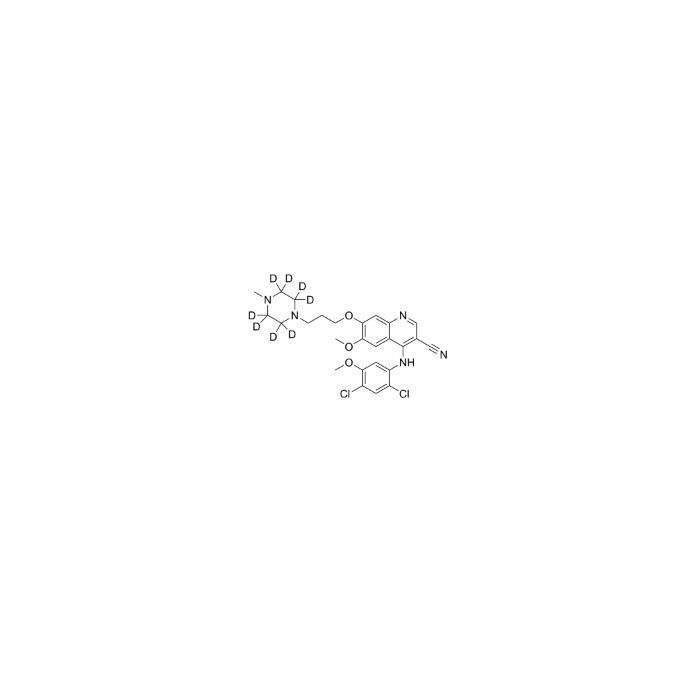
Brief overview: Bosutinib-d8 is the stable-isotope–labeled analog of the small-molecule kinase inhibitor bosutinib, incorporating eight deuterium atoms for mass spectrometric discrimination. It is typically used as an internal standard and in mechanistic/isotopic studies.
Item-specific identifiers from Product Data:
CAS: 2733145-45-2
SMILES: Not specified for this item; refer to CoA/Spec Sheet.
InChIKey: Not specified for this item; refer to CoA/Spec Sheet.
Molecular Formula: Not specified for this item; refer to CoA/Spec Sheet.
Molecular Weight: Not specified for this item; refer to CoA/Spec Sheet.
Structural features (general/literature description of bosutinib scaffold; for reference only):
Comprises a 4-anilino-3-quinolinecarbonitrile core.
Substituents typically include di/halogenated anisidyl (anilide) and an alkoxy side chain terminating in a dialkylamino/piperazinyl moiety (literature).
Bosutinib-d8 replaces eight protium atoms with deuterium at pre-defined positions (supplier-dependent) to afford a +8 Da mass shift; exact labeling pattern for this item is not specified.
2D structure described in words (literature, generic):
Fused bicyclic quinoline ring bearing a nitrile at C-3 and an anilide at C-4; additional methoxy/alkoxy and tertiary amine substituents contribute to amphiphilicity and basicity.
Notes:
Where precise stereochemistry would be listed: bosutinib is achiral (literature); deuteration does not introduce stereocenters. For this specific item, confirm exact labeling positions and identifiers on the CoA/Spec Sheet.
Synthetic Utility
Bosutinib-d8 is primarily an analytical standard rather than a synthetic building block; it is not commonly used as a reagent or intermediate. Nevertheless, deuterated small molecules can have specialized synthetic/analytical utility:
Isotope tracing: Track degradation or transformation pathways in forced-degradation studies of formulations and in oxidative stress models by monitoring d8 → lower-d species.
Fragmentation mapping: Use MS/MS spectra of the d8 analog to assign fragment origins in tandem-MS method development, aiding structural elucidation and transition selection.
Kinetic isotope effect probes: Where deuterium is positioned at C–H activation sites, comparative reactivity versus the d0 analog can indicate rate-determining hydrogen abstraction. This is typically applied in enzymatic oxidation studies rather than in synthetic catalysis for this scaffold.
Limitations:
The complex, highly functionalized structure offers limited handles for further derivatization without affecting identity as an internal standard.
Deuterium scrambling/exchange under strongly acidic or basic conditions can erode labeling fidelity if labile positions are present; avoid such conditions when the isotopic label must be preserved.
Conclusion: Treat Bosutinib-d8 as a reference material for analytical chemistry and mechanistic experiments rather than a general-purpose synthetic reagent.
Target Specificity
Target/antigen information is not applicable to this small-molecule chemical standard. No antibody or biologic targeting data are provided in the Product Data. For biochemical context, literature describes bosutinib as a kinase inhibitor active against Src-family and Abl kinases; however, no target-specific validation is claimed for this deuterated analytical standard.
We use cookies to ensure the website functions properly and, where permitted, to improve your experience. You can manage your preferences at any time in Settings. Learn more in our Cookie Policy.
Shall we send you a message when we have discounts available?
Remind me later
Thank you! Please check your email inbox to confirm.
Products are supplied to verified businesses, institutions, and qualified professionals for research and development use only. Not for use in humans, animals, diagnosis, or therapy.

 C2521136