for sensitive chromatographic and analytical workflows requiring minimal baseline interference.
🌡
Storage & shipping
Store at -20°C Ships Ice chest + Ice pads Check lot-specific COA for exact specifications.
📋
Quality documents
SDS, COA, datasheet, and spec sheet available for download. Lot-specific COA accessible via lot number lookup.
📚
Literature proof
Cited in 0 peer-reviewed publications across chromatography, organic synthesis, and cross-coupling reactions.
Overview
Bromochloronitromethane is a Halonitromethane. Halonitromethanes (HNMs) are a recently identified class of disinfection byproducts (DPBs) in drinking water that are mutagenic in Salmonella and potent inducers of DNA strand breaks in mammalian cells.
This compound belongs to the class of organic compounds known as c-nitro compounds. These are compounds having the nitro group, -NO2 (free valence on nitrogen), which is attached to carbon.
External Descriptors
Not available
1. Djoumbou Feunang Y, Eisner R, Knox C, Chepelev L, Hastings J, Owen G, Fahy E, Steinbeck C, Subramanian S, Bolton E, Greiner R, and Wishart DS. ClassyFire: Automated Chemical Classification With A Comprehensive, Computable Taxonomy. Journal of Cheminformatics, 2016, 8:61.
Determine the necessary mass, volume, or concentration for preparing a solution.
Dilution Calculator
Determine the dilution needed to prepare a stock solution.
Reconstitution Calculator
Reviews
Customer Reviews
Application Protocols
No vendor-tested biological assay protocols (WB, IHC, IF, FC, etc.) apply to this small molecule reagent.
General lab protocol examples (non-validated, for orientation):
Preparation of a GC-MS calibration curve: Weigh an appropriate mass gravimetrically into a volumetric flask, dissolve in pesticide-grade acetonitrile to a certified concentration, and prepare serial dilutions. Store aliquots at −20°C in amber vials; bring to room temperature before use and vortex briefly.
Stability check: Analyze freshly prepared vs. stored standard after defined intervals to establish storage stability in your solvent/matrix.
Always defer to your laboratory’s SOPs and the SDS. This product is for research use only.
Biological Roles
Scope: This product is sold for research use only.
General context (literature; not item-specific claims):
Halonitromethanes are investigated as disinfection byproducts formed during water treatment processes involving chlorination/chloramination in the presence of bromide/organic nitrogen precursors. They are of interest in environmental toxicology and exposure assessment due to their reactivity and potential for biological interactions in vitro.
Mechanistic considerations: The nitro group and geminal halogens confer electrophilicity and potential to react with nucleophiles in biological matrices; however, specific metabolic pathways and quantitative toxicokinetics for bromochloronitromethane are not detailed here and should be sourced from primary literature.
Caution: No biomedical or clinical utility is implied. Any in vitro work should be conducted with appropriate containment and controls, referencing institutional safety protocols.
Buffer Applications
Not typically applicable. Bromochloronitromethane is not a buffering agent and is not used to prepare biological buffers.
Practical note: If preparing analytical standards in aqueous media, use pre-made buffers only to control matrix pH during extraction or stability testing, and confirm that the buffer components do not induce degradation. Organic solvent stocks (e.g., acetonitrile) diluted into water may be preferable for GC/LC sample preparation.
Green Alternatives
Context: Bromochloronitromethane is a halogenated nitro-organic that carries environmental and health hazards typical of this class. When possible, limit scale and exposure, and evaluate alternatives in line with green chemistry principles.
Alternatives and strategies (general guidance):
Analytical surrogates: If method development does not require this exact analyte, consider less hazardous nitro-organics or deuterated/internal standards with lower toxicity profiles for instrument tuning. However, for DBP occurrence studies, analyte identity is often non-substitutable.
Solvent choices: Prefer greener solvents (e.g., ethyl acetate, alcohols, or acetonitrile with proper recovery) over chlorinated solvents when analytically compatible. Use microscale preparations to minimize waste.
Process intensification: Employ low-temperature storage, single-use aliquots, and on-demand solution preparation to reduce decomposition and waste.
Comparison (qualitative):
Halonitromethanes vs. non-halogenated nitro compounds: The former generally exhibit higher persistence and toxicity; the latter may be greener but are usually not suitable as direct surrogates for DBP monitoring.
Chlorinated solvents (e.g., DCM) vs. greener options (e.g., EtOAc, MeCN): Greener options reduce halogenated waste but must be validated for stability/recovery of bromochloronitromethane in your method.
Disposal: Ensure collection as halogenated organic waste and consider solvent recycling where feasible.
Pharmaceutical Uses
Not an excipient or processing aid in pharmaceutical manufacturing to the best of general knowledge and not indicated in the Product Data.
Research-only context: If employed in pharmaceutical analytical labs, it would be as a research-grade reference analyte for method development in environmental or impurity profiling studies, not for formulation. No pharmacopeial monograph is indicated for this item.
Physical Properties
Item-specific specifications: Not specified for this item; refer to CoA/Spec Sheet.
Literature/general values and expectations (for technical context only; not product specifications):
Physical state: small, dense halogenated nitro-organic; often encountered as a low-volatility liquid at ambient conditions for related halonitromethanes. Actual appearance for this item is not specified.
Polarity: Moderately polar due to the nitro group, yet overall low hydrogen-bonding capability; expected to have appreciable solubility in polar aprotic organics (e.g., DCM, MeCN, acetone) and limited solubility in water (literature, class behavior).
Acid/base: No titratable protons associated with the nitro group; the α-CH is relatively acidic vs. simple alkanes but far less acidic than nitromethane (literature, qualitative).
Volatility and density: Halogenation generally increases density and decreases volatility relative to nitromethane; exact values for this compound are not provided here (literature, class trend).
Practical note: For any quantitative property required for method development (e.g., GC retention, vapor pressure, refractive index), consult a validated reference standard or the item’s CoA/SDS. Do not extrapolate exact numbers from homologs without verification.
Quality & Grades
Item-specific grade/purity: Not specified for this item; refer to CoA/Spec Sheet.
General notes on quality for this compound class:
Analytical applications: Bromochloronitromethane and related halonitromethanes are often used as reference materials for environmental monitoring (e.g., water disinfection byproduct studies via GC-ECD/GC-MS). For such uses, purity and low background impurities (especially other halonitromethanes) are important. Confirm identity and purity by GC-MS and/or NMR as appropriate.
Stabilizers: No stabilizer information is provided for this SKU. If stabilizers are present in similar products, they may affect trace analysis and baseline stability; consult the CoA.
Documentation: For regulated or method-validation work, request a detailed CoA with batch-specific purity, residual solvent, water, and uncertainty statements.
UV/fluorescence considerations: If chromatographic detection at low wavelengths is intended, verify UV cutoffs/absorbance for your specific lot; none are specified here.
Reaction & Applications
Research use (per Product Data): For research use only.
Application domains (literature/general for this class):
Environmental analytics: Halonitromethanes, including mixed-halogen members, are studied as disinfection byproducts (DBPs). Bromochloronitromethane may be employed as an analytical standard or surrogate in method development/validation for GC-ECD/GC-MS monitoring of nitro-DBPs in water matrices.
Synthetic reactivity: The carbon bearing Br/Cl/NO2/H is electrophilic and stereogenic. Under nucleophilic or basic conditions, substitution or elimination can occur. The nitro group can participate in polar and radical pathways, and α-deprotonation (vs. nitromethane) is reduced by the electron-withdrawing halogens but still feasible under strong base (literature, qualitative trends).
Derivatization: In sample preparation, derivatization (e.g., to more GC-stable species) is sometimes explored for related nitro-DBPs; applicability should be verified experimentally for this specific analyte.
Practical tips:
Handle in a cold, dry, oxygen-limited environment for stability; prepare analytical standards fresh or store aliquots frozen.
Avoid strong base if the parent integrity is required; consider acidified solvents to suppress adventitious reactions during storage.
For GC methods, use deactivated glassware/liners and short exposure at injector temperatures to limit thermal decomposition.
Note: No manufacturer-specific application details were provided; users should align with their validated SOPs.
Reaction Conditions
No item-specific, validated conditions are provided. The following are general literature-guided considerations for related halonitromethanes; verify experimentally:
Substitution chemistry:
Solvents: Polar aprotic (MeCN, DMF, DMSO) for SN2-type reactions; avoid protic solvents that can promote side reactions.
Nucleophiles: Thiolates, iodide, and other soft nucleophiles may preferentially displace the better leaving group (often Br > Cl), at 0–40°C. Monitor carefully; competing elimination may occur.
Bases: Use weaker, non-nucleophilic bases (e.g., carbonate) to moderate reactivity when substitution is desired; strong base can lead to elimination or decomposition.
Elimination to nitroalkenes:
Conditions: Stronger bases (e.g., t-BuOK) in THF/DMSO at 0–25°C; short reaction times minimize overreaction. Yields and selectivity vary; confirm by NMR/GC.
Analytical solution prep:
Stock standards: Prepare in acetonitrile or isooctane at low mM to µg/mL levels; store in amber vials at ≤−20°C. Include internal standards and perform stability checks over time.
Thermal sensitivity:
GC injection: Use splitless or split modes per method; liner deactivation and lower injector temperatures can reduce analyte degradation. Validate on your instrument.
Note: Expected yields, kinetics, and selectivity are highly substrate- and condition-dependent; consult primary literature before scale-up.
Safety & Handling
Authoritative data source: Always consult the SDS for GHS classification, pictograms, H/P statements, and first-aid measures applicable to this SKU.
Item-specific hazard data from Product Data:
GHS classification: Not specified for this item; refer to SDS.
Signal word: Not specified for this item; refer to SDS.
H-statements: Not specified for this item; refer to SDS.
Pictograms: Not specified for this item; refer to SDS.
General safety considerations for halonitromethanes (literature/general guidance):
Potential hazards: Strong irritants/lachrymators are known within this class (e.g., chloropicrin). Avoid inhalation, skin/eye contact, and ingestion. Use in a certified fume hood.
PPE: Lab coat, chemical-resistant gloves (e.g., nitrile; verify compatibility), splash goggles; consider face shield for bulk handling.
Handling: Minimize headspace and temperature to limit volatilization; avoid contact with bases, strong nucleophiles, and reducing agents that may trigger decomposition or substitution. Keep away from strong heat and ignition sources.
First aid (overview; defer to SDS for details): Move exposed persons to fresh air; flush eyes/skin with copious water for ≥15 minutes; remove contaminated clothing; seek medical attention if symptoms persist.
Spill response: Absorb with inert material (e.g., vermiculite), avoid generating vapors, and collect for halogenated organic waste disposal.
Stability concerns: Nitro-organics can decompose under strong heat or with reactive metals/bases. Store cold, tightly sealed, and protected from light as prudent practice.
Waste: Collect as halogenated organic waste; do not release to drain.
Solvent Selection
Applicability: As a small, halogenated nitro compound, bromochloronitromethane is typically handled in organic media.
General solvent compatibility (literature/class behavior; verify experimentally):
Likely good solvents: Dichloromethane, chloroform, acetonitrile, acetone, ethyl acetate, and other polar aprotics. Aromatics (toluene) may also dissolve it due to polarizability from halogens and the nitro group.
Limited solubility expected: Water and highly nonpolar alkanes may be less effective.
Avoid: Strongly basic media and nucleophile-rich solvents when the intact parent is required, as geminal dihalides adjacent to –NO2 can undergo substitution/elimination under forcing basic conditions.
Selection tips by use-case:
GC reference solutions: Use high-purity, low-bleed solvents (e.g., pesticide-grade hexane, isooctane, or acetonitrile) as per the target method; prepare fresh to minimize degradation.
Reaction chemistry: Choose non-nucleophilic, aprotic solvents (e.g., DCM, MeCN) to limit side reactions; rigorously dry solvents if base-sensitive pathways must be avoided.
Practical note: Confirm solubility and stability in the chosen solvent at working concentration and temperature. Prepare standard solutions under inert atmosphere and low light when trace stability matters.
Storage & Reconstitution
Item-specific conditions (from Product Data):
Storage: Store at −20°C.
Shipment: Shipped in an ice chest with ice pads.
Appearance: Not specified for this item; refer to CoA/Spec Sheet.
General guidance for this compound class:
Container: Store in tightly sealed, chemically compatible containers (amber glass recommended) to limit light exposure and vapor loss. Use PTFE-lined caps.
Atmosphere: Consider inert gas blanket (N2/Ar) for long-term storage to minimize oxidative or hydrolytic degradation.
Aliquoting: Prepare single-use aliquots to avoid repeated freeze–thaw and headspace oxygen exposure.
Reconstitution/solution prep: Dissolve the material in a dry, high-purity organic solvent appropriate for your application (e.g., acetonitrile or dichloromethane for analytical work). Filter (PTFE, low-adsorption) only if necessary and validated not to cause loss.
Stability checks: Verify concentration and integrity after storage by GC/LC-MS or NMR as applicable.
Incompatibilities (general): Avoid strong bases, reactive metals, and strong nucleophiles during storage. Keep away from heat and direct sunlight.
Research use note: For research use only.
Structure & Identity
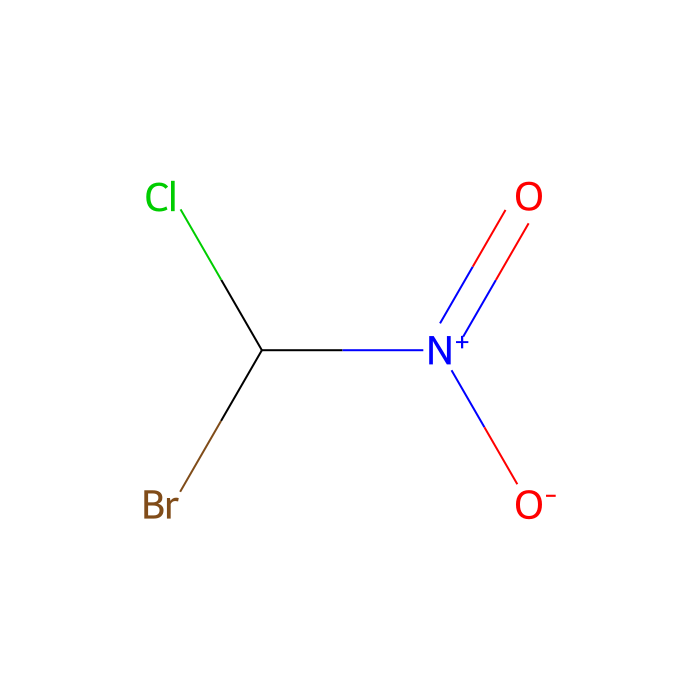
Short description: Bromochloronitromethane is a mixed-halogen nitromethane (a halonitromethane) bearing one bromo and one chloro substituent on the nitromethyl carbon. The central carbon is bound to Br, Cl, a nitro group (–NO2), and H, making the molecule chiral (typically supplied as a racemic mixture).
Item-specific identifiers (from Product Data):
CAS: 135531-25-8
InChIKey: Not specified for this item; refer to CoA/Spec Sheet.
SMILES: Not specified for this item; refer to CoA/Spec Sheet.
Literature identity (for reference; not item-specific):
Common name: Bromochloronitromethane
Synonym class: Mixed halonitromethane; halo-nitromethane disinfection byproduct analog (literature)
Molecular formula (literature): CHBrClNO2
Molecular weight (literature calculation): ~174.38 g/mol (C 12.01, H 1.008, Br 79.904, Cl 35.45, N 14.01, O2 32.00)
Functional groups: nitro (–NO2), geminal dihalide motif (–C(Br)(Cl)–), stereogenic center at carbon bearing NO2/Br/Cl/H.
2D structural description (literature): A tetrahedral carbon center substituted by bromine and chlorine in a geminal fashion, a nitro group (N double-bond O, single-bond O− in canonical resonance; typically drawn as –C–NO2), and a single hydrogen. No rings or additional heteroatoms beyond the nitro functionality.
Synthetic Utility
Functional group leverage (general/literature):
Geminal dihalide adjacent to a nitro group: Potential entry to substituted nitroalkenes or nitroalkanes via base-mediated elimination or substitution, respectively, though conditions must be tuned to avoid decomposition.
Nitro group chemistry: The –NO2 moiety enables transformations such as Nef reaction (after conversion to nitronate and subsequent hydrolysis) or reduction to amines; the presence of Br/Cl modifies acidity and may direct competing pathways.
Stereocenter: Reactions at the α-carbon can proceed with inversion/retention depending on mechanism (SN1/SN2/E2 vs. radical), offering opportunities for stereochemical studies on a small scale.
Precautions:
Strong bases/nucleophiles can induce halide displacement or elimination, potentially generating nitroalkenes or dehalogenated products. Conduct small-scale trials and monitor by GC/LC-MS.
Thermal sensitivity: Limit high-temperature operations; prefer photoredox or mild radical conditions if halogen transfer chemistry is explored.
Nucleophilic substitution at C–Br/C–Cl by soft nucleophiles under phase-transfer or polar aprotic conditions.
Elimination to nitroethylene derivatives under carefully moderated basic conditions.
Radical halogen atom transfer using appropriate initiators to craft functionalized nitroalkanes (literature precedents in related halonitromethanes).
Target Specificity
Not applicable. This product is a small organic molecule, not a biological targeting reagent (e.g., antibody, ligand with defined biomolecular target). No antigen/epitope or species reactivity information applies.
Frequently Asked Questions
How should this product be stored?
Store at ?20 °C. Freezer storage is required to maintain the specified shelf life.
We use cookies to ensure the website functions properly and, where permitted, to improve your experience. You can manage your preferences at any time in Settings. Learn more in our Cookie Policy.
Shall we send you a message when we have discounts available?
Remind me later
Thank you! Please check your email inbox to confirm.
Products are supplied to verified businesses, institutions, and qualified professionals for research and development use only. Not for use in humans, animals, diagnosis, or therapy.