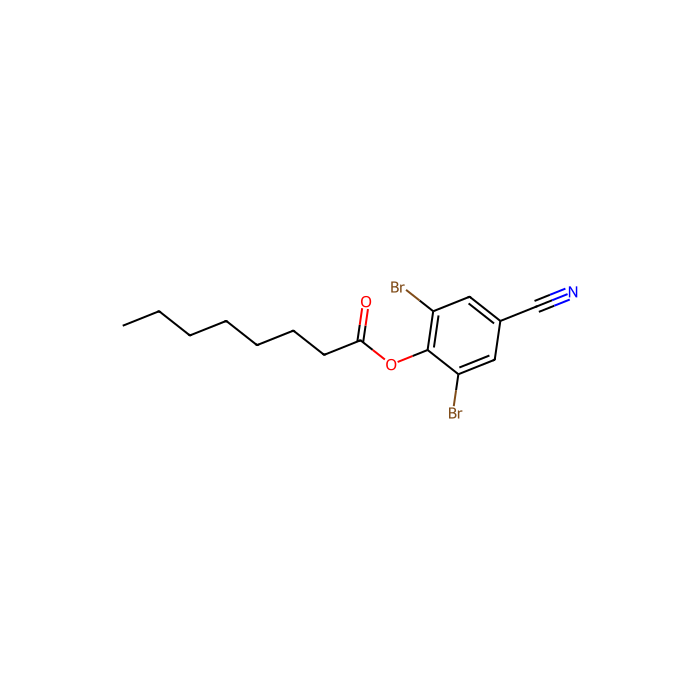
Bromoxynil-octanoate - analytical standard , CAS No.1689-99-2

CAS: 1689-99-2 Cat. No.: B114879 Formula: C15H17Br2NO2 Molecular Weight: 403.11 Beilstein Registry Number: 2756636 EC Number: 216-885-3
AVAILABLE TO ORDER
GRADE & PURITY Analytical standard ? Analytical standard — certified-purity material for quantitative calibration. Use to prepare calibration standards and validate analytical methods.
Synonyms
Bromoxynil octanoate [ISO]|3,5-Dibromo-4-hydroxybenzonitrile octanoate|4-Cyano-2,6-dibromophenyl octanoate|Bromoxynil octanoate|Octanoic acid, 2,6-dibromo-4-cyanophenyl ester|Benzonitrile, 3,5-dibromo-4-octanoyloxy-|2,6-DIBROMO-4-CYANOPHENYL OCTANOATE|BROMOXYNIL OCTANOATE [HSDB]|Bromoxynil octanoic acid ester|NPH 1320|RP-16272|Octanoic acid, ester with 3,5-dibromo-4-hydroxybenzonitrile|octanoic acid (2,6-dibromo-4-cyanophenyl) ester|Bromoxyniloctanoate|Bromoxynil-octanoate|Brominal W|Octanoicacid2,6-dibromo-4-cyanophenylester|Octanoic acid ester of 3,5-dibromo-4-hydroxybenzonitrile|3,5-Dibromo-4-octanoyloxy-benzonitrile|Bromoxynil octanoate E.C.|[2,6-bis(bromanyl)-4-cyano-phenyl] octanoate|2,6-Dibromo-4-cyanophenyloctanoate|BROMOXYNIL OCTANOATE [MI]|2,6-Dibromo-4-cyanophenyl octanoate
Storage
Store at -20°C
Shipped In
Ice chest + Ice pads
★
Size
Germany (EU)
USA*
Price
Qty
250mg
B114879-250mg
Made to order · 8–12 wks
€104.04
1g
B114879-1g
Made to order · 8–12 wks
€294.94
Enter a quantity for the sizes you want to add.

Overview

Bromoxynil octanoate is an herbicide widely applied to maize, is potentially toxic to both animals and humans.

Specifications

Synonyms
Bromoxynil octanoate [ISO] | 3,5-Dibromo-4-hydroxybenzonitrile octanoate | 4-Cyano-2,6-dibromophenyl octanoate | Bromoxynil octanoate | Octanoic acid, 2,6-dibromo-4-cyanophenyl ester | Benzonitrile, 3,5-dibromo-4-octanoyloxy- | 2,6-DIBROMO-4-CYANOPHENYL OCTANOATE | BROMOXYNIL OCTANOATE [HSDB] | Bromoxynil octanoic acid ester | NPH 1320 | Show more
Specifications & Purity
analytical standard
Storage
Store at -20°C
Shipped In
Ice chest + Ice pads
This product requires cold chain shipping. Ground and other economy services are not available.
Grade
Analytical standard
Names and Identifiers
SMILES
CCCCCCCC(=O)OC1=C(C=C(C=C1Br)C#N)Br
IUPAC Name
(2,6-dibromo-4-cyanophenyl) octanoate
InChIKey
DQKWXTIYGWPGOO-UHFFFAOYSA-N
InChI
1S/C15H17Br2NO2/c1-2-3-4-5-6-7-14(19)20-15-12(16)8-11(10-18)9-13(15)17/h8-9H,2-7H2,1H3
Isomeric SMILES
CCCCCCCC(=O)OC1=C(C=C(C=C1Br)C#N)Br
WGK Germany
3
RTECS
DI3325000
UN Number
2588
Packing Group
I
Molecular Weight
403.11
Beilstein
2756636
Reaxys
2756636
Reaxys-RN_link_address
https://www.reaxys.com/reaxys/secured/hopinto.do?context=S&query=IDE.XRN=2756636&ln=

Advanced Data

Taxonomic Classification

Taxonomy Tree

KingdomOrganic compounds
SuperclassBenzenoids
ClassPhenol esters
SubclassNot available
Intermediate Tree Nodes Not available
Direct ParentPhenol esters
Alternative Parents Phenoxy compounds  Benzonitriles  Fatty acid esters  Bromobenzenes  Aryl bromides  Carboxylic acid esters  Nitriles  Monocarboxylic acids and derivatives  Organopnictogen compounds  Organobromides  Organic oxides  Hydrocarbon derivatives  Carbonyl compounds  
Molecular FrameworkAromatic homomonocyclic compounds
Substituents Phenol ester - Phenoxy compound - Benzonitrile - Bromobenzene - Fatty acid ester - Halobenzene - Aryl bromide - Aryl halide - Monocyclic benzene moiety - Fatty acyl - Carboxylic acid ester - Carboxylic acid derivative - Monocarboxylic acid or derivatives - Carbonitrile - Nitrile - Organobromide - Organonitrogen compound - Organooxygen compound - Carbonyl group - Hydrocarbon derivative - Organic oxide - Organic nitrogen compound - Organic oxygen compound - Organopnictogen compound - Organohalogen compound - Aromatic homomonocyclic compound
DescriptionThis compound belongs to the class of organic compounds known as phenol esters. These are aromatic compounds containing a benzene ring substituted by a hydroxyl group and an ester group.
External Descriptors Not available
3D Structure
Interactive Chemical Structure Model


Associated Targets(Human)
NR3C1 Tclin Glucocorticoid receptor (14987 Activities)
Activity TypeRelationActivity valueUnitsAction TypeJournalPubMed IddoiAssay Aladdin ID
PPARA Tclin Peroxisome proliferator-activated receptor alpha (9197 Activities)
Activity TypeRelationActivity valueUnitsAction TypeJournalPubMed IddoiAssay Aladdin ID
Mechanisms of Action
Certificates (CoA,COO,BSE/TSE and Analysis Chart)
C of A & Other Certificates(BSE/TSE, COO):
Analytical Chart:

Find and download the COA for your product by matching the lot number on the packaging.

2 results found

Lot NumberCertificate TypeDateItem
C2609432C2609432Certificate of AnalysisFeb 27, 2026 B114879
C2609437C2609437Certificate of AnalysisFeb 27, 2026 B114879
Chemical and Physical Properties
SensitivityMoisture sensitive
Melt Point45-46°C
Molecular Weight403.11
XLogP35.800
Hydrogen Bond Donor Count0
Hydrogen Bond Acceptor Count3
Rotatable Bond Count8
Exact Mass402.961 Da
Monoisotopic Mass400.963 Da
Topological Polar Surface Area50.100 Ų
Heavy Atom Count20
Formal Charge0
Complexity341.000
Isotope Atom Count0
Defined Atom Stereocenter Count0
Undefined Atom Stereocenter Count0
Defined Bond Stereocenter Count0
Undefined Bond Stereocenter Count0
The total count of all stereochemical bonds0
Covalently-Bonded Unit Count1
Safety and Hazards(GHS)
Pictogram(s)
GHS06,   GHS07,   GHS08,   GHS09
Signal
Danger
Hazard Statements

H302:Harmful if swallowed

H317:May cause an allergic skin reaction

H331:Toxic if inhaled

H361d:Suspected of damaging the unborn child

H400:Very toxic to aquatic life

H410:Very toxic to aquatic life with long lasting effects

Precautionary Statements

P261:Avoid breathing dust/fume/gas/mist/vapors/spray.

P264:Wash hands [and …] thoroughly after handling.

P270:Do not eat, drink or smoke when using this product.

P271:Use only outdoors or in a well-ventilated area.

P272:Contaminated work clothing should not be allowed out of the workplace.

P273:Avoid release to the environment.

P280:Wear protective gloves/protective clothing/eye protection/face protection.

P321:Specific treatment (see ... on this label).

P330:Rinse mouth.

P391:Collect spillage.

P302+P352:IF ON SKIN: wash with plenty of water.

P304+P340:IF INHALED: Remove person to fresh air and keep comfortable for breathing.

P333+P313:IF SKIN irritation or rash occurs: Get medical advice/attention.

P362+P364:Take off contaminated clothing and wash it before reuse.

P405:Store locked up.

P403+P233:Store in a well-ventilated place. Keep container tightly closed.

P501:Dispose of contents/container to an approved waste disposal plant.

P203:Obtain, read and follow all safety instructions before use.

P301+P317:IF SWALLOWED: Get medical help.

P318:if exposed or concerned, get medical advice.

P316:Get emergency medical help immediately.

WGK Germany
3
RTECS
DI3325000
Reaxys
2756636
Reaxys-RN_link_address
https://www.reaxys.com/reaxys/secured/hopinto.do?context=S&query=IDE.XRN=2756636&ln=
Class
6.1
Citations of This Product
Solution Calculators
Reviews

Customer Reviews

Application Protocols

Example procedures for using bromoxynil-octanoate as an analytical standard (general guidance; adapt to your SOP):

  • Preparation of primary stock

    • Allow vial to equilibrate to room temperature in a desiccator.
    • Add HPLC-grade acetonitrile to make a 1.00 mg/mL stock. Cap tightly, vortex to dissolve. Record exact mass/volume for gravimetric accuracy.
    • Aliquot into amber autosampler vials; store at −20°C.
  • Working standards (LC–MS/MS)

    • Prepare serial dilutions in acetonitrile to 0.1–1000 ng/mL range depending on instrument response.
    • For matrix-matched curves, spike extracts post-extraction at equivalent levels. Include an internal standard where possible.
  • Sample extraction (produce/soil; QuEChERS-style)

    • Homogenize 10 g sample; add 10 mL acetonitrile and buffering salts (e.g., citrate).
    • Shake vigorously 1 min; centrifuge. Cleanup supernatant with PSA/C18 dSPE; filter (0.22 µm PTFE) prior to LC.
  • QC and stability

    • Check response stability over 24–48 h in the autosampler at 4–10°C. Replace vials if >15% loss observed.
    • Include blank, matrix blank, and continuing calibration verification standards every 10 injections.

These are illustrative; follow your lab’s validated methods.

Biological Roles

This product is supplied strictly for research use; no clinical or field use is implied.

Literature biological context (not product specification or usage claim)

  • Mode of action (parent herbicide class): Bromoxynil esters are pro-herbicides that hydrolyze to bromoxynil, a photosystem II inhibitor. Bromoxynil binds at/near the QB site of the D1 protein, blocking electron transport and leading to reactive oxygen species formation in susceptible plants.
  • Environmental fate: The octanoate ester increases hydrophobicity and foliar uptake but undergoes hydrolysis in soils and organisms to release bromoxynil and octanoate. Degradation proceeds via hydrolysis and microbial metabolism; sorption to organic matter is significant due to high hydrophobicity (literature trends for aryl ester herbicides).
  • Biotransformation: In plants/soil microbes, esterases cleave the aryl ester; subsequent pathways include hydroxylation and conjugation of bromoxynil (e.g., glucosylation) before sequestration or mineralization (reported for related phenolic herbicides).

These points are provided solely to inform laboratory investigations (e.g., metabolism studies) and method development.

Buffer Applications

Not typically used as a buffering agent. As a hydrophobic aryl ester analytical standard, it is incompatible with aqueous buffer stock solutions due to hydrolysis risk. For aqueous-phase analyses, prepare organic stocks (e.g., acetonitrile) and dilute immediately before use into mobile phase or extraction mixtures.

Green Alternatives

As an analytical standard, the compound itself has fixed identity; “greener” considerations focus on solvent and workflow.

  • Prefer solvents with better EHS profiles where chromatographically acceptable:
    • Replace dichloromethane with ethyl acetate or methyl tert-butyl ether (MTBE) when extraction efficiency allows.
    • For LC, acetonitrile typically offers lower toxicity and better waste minimization than halogenated solvents; ethanol (with caution for ester stability) may be viable for some steps.
  • Solid-phase extraction (SPE) over liquid–liquid extraction reduces solvent volumes.
  • Miniaturize: Use microscale calibrations and on-column focusing to cut solvent consumption.

Comparison (general, literature-based):

  • DCM vs Ethyl acetate: DCM offers stronger elution but higher toxicity and ozone-depleting potential (legacy concerns); EtOAc is biodegradable and less toxic but may need larger volumes.
  • Hexane vs Isooctane/heptane: Isooctane/heptane often preferred for lower n-hexane neurotoxicity concerns.
  • Methanol vs Acetonitrile: MeOH is renewable but may compromise ester stability under basic conditions; MeCN generates less viscosity/backpressure and better peak shapes for many pesticides.

Trade-offs: Ensure alternative solvents do not increase hydrolysis, reduce recovery, or impair detector response. Validate any process changes with matrix-matched calibration curves.

Pharmaceutical Uses

No direct pharmaceutical formulation role is typical for bromoxynil-octanoate. It is an agrochemical analytical standard used for research and method validation.

General notes for context (non-applicable to this item’s use):

  • Excipients and pharmacopeial status: Not described in major pharmacopeias for human medicinal use.
  • If handled in GMP/GLP laboratories for analytical purposes, maintain documentation (CoA, stability data) and segregation from any pharmaceutical production areas to avoid cross-contamination.
Physical Properties

Item-specific specs

  • Appearance: Not specified for this item; refer to CoA/Spec Sheet.

Computed/literature values (for reference; not item specifications)

  • Phase/state: Nonpolar organic liquid or low-melting solid is common for long-chain aryl esters; exact appearance depends on purity and temperature (literature generalization).
  • Molecular weight: ~403.1 g/mol (from literature calculation for C15H17Br2NO2).
  • Solubility: Low in water; soluble in nonpolar and moderately polar organic solvents (e.g., hexane, dichloromethane, ethyl acetate, acetone, acetonitrile) per typical aryl esters with C8 chains (literature general trend). Actual solubility varies by solvent and temperature.
  • LogP: Expected high (hydrophobic) due to dibrominated aryl and C8 acyl chain; literature on related esters suggests logP > 4 (qualitative guidance).
  • Hydrolytic behavior: Susceptible to base- or enzyme-catalyzed hydrolysis to bromoxynil and octanoate (literature behavior of aryl esters).
  • Boiling/melting/refractive index/density: Not specified for this item; consult primary literature or CoA/SDS for definitive values.

Note: Use these literature pointers only to guide method development; do not treat as product specifications.

Quality & Grades

Item-specific grade

  • Analytical standard (product-specific): Intended for calibration/quantitation in analytical methods (e.g., GC/LC-MS) where high chemical identity and purity are critical.

What "Analytical standard" generally implies (general guidance)

  • Identity confirmation by orthogonal techniques (e.g., NMR/HRMS/GC/LC purity, where applicable).
  • Tight controls on isomeric purity and known impurity profiles to support trace-level quantitation.
  • Documentation: Certificate of Analysis (CoA) typically includes assay, identity tests, and lot-specific data. For UV cutoff, water/peroxide/metal content: Not specified for this item; refer to CoA/Spec Sheet.

Implications for use

  • Calibration: Suitable for preparing stock and working standards for residue analysis of bromoxynil esters in environmental, food, or agricultural matrices.
  • Stability: Esters can hydrolyze in basic/aqueous media; prepare standards in dry, aprotic solvents and store cold to maintain integrity.
  • Traceability: Retain CoA and lot information to ensure auditability of analytical results.

Note: Do not infer pharmaceutical or clinical suitability from the analytical standard designation; this product is for research use only.

Reaction & Applications

Primary use (product-specific category): Analytical standard

  • Application focus: Calibration/validation of methods quantifying bromoxynil-octanoate and its hydrolysis product (bromoxynil) in environmental, food, or agrochemical matrices.

Analytical applications (literature practices; expand on intended use)

  • LC–MS/MS: Prepare acetonitrile stocks (e.g., 1–2 mg/mL) and dilute into water/acetonitrile mobile phases with 0.1% formic acid. Monitor parent → characteristic fragment ions of the aryl-nitrile/halogenated ring (method development required).
  • GC–ECD/MS: Suitable after solvent selection (isooctane/hexane). Thermally stable enough for GC under optimized conditions; monitor halogen-specific response with ECD or SIM ions on MS.
  • Sample prep: QuEChERS-like extraction from crops or soil using acetonitrile and buffered salts; cleanup via dispersive SPE (PSA/C18) to reduce matrix effects (literature guidance for hydrophobic herbicides). For water samples, SPE with C18 or HLB, elution with acetone/ethyl acetate.
  • Hydrolysis studies: Track conversion to bromoxynil under alkaline or enzymatic conditions to evaluate degradation kinetics.

Reactivity notes (general chemistry)

  • Ester bond is susceptible to base-catalyzed hydrolysis and transesterification; aromatic ring is deactivated by electron-withdrawing nitrile and bromine substituents.
  • Photolysis can occur; limit light exposure during analytical work to avoid degradation artifacts.

Always validate recovery, matrix effects, and stability for your specific method.

Reaction Conditions

For analytical and degradation studies (literature guidance; not product specifications):

  • Stock preparation: Dissolve in dry acetonitrile or isooctane at 1–2 mg/mL. Vortex/sonicate briefly. Filter (PTFE, 0.2 µm) if particulate is observed. Avoid prolonged contact with basic media.
  • Hydrolysis kinetics: Base-catalyzed hydrolysis proceeds rapidly at pH ≥ 9 in aqueous-organic mixtures (e.g., 50:50 ACN/water); lower temperatures and acidic modifiers (0.1% formic acid) slow degradation.
  • LC–MS/MS analysis: Typical mobile phases—water + 0.1% formic acid (A) / acetonitrile or methanol (B). Start 60–80% B, gradient to 95% B over 5–10 min. Column: C18, 2.1 × 100 mm, 1.7–3 µm. Flow 0.2–0.4 mL/min, 30–40°C. Optimize ionization (often ESI− for phenolic metabolites; APCI may favor neutral esters). Validate multiple reaction monitoring transitions empirically.
  • GC–MS/ECD: Injector 220–260°C, column phases for pesticides (e.g., 5% phenyl polysiloxane). Oven 80°C hold, ramp 10°C/min to 280–300°C. Use splitless injection for trace analysis. Verify thermal stability to prevent in-injector hydrolysis.
  • SPE cleanup: C18 or HLB cartridges; condition with MeOH and water, load aqueous sample (optionally salted), wash with water, elute with acetone/EtOAc. Evaporate under N2 at ≤35°C to minimize loss/degradation.

Always perform recovery, linearity, and stability checks (bench-top, autosampler, freeze–thaw) for your matrix.

Safety & Handling

Item-specific safety fields

  • Signal word: Not specified for this item; refer to SDS.
  • H-statements: Not specified for this item; refer to SDS.
  • GHS classification/pictograms: Not specified for this item; refer to SDS.

General safety guidance (literature/inferred for aryl ester herbicide standards; defer to SDS)

  • Likely hazards: Many bromoxynil esters are harmful if swallowed, cause skin/eye irritation, and are very toxic to aquatic life (literature on herbicide esters). Handle in a chemical fume hood and avoid environmental release.
  • PPE: Lab coat, nitrile gloves (double-glove for extended work), splash goggles. Use a certified fume hood when opening vials or preparing solutions.
  • Incompatibilities: Strong bases and nucleophiles accelerate hydrolysis; avoid prolonged contact with alkaline aqueous media. Strong oxidizers may react with the aromatic ring/alkyl chain. Store away from acids/alkalis and moisture.
  • First aid (overview): If inhaled—fresh air; skin—wash with soap and water; eyes—rinse with water for at least 15 minutes; ingestion—rinse mouth. Seek medical attention in all cases. Follow SDS instructions.
  • Spill response: Absorb with inert material (vermiculite), collect for disposal as hazardous waste. Prevent entry to drains due to aquatic toxicity concerns.
  • Waste: Dispose according to institutional and local regulations; minimize halogenated organic waste.

Always consult the product SDS for authoritative safety and regulatory information.

Solvent Selection

Bromoxynil-octanoate is a hydrophobic aryl ester; solvent choice strongly affects stability and solubility.

  • Polarity/miscibility (literature generalization):
    • Low water solubility; avoid aqueous phases for stock solutions.
    • Readily soluble in nonpolar to mid-polar organic solvents: hexane, toluene, dichloromethane (DCM), ethyl acetate, acetone, acetonitrile, and methanol (the latter two with caution re: transesterification/hydrolysis under basic conditions).
  • Recommended for standards: HPLC-grade acetonitrile or isooctane are common for pesticide residue work (literature practice); DCM or ethyl acetate are good for sample extraction.
  • Stability considerations:
    • Avoid basic alcohols and aqueous buffers; esters hydrolyze faster at elevated pH.
    • Use dry solvents; moisture accelerates hydrolysis. Consider adding molecular sieves for long working sessions (do not add to the stored standard vial).
  • Comparison (general):
    • Acetonitrile: excellent chromatographic compatibility; moderate polarity; good stability for esters.
    • Methanol: convenient but may promote transesterification in the presence of base; use for short-term only.
    • Hexane/isooctane: very nonpolar; useful for GC and for nonpolar SPE elution, but poorer miscibility with polar cleanup solvents.

Select solvent based on analytical platform (GC vs LC), extraction protocol, and required stability window.

Storage & Reconstitution

Item-specific instructions

  • Storage conditions: Store at −20°C (product-specific). Keep container tightly closed. Protect from light and moisture.
  • Shipping: Ice chest + Ice pads (product-specific) to maintain low temperature.

Reconstitution and handling (general guidance for analytical standards)

  • Solvent for initial dissolution: Use dry, HPLC-grade acetonitrile or isooctane. Avoid aqueous or basic media.
  • Concentration: Prepare a convenient primary stock (e.g., 1–2 mg/mL) gravimetrically for accuracy.
  • Aliquoting: Divide into small amber vials to minimize freeze–thaw cycles and headspace. Purge with inert gas if long-term storage is needed.
  • Stability: Esters can hydrolyze; maintain frozen (−20°C) for long-term. For short-term use, keep at 2–8°C and protect from light. Working solutions in autosampler should be monitored for degradation.
  • Freeze–thaw: Minimize cycles. Thaw at room temperature in a desiccator, mix gently, and promptly return unused material to −20°C.

For any lot-specific stability limits, appearance, and purity data: Not specified for this item; refer to CoA/Spec Sheet.

Structure & Identity

Item-specific identifiers (from Product Data)

  • SKU: B114879
  • Product name: Bromoxynil-octanoate
  • CAS: 1689-99-2
  • Grade: Analytical standard
  • Storage: Store at -20°C (product-specific)
  • Shipped in: Ice chest + Ice pads (product-specific)
  • InChIKey: 70150 (provided)
  • SMILES: Not specified for this item; refer to CoA/Spec Sheet.

Computed/literature structural information (for reference; not item specifications)

  • Common name: Bromoxynil octanoate (octanoate ester of bromoxynil)
  • Core features: 3,5-dibrominated phenyl ring bearing a para-benzonitrile (–C≡N) and a phenoxy ester linkage to an octanoyl group (–O–C(O)–(CH2)6–CH3).
  • Functional groups: Aryl nitrile, aryl ester (phenyl octanoate), two aryl bromides.
  • Molecular formula (literature): C15H17Br2NO2
  • Molecular weight (literature): ~403.1 g/mol
  • 2D description: A substituted benzene ring with bromine atoms at positions 3 and 5, a nitrile at position 1 (benzonitrile), and an ester at the para position connecting the ring oxygen to a linear C8 acyl chain (octanoyl).
Synthetic Utility

This compound is not typically employed as a general synthetic building block; it is supplied as an analytical standard. Nevertheless, understanding its chemical reactivity can aid in stability and degradation studies.

  • Transformations (literature/general):
    • Hydrolysis: Base-catalyzed or enzymatic cleavage to bromoxynil (phenol) and octanoate; acid-catalyzed hydrolysis is slower but possible under strong conditions.
    • Transesterification: Exchange of the octanoyl group in alcohol solvents under acidic/basic catalysis.
    • Reduction/oxidation: The nitrile and aryl bromides are relatively inert under mild conditions used in analytical workflows; strong nucleophiles or radical conditions could induce side reactions (not typically relevant for standards).
  • Retrosynthetic note: The ester is commonly prepared by acylation of bromoxynil (phenol) with octanoyl chloride or mixed anhydrides under base, or via DCC/EDC couplings (literature routes). This is useful background for preparing labeled analogs for internal standards.

Takeaway: Treat primarily as an analyte; leverage its predictable ester chemistry when designing stability-indicating methods.

Target Specificity

Not applicable. This product is a small-molecule analytical standard (not an antibody, enzyme, or affinity reagent). No antigen/epitope specificity, clone, isotype, or species reactivity data apply.

Need help choosing the grade?

Our grade selection guide covers purity, stabilizer status, and application suitability for all variants in our catalog.

View Analytical standard grade guide →

Shall we send you a message when we have discounts available?

Remind me later

Thank you! Please check your email inbox to confirm.

Oops! Notifications are disabled.