≥98% for sensitive chromatographic and analytical workflows requiring minimal baseline interference.
🌡
Storage & shipping
Store at -20°C,Argon charged,Desiccated Ships Ice chest + Ice pads Check lot-specific COA for exact specifications.
📋
Quality documents
SDS, COA, datasheet, and spec sheet available for download. Lot-specific COA accessible via lot number lookup.
📚
Literature proof
Cited in 0 peer-reviewed publications across chromatography, organic synthesis, and cross-coupling reactions.
Overview
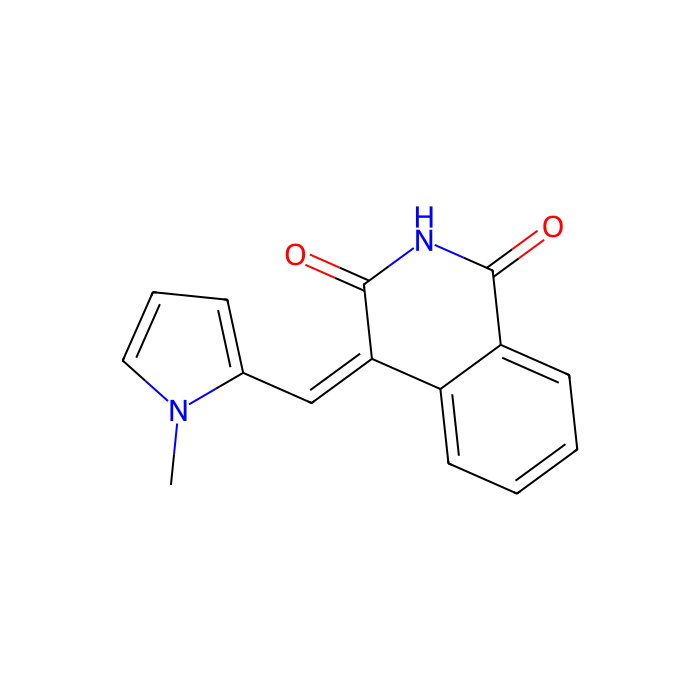
BYK204165, also known as PARP Inhibitor XIV, is a cell-permeable isoquinolinedione compound that potently and selectively inhibits poly (ADP-ribose) polymerase 1 (PARP1). PARP1 is a nuclear enzyme involved in the regulation of various cell processes such as differentiation, proliferation, and tumor transformation. It is also involved in the regulation of the molecular events involved in the recovery of cell from DNA damage. BYK204165's potency is similar or higher than most current standard PARP-1 inhibitors (just slightly lower than PJ34), and it is 100-fold selective for PARP-1 over PARP-2
Specifications
Synonyms
HMS3678B15 | BYK204165 | BYK-204165 | SCHEMBL22022391 | PARP Inhibitor XIV - CAS 1104546-89-5 | AKOS024457779 | HMS3414B15 | (4Z)-4-[(1-methylpyrrol-2-yl)methylidene]isoquinoline-1,3-dione | 1104546-89-5 | BDBM27496 | PARP Inhibitor XIV | (4Z)-4-[(1-methy
Specifications & Purity
≥98%
Biochemical and Physiological Mechanisms
BYK204165 is a potent and selective inhibitor of poly(ADP-ribose) polymerase 1 (PARP1). It is 100-fold selective for PARP-1 over PARP-2.
Storage
Store at -20°C,Argon charged,Desiccated
Shipped In
Ice chest + Ice pads
This product requires cold chain shipping. Ground and other economy services are not available.
This compound belongs to the class of organic compounds known as 1,3-isoquinolinediones. These are isoquinoline derivatives carrying one C=O group at positions 1, and 3 respectively.
External Descriptors
Not available
1. Djoumbou Feunang Y, Eisner R, Knox C, Chepelev L, Hastings J, Owen G, Fahy E, Steinbeck C, Subramanian S, Bolton E, Greiner R, and Wishart DS. ClassyFire: Automated Chemical Classification With A Comprehensive, Computable Taxonomy. Journal of Cheminformatics, 2016, 8:61.
Determine the necessary mass, volume, or concentration for preparing a solution.
Dilution Calculator
Determine the dilution needed to prepare a stock solution.
Reconstitution Calculator
Reviews
Customer Reviews
Application Protocols
Manufacturer-tested applications: Not specified for this item; refer to CoA/Spec Sheet.
General protocol outlines for small-molecule tool compounds (adjust per SOP):
Biochemical IC50 determination:
Prepare a 10 mM DMSO stock; perform 10-point 3-fold serial dilutions.
Keep final DMSO constant (e.g., 0.5% v/v) across all wells.
Incubate compound with target enzyme and substrate under optimized conditions; read appropriate signal (fluorescence/absorbance/MS).
Fit data with a 4-parameter logistic model; report IC50 with confidence intervals.
Cell-based assay:
Prepare intermediate dilutions in media-compatible vehicle; filter if necessary (0.22 μm).
Treat cells for a defined period; include cytotoxicity counter-assay (e.g., CellTiter-Glo) to contextualize phenotypic effects.
Analytical QC:
Verify identity/purity by LC–MS prior to critical experiments.
Assess solubility/precipitation by visual inspection and, if needed, nephelometry.
These are generic templates; tailor concentrations, incubation times, and detection modalities to your specific target and assay system.
Biological Roles
Item-specific biological target/role: Not specified for this item; refer to primary literature associated with CAS 1104546-89-5 and your internal target annotations. No target specificity is provided in the Product Data.
General guidance for small-molecule probes in biological research:
Role characterization: Establish mechanism-of-action hypotheses via biochemical potency measurements (e.g., IC50/Ki), target engagement assays in cells (e.g., CETSA, NanoBRET), and pathway readouts (reporter assays, phospho-protein panels).
Off-target profiling: Use counterscreens against related enzyme/receptor families, and run PAINS/REOS substructure checks to flag potential assay interference scaffolds.
ADME-relevant properties: Evaluate solubility, permeability (PAMPA/MDCK), microsomal stability, and plasma protein binding to interpret cellular/phenotypic results.
Aggregation/artifacts: Test with and without a nonionic detergent and assess light scattering to exclude colloidal aggregation as a false-positive mechanism.
Controls: Include a well-annotated positive control (if available for the pathway) and vehicle controls at matched solvent percentages.
Note: No clinical or therapeutic claims are made. Use is strictly for research applications as noted in the Product Data (Research Use Only).
Buffer Applications
This product is a discrete organic small molecule and is not itself a buffering agent. Therefore, standard buffer system guidance (e.g., phosphate, HEPES, TRIS) does not directly apply.
Practical notes (general):
Dilute DMSO stocks into assay-compatible buffers (e.g., PBS, HEPES, TRIS) while maintaining constant final DMSO across all wells/samples to avoid confounding effects.
For compounds with potential ionizable groups (unknown here), buffer pH can influence solubility and target engagement; evaluate performance across a modest pH range (e.g., pH 6.5–7.8) consistent with biological context.
Filter or centrifuge working solutions to remove any microprecipitates prior to use in optical assays to reduce scattering/background.
Green Alternatives
As a discrete small-molecule library compound, BYK204165 itself does not have a “greener” substitute in the way commodity solvents or reagents do. However, greener practices can be applied to its use and handling in assays:
Greener practice suggestions (general):
Solvent minimization: Use high-concentration DMSO stocks (e.g., 50 mM) to reduce total organic solvent volume in workflows; dispense via acoustic or low-volume liquid handlers to limit waste.
Prefer ethanol/water cosolvent systems over DMF/NMP where solubility and assay biology permit.
Aqueous buffers: Formulate final working solutions in aqueous buffers at the lowest feasible organic percentage consistent with solubility and stability.
Energy efficiency: Store in energy-efficient, well-maintained −20°C freezers; consolidate aliquots to minimize door-open time and frost accumulation.
Waste reduction: Employ miniaturized assay formats (384- to 1536-well plates) to cut reagent consumption.
Illustrative comparison (general solvent impact):
DMSO vs DMF/NMP: DMSO is generally preferable from a worker-exposure and environmental standpoint, with robust waste-handling infrastructure. DMF/NMP have stricter hazard classifications and should be avoided unless necessary for solubility.
Documentation: Track solvent choices and volumes in ELNs to support green metrics (mass intensity, PMI) reporting for screening campaigns.
Pharmaceutical Uses
No pharmacopeial status, excipient role, or formulation use is specified for this item in the Product Data.
General considerations (non-clinical, research context only):
If used as a research tool in preclinical formulation studies, typical vehicles include aqueous buffers with limited cosolvent (e.g., DMSO/PEG400/solutol), but any in vivo or clinical formulation use falls outside the intended scope of this product.
Do not use for human or veterinary applications. This material is supplied strictly for research use only, as noted in the Product Data.
If conducting in vitro ADME or stability assessments, prepare defined concentrations in assay media, verify stability by LC–MS over the experimental timeframe, and document any salt forms or counter-ions from the CoA.
Physical Properties
Item-specific properties (Product Data):
Appearance: Not specified for this item; refer to CoA/Spec Sheet.
Thermophysical data (not provided in Product Data):
Melting point (mp): Not specified for this item; refer to CoA/Spec Sheet.
Boiling point (bp): Not specified for this item; refer to CoA/Spec Sheet.
Density: Not specified for this item; refer to CoA/Spec Sheet.
Refractive index: Not specified for this item; refer to CoA/Spec Sheet.
LogP / cLogP: Not specified for this item; refer to CoA/Spec Sheet.
pKa: Not specified for this item; refer to CoA/Spec Sheet.
UV-Vis maxima / cutoff: Not specified for this item; refer to CoA/Spec Sheet.
Solubility profile: Not specified for this item; refer to CoA/Spec Sheet.
Practical handling notes for small-molecule library solids (general guidance, literature/practice):
Many drug-like compounds are formulated as DMSO stocks at 10–50 mM. Start with a small DMSO aliquot, vortex/sonicate, then dilute into assay buffer immediately before use to the desired working concentration, keeping final DMSO ≤0.5–1% v/v for most biochemical/cell-based assays.
If aqueous solubility is limited, consider co-solvents (DMSO, DMF, ethanol) or vehicle with nonionic surfactants (e.g., 0.01–0.1% Tween 20) depending on assay compatibility.
Record exact solvent lot and concentration; verify clarity and absence of precipitate prior to dispensing.
Quality & Grades
Item-specific grade/purity: Not specified for this item; refer to CoA/Spec Sheet.
Interpretation and guidance (general):
For small-molecule screening compounds, typical quality expectations include identity confirmation (1H NMR/LC–MS/HRMS), purity by HPLC/UPLC (often ≥95% peak area), and controlled residual solvents/inorganics. In absence of a stated grade, consult the CoA for analytical methods, system suitability, and acceptance criteria.
UV transparency and counter-ion content can influence assay readouts (fluorescence/absorbance). If using optical assays, request UV spectra or ensure low background absorbance at assay wavelengths.
If a stabilizer or salt form is present, it will be indicated on the CoA. Stabilizers can affect biological assays or crystallography; account for them in controls.
Batch-to-batch consistency: Record lot numbers in ELNs/LIMS; if reproducing published data, match the lot or verify critical quality attributes (CQA) such as purity, polymorph, and water content via Karl Fischer if relevant.
Recommended verifications on receipt (best practice):
Visual check (color/appearance, caking, signs of moisture uptake).
Quick LC–MS check against reference mass and retention time.
Orthogonal purity assessment (qNMR or HPLC with dual-wavelength detection) for high-consequence experiments.
Reaction & Applications
This product is offered as a small-molecule compound within a screening/compound library and is not primarily intended as a general synthetic reagent.
Applicable use-cases (general for small-molecule probes):
Tool compound in biochemical binding or enzymatic activity assays (e.g., fluorescence polarization, FRET, SPR, ITC) to develop SAR or benchmark control curves.
Cell-based phenotypic assays to profile pathway modulation, subject to solubility and cytotoxicity controls.
Reference standard in LC–MS method development and quantitative bioanalytical assays after appropriate calibration.
Good practices (general):
Prepare fresh DMSO stocks at 10–50 mM, aliquot under inert gas, and store at −20°C to minimize hydrolysis/oxidation.
Perform serial dilutions in assay buffer immediately prior to use; include vehicle controls matched for DMSO percentage.
Confirm identity and purity for critical studies via LC–MS and, if needed, 1H NMR.
Run orthogonal assays to rule out assay interference (fluorescence quenching, redox activity, aggregation). Employ detergent supplementation (e.g., 0.01–0.05% Tween 20) to reduce colloidal aggregation where relevant.
Note: No manufacturer application specifics were supplied in the Product Data for this SKU; design experiments according to your laboratory SOPs and the current primary literature for compounds associated with CAS 1104546-89-5.
Reaction Conditions
Not typically applicable. BYK204165 is supplied as a discrete small-molecule research compound rather than a reagent employed to mediate chemical reactions. No catalytic or stoichiometric reaction conditions are specified for this item.
General handling conditions for solution preparation (research practice):
Solvent: DMSO for stock solutions; dilute into aqueous buffer or cell culture medium for assays.
Temperature: Prepare and handle at ambient temperature; avoid prolonged exposure to elevated temperatures unless stability has been verified.
Atmosphere: Product Data recommends storage under argon; when feasible, purge headspace with inert gas after aliquoting to limit oxidative degradation.
Light: If chromophoric, protect from strong light; wrap vials/plates in foil when necessary.
Time-in-solution: Minimize time between dilution and assay readout to reduce hydrolysis or oxidation risks; verify stability by LC–MS if long incubations are required.
Safety & Handling
Product Data safety fields:
Signal Word: Not specified for this item; refer to SDS.
H-Statements: Not specified for this item; refer to SDS.
GHS Classification: Not specified for this item; refer to SDS.
Pictograms: Not specified for this item; refer to SDS.
General laboratory safety (guidance; defer to SDS for authoritative information):
Personal protective equipment: Use lab coat, safety glasses or chemical splash goggles, and appropriate gloves (typically nitrile). Handle in a chemical fume hood to avoid inhalation of dust or solvent vapors.
Avoid contact with skin, eyes, and clothing. Prevent inhalation of dust/aerosols. Wash thoroughly after handling.
Storage incompatibilities (general): Keep away from strong oxidizers and strong acids/bases unless compatibility is known. Protect from moisture and air if the compound is hydrolytically or oxidatively sensitive.
Specific storage from Product Data: Store at −20°C, Argon charged, Desiccated. This indicates sensitivity to moisture and/or oxygen; maintain under inert atmosphere, tightly sealed, with desiccant.
First aid (overview): If on skin/eyes, rinse with water for at least 15 minutes; remove contaminated clothing. If inhaled, move to fresh air. If swallowed, rinse mouth. Seek medical attention as needed. Provide the SDS to responders.
Spill response: Avoid dust generation; absorb solutions with inert material. Dispose of according to institutional and local regulations.
Waste: Collect in appropriate organic waste containers; do not discharge to drains.
Solvent Selection
Item-specific solubility: Not specified for this item; refer to CoA/Spec Sheet.
General strategy for small-molecule library compounds:
Primary stock solvent: DMSO is the default due to broad solvency for drug-like scaffolds and biological compatibility at low percentages.
Alternative solvents: DMF and NMP can improve solubility but may be less assay-compatible; ethanol or isopropanol are useful for more lipophilic yet alcohol-soluble entities.
Aqueous vehicles: For working solutions, dilute DMSO stocks into buffer (e.g., PBS, HEPES, assay-specific media) while keeping final DMSO ≤0.1–1% v/v depending on system tolerance.
pH considerations: If ionizable, solubility may improve at pH > pKa for bases or pH < pKa for acids. Adjust buffer pH within assay constraints.
Order of addition: Add organic stock to rapidly stirred buffer; pre-wet pipette tips with DMSO to improve volumetric accuracy at microliter scales.
Quick comparison (general):
DMSO: Highest solvency; hygroscopic; can affect membrane integrity at >1–2% v/v.
Ethanol: Volatile; generally tolerated up to ~0.5–1% v/v in many cells.
DMF/NMP: Strong solvents; use sparingly due to cytotoxicity; suitable for biochemical assays with low final %.
Always verify solubility visually and by analytical QC (e.g., light scattering at 600–700 nm) to avoid precipitate-driven assay artifacts.
Storage & Reconstitution
Item-specific storage (Product Data):
Store at −20°C, Argon charged, Desiccated.
Shipped in ice chest with ice pads.
Practical guidance for handling and reconstitution (general best practice for small-molecule solids):
Upon receipt: Allow the sealed container to equilibrate to room temperature before opening to prevent condensation. Open in a dry environment (desiccator or glove box) if possible, especially given the recommended argon and desiccation conditions.
Aliquoting: If frequent access is anticipated, subdivide into single-use aliquots under inert gas to minimize moisture/oxygen exposure and freeze–thaw cycles.
Stock solution preparation: Dissolve in anhydrous DMSO to a convenient concentration (e.g., 10–50 mM). Vortex and, if needed, sonicate briefly to assist dissolution. Record exact concentration and solvent lot.
Storage of solutions: Dispense into inert, airtight vials or plate wells, backfill with argon or nitrogen, and store at −20°C. Avoid repeated freeze–thaw; use single-use aliquots.
Stability checks: Before critical experiments, confirm solution integrity by LC–MS or HPLC after storage. Discard if discoloration, precipitate, or unexpected LC–MS features are observed.
Safety note: Handle under a fume hood; cap promptly after use. Dispose of waste according to institutional and local regulations.
Research Use Only: As stated in the Product Data, this product is for research use only.
SMILES: Not specified for this item; refer to CoA/Spec Sheet.
Chemical Name: Not specified for this item; refer to CoA/Spec Sheet.
Molecular descriptors:
Molecular Formula: Not specified for this item; refer to CoA/Spec Sheet.
Molecular Weight: Not specified for this item; refer to CoA/Spec Sheet.
Structural features (general note):
Detailed functional groups, ring systems, and stereochemistry cannot be stated without the full structure. Please consult the CoA/Spec Sheet or authoritative databases keyed to CAS 1104546-89-5 for the definitive 2D/3D structure.
2D structure description (general):
Not specified for this item; refer to CoA/Spec Sheet. If using BYK204165 as a screening compound, retain the exact structural record in ELNs/LIMS to ensure unambiguous provenance for assay data and SAR interpretation.
Synthetic Utility
This SKU represents a finalized small-molecule entity intended for screening and research rather than a general synthetic building block or reagent. Without a disclosed structure, specific transformations or named-reaction roles cannot be enumerated.
General utility (if derivatization is desired in research settings):
If the structure contains modifiable handles (e.g., aryl halides, anilines, carboxylic acids; unknown here), customary transformations might include cross-couplings (Suzuki, Buchwald–Hartwig), amidations (HATU/EDC), or protective group strategies to generate analogs for SAR. Such work requires the exact structure and should be guided by literature precedents.
For analytical derivatization (e.g., to improve detectability), consider forming UV-active or MS-friendly adducts only if compatible with your study design and with a full understanding of structural implications.
Conclusion: Treat this product as a tool compound, not a general reagent. Consult the CoA/Spec Sheet and primary literature keyed to CAS 1104546-89-5 for any structure-led synthetic planning.
Target Specificity
Target/biomolecule specificity: Not specified for this item; refer to CoA/Spec Sheet and primary literature for compounds associated with CAS 1104546-89-5.
Notes:
If your lab has an internal target annotation for BYK204165, document the UniProt/Gene IDs, assay format, and reference controls in your ELN. Absent manufacturer claims, all target attributions should be independently verified.
No antigen/epitope/clone/isotype information is applicable; this product is not an antibody or biologic reagent.
Frequently Asked Questions
What is the purity of this product?
This product is supplied at ≥98% purity (chemical assay). Lot-specific values are stated on the Certificate of Analysis.
How should this product be stored?
Store at ?20 °C, desiccated, under argon. It is supplied under an argon blanket; reseal under inert gas after each use.
How is this product shipped?
This product ships in an insulated container with ice pads. Unpack on arrival and transfer it to the storage condition stated above.
What are the CAS number, molecular formula and molecular weight?
The CAS Number is 1104546-89-5, the molecular formula is C15H12N2O2, and the molecular weight is 252.27 g/mol. InChIKey BTYSIDSTHDDAJW-LCYFTJDESA-N.
What documentation is provided?
Available product documentation, including Certificates of Analysis (COA), Safety Data Sheets (SDS), and specification sheets, is shown in the product document area. Document availability and access follow the current site policy.
We use cookies to ensure the website functions properly and, where permitted, to improve your experience. You can manage your preferences at any time in Settings. Learn more in our Cookie Policy.
Shall we send you a message when we have discounts available?
Remind me later
Thank you! Please check your email inbox to confirm.
Products are supplied to verified businesses, institutions, and qualified professionals for research and development use only. Not for use in humans, animals, diagnosis, or therapy.

 A23301150