GRADE & PURITYMoligand™?Moligand™ — Aladdin's line of ligands and bioactive small molecules. Use for receptor, pathway, and binding studies needing defined small-molecule tools.10mM in DMSO
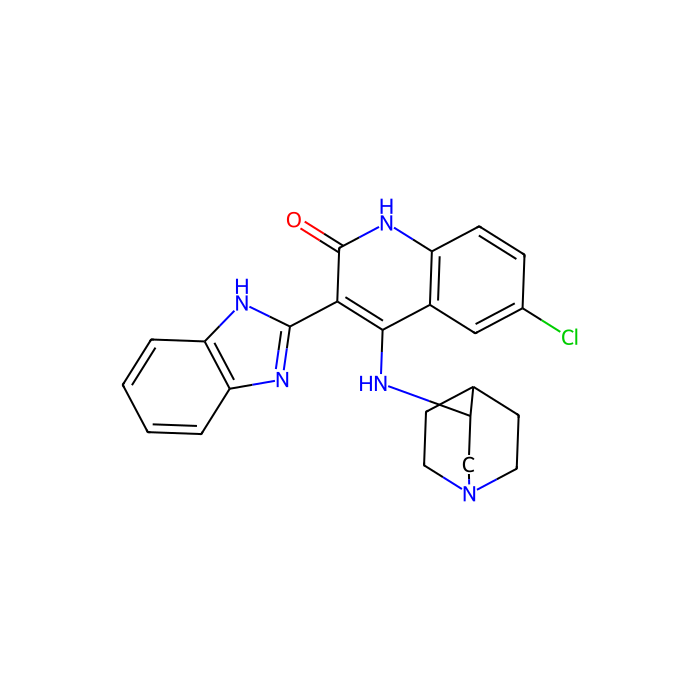
CHIR-124 is a novel and potentChk1inhibitor withIC50of 0.3 nM in a cell-free assay. It shows 2,000-fold selectivity against Chk2, 500- to 5,000-fold less activity against CDK2/4 and Cdc2. In vitro
CHIR-124 is a quinolone-based small molecule that is structurally unrelated to other known inhibitors of Chk1. CHIR-124 interacts synergistically with topoisomerase poisons (e.g., Camptothecin or SN-38) in causing growth inhibition in a variety of cancer cell lines, including breast carcinoma (MDA-MB-231 and MDA-MB-435) and colon carcinoma (SW-620 and Colo205), all of which contains the mutant p53 gene. CHIR-124 abrogates the SN-38-induced S and G2-M checkpoints and potentiates apoptosis in MDA-MD-435 breast cancer cells. The abrogation of the G2-Mcheckpoint and induction of apoptosis by CHIR-124 are enhanced by the loss of p53. CHIR-124 also potently targets other kinases such as PDGFR and Flt3 with IC50 of 6.6 nM and 5.8 nM, respectively.
In vivo
CHIR-124 potentiates the growth inhibitory effects of Irinotecan by abrogating the G2-M checkpoint and increasing tumor apoptosis in an orthotopic breast cancer xenograft model. Cell Data
CHIR-124 is a novel and potent Chk1 inhibitor with IC50 of 0.3 nM in a cell-free assay. It shows 2,000-fold selectivity against Chk2, 500- to 5,000-fold less activity against CDK2/4 and Cdc2.
Storage
Store at -80°C
Shipped In
Dry ice packs + Cold packs
This product requires cold chain shipping. Ground and other economy services are not available.
We use cookies to ensure the website functions properly and, where permitted, to improve your experience. You can manage your preferences at any time in Settings. Learn more in our Cookie Policy.
Shall we send you a message when we have discounts available?
Remind me later
Thank you! Please check your email inbox to confirm.
Products are supplied to verified businesses, institutions, and qualified professionals for research and development use only. Not for use in humans, animals, diagnosis, or therapy.