GRADE & PURITYMoligand™?Moligand™ — Aladdin's line of ligands and bioactive small molecules. Use for receptor, pathway, and binding studies needing defined small-molecule tools.10 mM in DMSO
Moligand™, 10 mM in DMSO Moligand™ for sensitive chromatographic and analytical workflows requiring minimal baseline interference.
🌡
Storage & shipping
Store at -80°C Ships Dry ice packs + Cold packs Check lot-specific COA for exact specifications.
📋
Quality documents
SDS, COA, datasheet, and spec sheet available for download. Lot-specific COA accessible via lot number lookup.
📚
Literature proof
Cited in 2 peer-reviewed publications across chromatography, organic synthesis, and cross-coupling reactions.
Overview
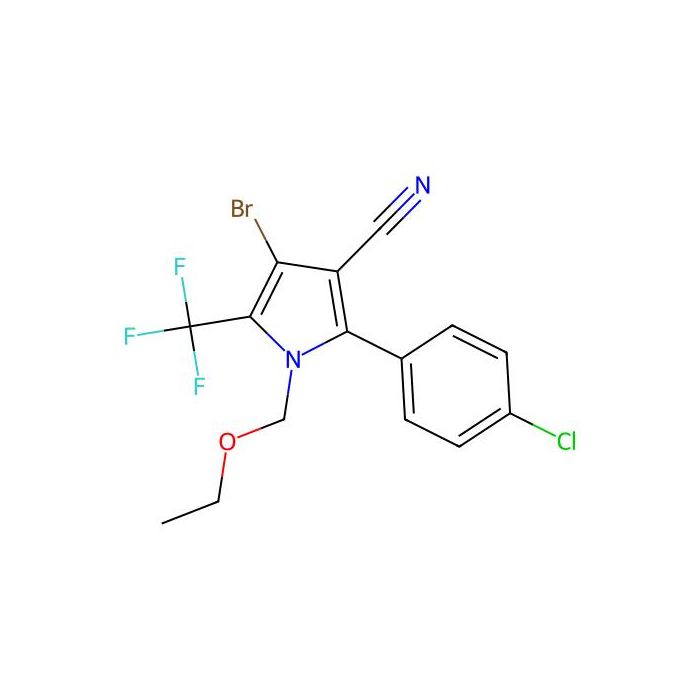
Chlorfenapyr is a pyrrole insecticide. Chlorfenapyr has a mode of action: the mixed function oxidase oxidizes and removes the Nethoxymethyl group to form the active metabolite, CL 303268. Chlorfenapyr is used for termite control and crop protection against a variety of insect and mite pests .
Specifications
Specifications & Purity
Moligand™, 10 mM in DMSO
Storage
Store at -80°C
Shipped In
Dry ice packs + Cold packs
This product requires cold chain shipping. Ground and other economy services are not available.
Grade
Moligand™
Names and Identifiers
Isomeric SMILES
CCOCN1C(=C(C(=C1C(F)(F)F)Br)C#N)C2=CC=C(C=C2)Cl
WGK Germany
3
UN Number
2811
Molecular Weight
407.62
Beilstein
6940152
Documentation
📋 Safety Data Sheet (SDS)
Comprehensive hazard, handling, storage, and regulatory compliance document.
1.Zhi-Xiang Liu, Xiao-Rong Xing, Xin-Hao Liang, Jian-hao Ding, Yi-Jiangcheng Li, Ying Shao, Fu-An Wu, Jun Wang, Sheng Sheng. (2021) The role of Glutathione-S-transferases in phoxim and chlorfenapyr tolerance in a major mulberry pest, Glyphodes pyloalis walker (Lepidoptera: Pyralidae). PESTICIDE BIOCHEMISTRY AND PHYSIOLOGY, [PMID:35082028][10.1016/j.pestbp.2021.105004]
2.Yifan Li, Hong Sun, Hassan Yasoob, Zhen Tian, Yue Li, Ruichi Li, Shengli Zheng, Jiyuan Liu, Yalin Zhang. (2021) Biogenetic cantharidin is a promising leading compound to manage insecticide resistance of Mythimna separata (Lepidoptera: Noctuidae). PESTICIDE BIOCHEMISTRY AND PHYSIOLOGY, [PMID:33518040][10.1016/j.pestbp.2020.104769]
Solution Calculators
Molarity Calculator
Determine the necessary mass, volume, or concentration for preparing a solution.
Dilution Calculator
Determine the dilution needed to prepare a stock solution.
Reconstitution Calculator
Reviews
Customer Reviews
Application Protocols
No manufacturer-validated protocols are provided for this item. The following generalized, literature-style procedures are offered as starting points for research method development.
Preparation of DMSO stock and plate dosing (cell-based assays):
Dissolve Chlorfenapyr in anhydrous DMSO to 10 mM.
Aliquot into amber microtubes; store at −80 °C. Thaw once and keep on ice during use.
For a 96-well plate, prepare serial dilutions (e.g., 10-point, 1:3). Maintain final DMSO ≤0.5% v/v in wells. Include vehicle and positive-control uncoupler controls.
LC–MS/MS residue analysis (example workflow):
Sample extraction: Homogenize 10 g matrix with 10 mL acetonitrile; add MgSO4/NaCl (QuEChERS). Vortex and centrifuge. Collect ACN layer.
Incubate Chlorfenapyr (0.5–10 μM) with insect or liver microsomes (0.5–1 mg/mL protein), NADPH-regenerating system, 30–60 min at 37 °C.
Quench with cold ACN, centrifuge, and analyze supernatant by LC–MS for the de-alkylated metabolite.
Always perform appropriate controls and safety assessments; adapt conditions to your instrumentation.
Biological Roles
Context: Provided for background on mechanism and pathways; not a statement of suitability for clinical/therapeutic use.
Literature-based overview:
Pro-insecticide: Chlorfenapyr is bioactivated by oxidative N-dealkylation (e.g., by cytochrome P450 monooxygenases) to a pyrrole metabolite that acts as a protonophore/uncoupler of oxidative phosphorylation in mitochondria.
Site of action: Disrupts mitochondrial proton gradient, leading to increased oxygen consumption and reduced ATP synthesis. Effects are energy deprivation and eventual organismal lethality in susceptible arthropods.
Selectivity rationale: Activation-dependent toxicity; metabolic capacity and detoxification pathways influence species sensitivity. The parent compound is comparatively less active until converted to the uncoupling metabolite.
Biotransformation: Major processes include N-dealkylation (activation), hydroxylation, and conjugation; environmental photolysis and hydrolysis can also occur, yielding less active products over time.
Research implications:
Tool compound for studying bioenergetics, mitochondrial coupling efficiency, and xenobiotic metabolism in insect systems.
Useful in resistance mechanism studies (e.g., P450-mediated activation variance, metabolic detoxification), without implying any pest control recommendations here.
Note: Use strictly for research; observe institutional biosafety and chemical safety protocols.
Buffer Applications
This product is not a buffer reagent. Chlorfenapyr is a hydrophobic small molecule with negligible water solubility and is not used to formulate laboratory buffers.
Practical guidance:
If dosing into aqueous buffers for bioassays, prepare concentrated DMSO stocks and dilute into the target buffer, keeping cosolvent typically ≤0.1–1% v/v to maintain biological compatibility.
For stability, protect assay plates or tubes from light and excessive heat during incubations.
Green Alternatives
Chlorfenapyr is an active pesticidal research compound; there are no direct “green” drop-in substitutes for its bioactivity. However, greener practices apply to its handling and analytical workflows.
Greener practice suggestions (general):
Solvent choice: Prefer acetonitrile over dichloromethane for sample preparation and HPLC where performance allows; use ethanol or ethyl acetate for extractions when compatible with target recovery.
Miniaturization: Adopt microscale extraction (e.g., μQuEChERS) to reduce solvent volumes.
Energy: Cold-chain storage is required for stability; mitigate impact by aliquoting to minimize freezer door openings and by consolidating shipments.
Waste: Segregate halogenated organic waste; use adsorbents to capture residuals before aqueous disposal streams. Treat as persistent/toxic waste per local regulations.
Comparison (illustrative; not bioequivalent):
Alternative analytes for method development: benign surrogates (e.g., halogenated aromatics without pesticidal activity) can be used to validate retention windows before introducing Chlorfenapyr standards.
Alternative extraction systems: Switch from chlorinated solvents to acetonitrile or ethyl acetate when recovery and matrix effects remain acceptable.
Pharmaceutical Uses
Not applicable. Chlorfenapyr is an agricultural/entomological research compound and is not used as a pharmaceutical excipient or in drug product formulation.
Laboratory-related notes (general):
It may serve as a reference material in analytical method development for xenobiotic detection in biological matrices but has no recognized pharmacopeial monograph as an excipient.
Any handling in a pharmaceutical lab context should be confined to nonclinical research and method development with appropriate containment.
Aqueous solubility (25 °C): very low (on the order of 0.1–1 mg/L, literature)
Vapor pressure: very low (literature; sub-Pa at 25 °C)
pKa: not applicable (neutral molecule without ionizable centers in physiologic range; literature rationale)
UV–vis: strong absorbance in the UV region typical for halogenated aromatics/heteroaromatics (literature, qualitative)
Practical notes (general):
Due to hydrophobicity, Chlorfenapyr dissolves readily in nonpolar/medium-polar organic solvents (e.g., DMSO, DMF, acetone, acetonitrile) and poorly in water.
For analytical work, LC–MS/MS or HPLC–UV methods commonly use acetonitrile/water (with 0.1% formic acid) gradients to track elution of this moderately nonpolar analyte.
Quality & Grades
Grade/Purity: Moligand™ (as listed for this item)
What Moligand™ implies (general explanation):
Moligand™ designates compounds curated for small-molecule screening, ligand discovery, and chemical biology libraries. Emphasis is on identity confirmation and suitability for high-throughput screening workflows rather than chromatographic-grade solvent purity.
Typical controls for such library-grade materials include structure confirmation (e.g., NMR/HRMS), purity assessment suitable for screening, and barcoded/traceable packaging. Exact acceptance criteria are batch-specific.
Item-specific notes:
Exact purity assay method and limits: Not specified for this item; refer to CoA/Spec Sheet.
Stabilizers/inhibitors: Not specified for this item; refer to CoA/Spec Sheet.
UV cutoff, water content, residual solvents, and elemental impurities: Not specified for this item; refer to CoA/Spec Sheet.
When to choose this grade:
Appropriate for discovery screening, target validation assays, environmental fate method development, and as a reference standard in chromatographic or spectrometric methods where Moligand™ quality suffices.
For regulated applications (GxP) or quantitative reference standards with metrological traceability, request a dedicated analytical standard grade and full certificate of analysis.
Reaction & Applications
This compound is primarily a bioactive small molecule rather than a synthetic reagent. Accordingly, laboratory use centers on analytical, environmental, and biological testing rather than as a reaction solvent or substrate.
Research application themes (literature/general):
Mode-of-action studies: Chlorfenapyr is a pro-insecticide that undergoes oxidative N-dealkylation to an active metabolite that uncouples mitochondrial oxidative phosphorylation. It is used to probe bioenergetics disruption in invertebrates and model systems.
Analytical reference: Employed as a calibration/reference standard for LC–MS/MS and GC–MS methods in residue analysis (soil, water, food matrices) and in degradation/photolysis studies.
Environmental fate: Used in hydrolysis, photolysis, and biodegradation studies to establish DT50 values and identify transformation products.
Practical tips:
Handle solutions under subdued light to minimize photolysis during long analytical runs.
For metabolism studies, microsomal or S9 fraction incubations (insect or mammalian) can generate the de-alkylated active metabolite; control for protein binding given hydrophobicity.
For adsorption/fate assays, pre-equilibrate with organic-rich matrices and account for strong sorption to plastics—use glass when feasible.
Reaction Conditions
As Chlorfenapyr is generally used as an analyte or bioactive probe rather than a reagent, there are no standard “reaction conditions” in the synthetic sense. The following notes pertain to analytical and bioassay handling (literature/general):
Stock solutions: 10–50 mM in anhydrous DMSO are commonly prepared for screening; filter through PTFE (0.2 μm) if particulate is present. Avoid adsorption losses by using glass vials.
Working concentrations: In cellular or enzymatic bioenergetics assays, exploratory ranges of 0.01–30 μM are typical for concentration–response curves; optimize per system and include vehicle controls.
Chromatography: HPLC or UPLC on C18 using ACN/H2O (±0.1% formic acid) gradients; detection by UV (200–300 nm) or MS (ESI/APCI). Flow and gradient depend on column and matrix complexity.
Stability: Protect from strong light and elevated temperature during extended runs. Monitor for de-alkylated metabolite formation in oxidative systems.
These are general literature-style guidelines; adjust conditions to your platform and consult primary sources and your method validation plan.
Safety & Handling
Safety information specific to this item:
Signal word: Not specified for this item; refer to SDS.
Hazard statements (H-codes): Not specified for this item; refer to SDS.
GHS classification and pictograms: Not specified for this item; refer to SDS.
General safety considerations for Chlorfenapyr (literature/typical for this class):
Toxicity: Chlorfenapyr is a bioactivated insecticidal compound; handle as acutely toxic and environmentally hazardous. Avoid inhalation, ingestion, and skin contact.
Aquatic hazard: Expected to be very toxic to aquatic life with long-lasting effects; prevent release to the environment. Collect spillage using inert absorbents.
PPE: Use lab coat, nitrile gloves (double-gloving recommended for extended handling), and splash-resistant safety goggles. Work in a certified chemical fume hood.
Incompatibilities: Strong oxidizers and strong acids/bases may cause degradation; avoid excessive heat and UV exposure.
First aid overview: If inhaled, move to fresh air and seek medical advice; if on skin, wash with soap and water; if in eyes, rinse cautiously with water for several minutes; if swallowed, rinse mouth—do NOT induce vomiting—seek medical attention.
Fire response: Use CO2, dry chemical, or foam. Combustion/thermal decomposition may release hydrogen halides and other toxic fumes; firefighters should wear self-contained breathing apparatus.
Always consult the product SDS for authoritative hazard, exposure limits, spill response, and disposal guidance.
Solvent Selection
Applicability: Chlorfenapyr is a hydrophobic, neutral solid; solvent choice impacts solubility, stability, and assay compatibility.
General solvent behavior (literature/general):
Polarity class: low-to-moderate polarity solute with high hydrophobicity (log Kow ~4.5–5.0).
Recommended stock solvents: DMSO (primary choice for bioassays), DMF, acetone, acetonitrile, ethyl acetate, dichloromethane, toluene. Poorly soluble in water and aqueous buffers.
Miscibility profile: DMSO and DMF stocks can be diluted into aqueous media; keep final cosolvent typically ≤0.1–1% v/v in biological assays to minimize vehicle effects.
Selection tips:
For LC–MS/HPLC method development: start with acetonitrile/water gradients (0.1% formic acid optional) using C18 columns; Chlorfenapyr elutes in the mid-to-late organic phase.
For stability during storage: prepare anhydrous DMSO stocks, aliquot, and store at −80 °C; avoid repeated freeze–thaw.
For extraction from matrices: nonpolar/medium-polar solvents (hexane:acetone, acetonitrile:water with salts—QuEChERS-type approaches) are commonly effective.
Comparison (general):
DMSO: maximal solubility and cryostability; may affect some enzyme assays at >0.5% v/v.
Acetonitrile: excellent for chromatography; limited solubility versus DMSO but volatile and MS-friendly.
Ethyl acetate: good for extractions; less suitable for long-term stocks due to volatility.
General guidance for this compound type (supporting, not replacing item-specific instructions):
Container: Store as tightly sealed, light-protected aliquots (amber glass vials) under dry, inert atmosphere if feasible to limit oxidative degradation.
Reconstitution: For most applications, reconstitute in anhydrous DMSO to prepare concentrated stocks (e.g., 10–50 mM). Vortex thoroughly; gentle warming (to ~25–30 °C) may aid dissolution. Avoid water ingress.
Aliquoting: Prepare single-use aliquots to minimize freeze–thaw cycles. Record preparation date and lot traceability on each aliquot.
Handling: Allow frozen aliquots to equilibrate briefly on ice before opening to prevent moisture condensation. After use, promptly refreeze unused aliquots.
Stability monitoring: Periodically verify integrity by LC–MS or HPLC (single major peak) if stocks are stored for >6 months.
Note: When formulating into aqueous systems, add DMSO stock to the buffer under vigorous mixing to avoid precipitation. Final vehicle content should be minimized consistent with assay tolerance.
Structure & Identity
Chlorfenapyr is a halogenated pyrrole insecticide widely used as a research reference standard and library compound.
SKU: C1499424
Product Name: Chlorfenapyr
CAS: 122453-73-0 (literature)
PubChem CID: 91778 (literature)
Molecular formula: C15H11BrClF3N2O (literature)
Molecular weight: ~407.6 g/mol (literature)
InChIKey: Not specified for this item; refer to CoA/Spec Sheet.
SMILES: Not specified for this item; refer to CoA/Spec Sheet.
Structural features (literature description):
Core heteroaromatic ring: substituted pyrrole.
Substituents: para-chlorophenyl, bromine on the pyrrole ring, a trifluoromethyl group, and an N-ethoxymethyl moiety (pro-insecticide masking group).
Functional groups: halogens (Br, Cl), trifluoromethyl (–CF3), ether (–O–), and a bioactivation-labile N-alkoxymethyl group.
2D structure in words: a polysubstituted pyrrole bearing an aryl substituent and multiple electron-withdrawing/halogen substituents; the pyrrolic nitrogen is protected as an ethoxymethyl ether-like group that is cleaved metabolically to the active uncoupler.
Note: Exact structural identifiers (SMILES/InChI) may vary across tautomeric/neutral representations; consult the CoA/SDS for definitive identifiers for this specific lot.
Synthetic Utility
Chlorfenapyr is typically a target/analyte rather than a synthetic reagent. Its synthetic relevance to practicing chemists is mainly as follows:
Reference standard: Used to validate extraction, cleanup, and detection workflows (e.g., QuEChERS LC–MS/MS) for halogenated heteroaromatics.
Metabolite synthesis: Serves as a starting point for preparing and characterizing its active de-alkylated metabolite and other transformation products for toxicology and environmental fate studies.
Structural motif insight: The molecule exemplifies design elements common in modern agrochemicals—polysubstituted pyrroles, heavy halogenation for metabolic stability, and bio-reversible masking groups (N-alkoxymethyl) for pro-activation.
Retrosynthetic considerations (general):
Disconnections often target formation of the substituted pyrrole core (e.g., Paal–Knorr-type strategies or cyclizations from 1,4-dicarbonyl surrogates), followed by late-stage halogenation, aryl substitution, CF3 introduction, and N-alkoxymethyl protection.
Regiochemical control in halogenation and arylation of the pyrrole nucleus is a key challenge addressed via directed metalation or cross-coupling approaches in literature syntheses.
Target Specificity
This section is primarily applicable to biological macromolecules (e.g., antibodies, enzymes). For this small-molecule library compound, no antigen/clone/isotype information applies.
Target binding specificity data: Not specified for this item; refer to literature on mitochondrial uncouplers for mechanistic context.
Summary (general literature): Chlorfenapyr’s bioactivity arises from metabolic conversion to an uncoupling agent that broadly disrupts mitochondrial proton gradients rather than binding a single protein target with high specificity.
We use cookies to ensure the website functions properly and, where permitted, to improve your experience. You can manage your preferences at any time in Settings. Learn more in our Cookie Policy.
Shall we send you a message when we have discounts available?
Remind me later
Thank you! Please check your email inbox to confirm.
Products are supplied to verified businesses, institutions, and qualified professionals for research and development use only. Not for use in humans, animals, diagnosis, or therapy.