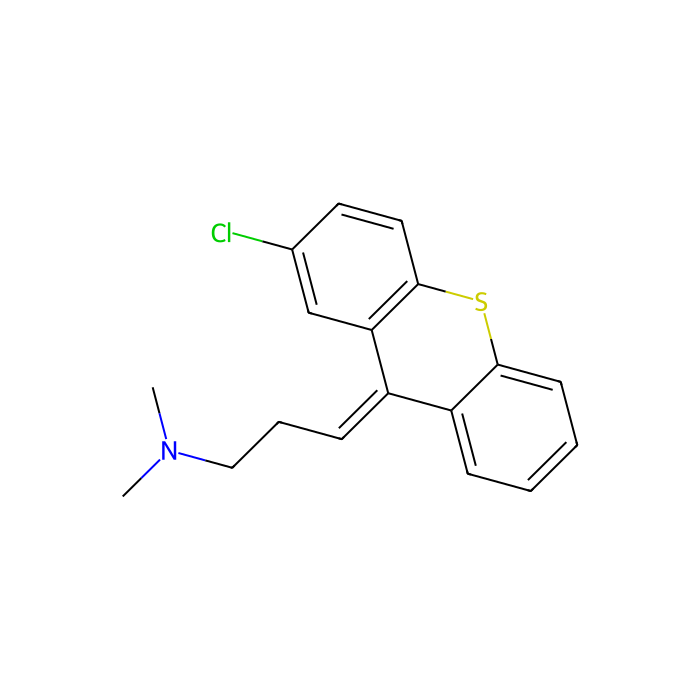
Chlorprothixene - Moligand™, ≥98% , Serotonin 2c (5-HT2c) receptor antagonist, CAS No.113-59-7, Serotonin 2c (5-HT2c) receptor antagonist

CAS: 113-59-7 Cat. No.: C129441 Formula: C18H18ClNS Molecular Weight: 315.86 EC Number: 204-032-8
AVAILABLE TO ORDER
GRADE & PURITY Moligand™ ? Moligand™ — Aladdin's line of ligands and bioactive small molecules. Use for receptor, pathway, and binding studies needing defined small-molecule tools. ≥98%
Synonyms
Chlorprothixene 100 microg/mL in Acetonitrile | NCGC00166133-01 | CCG-36988 | Chlorprotixene | BRD-K81091703-003-01-0 | Clorprotisene | Clorprotixeno [INN-Spanish] | Ro 4-0403 | 3-(2-chloro-9H-thioxanthen-9-ylidene)-N,N-dimethylpropan-1-amine | 9S7OD60EWP
Storage
Store at 2-8°C
Shipped In
Wet ice
★
Size
Germany (EU)
USA*
Price
Qty
50mg
C129441-50mg
—
6 In stock
€51.98
250mg
C129441-250mg
—
3 In stock
€148.30
1g
C129441-1g
—
2 In stock
€342.67
5g
C129441-5g
—
2 In stock
€1,147.06
Enter a quantity for the sizes you want to add.

Overview

Chlorprothixene has strong binding affinities to dopamine and histamine receptors, such as D1, D2, D3, D5, H1, 5-HT2, 5-HT6 and 5-HT7, with Ki of 18 nM, 2.96 nM, 4.56 nM, 9 nM, 3.75 nM, 9.4 nM, 3 nM and 5.6 nM, respectively.

Specifications

Specifications & Purity
Moligand™, ≥98%
Biochemical and Physiological Mechanisms
Potent, non-selective dopamine, 5-HT and H 1 receptor antagonist (K i values are 18, 3, 5, 9, 9, 3, 6 and 4 nM for D 1 , D 2 , D 3 , D5, 5-HT 2 , 5-HT 6 , 5-HT 7 and H 1 receptors respectively). α1-adrenoceptor and muscarinic receptor antagonist.
Storage
Store at 2-8°C
Shipped In
Wet ice
This product requires cold chain shipping. Ground and other economy services are not available.
Grade
Moligand™
Action Type
ANTAGONIST
Mechanism of action
Serotonin 2c (5-HT2c) receptor antagonist
Note
Wherever possible, you should prepare and use solutions on the same day. However, if you need to make up stock solutions in advance, we recommend that you store the solution as aliquots in tightly sealed vials at -20°C. Generally, these will be useable for up to one month. Before use, and prior to opening the vial we recommend that you allow your product to equilibrate to room temperature for at least 1 hour. Toxic, refer to SDS for further information. Need more advice on solubility, usage and handling? Please visit our frequently asked questions (FAQ) page for more details.
Purity
≥98%
Product Properties
ALogP
5.2
Names and Identifiers
Pubchem Sid
Pubchem Sid Url
https://pubchem.ncbi.nlm.nih.gov/substance/488191018
Canonical Smiles
CN(C)CCC=C1C2=CC=CC=C2SC3=C1C=C(C=C3)Cl
IUPAC Name
(3Z)-3-(2-chlorothioxanthen-9-ylidene)-N,N-dimethylpropan-1-amine
InChIKey
WSPOMRSOLSGNFJ-AUWJEWJLSA-N
INCHI
1S/C18H18ClNS/c1-20(2)11-5-7-14-15-6-3-4-8-17(15)21-18-10-9-13(19)12-16(14)18/h3-4,6-10,12H,5,11H2,1-2H3/b14-7-
Isomeric SMILES
CN(C)CC/C=C\1/C2=CC=CC=C2SC3=C1C=C(C=C3)Cl
Molecular Weight
315.86
Reaxy-Rn
89898
Reaxys-RN_link_address
https://www.reaxys.com/reaxys/secured/hopinto.do?context=S&query=IDE.XRN=89898&ln=

Advanced Data

Taxonomic Classification

Taxonomy Tree

KingdomOrganic compounds
SuperclassOrganoheterocyclic compounds
ClassBenzothiopyrans
Subclass1-benzothiopyrans
Intermediate Tree Nodes Not available
Direct ParentThioxanthenes
Alternative Parents Diarylthioethers  Benzenoids  Aryl chlorides  Trialkylamines  Organopnictogen compounds  Organochlorides  Hydrocarbon derivatives  
Molecular FrameworkAromatic heteropolycyclic compounds
Substituents Thioxanthene - Diarylthioether - Aryl thioether - Aryl chloride - Aryl halide - Benzenoid - Tertiary amine - Tertiary aliphatic amine - Thioether - Hydrocarbon derivative - Organonitrogen compound - Organochloride - Organohalogen compound - Organopnictogen compound - Organic nitrogen compound - Amine - Aromatic heteropolycyclic compound
DescriptionThis compound belongs to the class of organic compounds known as thioxanthenes. These are organic polycyclic compounds containing a thioxanthene moiety, which is an aromatic tricycle derived from xanthene by replacing the oxygen atom with a sulfur atom.
External Descriptors organochlorine compound
3D Structure
Interactive Chemical Structure Model


Associated Targets(Human)
DRD1 Tclin D(1A) dopamine receptor (1 Activities)
Activity TypeActivity Value -log(M)Mechanism of ActionActivity ReferencePublications (PubMed IDs)
DRD2 Tclin D(2) dopamine receptor (1 Activities)
Activity TypeActivity Value -log(M)Mechanism of ActionActivity ReferencePublications (PubMed IDs)
HRH1 Tclin Histamine H1 receptor (2 Activities)
Activity TypeActivity Value -log(M)Mechanism of ActionActivity ReferencePublications (PubMed IDs)
DRD3 Tclin D(3) dopamine receptor (1 Activities)
Activity TypeActivity Value -log(M)Mechanism of ActionActivity ReferencePublications (PubMed IDs)
DRD5 Tchem D(1B) dopamine receptor (1 Activities)
Activity TypeActivity Value -log(M)Mechanism of ActionActivity ReferencePublications (PubMed IDs)
HTR6 Tchem 5-hydroxytryptamine receptor 6 (1 Activities)
Activity TypeActivity Value -log(M)Mechanism of ActionActivity ReferencePublications (PubMed IDs)
F2 Tclin Thrombin (11687 Activities)
Activity TypeRelationActivity valueUnitsAction TypeJournalPubMed IddoiAssay Aladdin ID
ESR1 Tclin Estrogen receptor alpha (17718 Activities)
Activity TypeRelationActivity valueUnitsAction TypeJournalPubMed IddoiAssay Aladdin ID
NR3C1 Tclin Glucocorticoid receptor (14987 Activities)
Activity TypeRelationActivity valueUnitsAction TypeJournalPubMed IddoiAssay Aladdin ID
PGR Tclin Progesterone receptor (8562 Activities)
Activity TypeRelationActivity valueUnitsAction TypeJournalPubMed IddoiAssay Aladdin ID
CHRM2 Tclin Muscarinic acetylcholine receptor M2 (10671 Activities)
Activity TypeRelationActivity valueUnitsAction TypeJournalPubMed IddoiAssay Aladdin ID
ADRB1 Tclin Beta-1 adrenergic receptor (6630 Activities)
Activity TypeRelationActivity valueUnitsAction TypeJournalPubMed IddoiAssay Aladdin ID
HTR1A Tclin Serotonin 1a (5-HT1a) receptor (14969 Activities)
Activity TypeRelationActivity valueUnitsAction TypeJournalPubMed IddoiAssay Aladdin ID
ADRA2A Tclin Alpha-2a adrenergic receptor (9450 Activities)
Activity TypeRelationActivity valueUnitsAction TypeJournalPubMed IddoiAssay Aladdin ID
AR Tclin Androgen Receptor (11781 Activities)
Activity TypeRelationActivity valueUnitsAction TypeJournalPubMed IddoiAssay Aladdin ID
CHRM1 Tclin Muscarinic acetylcholine receptor M1 (12690 Activities)
Activity TypeRelationActivity valueUnitsAction TypeJournalPubMed IddoiAssay Aladdin ID
DRD2 Tclin Dopamine D2 receptor (23596 Activities)
Activity TypeRelationActivity valueUnitsAction TypeJournalPubMed IddoiAssay Aladdin ID
GABRA1 Tclin GABA receptor alpha-1 subunit (399 Activities)
Activity TypeRelationActivity valueUnitsAction TypeJournalPubMed IddoiAssay Aladdin ID
MAOA Tclin Monoamine oxidase A (11911 Activities)
Activity TypeRelationActivity valueUnitsAction TypeJournalPubMed IddoiAssay Aladdin ID
DRD1 Tclin Dopamine D1 receptor (9720 Activities)
Activity TypeRelationActivity valueUnitsAction TypeJournalPubMed IddoiAssay Aladdin ID
ACHE Tclin Acetylcholinesterase (18204 Activities)
Activity TypeRelationActivity valueUnitsAction TypeJournalPubMed IddoiAssay Aladdin ID
PTGS1 Tclin Cyclooxygenase-1 (9233 Activities)
Activity TypeRelationActivity valueUnitsAction TypeJournalPubMed IddoiAssay Aladdin ID
SLC6A2 Tclin Norepinephrine transporter (10102 Activities)
Activity TypeRelationActivity valueUnitsAction TypeJournalPubMed IddoiAssay Aladdin ID
AVPR2 Tclin Vasopressin V2 receptor (2912 Activities)
Activity TypeRelationActivity valueUnitsAction TypeJournalPubMed IddoiAssay Aladdin ID
ADORA1 Tclin Adenosine A1 receptor (17603 Activities)
Activity TypeRelationActivity valueUnitsAction TypeJournalPubMed IddoiAssay Aladdin ID
AGTR1 Tclin Type-1 angiotensin II receptor (5176 Activities)
Activity TypeRelationActivity valueUnitsAction TypeJournalPubMed IddoiAssay Aladdin ID
SLC6A4 Tclin Serotonin transporter (12625 Activities)
Activity TypeRelationActivity valueUnitsAction TypeJournalPubMed IddoiAssay Aladdin ID
ADRA1A Tclin Alpha-1a adrenergic receptor (8359 Activities)
Activity TypeRelationActivity valueUnitsAction TypeJournalPubMed IddoiAssay Aladdin ID
PTGS2 Tclin Cyclooxygenase-2 (13999 Activities)
Activity TypeRelationActivity valueUnitsAction TypeJournalPubMed IddoiAssay Aladdin ID
HRH1 Tclin Histamine H1 receptor (7573 Activities)
Activity TypeRelationActivity valueUnitsAction TypeJournalPubMed IddoiAssay Aladdin ID
OPRM1 Tclin Mu opioid receptor (19785 Activities)
Activity TypeRelationActivity valueUnitsAction TypeJournalPubMed IddoiAssay Aladdin ID
DRD3 Tclin Dopamine D3 receptor (14368 Activities)
Activity TypeRelationActivity valueUnitsAction TypeJournalPubMed IddoiAssay Aladdin ID
PPARG Tclin Peroxisome proliferator-activated receptor gamma (15191 Activities)
Activity TypeRelationActivity valueUnitsAction TypeJournalPubMed IddoiAssay Aladdin ID
AVPR1A Tclin Vasopressin V1a receptor (5412 Activities)
Activity TypeRelationActivity valueUnitsAction TypeJournalPubMed IddoiAssay Aladdin ID
SLC6A3 Tclin Dopamine transporter (10535 Activities)
Activity TypeRelationActivity valueUnitsAction TypeJournalPubMed IddoiAssay Aladdin ID
KCNH2 Tclin HERG (29587 Activities)
Activity TypeRelationActivity valueUnitsAction TypeJournalPubMed IddoiAssay Aladdin ID
PDE3A Tclin Phosphodiesterase 3A (3309 Activities)
Activity TypeRelationActivity valueUnitsAction TypeJournalPubMed IddoiAssay Aladdin ID
SLC29A1 Tclin Equilibrative nucleoside transporter 1 (1711 Activities)
Activity TypeRelationActivity valueUnitsAction TypeJournalPubMed IddoiAssay Aladdin ID
DRD5 Tchem Dopamine D5 receptor (1597 Activities)
Activity TypeRelationActivity valueUnitsAction TypeJournalPubMed IddoiAssay Aladdin ID
HTR2B Tclin Serotonin 2b (5-HT2b) receptor (10323 Activities)
Activity TypeRelationActivity valueUnitsAction TypeJournalPubMed IddoiAssay Aladdin ID
TBXA2R Tclin Thromboxane A2 receptor (5717 Activities)
Activity TypeRelationActivity valueUnitsAction TypeJournalPubMed IddoiAssay Aladdin ID
EDNRA Tclin Endothelin receptor ET-A (5008 Activities)
Activity TypeRelationActivity valueUnitsAction TypeJournalPubMed IddoiAssay Aladdin ID
ADORA2A Tclin Adenosine A2a receptor (16305 Activities)
Activity TypeRelationActivity valueUnitsAction TypeJournalPubMed IddoiAssay Aladdin ID
PDE4A Tclin Phosphodiesterase 4A (1943 Activities)
Activity TypeRelationActivity valueUnitsAction TypeJournalPubMed IddoiAssay Aladdin ID
ADORA3 Tchem Adenosine A3 receptor (15931 Activities)
Activity TypeRelationActivity valueUnitsAction TypeJournalPubMed IddoiAssay Aladdin ID
BDKRB2 Tclin Bradykinin B2 receptor (3970 Activities)
Activity TypeRelationActivity valueUnitsAction TypeJournalPubMed IddoiAssay Aladdin ID
HRH3 Tclin Histamine H3 receptor (10389 Activities)
Activity TypeRelationActivity valueUnitsAction TypeJournalPubMed IddoiAssay Aladdin ID
HTR6 Tchem Serotonin 6 (5-HT6) receptor (9749 Activities)
Activity TypeRelationActivity valueUnitsAction TypeJournalPubMed IddoiAssay Aladdin ID
CHRNA4 Tclin Neuronal acetylcholine receptor protein alpha-4 subunit (1265 Activities)
Activity TypeRelationActivity valueUnitsAction TypeJournalPubMed IddoiAssay Aladdin ID
PIM1 Tchem Serine/threonine-protein kinase PIM1 (9629 Activities)
Activity TypeRelationActivity valueUnitsAction TypeJournalPubMed IddoiAssay Aladdin ID
MC3R Tchem Melanocortin receptor 3 (5659 Activities)
Activity TypeRelationActivity valueUnitsAction TypeJournalPubMed IddoiAssay Aladdin ID
MLNR Tchem Motilin receptor (1724 Activities)
Activity TypeRelationActivity valueUnitsAction TypeJournalPubMed IddoiAssay Aladdin ID
CCKBR Tclin Cholecystokinin B receptor (3550 Activities)
Activity TypeRelationActivity valueUnitsAction TypeJournalPubMed IddoiAssay Aladdin ID
GHSR Tclin Ghrelin receptor (6229 Activities)
Activity TypeRelationActivity valueUnitsAction TypeJournalPubMed IddoiAssay Aladdin ID
GLP1R Tclin Glucagon-like peptide 1 receptor (111429 Activities)
Activity TypeRelationActivity valueUnitsAction TypeJournalPubMed IddoiAssay Aladdin ID
NR1I2 Tchem Pregnane X receptor (6667 Activities)
Activity TypeRelationActivity valueUnitsAction TypeJournalPubMed IddoiAssay Aladdin ID
Associated Targets(non-human)
Htr7 Serotonin 7 (5-HT7) receptor (19 Activities)
Activity TypeRelationActivity valueUnitsAction TypeJournalPubMed IddoiAssay Aladdin ID
Npy1r Neuropeptide Y receptor type 1 (8 Activities)
Activity TypeRelationActivity valueUnitsAction TypeJournalPubMed IddoiAssay Aladdin ID
Cckar Cholecystokinin A receptor (90 Activities)
Activity TypeRelationActivity valueUnitsAction TypeJournalPubMed IddoiAssay Aladdin ID
Abcb1b P-glycoprotein 1 (174 Activities)
Activity TypeRelationActivity valueUnitsAction TypeJournalPubMed IddoiAssay Aladdin ID
Plasmodium falciparum (966862 Activities)
Activity TypeRelationActivity valueUnitsAction TypeJournalPubMed IddoiAssay Aladdin ID
Felis catus (3858 Activities)
Activity TypeRelationActivity valueUnitsAction TypeJournalPubMed IddoiAssay Aladdin ID
Mus musculus (284745 Activities)
Activity TypeRelationActivity valueUnitsAction TypeJournalPubMed IddoiAssay Aladdin ID
Rattus norvegicus (775804 Activities)
Activity TypeRelationActivity valueUnitsAction TypeJournalPubMed IddoiAssay Aladdin ID
rep Replicase polyprotein 1ab (378 Activities)
Activity TypeRelationActivity valueUnitsAction TypeJournalPubMed IddoiAssay Aladdin ID
PDR5 Pleiotropic ABC efflux transporter of multiple drugs (46 Activities)
Activity TypeRelationActivity valueUnitsAction TypeJournalPubMed IddoiAssay Aladdin ID
Snq2p (23 Activities)
Activity TypeRelationActivity valueUnitsAction TypeJournalPubMed IddoiAssay Aladdin ID
Scn2a Sodium channel alpha subunits; brain (Types I, II, III) (344 Activities)
Activity TypeRelationActivity valueUnitsAction TypeJournalPubMed IddoiAssay Aladdin ID
Whole blood (71 Activities)
Activity TypeRelationActivity valueUnitsAction TypeJournalPubMed IddoiAssay Aladdin ID
SARS-CoV-2 (38078 Activities)
Activity TypeRelationActivity valueUnitsAction TypeJournalPubMed IddoiAssay Aladdin ID
Mechanisms of Action
Certificates (CoA,COO,BSE/TSE and Analysis Chart)
C of A & Other Certificates(BSE/TSE, COO):
Analytical Chart:

Find and download the COA for your product by matching the lot number on the packaging.

8 results found

Lot NumberCertificate TypeDateItem
C2329812C2329812Certificate of AnalysisSep 22, 2026 C129441
C2329813C2329813Certificate of AnalysisSep 22, 2026 C129441
C2329814C2329814Certificate of AnalysisSep 22, 2026 C129441
C2329815C2329815Certificate of AnalysisSep 22, 2026 C129441
C2329816C2329816Certificate of AnalysisSep 22, 2026 C129441
C2329817C2329817Certificate of AnalysisSep 22, 2026 C129441
C2329821C2329821Certificate of AnalysisSep 22, 2026 C129441
E1529005E1529005Certificate of AnalysisJun 15, 2026 C129441
Chemical and Physical Properties
SolubilityDMSO 6 mg/mL Water Ethanol 28 mg/mL
SensitivityHeat Sensitive
Melt Point(°C)97 °C
Molecular Weight315.900 g/mol
XLogP35.200
Hydrogen Bond Donor Count0
Hydrogen Bond Acceptor Count2
Rotatable Bond Count3
Exact Mass315.085 Da
Monoisotopic Mass315.085 Da
Topological Polar Surface Area28.500 Ų
Heavy Atom Count21
Formal Charge0
Complexity381.000
Isotope Atom Count0
Defined Atom Stereocenter Count0
Undefined Atom Stereocenter Count0
Defined Bond Stereocenter Count1
Undefined Bond Stereocenter Count0
The total count of all stereochemical bonds1
Covalently-Bonded Unit Count1
Solution Calculators
Reviews

Customer Reviews

Application Protocols

No tested application protocols are provided for this SKU in the Product Data. Refer to the CoA/Spec Sheet and your laboratory’s validated SOPs.

  • Research Use Only (from Product Data): Any protocol development should include internal controls, solvent controls (e.g., DMSO ≤1% v/v final), and verification of concentration by analytical methods (e.g., UV or LC–MS).

If you require standardized protocols (e.g., radioligand binding, functional GPCR assays), consult domain-specific literature and adapt to your instrumentation and cell/assay system.

Biological Roles
  • General/literature context (non-clinical; for research only):

    • Chlorprothixene belongs to the thioxanthene class known to interact with aminergic receptors in the CNS. It has been studied as an antagonist at dopamine (e.g., D2-like), serotonin (e.g., 5‑HT2 family), histamine H1, and adrenergic receptors in pharmacology literature. These interactions underpin its frequent use as a reference tool compound for receptor binding and functional assays.
    • The tertiary amine enables protonation under physiological pH, influencing membrane permeability, target engagement, and distribution in in vitro systems. Its lipophilic tricyclic core can drive high nonspecific membrane binding; careful control experiments (vehicle controls, counter-screens) are recommended.
    • Off-target profiling: In cheminformatics studies, tricyclic, cationic amphiphilic compounds may exhibit lysosomotropic behavior and hERG channel interactions; such properties are typically assessed during safety pharmacology screening (research context only).
  • Experimental implications:

    • Use as a positive/negative control in receptor panels to map assay sensitivity and specificity.
    • Consider time-dependent effects due to accumulation in membranes/organelles in cell-based assays; washout steps and pre-incubation times should be standardized.

Note: No medical, diagnostic, or therapeutic use is implied. All biological role descriptions are from general literature and are provided solely to aid experimental design.

Buffer Applications

This product is not a buffering agent and is not typically used to prepare buffer systems.

  • Practical note for assay buffers (general):
    • When dosing into aqueous buffers, dissolve first in DMSO (or another compatible organic), then dilute into buffer to the desired final concentration while keeping the final organic content low and constant across controls.
    • To increase apparent aqueous solubility, slight acidification of the buffer (e.g., 0.1% formic or acetic acid) can help by protonating the tertiary amine. Verify that pH and additives are compatible with your biological assay.

For specific buffer recipes or pH ranges, refer instead to your assay’s validated SOPs; this compound itself does not define a buffering system.

Green Alternatives

Green chemistry considerations are not typically centered on the molecule itself (a specialized thioxanthene ligand) but on the solvents and processes used to handle it.

  • Solvent greener choices (general):

    • Prefer ethanol or isopropanol over chlorinated solvents when feasible for cleaning and preliminary dissolution trials.
    • For chromatography, consider ACN/water mobile phases with volatile buffers instead of halogenated eluents when MS compatibility is needed.
  • Example comparison (general; molecule handling context):

    • DMSO vs DMF: DMSO has a better EHS profile and is widely accepted for screening stocks; DMF poses additional reproductive toxicity concerns.
    • ACN vs CHCl3 for analytical prep: acetonitrile with aqueous buffers is typically greener and safer than chloroform for routine sample work.
  • Process minimization:

    • Prepare concentrated master stocks to minimize solvent volume in assays.
    • Use low-volume, high-throughput dispensing to reduce waste.

Because Chlorprothixene is a target ligand rather than a process solvent or bulk reagent, there is no direct “green alternative molecule.” Focus sustainability efforts on solvent selection, right-sizing batch sizes, and efficient waste management.

Pharmaceutical Uses

This material is provided strictly for research use only (from Product Data). No clinical or therapeutic claims are made.

  • Laboratory/industry roles (general, non-clinical):
    • Reference standard in analytical methods: used to establish retention times, MS transitions, and calibration curves in research and quality-control method development.
    • System suitability and impurity profiling: serves as a comparator for related thioxanthene analogs in chromatographic separations.
    • Formulation research: exploration of salt forms and solubilization strategies to understand how tertiary-amine, lipophilic scaffolds behave in excipient matrices (research context only).

Any application in regulated pharmaceutical manufacturing or clinical environments requires independent qualification, and suitability of this specific SKU must be confirmed via its CoA and SDS.

Physical Properties
  • Item-specific specifications: Not specified for this item; refer to CoA/Spec Sheet.

  • Literature/general properties (for reference only; not product specifications):

    • Physical state: typically isolated as a crystalline solid when in salt form; the free base is a lipophilic amine that may be an oil or low-melting solid depending on solvate/form.
    • Ionization: tertiary amine pKa commonly in the basic range for dimethylaminopropyl arylamines (literature: basic nitrogen expected pKa ~8–10). Exact pKa for this item is not specified.
    • Solubility profile: sparingly soluble in water as free base; freely soluble in polar aprotic organic solvents such as DMSO, DMF, and chloroform; protonated salts exhibit improved aqueous solubility (literature, qualitative).
    • Partitioning: lipophilic scaffold with expected high logP for the free base (literature: thioxanthene analogs often logP >4). Exact value not specified for this item.
    • UV–Vis: aromatic thioxanthene chromophore typically shows strong UV absorbance in the 200–300 nm region (literature, qualitative); specific extinction coefficients not specified for this item.

Note: Do not treat literature values above as product specifications. For analytical work (e.g., LC/UV method setup), determine actual properties using your lab conditions or consult the CoA/SDS.

Quality & Grades
  • Supplied grade: Moligand™ (from Product Data).

  • About Moligand™ grade (general description):

    • Intended for discovery research, screening, and chemical biology where reliable identity and performance as a small-molecule ligand are critical.
    • Emphasis typically includes confirmed structure and identity (e.g., NMR/MS), suitability for preparation of DMSO stocks, and consistent behavior in assay buffers. Exact certificate elements for this item are not specified here; refer to the CoA/Spec Sheet.
  • What Moligand™ means in practice:

    • Identity: batch-level confirmation by orthogonal techniques is expected for ligand-grade materials to reduce false positives/negatives in screening.
    • Purity: optimized for bioassay use; trace impurities that interfere with fluorescence/absorbance are typically minimized. Specific percentage purity for this SKU is not specified; refer to CoA/Spec Sheet.
    • Form: may be supplied as free base or salt depending on stability and solubility optimization for screening collections. The exact form for this item is not specified; check label/CoA.
  • Documentation and compliance:

    • Research Use Only (from Product Data). Not for diagnostic or therapeutic use. For regulated workflows (GLP/GMP), verify suitability and documentation requirements prior to use.
Reaction & Applications

This product is primarily used as a small-molecule research ligand rather than as a synthetic reagent. Typical laboratory applications center on receptor pharmacology, binding, and analytical reference use.

  • Research/assay applications (general, non-clinical):

    • Receptor binding studies: employed as a reference antagonist/ligand in radioligand displacement or fluorescence-based binding assays for aminergic GPCRs (e.g., dopaminergic, serotonergic, histaminergic systems; literature context). Useful for benchmarking assay windows and validating target engagement.
    • Functional assays: used to probe signaling pathways associated with G protein or β‑arrestin recruitment in overexpressing cell lines; facilitates antagonist control curves.
    • Analytical standard: serves as a reference compound in LC–MS method development, retention time locking, and system suitability for related-substance testing in research contexts.
  • Practical tips:

    • Stock solutions: prepare in anhydrous DMSO; aliquot and store cold to limit freeze–thaw cycles. Filter (0.2 µm PTFE) if particulate forms.
    • Salt vs free base: protonated salts enhance aqueous handling for bioassays; free base may be preferable for non-aqueous analytical methods. Confirm supplied form on the CoA.
    • Adsorption: reduce nonspecific binding to plastics by pre-wetting tips and using low-bind consumables; maintain consistent solvent composition across dilutions.
  • Synthetic chemistry note:

    • While not commonly used as a reagent, chlorprothixene’s tertiary amine permits formation of analytically convenient salts and potential derivatization (e.g., quaternization for tracer synthesis) in method-development studies.
Reaction Conditions

As the product is supplied for use as a research ligand rather than for performing a particular named reaction, there are no item-specific reaction conditions. The following general, literature-based conditions relate to common manipulations of tertiary-amine, thioxanthene scaffolds (for method-development insight only):

  • Salt formation: dissolve the free base in anhydrous ether or ethanol and treat with dry HCl (gas or ethanolic) at 0–25°C to precipitate the ammonium salt. Isolate by filtration and dry under reduced pressure.
  • Quaternization: react the tertiary amine with an alkyl halide (e.g., MeI, BnBr) in acetonitrile or acetone at 20–60°C; monitor by TLC/LC–MS. Typical times range from 1–24 h depending on electrophile.
  • Hydrogenation of exocyclic alkene (scaffold-level): Pd/C (5–10 wt%) under 1–3 atm H2 in ethanol or ethyl acetate at ambient temperature until uptake ceases; avoids over-reduction of aromatic rings under mild conditions.
  • Cross-coupling at aryl chloride (if pursued): Pd catalysis (e.g., Buchwald-type ligands) in toluene/DMF with base (K3PO4, Cs2CO3) at 80–120°C; feasibility depends on ring electronics/sterics and may require directed activation.

These conditions are general literature guidance and not specifications for this SKU. Optimize experimentally and consult safety guidance before scale-up.

Safety & Handling
  • GHS classification, signal word, pictograms, and H-statements: Not specified for this item; refer to the SDS for authoritative safety information.

  • General laboratory precautions (good practice; not a substitute for SDS):

    • PPE: wear appropriate lab coat, safety glasses, and gloves (e.g., nitrile). Use a fume hood to avoid inhalation of dusts/aerosols.
    • Avoid contact with skin and eyes; prevent ingestion and inhalation. Wash thoroughly after handling. Decontaminate benches and tools after use.
    • Incompatibilities: as a basic tertiary amine, may form salts with strong acids; avoid strong oxidizers. Store away from reactive halogenating agents. Keep containers tightly closed to minimize oxidation/photodegradation of aromatic amines.
    • First aid (overview): in case of skin/eye contact, rinse with plenty of water for at least 15 minutes and seek medical attention. If inhaled, move to fresh air. If ingested, do not induce vomiting; seek medical attention. Always follow institutional emergency procedures.
  • Environmental/housekeeping:

    • Prevent releases to the environment. Collect organic solvent waste and contaminated disposables according to local regulations.
  • Storage (item-specific from Product Data): Store at 2–8°C. Shipments are on wet ice to maintain recommended temperature. Protect from light and moisture as general good practice for aromatic amines; verify with SDS/CoA.

Solvent Selection

Chlorprothixene is a lipophilic tertiary amine. Solvent choice is driven by the need to prepare concentrated, stable stock solutions for screening or analytical use.

  • Practical solvent choices (general guidance):

    • DMSO: first-line solvent for preparing assay stocks (e.g., 10–50 mM) due to high solvency and assay compatibility at low final % v/v. Degas and use anhydrous grades when long-term freezer stocks are needed.
    • DMF or NMP: alternatives when DMSO interference is a concern; both have high solvency but different assay interference profiles.
    • Alcohols (MeOH, EtOH): useful for analytical sample prep (HPLC/LC–MS) and intermediate dilution; free base solubility may vary.
    • Aqueous buffers: limited solubility for the free base; solubility can be increased by acidifying (e.g., 0.1%–1% formic or acetic acid) to form a water-soluble ammonium salt for LC–MS sample work.
  • Miscibility/polarity (general):

    • The free base is highly soluble in polar aprotic organics (DMSO/DMF/CHCl3) and many non-protic organics; salts show enhanced aqueous compatibility.
  • Selection tips:

    • For biochemical assays: prepare concentrated DMSO stocks; keep final DMSO in assay ≤0.5–1% v/v when possible to reduce solvent effects.
    • For LC–MS: consider acidified methanol/acetonitrile and aqueous mobile phases with volatile buffers (e.g., ammonium formate) to maintain ionization.
    • For NMR: CDCl3 or DMSO‑d6 are commonly suitable; protonation with a drop of TFA‑d can sharpen basic amine signals if needed.
Storage & Reconstitution
  • Storage (item-specific from Product Data):

    • Store at 2–8°C.
    • Shipped on wet ice to maintain recommended temperature during transit.
  • Container and handling (good practice):

    • Keep tightly closed in the original container. Minimize exposure to light and moisture. Allow to equilibrate to room temperature before opening to reduce condensation.
  • Reconstitution:

    • Item-specific solvent and concentration guidance: Not specified for this item; refer to CoA/Spec Sheet.
    • General lab practice for small-molecule ligands: prepare concentrated stock in anhydrous DMSO; aliquot to avoid repeated freeze–thaw; store sealed at 2–8°C or colder as appropriate for stability. Verify concentration by weight and/or analytical assay before use.

Always consult the CoA and SDS for definitive storage, stability, and handling instructions for this SKU.

Structure & Identity

Chlorprothixene is a tricyclic thioxanthene derivative supplied here as a Moligand-grade small-molecule research ligand.

  • Item-specific identifiers (from Product Data):

    • SKU: C129441
    • CAS: 113-59-7
    • InChIKey: 407044 (as provided)
    • SMILES: Not specified for this item; refer to CoA/Spec Sheet.
    • Molecular formula: Not specified for this item; refer to CoA/Spec Sheet.
    • Molecular weight: Not specified for this item; refer to CoA/Spec Sheet.
  • Structural features (general/literature description, not item-specific):

    • Core ring system: thioxanthene (tricyclic anthracene-like scaffold with a central thioether/sulfide in place of one ring junction carbon and a diaryl olefin).
    • Substitution: typically 2-chloro on the aromatic ring and a 3-dimethylaminopropylidene side chain exocyclic to the central ring.
    • Functional groups: tertiary aliphatic amine (basic), thioether sulfur, aryl chloride, and an exocyclic C=C that can exhibit E/Z geometrical isomerism in thioxanthenes.
    • Protonation state: forms readily protonated ammonium salts (e.g., hydrochloride) under acidic conditions; free base is a lipophilic amine.
  • 2D structure in words (general): a fused tricyclic system with two benzene rings flanking a central unsaturated thioether ring; one aromatic carbon bears chlorine, and an exocyclic double bond connects to a 3-carbon chain terminating in a dimethylamino group.

Synthetic Utility

Chlorprothixene is not commonly employed as a general-purpose building block, but its structure allows certain transformations useful in probe or analog development.

  • Functional handles (general/literature):

    • Tertiary amine: amenable to salt formation (e.g., HCl, maleate) for improved handling; can be quaternized (e.g., with methyl iodide or benzyl halides) to generate permanently charged derivatives for chromatographic tracers or permeability studies.
    • Aryl chloride: provides a potential site for metal-catalyzed cross-coupling in suitably activated systems, though the fused-ring environment may limit reactivity; directed metalation strategies have been explored on related tricyclics.
    • Exocyclic alkene: E/Z isomerism can be leveraged in SAR; hydrogenation or electrophilic additions have been described for thioxanthene scaffolds to modulate geometry and electronics.
  • Applications in synthesis (research context):

    • Preparation of labeled probes: N-alkylation with isotopically labeled alkylating agents or installation of reporter groups (e.g., azidoalkyl quaternization) for click-compatible conjugates.
    • Prodrug/salt screening: forming diverse acid salts to study solubility and stability in pre-formulation research (non-clinical).

These are literature-style possibilities; they are not manufacturing recommendations. For this SKU, no item-specific reactivity specifications are provided—consult primary literature and perform small-scale feasibility tests.

Target Specificity

Item-specific target/assay validation data are not provided for this SKU.

  • From Product Data: Target, antigen/epitope, species reactivity, clone/isotype (where applicable), and any tested application readouts are Not specified for this item; refer to CoA/Spec Sheet.

  • General literature context (for planning only, not item-specific): Chlorprothixene has been studied as a ligand at multiple aminergic receptors (e.g., dopamine, serotonin, histamine). If target specificity data are required for your assay, please consult peer-reviewed literature and perform in-house validation with appropriate controls.

Frequently Asked Questions

What is the purity of this product?
This product is supplied at ≥98% purity (chemical assay). Lot-specific values are stated on the Certificate of Analysis.
What is Moligand??
Moligand? is one of Aladdin Scientific's premium product lines, formulated for high-purity applications across multiple workflows. Compared to standard grades in the same workflow, Moligand? products typically offer tighter specifications, more rigorous QC, and stronger lot-to-lot consistency.
How should this product be stored?
Store at 2–8 °C. Refrigerated storage is required to maintain the specified shelf life.
How is this product shipped?
This product ships chilled on wet ice. Unpack on arrival and transfer it to the storage condition stated above.
What are the CAS number, molecular formula and molecular weight?
The CAS Number is 113-59-7, the molecular formula is C18H18ClNS, and the molecular weight is 315.86 g/mol. InChIKey WSPOMRSOLSGNFJ-AUWJEWJLSA-N.
What documentation is provided?
Available product documentation, including Certificates of Analysis (COA), Safety Data Sheets (SDS), and specification sheets, is shown in the product document area. Document availability and access follow the current site policy.

Shall we send you a message when we have discounts available?

Remind me later

Thank you! Please check your email inbox to confirm.

Oops! Notifications are disabled.