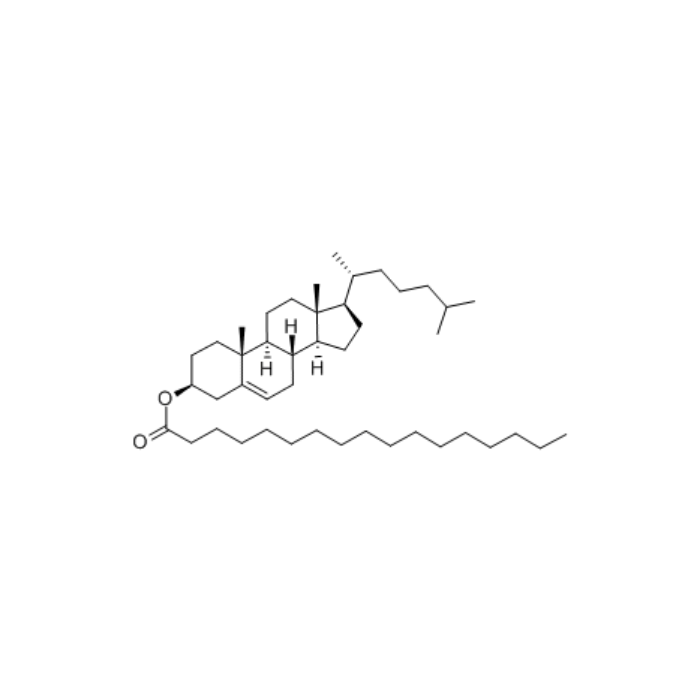
Cholesterol Margarate - ≥97% , CAS No.24365-37-5

CAS: 24365-37-5 Cat. No.: C303173 Formula: C44H78O2 Molecular Weight: 639.11
AVAILABLE TO ORDER
GRADE & PURITY ≥97%
Synonyms
CHOLESTERYLHEPTADECANOATE|cholest-5-en-3beta-yl heptadecanoate|Cholesterol margarate|(1R,3aS,3bS,7S,9aR,9bS,11aR)-9a,11a-dimethyl-1-[(2R)-6-methylheptan-2-yl]-1H,2H,3H,3aH,3bH,4H,6H,7H,8H,9H,9aH,9bH,10H,11H,11aH-cyclopenta[a]phenanthren-7-yl heptadecanoate|(3S,8S,9S,10R,13R,14S,17R)-10,13-Dimethyl-17-((R)-6-methylheptan-2-yl)-2,3,4,7,8,9,10,11,12,13,14,15,16,17-tetradecahydro-1H-cyclopenta[a]phenanthren-3-yl heptadecanoate|CHOLESTERYL HEPTADECANOATE|17:0 Cholesteryl ester|(3beta)-cholest-5-en-3-yl heptadecanoate|[(3S,8S,9S,10R,13R,14S,17R)-10,13-dimethyl-17-[(2R)-6-methylheptan-2-yl]-2,3,4,7,8,9,11,12,14,15,16,17-dodecahydro-1H-cyclopenta[a]phenanthren-3-yl] heptadecanoate|Margaric Acid Cholesterol Ester|Cholesterol Heptadecanoate|Heptadecanoic Acid Cholesterol Ester|17-(1,5-Dimethylhexyl)-10,13-dimethyl-2,3,4,7,8,9,10,11,12,13,14,15,16,17-tetradecahydro-1H-cyclopenta[a]phenanthren-3-yl heptadecanoate #
Storage
Room temperature,Argon charged,Desiccated
Shipped In
Normal
★
Size
Germany (EU)
USA*
Price
Qty
100mg
C303173-100mg
—
2 In stock
€64.13
250mg
C303173-250mg
—
2 In stock
€109.25
1g
C303173-1g
—
1 In stock
€294.94
5g
C303173-5g
—
1 In stock

€719.27

€1,023.85
Save €304.58 (29.75%)
Enter a quantity for the sizes you want to add.

Overview

Product description:

17:0 cholesteryl ester (cholesteryl heptadecanoate) is a lipid present in the seeds of Persea grattisima and Chrysophyllum albidum.


Application:

17:0 cholesteryl ester (cholesteryl heptadecanoate) has been used as an internal standard in mass spectrometry imaging (MSI). It may be used:

in the egg yolk lipid extraction as an internal standard for mass spectroscopy analysis

as a reference internal standard for plasma lipid determination using thin layer chromatography (TLC)

as an external standard in liquid chromatography-tandem mass spectrometry

Specifications

Synonyms
CHOLESTERYLHEPTADECANOATE | cholest-5-en-3beta-yl heptadecanoate | Cholesterol margarate | (1R,3aS,3bS,7S,9aR,9bS,11aR)-9a,11a-dimethyl-1-[(2R)-6-methylheptan-2-yl]-1H,2H,3H,3aH,3bH,4H,6H,7H,8H,9H,9aH,9bH,10H,11H,11aH-cyclopenta[a]phenanthren-7-yl heptadecanoate | (3S,8S,9S,10R,13R,14S,17R)-10,13-Dimethyl-17-((R)-6-methylheptan-2-yl)-2,3, Show more
Specifications & Purity
≥97%
Storage
Room temperature,Argon charged,Desiccated
Shipped In
Normal
Purity
≥97%
Names and Identifiers
Pubchem Sid
Pubchem Sid Url
https://pubchem.ncbi.nlm.nih.gov/substance/504767568
SMILES
CCCCCCCCCCCCCCCCC(=O)OC1CCC2(C3CCC4(C(C3CC=C2C1)CCC4C(C)CCCC(C)C)C)C
IUPAC Name
[(3S,8S,9S,10R,13R,14S,17R)-10,13-dimethyl-17-[(2R)-6-methylheptan-2-yl]-2,3,4,7,8,9,11,12,14,15,16,17-dodecahydro-1H-cyclopenta[a]phenanthren-3-yl] heptadecanoate
InChIKey
PPQNZVDOBYGOLY-BFGJSWSOSA-N
InChI
1S/C44H78O2/c1-7-8-9-10-11-12-13-14-15-16-17-18-19-20-24-42(45)46-37-29-31-43(5)36(33-37)25-26-38-40-28-27-39(35(4)23-21-22-34(2)3)44(40,6)32-30-41(38)43/h25,34-35,37-41H,7-24,26-33H2,1-6H3/t35-,37+,38+,39-,40+,41+,43+,44-/m1/s1
Isomeric SMILES
CCCCCCCCCCCCCCCCC(=O)O[C@H]1CC[C@@]2([C@H]3CC[C@]4([C@H]([C@@H]3CC=C2C1)CC[C@@H]4[C@H](C)CCCC(C)C)C)C
Molecular Weight
639.11
Reaxys
2230293
Reaxys-RN_link_address
https://www.reaxys.com/reaxys/secured/hopinto.do?context=S&query=IDE.XRN=2230293&ln=

Advanced Data

Taxonomic Classification

Taxonomy Tree

KingdomOrganic compounds
SuperclassLipids and lipid-like molecules
ClassSteroids and steroid derivatives
SubclassSteroid esters
Intermediate Tree Nodes Not available
Direct ParentCholesteryl esters
Alternative Parents Cholesterols and derivatives  Delta-5-steroids  Carboxylic acid esters  Monocarboxylic acids and derivatives  Organic oxides  Hydrocarbon derivatives  Carbonyl compounds  
Molecular FrameworkAliphatic homopolycyclic compounds
Substituents Cholesteryl ester - Cholesterol - Cholestane-skeleton - Delta-5-steroid - Carboxylic acid ester - Monocarboxylic acid or derivatives - Carboxylic acid derivative - Organic oxygen compound - Organic oxide - Hydrocarbon derivative - Organooxygen compound - Carbonyl group - Aliphatic homopolycyclic compound
DescriptionThis compound belongs to the class of organic compounds known as cholesteryl esters. These are compounds containing an esterified cholestane moiety.
External Descriptors cholesterol ester
3D Structure
Interactive Chemical Structure Model


Certificates (CoA,COO,BSE/TSE and Analysis Chart)
C of A & Other Certificates(BSE/TSE, COO):
Analytical Chart:

Find and download the COA for your product by matching the lot number on the packaging.

8 results found

Lot NumberCertificate TypeDateItem
E2423221E2423221Certificate of AnalysisJan 23, 2024 C303173
E2423222E2423222Certificate of AnalysisJan 23, 2024 C303173
E2423223E2423223Certificate of AnalysisJan 23, 2024 C303173
E2423224E2423224Certificate of AnalysisJan 23, 2024 C303173
E2423225E2423225Certificate of AnalysisJan 23, 2024 C303173
E2423226E2423226Certificate of AnalysisJan 23, 2024 C303173
E2423227E2423227Certificate of AnalysisJan 23, 2024 C303173
E2423228E2423228Certificate of AnalysisJan 23, 2024 C303173
Chemical and Physical Properties
SolubilitySolubility:Ethanol: >50 mg/mL;DMF: >50 mg/mL;Ethanol:PBS (pH 7.2) (1:10): <10μg/mL;DMSO: >50 mg/mL
SensitivityMoisture sensitive
Melt Point76.0-82.0 °C
Molecular Weight639.1
XLogP317.000
Hydrogen Bond Donor Count0
Hydrogen Bond Acceptor Count2
Rotatable Bond Count22
Exact Mass638.6 Da
Monoisotopic Mass638.6 Da
Topological Polar Surface Area26.300 Ų
Heavy Atom Count46
Formal Charge0
Complexity919.000
Isotope Atom Count0
Defined Atom Stereocenter Count8
Undefined Atom Stereocenter Count0
Defined Bond Stereocenter Count0
Undefined Bond Stereocenter Count0
The total count of all stereochemical bonds0
Covalently-Bonded Unit Count1
Safety and Hazards(GHS)
Precautionary Statements

P264:Wash hands [and …] thoroughly after handling.

Reaxys
2230293
Reaxys-RN_link_address
https://www.reaxys.com/reaxys/secured/hopinto.do?context=S&query=IDE.XRN=2230293&ln=
Solution Calculators
Reviews

Customer Reviews

Application Protocols

No vendor‑validated application protocols are provided for this item; refer to CoA/Spec Sheet for any lot‑specific notes.

General literature‑based starting points:

  • Lipid standard preparation: Dissolve to 1–10 mg/mL in chloroform or toluene under inert gas. For multi‑analyte standards, combine with other cholesteryl esters, evaporate to a film, and redissolve to the desired concentration.
  • Enzyme assay substrate: Pre‑solubilize in a small volume of ethanol or DMSO, then add to buffered assay containing a bile salt or detergent to ensure dispersion. Keep organic cosolvent ≤1–2% v/v to maintain enzyme activity.
  • TLC reference spot: Apply 1–5 µg per lane in hexane; run in hexane:diethyl ether (85:15). Compare Rf against cholesterol and triacylglycerol standards.

These are general suggestions; optimize for your system and analytical requirements.

Biological Roles

Literature context (biochemistry; not specific to this item):

  • Neutral lipid storage: Cholesteryl esters, including cholesteryl heptadecanoate, are major neutral lipids in lipid droplets of many cell types. They sequester cholesterol in an inert, hydrophobic form.
  • Formation: In cells, acyl‑CoA:cholesterol acyltransferases (ACAT1/ACAT2) in the endoplasmic reticulum and lecithin–cholesterol acyltransferase (LCAT) in plasma esterify cholesterol using fatty acyl donors (acyl‑CoA or phosphatidylcholine acyl groups).
  • Turnover: Hydrolysis by neutral and acid cholesterol ester hydrolases/esterases liberates free cholesterol and fatty acid, enabling membrane synthesis or steroidogenesis. Hormonal and metabolic cues regulate this cycle.
  • Lipoprotein transport: In plasma, cholesteryl esters are a major cargo in LDL/HDL particles, packaged by LCAT activity and transferred by CETP (cholesteryl ester transfer protein).
  • Physical behavior: They form oil phases with high melting points relative to triacylglycerols; their presence modulates lipid droplet viscosity and phase transitions.

Notes:

  • Fatty acyl composition (chain length/saturation) modulates packing, melting, and enzymatic susceptibility. The C17:0 (margarate) moiety is a saturated, odd‑chain fatty acid, which can be useful as an internal standard due to its distinctive mass/retention properties.
  • This product is for research use only. No clinical or diagnostic claims are made.
Buffer Applications

This compound is a highly hydrophobic neutral lipid and is not used as a buffering agent or pH control component.

Practical guidance (if working in aqueous systems):

  • For dispersion into buffers, prepare a stock solution in a compatible organic solvent (e.g., chloroform, toluene, or THF), then incorporate into emulsions, lipoprotein reconstitution systems, or detergent micelles. Alternatively, form lipid films and rehydrate with surfactant‑containing buffers.
  • Avoid prolonged exposure to aqueous basic conditions, which can hydrolyze the ester. Maintain neutral pH where possible when organic cosolvents or emulsifiers are present.
Green Alternatives

The compound itself is a neutral lipid; “greenness” considerations primarily concern solvent choices for handling, chromatography, and formulation.

Greener handling options (literature/best practice):

  • Prefer hydrocarbons (heptane, cyclohexane) or greener ethers (2‑MeTHF, CPME) over chlorinated solvents when solubility and performance permit.
  • Use ethanol or isopropanol only as co‑solvents/emulsifiers if hydrolysis risk is acceptable and short contact times are ensured.
  • Minimize solvent volumes via concentrated stock solutions and film‑casting techniques, recovering solvents by rotavap for reuse.

Comparison (general guidance):

  • CHCl3 vs 2‑MeTHF
    • Solubility: CHCl3 excellent; 2‑MeTHF moderate to good with mild warming.
    • EHS profile: CHCl3 is toxic and regulated; 2‑MeTHF is considered a greener alternative with lower toxicity and renewable sourcing.
  • DCM vs CPME
    • Volatility: both volatile; CPME has higher bp (safer handling window) and superior stability; DCM is a problematic solvent from a green perspective.
  • Hexane vs Heptane
    • Similar solvency; n‑heptane has a better occupational exposure profile and lower vapor pressure.

Trade‑offs:

  • Greener ethers/hydrocarbons may require longer dissolution times or slight heating and may change chromatographic selectivity. Validate method performance when substituting solvents.
Pharmaceutical Uses

No pharmacopeial grade or excipient designation is specified for this item; refer to CoA/Spec Sheet.

General formulation context (literature; non‑clinical, research use only):

  • Neutral lipid matrices: Cholesteryl esters are used in research formulations as hydrophobic matrices or carriers in lipid‑based delivery systems and to modulate the rheology of lipid phases.
  • Reference standards: Employed as analytical standards during development of assays quantifying cholesteryl esters in biological samples and lipid formulations.
  • Stability considerations: Compared with free cholesterol, sterol esters are less surface‑active and less prone to crystallization in certain matrices, potentially affecting storage stability of lipid blends.

Notes:

  • If considering this material in preformulation studies, evaluate solvent residues and purity, and perform compatibility screening with surfactants and oils. Any use beyond research must adhere to applicable regulatory and quality frameworks; this listing is for research use only.
Physical Properties

Item-specific physicochemical specifications (bp/mp/density/UV cutoff, etc.): Not specified for this item; refer to CoA/Spec Sheet.

Literature/general reference values for cholesteryl esters (C17:0 specifically where available; for guidance only):

  • Physical state: waxy solid or crystalline solid; colorless to pale.
  • Melting point: typically in the high solid‑lipid range; cholesteryl long‑chain saturated esters often melt ~80–95 °C. Reported values for closely related homologs (C16:0, C18:0) are ~86–89 °C; C17:0 is expected within a similar window (literature/general guidance).
  • Boiling point: not practical; decomposes before boiling at ambient pressure (literature expectation for high‑MW sterol esters).
  • Solubility: insoluble in water; soluble in nonpolar and moderately polar organic solvents (e.g., chloroform, dichloromethane, toluene, benzene, hexane, heptane, diethyl ether, THF) (literature).
  • LogP: very high (qualitative: >> 8), consistent with a neutral sterol ester (literature qualitative assessment).
  • Density: ~0.9–1.0 g/mL for molten/packed solids of similar sterol esters; specific value not established for this item (literature context only).
  • Spectral behavior: strong C=O stretching near ~1735–1745 cm−1 in IR; sterane C–H stretches dominate; no strong UV chromophore beyond deep UV (literature).

Note: Values above are general literature expectations for cholesteryl esters and are provided for planning only. For certificate‑bound specifications, consult the item’s CoA/Spec Sheet.

Quality & Grades
  • Item-specific grade/purity statement: Not specified for this item; refer to CoA/Spec Sheet.

Guidance on quality considerations for cholesteryl esters (general):

  • Purity profile: key impurities commonly include free cholesterol, residual fatty acid (margaric acid), alternative chain‑length cholesteryl esters, and traces of solvents. For quantitative lipidomics or enzyme kinetics, low levels of these impurities are important.
  • Identity confirmation: typical QC includes 1H/13C NMR (disappearance of cholesterol 3β‑OH resonance; presence of ester carbonyl at ~170–175 ppm in 13C), IR (C=O ~1735–1745 cm−1), MS (M+•/adducts near m/z ~639), and TLC/HPLC purity (neutral lipid methods).
  • Stabilizers: sterol esters generally do not require stabilizers; handling under inert gas minimizes slow oxidative changes. If any antioxidant were present, it would be disclosed on the CoA. None is specified for this item.
  • Lot-to-lot consistency: melting behavior and chromatographic Rf/retention are useful fingerprints; lipid standards frequently report assay by GC-FID or HPLC-ELSD.

Recommendation: Select lots with documented assay/purity appropriate to your application (e.g., ≥98% for reference standards). Verify UV background if using in detector‑sensitive workflows. For this catalog item, consult the lot-specific CoA for definitive purity, residual solvent limits, and identity data.

Reaction & Applications

While cholesteryl esters are chemically stable storage lipids, cholesterol margarate finds frequent use as a research material and analytical standard.

Applications (literature/general):

  • Lipidomics/analytical standards: used to calibrate GC–MS/LC–MS or HPLC‑ELSD methods for cholesteryl esters; aids method development, retention mapping, and response factor determination.
  • Enzymology: substrate for cholesterol esterase, carboxylesterases, and lipases to study ester hydrolysis kinetics and specificity; useful in assessing ACAT/LCAT reaction products in vitro.
  • Model lipid droplets: employed in reconstituted lipid droplet cores or oil‑in‑water emulsions to study neutral‑lipid storage and phase behavior.
  • Materials/lipid carriers: component in hydrophobic matrices or nanoparticles where slow diffusion and high hydrophobicity are beneficial.

Reactivity and transformations (literature):

  • Saponification: base‑catalyzed hydrolysis (e.g., methanolic KOH, NaOH in i‑PrOH/H2O) regenerates cholesterol and heptadecanoate.
  • Transesterification: sodium methoxide or enzymatic catalysts can exchange the acyl group or liberate cholesterol under mild conditions.
  • Oxidation: prolonged exposure to strong oxidants can affect the steroid nucleus; not typically exploited synthetically for this ester.

Practical tips:

  • Dry, oxygen‑limited handling helps preserve composition. Use amber glass and inert gas blankets during solution prep and storage.
  • For enzymatic assays, pre‑solubilize in minimal organic solvent and deliver via solvent‑spiking or detergent micelles to ensure substrate availability.
Reaction Conditions

General laboratory conditions relevant to cholesteryl ester handling and typical transformations (literature guidance; not item‑specific specs):

  • Saponification (to cholesterol + heptadecanoate):

    • Reagents: KOH or NaOH (0.5–2 M) in MeOH, EtOH, or i‑PrOH; small % H2O may accelerate.
    • Conditions: RT to 50 °C, 0.5–4 h depending on solvent/base strength and loading.
    • Workup: dilute with water, extract free cholesterol into hexane/Et2O; acidify aqueous phase to recover fatty acid if desired.
  • Transesterification (acyl exchange or alcoholysis):

    • Catalyst: sodium methoxide (≤5 mol%) or enzymatic lipases/esterases for selective processes.
    • Solvent: anhydrous toluene, THF, or tert‑butanol; 25–60 °C.
  • Enzymatic hydrolysis (cholesterol esterase assays):

    • Media: buffered aqueous phase with a surfactant or bile salt (e.g., taurocholate) and an organic cosolvent spike to deliver substrate.
    • Temperature: 25–37 °C; monitor release of cholesterol or heptadecanoate by LC/GC.
  • Chromatography (purification/analysis):

    • TLC: silica; mobile phases hexane:diethyl ether (9:1 to 4:1); detect with anisaldehyde or phosphomolybdic acid.
    • HPLC: normal‑phase silica with hexane/IPA or hexane/EtOAc; ELSD/UV (deep UV) or MS detection.

Note: The ester is stable under neutral, dry conditions. Avoid strong oxidants and prolonged exposure to strong acids/bases unless hydrolysis or further transformation is intended.

Safety & Handling

Authoritative safety data (GHS classification, H‑statements, pictograms) for this specific item: Not specified for this item; refer to SDS.

General laboratory safety guidance for sterol esters (literature/experience-based):

  • Hazards: typically categorized as combustible organic solids; low acute toxicity expected by analogy to neutral lipids; may cause mechanical irritation. Fine powders can present combustible dust hazards if dispersed in air.
  • PPE: lab coat, safety glasses, and appropriate gloves (e.g., nitrile). Avoid generating dust/aerosols. Use in a well‑ventilated area or fume hood when weighing/dissolving in volatile solvents.
  • Incompatibilities: strong oxidizers (can oxidize the aliphatic/steroidal framework), strong acids/bases under forcing conditions (can hydrolyze the ester). Avoid prolonged exposure to air/oxygen and light during solution handling to minimize autoxidation of aliphatic chains.
  • Fire safety: treat as combustible; use CO2, dry chemical, or foam for extinguishing. Solvent solutions may be highly flammable depending on solvent choice.
  • First aid (overview): if inhaled, move to fresh air; if on skin, wash with soap/water; if in eyes, rinse cautiously with water; if ingested, rinse mouth—seek medical attention as needed. Provide SDS to medical personnel.

Always consult the product’s SDS for definitive hazard classification, spill response, waste disposal guidance, and transport information.

Solvent Selection

Cholesterol margarate is a highly hydrophobic, neutral lipid (sterol ester). Solvent choice focuses on nonpolar or moderately polar organic media that dissolve long‑chain esters.

  • Polarity/miscibility profile (literature):
    • Readily soluble: chloroform, dichloromethane, benzene/toluene, hexane/heptane, isooctane, diethyl ether, THF, CPME. Often used as stock solutions in CHCl3 or toluene.
    • Poorly soluble/negligible: water and aqueous buffers; lower alcohols only sparingly at room temperature.
  • Practical guidance:
    • Lipid film preparation: dissolve in CHCl3 or CHCl3:MeOH (e.g., 2:1 v/v) for co‑dissolution with other lipids, then rotary‑evaporate to a thin film before rehydration with surfactants if needed (note: cholesteryl esters are not classical membrane‑forming lipids).
    • Normal‑phase chromatography: hexane/diethyl ether or hexane/ethyl acetate eluent systems separate cholesteryl esters from cholesterol and TAGs.
    • Avoid highly protic media for storage solutions; they can promote slow hydrolysis.

Small comparison (literature context):

  • CHCl3: excellent solubility; good for film casting; toxic/regulated.
  • Toluene: good solubility; higher bp enables elevated‑temperature work.
  • Hexane/heptane: good for NP chromatography and precipitation control; lower solvating power than aromatics.
  • 2‑MeTHF/CPME: greener ethers with moderate solvency; may need mild warming to fully dissolve.
Storage & Reconstitution

Item-specific storage conditions (Product Data):

  • Storage: Room temperature, Argon charged, Desiccated.
  • Shipped in: Normal.

Practical guidance (literature/best practice):

  • Container: Store in tightly sealed, inert‑gas‑blanketed amber glass vials to minimize oxidation and moisture ingress. Maintain desiccant in the storage container.
  • Shelf life: Sterol esters are generally stable when dry and protected from light/air. Inspect periodically by TLC/HPLC for signs of hydrolysis (emergence of cholesterol or heptadecanoic acid).
  • Reconstitution/dissolution: Prepare stock solutions in chloroform, toluene, THF, or hexane at 1–50 mg/mL as needed. Flush headspace with argon or nitrogen, cap tightly, and store solutions at 2–8 °C, protected from light. Use within days to a few weeks depending on solvent and exposure.
  • Freeze–thaw: For solutions, avoid repeated freeze–thaw cycles; aliquot into single‑use volumes. For solids, no special freeze–thaw concerns under dry conditions.

Note: For any lot‑specific handling or stability statements (e.g., assay/retest date), consult the CoA. This product is for research use only.

Structure & Identity

Cholesterol margarate (cholesteryl heptadecanoate) is the fatty‑acid ester of cholesterol with margaric (heptadecanoic, C17:0) acid. It is a neutral, highly hydrophobic sterol ester used as a lipid standard and model storage lipid.

  • Item identifiers (Product Data):

    • CAS: 24365-37-5
    • CID: 14077841
    • InChIKey: 283770 (as provided; full InChIKey not specified for this item; refer to CoA/Spec Sheet.)
    • SMILES: Not specified for this item; refer to CoA/Spec Sheet.
  • Literature/computed identity details (for reference; not item-specific specs):

    • Preferred name: Cholesteryl heptadecanoate (cholesterol margarate)
    • Molecular formula: C44H78O2 (literature/computed by esterification of cholesterol with C17:0 acid)
    • Molecular weight: ~639.09 g/mol (computed: 386.65 + 270.45 − 18.02)
    • Structural features: steroid nucleus (cyclopentanoperhydrophenanthrene; four fused rings A–D) with a 3β‑O‑heptadecanoyl ester; isooctyl side chain at C17; one ester carbonyl; no free hydroxyl.
    • Stereochemistry: retains the natural cholesterol stereochemistry (multiple chiral centers; 3β‑configuration at C3 now esterified).
  • 2D description: tetracyclic fused ring system with an aliphatic side chain (C8) at ring D; the C3 position of ring A bears an O–C(=O)–(CH2)15–CH3 substituent from margaric acid; overall molecule is linear‑branched hydrocarbon rich with one carbonyl oxygen and one ether oxygen.

Synthetic Utility

From a synthetic perspective, cholesterol margarate is a protected (esterified) form of cholesterol and a defined sterol ester standard.

Utility (literature/general):

  • Protecting‑group strategy: The 3β‑OH of cholesterol is masked as a heptadecanoyl ester, rendering the sterol less polar and altering solubility. This can facilitate steroid‑core transformations that are sensitive to a free hydroxyl.
  • Hydrolysis/transesterification: Provides a controlled route back to cholesterol or to other cholesteryl esters via alcoholysis or acyl exchange (e.g., sodium methoxide catalysis), enabling libraries of cholesteryl esters with varied chain length/saturation.
  • Analytical handle: The defined odd‑chain acyl group is advantageous as an internal standard in GC/LC methods, avoiding overlap with even‑chain endogenous species.
  • Separation pedagogy: Serves as a model neutral lipid for teaching/practicing normal‑phase separations (TLC/HPLC) of sterols vs sterol esters.

Transformations on the steroid nucleus (general):

  • Electrophilic substitutions/oxidations (e.g., allylic oxidation at C7) can be performed while the 3‑OH is protected as an ester, followed by deprotection to the free sterol if desired.

Caveats:

  • Strong acid/base or prolonged heating in protic media can cause partial hydrolysis/isomerization. Maintain anhydrous, neutral conditions during transformations not intended to cleave the ester.
Target Specificity

Not an antibody, enzyme, or receptor ligand standardized for biological target binding in this catalog entry. No target specificity data are provided for this item. If using as an enzymatic substrate (e.g., cholesterol esterase), consult relevant literature for enzyme source and kinetic parameters.

Shall we send you a message when we have discounts available?

Remind me later

Thank you! Please check your email inbox to confirm.

Oops! Notifications are disabled.