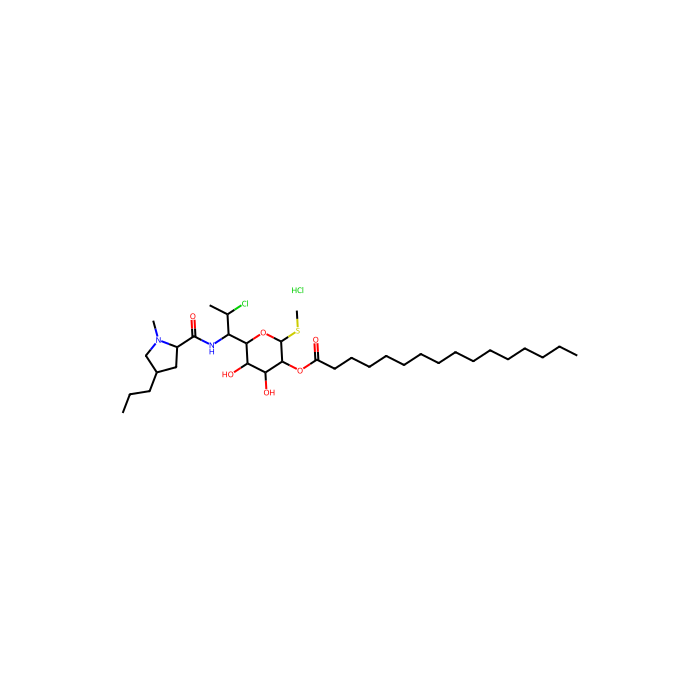
Clindamycin palmitate HCl is a water soluble hydrochloride salt of the ester of clindamycin and palmitic acid and a lincosamide antibiotic.
Specifications
Synonyms
CLINDAMYCIN PALMITATE HYDROCHLORIDE [USP-RS] | (2R,3r,4s,5r,6r)-6-((1s,2s)-2-chloro-1-((2s,4r)-1-methyl-4-propylpyrrolidine-2-carboxamido)propyl)-4,5-dihydroxy-2-(methylthio)tetrahydro-2h-pyran-3-yl palmitate | CLINDAMYCIN PALMITATE HYDROCHLORIDE (MART.) | METHYL 7-CHLORO-6,7,8-TRIDEOXY-6-(1-METHYL-TRANS-4-PROPYL-L-2-PYRROLIDINECARBOXAMID Show more
Specifications & Purity
≥99%
Biochemical and Physiological Mechanisms
Clindamycin palmitate HCl is a water soluble hydrochloride salt of the ester of clindamycin and palmitic acid and a lincosamide antibiotic. Clindamycin palmitate HCl is a bacterial protein synthesis inhibitor by inhibiting ribosomal translocation, in a similar way to macrolides. Clindamycin palmitate HCl does so by binding to the 50S rRNA of the large bacterial ribosome subunit. Clindamycin palmitate HCl inhibits protein synthesis in susceptible bacteria at level of 50S ribosome, thereby inhibiting peptide bond formation and causing cell death.Broad spectrum lincosamide antibiotic agent. Clindamycin derivative. Competitive inhibitor of peptide formation in large 50S ribosomal unit. Orally active.
Storage
Store at -20°C
Shipped In
Ice chest + Ice pads
This product requires cold chain shipping. Ground and other economy services are not available.
Action Type
INHIBITOR
Mechanism of action
Bacterial 70S ribosome inhibitor
Note
Wherever possible, you should prepare and use solutions on the same day. However, if you need to make up stock solutions in advance, we recommend that you store the solution as aliquots in tightly sealed vials at -20°C. Generally, these will be useable for up to one month. Before use, and prior to opening the vial we recommend that you allow your product to equilibrate to room temperature for at least 1 hour. Need more advice on solubility, usage and handling? Please visit our frequently asked questions (FAQ) page for more details.
This compound belongs to the class of organic compounds known as thioglycosides. These are glycoside in which a sugar group is bonded through one carbon to another group via a S-glycosidic bond.
External Descriptors
Not available
1. Djoumbou Feunang Y, Eisner R, Knox C, Chepelev L, Hastings J, Owen G, Fahy E, Steinbeck C, Subramanian S, Bolton E, Greiner R, and Wishart DS. ClassyFire: Automated Chemical Classification With A Comprehensive, Computable Taxonomy. Journal of Cheminformatics, 2016, 8:61.
We use cookies to ensure the website functions properly and, where permitted, to improve your experience. You can manage your preferences at any time in Settings. Learn more in our Cookie Policy.
Shall we send you a message when we have discounts available?
Remind me later
Thank you! Please check your email inbox to confirm.
Products are supplied to verified businesses, institutions, and qualified professionals for research and development use only. Not for use in humans, animals, diagnosis, or therapy.

 D23211674