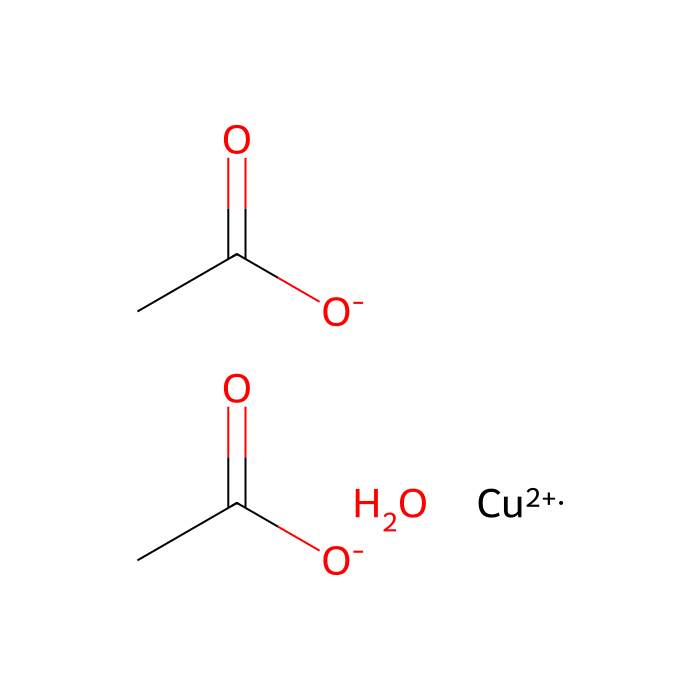
Copper acetate monohydrate - ≥99.95% metals basis , CAS No.6046-93-1

CAS: 6046-93-1 Cat. No.: C108085 Formula: C4H6CuO4·H2O Molecular Weight: 199.65 Beilstein Registry Number: 3730548 EC Number: 611-978-9
AVAILABLE TO ORDER
GRADE & PURITY ≥99.95% metals basis
Synonyms
Copper(II) Acetate Monohydrate|Acetic Acid Copper(II) Salt Monohydrate
Storage
Room temperature
Shipped In
Normal
★
Size
Germany (EU)
USA*
Price
Qty
10g
C108085-10g
—
9 In stock
€12.06
50g
C108085-50g
—
5 In stock
€38.96
250g
C108085-250g
2 In stock
3 In stock
€131.81
Enter a quantity for the sizes you want to add.

Specifications

Synonyms
Copper(II) Acetate Monohydrate | Acetic Acid Copper(II) Salt Monohydrate
Specifications & Purity
≥99.95% metals basis
Storage
Room temperature
Shipped In
Normal
Purity
≥99.95% metals basis
Names and Identifiers
Pubchem Sid
Pubchem Sid Url
https://pubchem.ncbi.nlm.nih.gov/substance/508811966
SMILES
CC(=O)[O-].CC(=O)[O-].O.[Cu+2]
IUPAC Name
copper;diacetate;hydrate
InChIKey
NWFNSTOSIVLCJA-UHFFFAOYSA-L
InChI
1S/2C2H4O2.Cu.H2O/c2*1-2(3)4;;/h2*1H3,(H,3,4);;1H2/q;;+2;/p-2
Isomeric SMILES
CC(=O)[O-].CC(=O)[O-].O.[Cu+2]
WGK Germany
3
RTECS
AG3500000
UN Number
3077
Packing Group
II
Molecular Weight
199.65
Beilstein
3730548
Reaxys
3730548
Reaxys-RN_link_address
https://www.reaxys.com/reaxys/secured/hopinto.do?context=S&query=IDE.XRN=3730548&ln=

Advanced Data

Taxonomic Classification

Taxonomy Tree

KingdomOrganic compounds
SuperclassOrganic acids and derivatives
ClassCarboxylic acids and derivatives
SubclassCarboxylic acid derivatives
Intermediate Tree Nodes Carboxylic acid salts
Direct ParentAcetate salts
Alternative Parents Monocarboxylic acids and derivatives  Carboxylic acids  Organic oxides  Organic copper salts  Hydrocarbon derivatives  Carbonyl compounds  
Molecular FrameworkNot available
Substituents Acetate salt - Organic transition metal salt - Monocarboxylic acid or derivatives - Carboxylic acid - Organic oxygen compound - Organic oxide - Hydrocarbon derivative - Organic copper salt - Organic salt - Organooxygen compound - Carbonyl group - Aliphatic acyclic compound
DescriptionThis compound belongs to the class of organic compounds known as acetate salts. These are organic compounds containing acetic acid as its acid component.
External Descriptors Not available
3D Structure
Interactive Chemical Structure Model


Certificates (CoA,COO,BSE/TSE and Analysis Chart)
C of A & Other Certificates(BSE/TSE, COO):
Analytical Chart:

Find and download the COA for your product by matching the lot number on the packaging.

33 results found

Lot NumberCertificate TypeDateItem
A2305495A2305495Certificate of AnalysisSep 22, 2026 C108085
A2305496A2305496Certificate of AnalysisSep 22, 2026 C108085
A2305498A2305498Certificate of AnalysisSep 22, 2026 C108085
L2210432L2210432Certificate of AnalysisSep 01, 2026 C108085
J2612256J2612256Certificate of AnalysisJan 09, 2026 C108085
G2602332G2602332Certificate of AnalysisJan 09, 2026 C108085
B2625454B2625454Certificate of AnalysisJan 09, 2026 C108085
B2625428B2625428Certificate of AnalysisJan 09, 2026 C108085
B2625427B2625427Certificate of AnalysisJan 09, 2026 C108085
J2612285J2612285Certificate of AnalysisJan 09, 2026 C108085
J2612279J2612279Certificate of AnalysisJan 09, 2026 C108085
K2519274K2519274Certificate of AnalysisNov 10, 2025 C108085
K2519300K2519300Certificate of AnalysisNov 10, 2025 C108085
K2519292K2519292Certificate of AnalysisNov 10, 2025 C108085
F2526229F2526229Certificate of AnalysisJun 12, 2025 C108085
F2526232F2526232Certificate of AnalysisJun 12, 2025 C108085
F2526233F2526233Certificate of AnalysisJun 12, 2025 C108085
L2210431L2210431Certificate of AnalysisNov 08, 2022 C108085
A2305489A2305489Certificate of AnalysisNov 08, 2022 C108085
L2210433L2210433Certificate of AnalysisNov 08, 2022 C108085
L2210434L2210434Certificate of AnalysisNov 08, 2022 C108085
L2210435L2210435Certificate of AnalysisNov 08, 2022 C108085
F2502136F2502136Certificate of AnalysisNov 08, 2022 C108085
A2305487A2305487Certificate of AnalysisNov 08, 2022 C108085
I2214386I2214386Certificate of AnalysisJun 09, 2022 C108085
I2214380I2214380Certificate of AnalysisJun 09, 2022 C108085
I2214379I2214379Certificate of AnalysisJun 09, 2022 C108085
I2214372I2214372Certificate of AnalysisJun 09, 2022 C108085
I2214371I2214371Certificate of AnalysisJun 09, 2022 C108085
I2214370I2214370Certificate of AnalysisJun 09, 2022 C108085
B2209020B2209020Certificate of AnalysisDec 14, 2021 C108085
B2209019B2209019Certificate of AnalysisDec 14, 2021 C108085
B2209017B2209017Certificate of AnalysisDec 14, 2021 C108085
Chemical and Physical Properties
SensitivityMoisture sensitive.
Melt Point240 °C
Molecular Weight199.65
XLogP3
Hydrogen Bond Donor Count1
Hydrogen Bond Acceptor Count5
Rotatable Bond Count0
Exact Mass198.967 Da
Monoisotopic Mass198.967 Da
Topological Polar Surface Area81.300 Ų
Heavy Atom Count10
Formal Charge0
Complexity25.500
Isotope Atom Count0
Defined Atom Stereocenter Count0
Undefined Atom Stereocenter Count0
Defined Bond Stereocenter Count0
Undefined Bond Stereocenter Count0
The total count of all stereochemical bonds0
Covalently-Bonded Unit Count4
Safety and Hazards(GHS)
Pictogram(s)
GHS05,   GHS07,   GHS09
Signal
Danger
Hazard Statements

H302:Harmful if swallowed

H314:Causes severe skin burns and eye damage

H315:Causes skin irritation

H318:Causes serious eye damage

H319:Causes serious eye irritation

H335:May cause respiratory irritation

H400:Very toxic to aquatic life

H410:Very toxic to aquatic life with long lasting effects

Precautionary Statements

P260:Do not breathe dust/fume/gas/mist/vapors/spray.

P261:Avoid breathing dust/fume/gas/mist/vapors/spray.

P264:Wash hands [and …] thoroughly after handling.

P270:Do not eat, drink or smoke when using this product.

P271:Use only outdoors or in a well-ventilated area.

P273:Avoid release to the environment.

P280:Wear protective gloves/protective clothing/eye protection/face protection.

P321:Specific treatment (see ... on this label).

P330:Rinse mouth.

P363:Wash contaminated clothing before reuse.

P391:Collect spillage.

P301+P330+P331:IF SWALLOWED: Rinse mouth. Do NOT induce vomiting.

P302+P352:IF ON SKIN: wash with plenty of water.

P304+P340:IF INHALED: Remove person to fresh air and keep comfortable for breathing.

P305+P351+P338:IF IN EYES: Rinse cautiously with water for several minutes. Remove contact lenses if present and easy to do - continue rinsing.

P362+P364:Take off contaminated clothing and wash it before reuse.

P405:Store locked up.

P403+P233:Store in a well-ventilated place. Keep container tightly closed.

P501:Dispose of contents/container to an approved waste disposal plant.

P264+P265:Wash hands [and …] thoroughly after handling. Do not touch eyes.

P301+P317:IF SWALLOWED: Get medical help.

P305+P354+P338:IF IN EYES: Immediately rinse with water for several minutes. Remove contact lenses if present and easy to do. Continue rinsing.

P317:Get emergency medical help.

P337+P317:If eye irritation persists: Get medical help.

P332+P317:If skin irritation occurs: Get medical help.

P302+P361+P354:IF ON SKIN: Take off Immediately all contaminated clothing. Immediately rinse with water for several minutes.

P316:Get emergency medical help immediately.

P319:Get medical help if you feel unwell.

WGK Germany
3
RTECS
AG3500000
Reaxys
3730548
Reaxys-RN_link_address
https://www.reaxys.com/reaxys/secured/hopinto.do?context=S&query=IDE.XRN=3730548&ln=
Class
8
Documents & Articles
Chemical Synthesis Methods of Nanomaterials
Dimethoxymethylsilane, DMMS
PMHS, Polymethylhydrosiloxane
TEMPO-Catalyzed Oxidation Quick Reference (Alcohol Oxidation Focus): Three Regeneration Routes (NaOCl / Cu–O₂ / PIDA) + Selection & Troubleshooting
Transition-Metal Salts/Precursor Selection Guide: How “Different Salts of the Same Metal” Start from Different Chemical Realities—and How to Reproduce Results (including a Selection Navigator and Product Tables 1–5)
Experimental Selection Logic for C-C Bond Construction: Understanding Fragment Coupling, Carbonyl Chain Extension, Olefination, and Late-Stage Bond-Forming Pathways by Bond-Forming Task
Reaction Selection in Small-Molecule Synthesis: From Transformation-Type Assessment to Experimental Route Screening
Experimental Selection Logic for Transition-Metal-Catalyzed C–H Functionalization: When It Is Worth Pursuing and How to Assess Site Selectivity and Conditions
Copper Tripeptide GHK-Cu and Skin Repair: From Copper Coordination Chemistry to Extracellular Matrix Remodeling
Why Do Skincare Oligopeptides Have Different Effects? — Molecular Structure, Skin Delivery, and Mechanisms of Action
Citations of This Product
Solution Calculators
Reviews

Customer Reviews

Shall we send you a message when we have discounts available?

Remind me later

Thank you! Please check your email inbox to confirm.

Oops! Notifications are disabled.