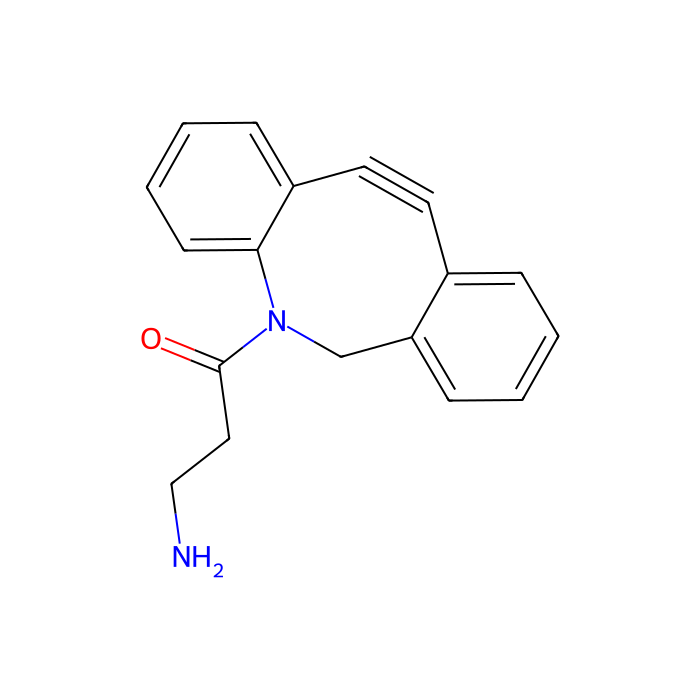
DBCO Amine is a simple DBCO-containing building block used to derivatize carboxyl groups in the presence of activators (e.g. EDC, or DCC) or activated esters (e.g. NHS esters) with DBCO moiety through a stable amide bond.|DBCO reagents, also know as ADIBO or DIBAC are the most commonly used substrates for copper-free click reaction. DBCO compounds react with azide functionalized compounds or biomolecules without the need for a Cu(I) catalyst to result in a stable triazole linkage.
Specifications
Synonyms
DBCO-NH2 | 1-Propanone, 3-amino-1-(11,12-didehydrodibenz[b,f]azocin-5(6H)-yl)- | DBCO-NH2;ADIBO-amine;Azadibenzocyclooctyne-amine;Dibenzocyclooctyne-amine | 3-amino-1-(2-azatricyclo[10.4.0.04,9]hexadeca-1(16),4,6,8,12,14-hexaen-10-yn-2-yl)propan-1-one | DBCO-(CH2)2-NH2.TFA | 3-Amino-1-[(5-aza-3,4:7,8-dibenzocyclooct-1-yne)-5-yl]-1-propano Show more
Specifications & Purity
≥98%
Storage
Protected from light,Store at -20°C,Argon charged
Shipped In
Ice chest + Ice pads
This product requires cold chain shipping. Ground and other economy services are not available.
This compound belongs to the class of organic compounds known as beta amino acids and derivatives. These are amino acids having a (-NH2) group attached to the beta carbon atom.
External Descriptors
Not available
1. Djoumbou Feunang Y, Eisner R, Knox C, Chepelev L, Hastings J, Owen G, Fahy E, Steinbeck C, Subramanian S, Bolton E, Greiner R, and Wishart DS. ClassyFire: Automated Chemical Classification With A Comprehensive, Computable Taxonomy. Journal of Cheminformatics, 2016, 8:61.
Determine the necessary mass, volume, or concentration for preparing a solution.
Dilution Calculator
Determine the dilution needed to prepare a stock solution.
Reconstitution Calculator
Reviews
Customer Reviews
Application Protocols
Not specified for this item; refer to CoA/Spec Sheet.
Note: While no item-specific protocols are provided, general reaction guidance for SPAAC and coupling is outlined in the Reaction Conditions section. For biomolecule conjugations, validate on a small scale and follow institutional SOPs.
Biological Roles
Item is a synthetic small molecule reagent; no endogenous biological role is claimed for this SKU.
General/literature context for DBCO scaffolds:
Bioorthogonal handle: The strained alkyne participates in SPAAC with azides installed metabolically (e.g., azido sugars in glycans) or chemically on biomolecules. The reaction proceeds under physiological conditions without perturbing native biochemistry.
Bioconjugation utility: Facilitates site-selective labeling of proteins, nucleic acids, lipids, and carbohydrates bearing azides, enabling imaging, pull-downs, and materials assembly in vitro and in live cells (methodological literature).
Minimal biological interference: In the absence of azides, DBCO shows low reactivity toward native cellular nucleophiles compared with electrophiles like NHS esters, underpinning its bioorthogonality. Hydrophobicity may influence membrane interactions; formulation can mitigate nonspecific binding.
Note: All uses are for research and laboratory applications only. No clinical or therapeutic claims are made or implied for this product.
Buffer Applications
This product is a small-molecule conjugation reagent rather than a buffering agent. It does not constitute a classical buffer system and is not typically used to control pH.
Practical notes (general):
SPAAC reactions are commonly run in biological buffers (e.g., PBS, HEPES) at pH ~6.5–8.0 with 5–10% DMSO or DMF to keep DBCO-Amine in solution.
Avoid primary amine buffers (e.g., Tris) during amide-coupling steps to prevent competition for activated esters; for SPAAC alone, Tris can be acceptable if solubility is managed.
For precise buffer recipes or pH ranges, select based on the biomolecule’s stability and the azide partner rather than the DBCO reagent itself.
Green Alternatives
DBCO-Amine already enables metal-free conjugation, reducing copper waste associated with CuAAC. Greener choices further optimize solvent use, hazard potential, and solubility.
Strategy 1: Prefer SPAAC over CuAAC when feasible
Benefit: Eliminates Cu(I) catalysts and associated ligands/reductants; lowers ecotoxicity and simplifies aqueous workup.
Trade-off: DBCO is hydrophobic; may require organic co-solvent. Reaction rates can be slower for certain azides vs optimized CuAAC systems.
Strategy 2: Solvent optimization
Replace DMF/NMP with water-rich media plus minimal DMSO (5–10%) when doing bioconjugations.
Consider 2-MeTHF or EtOAc for non-aqueous extractions/purifications as greener alternatives to DCM (where compatible).
Strategy 3: Alternative strained alkynes (literature)
Recommendation: Use aqueous buffers with minimal DMSO and select hydrophilic DBCO derivatives when large-scale or environmentally sensitive workflows are planned.
Pharmaceutical Uses
No pharmacopeial or excipient designation is provided for this item. It is supplied for research use only.
General formulation/manufacturing context (literature/methodological):
Bioconjugate manufacturing: DBCO-Amine can be incorporated into linkers or payloads via amide coupling, enabling downstream SPAAC attachment to azide-bearing counterparts in process development settings (e.g., protein–polymer, oligo–dye conjugates).
Payload/linker engineering: The amine facilitates synthesis of DBCO-tagged intermediates that can be further formulated once conjugated to biomolecules or materials. Hydrophilic spacers (PEG units) are often introduced to improve solubility and processing.
Analytical characterization: Conjugates are typically confirmed by LC–MS, SEC, and UV–Vis. Residual free DBCO is removed by dialysis or SEC as part of process development.
Note: No therapeutic, diagnostic, or clinical use is implied. Any GMP or regulatory aspects, if required, must be addressed with appropriate grade and documentation not specified here.
Physical Properties
Item-specific specifications are not provided in the Product Data; consult the CoA/Spec Sheet for definitive values.
Appearance: Not specified for this item; refer to CoA/Spec Sheet.
Molecular weight: Not specified for this item; refer to CoA/Spec Sheet.
Molecular formula: Not specified for this item; refer to CoA/Spec Sheet.
Melting/boiling point: Not specified for this item; refer to CoA/Spec Sheet.
Density/refractive index: Not specified for this item; refer to CoA/Spec Sheet.
UV cutoff/ε: Not specified for this item; refer to CoA/Spec Sheet.
Literature/general behavior (non-specification, for context):
Aggregated solubility profile: Typically soluble in polar aprotic organic solvents (e.g., DMSO, DMF, acetonitrile) and common organics (DCM, THF); sparingly soluble in water unless modified with hydrophilic linkers.
Acid–base: The primary amine is basic and can form salts with mineral or organic acids, improving aqueous solubility when protonated.
Stability: DBCO cores are generally stable when protected from light and oxygen; prolonged exposure to strong acids/bases or nucleophiles may degrade the cyclooctyne. Light and oxygen exclusion reduces side reactions and preserves click reactivity.
Hygroscopicity: Free-base amines may absorb CO2/H2O from air; handling under inert gas and in drybox/with desiccant is recommended for reproducibility.
Quality & Grades
Item-specific grade/purity: Not specified for this item; refer to CoA/Spec Sheet.
Context and guidance for this class of reagent:
Typical expectations for click-ready small molecules
High organic purity and low residual metal content are often desired for sensitive bioconjugations and materials applications; low peroxide content is generally beneficial, though not typically critical for DBCO.
If supplied as free base versus acid salt, purity reporting may differ (free base % vs. salt content). Verify salt form on the CoA.
UV/fluorescence background
Dibenzo-fused scaffolds absorb in the UV; if the application is analytical (e.g., HPLC detection or photo-sensitive systems), a low-UV grade solvent and clean baseline are advantageous. For this item, UV specifications are Not specified for this item; refer to CoA/Spec Sheet.
Stabilizers/additives
No stabilizer information is provided for this SKU. If stabilizers are present in other catalog variants, they may influence reactivity in amide couplings. For this item: Not specified for this item; refer to CoA/Spec Sheet.
Recommendation: Consult the CoA for batch-specific assay, residual solvents, water content (Karl Fischer), and any chromatographic purity metrics before use in critical bioconjugations.
Reaction & Applications
DBCO-Amine is a cornerstone reagent for copper-free bioorthogonal conjugation and serves as a versatile handle for constructing DBCO-functional linkers.
Reacts rapidly and selectively with organic azides to form stable triazole adducts without Cu(I) catalysis (literature). Compatible with live-cell labeling, protein/oligo conjugation, and polymer/biomaterial functionalization due to benign conditions.
Kinetic considerations: Second-order rate constants typically 10−2–100 M−1 s−1 depending on azide structure and medium (literature). Higher rates in aqueous media; electron-deficient azides often react faster.
Practical tips: Use micromolar to low millimolar concentrations; maintain DBCO in solution (5–10% DMSO/DMF in buffer). Exclude light and oxygen when possible to preserve reactivity during long incubations.
Amine-enabled derivatization
Amide coupling: Couple to carboxylic acids (HATU/HBTU/EDC•HCl) to make DBCO-tagged ligands, dyes, linkers, or solid supports.
Ureas/carbamates: React with isocyanates or carbonates to tune hydrophilicity or introduce cleavable motifs.
Solid-phase strategies: Anchor via amide to resins or scaffolds, then perform on- or off-resin SPAAC.
Orthogonality and selectivity
SPAAC is orthogonal to thiol–maleimide, NHS–amine, and CuAAC. Sequence reactions to minimize cross-reactivity (perform SPAAC before introducing nucleophilic thiols when possible).
Use cases (typical)
Protein/antibody azide labeling, nucleic acid 3′-azide conjugation, glycan azide tagging, and surface functionalization of azide-presenting materials—all without metal catalysts (literature).
Reaction Conditions
The following are general literature/methodological guidelines for DBCO-Amine; adjust to your system and verify by small-scale trials.
SPAAC with azides (bioconjugation)
Solvent/buffer: Aqueous buffer (PBS, HEPES, pH 6.5–8.0) with 5–10% DMSO or DMF to maintain solubility.
Concentration: 1–100 µM for biomolecules; up to low mM for small-molecule coupling.
Temperature/time: 20–37 °C; reaction typically completes in 0.5–24 h depending on azide and loading.
Stoichiometry: 1.2–3.0 eq DBCO relative to azide sites for complete conversion on biomolecules; monitor by LC–MS or UV.
Notes: Protect from light; avoid excess nucleophiles that may engage the amine if not desired.
Temperature: 0–25 °C; 0.5–4 h typically, with overnight if hindered.
Workup: Quench, extract, and purify by silica gel; add 0.1–1% Et3N to mobile phase to mitigate amine tailing.
Reductive amination (if attaching to carbonyls)
Solvent: MeOH, EtOH, or DMF.
Conditions: Carbonyl compound, DBCO-Amine, mild acid catalyst, then NaBH3CN or picoline borane; 0–25 °C.
All conditions are representative literature guidance; optimize per substrate and scale. For specifications on this SKU (purity, form), consult the CoA.
Safety & Handling
Hazard classification details are not specified for this item; refer to the product SDS for authoritative safety information.
GHS data (item-specific)
Signal word: Not specified for this item; refer to SDS.
H-statements: Not specified for this item; refer to SDS.
Pictograms/GHS classification: Not specified for this item; refer to SDS.
General laboratory precautions (best practice)
PPE: Wear lab coat, safety glasses, and appropriate chemical-resistant gloves. Handle powders/solids in a fume hood to avoid dust or aerosol exposure.
Incompatibilities: Strong oxidizers, strong acids/bases (prolonged exposure can degrade strained alkynes or amines). Avoid azide sources you do not intend to react; SPAAC is highly selective but will proceed with accessible organic azides.
Special risks: Strained alkynes are reactive; avoid unnecessary contact with azide-containing materials. Light/oxygen can slowly diminish reactivity—minimize exposure.
First aid (overview): Inhalation—move to fresh air; Skin/eye—rinse with water for 15 minutes; Ingestion—rinse mouth. Seek medical attention in all cases. Follow institutional procedures.
Handling & dispensing tips
Work under inert atmosphere (argon/nitrogen) as provided (argon charged), and protect from light to preserve click activity.
Prepare stock solutions in anhydrous DMSO/DMF or appropriate dry solvent; aliquot to minimize freeze–thaw.
Waste: Collect solvent and azide-containing waste in clearly labeled containers; follow local regulations and institutional guidance.
Solvent Selection
DBCO-Amine is a hydrophobic, amine-functional cyclooctyne. Solvent choice impacts solubility, coupling efficiency, and SPAAC kinetics.
Polarity/miscibility (literature/general)
Preferred: Polar aprotic solvents—DMSO, DMF, NMP, acetonitrile—offer high solubility and compatibility with carbodiimide/HATU/HBTU couplings.
Also usable: Ethyl acetate, THF, DCM for extractions and non-aqueous workups.
Aqueous systems: Limited solubility as free base; protonated salts (e.g., HCl) or co-solvents (5–20% DMSO or DMF) can aid in aqueous/biological media.
When to choose what
SPAAC bioconjugation in buffers: Use aqueous buffer (pH 6.5–8.0) with 5–10% DMSO or DMF to keep DBCO-Amine in solution; avoid primary amine buffers if amide coupling is intended upstream.
Amide coupling to carboxylic acids: Dry DMF, NMP, or DCM with standard coupling reagents; add tertiary amine bases (DIPEA) as required.
Purification: Normal-phase chromatography with hexanes/EtOAc or DCM/MeOH; add small % Et3N to suppress amine tailing.
Quick comparison (general)
DMSO vs DMF: DMSO maximizes solubility and biocompatibility; DMF offers lower viscosity and is widely used for solid-phase and solution-phase couplings.
Aqueous buffers vs organic: SPAAC tolerates water well; keep DBCO in solution with co-solvent, and avoid nucleophiles that may undermine stability.
Storage & Reconstitution
Item-specific storage (from Product Data)
Store at −20 °C.
Protect from light.
Argon charged (store under inert atmosphere).
Shipped in ice chest with ice pads.
General handling best practices (supporting guidance)
Minimize exposure to air and moisture; open vials under inert gas when possible. Reseal promptly and backfill with argon.
Prepare stock solutions in anhydrous solvents (e.g., DMSO, DMF). Filter sterilize if required for biological applications, using compatible low-protein-binding membranes.
Aliquot stock solutions into amber vials or foil-wrap to avoid repeated freeze–thaw and light exposure.
Working solution stability is system-dependent; for extended incubations, keep protected from light at 4–25 °C and confirm activity by a small pilot reaction.
Reconstitution
Specific reconstitution instructions: Not specified for this item; refer to CoA/Spec Sheet.
Typical practice: Dissolve to 1–10 mM in dry DMSO or DMF; for aqueous use, dilute into buffer to final organic content of 5–10% immediately before use.
Always follow institutional SDS-based guidance for storage and disposal. For long-term projects, verify stability and reactivity of a retained aliquot periodically.
Structure & Identity
DBCO-Amine is a strained, dibenzo-fused cyclooctyne bearing a primary amine handle, widely used for copper-free click (SPAAC) conjugations with azides.
Item-specific identifiers (from Product Data)
CAS: 1255942-06-3
InChIKey: 254012 (as provided; consult CoA/SDS for the canonical 27-character key)
SMILES: Not specified for this item; refer to CoA/Spec Sheet.
Molecular formula: Not specified for this item; refer to CoA/Spec Sheet.
Molecular weight: Not specified for this item; refer to CoA/Spec Sheet.
Structural features (general/literature description)
Core: A dibenzocyclooctyne motif (two benzene rings fused to an 8‑membered cycloalkyne), providing substantial ring strain to activate the alkyne toward azide cycloaddition (SPAAC).
Functional group: A primary aliphatic amine (–NH2), typically attached through a short linker to the cyclooctyne scaffold, enabling amide/urea/carbamate formation with standard coupling chemistries.
2D description: Two peri-fused benzene rings flank an internal C≡C within an eight‑membered ring; a pendant –CH2–NH2 (or analogous short linker) projects from the aryl/cyclooctyl framework. No defined stereocenters; the ring adopts conformations that accommodate strain.
Reactivity handle: The strained internal alkyne reacts rapidly and selectively with organic azides without a metal catalyst, yielding a triazole adduct (SPAAC).
Synthetic Utility
DBCO-Amine combines a highly reactive strained alkyne with a primary amine, offering two orthogonal synthetic handles.
Alkyne (strained) reactivity
SPAAC with azides: Rapid formation of robust triazole linkages without metal catalysts (literature). Useful for late-stage diversification of azide-bearing building blocks, polymers, and biomolecules.
Selectivity: Chemoselective toward azides in the presence of alcohols, amines, thiols, and carboxylates under neutral conditions.
Primary amine reactivity
Amide formation with carboxylic acids (EDC/HOBt, HATU/HBTU, CDI); urea formation with isocyanates; carbamates via chloroformates or activated carbonates.
Reductive amination onto aldehydes/ketones to install DBCO under mild conditions.
Succinimidyl carbonate formation to give NHS-activated DBCO reagents for streamlined bioconjugations.
Retrosynthetic value
Serves as a convergent module: attach DBCO to a scaffold via the amine, then perform SPAAC to append the azide-bearing partner—minimizing protecting-group gymnastics and metal exposure.
Orthogonal assembly strategies
Sequence reactions to leverage orthogonality: first amide coupling (in dry organic), then SPAAC (in aqueous/co-solvent). Alternatively, SPAAC first, followed by amine derivatization if the partner tolerates conditions.
Materials chemistry
Surface grafting onto azide-functionalized polymers and nanoparticles; post-polymerization modification to control density and spatial distribution of functional groups.
Target Specificity
Not applicable. This product is a small-molecule reagent and is not an antibody, protein, or assay kit. No antigen, epitope, species reactivity, clone, or isotype information applies to this item.
We use cookies to ensure the website functions properly and, where permitted, to improve your experience. You can manage your preferences at any time in Settings. Learn more in our Cookie Policy.
Shall we send you a message when we have discounts available?
Remind me later
Thank you! Please check your email inbox to confirm.
Products are supplied to verified businesses, institutions, and qualified professionals for research and development use only. Not for use in humans, animals, diagnosis, or therapy.

 E2628330