
Determine the necessary mass, volume, or concentration for preparing a solution.
| Activity Type | Activity Value -log(M) | Mechanism of Action | Activity Reference | Publications (PubMed IDs) |
|---|
Moligand™,10mM in DMSO Moligand™ for sensitive chromatographic and analytical workflows requiring minimal baseline interference.
Store at -80°C Ships Dry ice packs + Cold packs Check lot-specific COA for exact specifications.
SDS, COA, datasheet, and spec sheet available for download. Lot-specific COA accessible via lot number lookup.
Cited in 95 peer-reviewed publications across chromatography, organic synthesis, and cross-coupling reactions.
Information
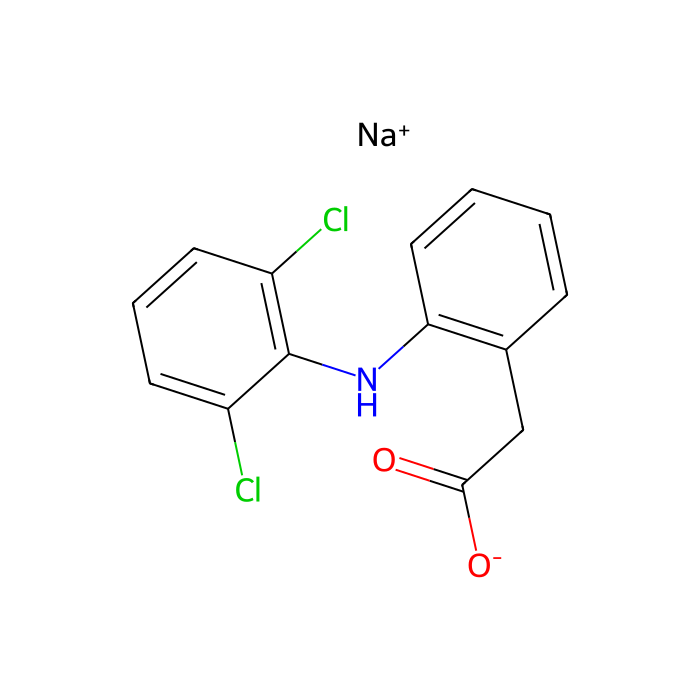
Diclofenac Sodium (GP 45840) is a non-selective COX inhibitor withIC50of 0.5 μg/ml and 0.5 μg/ml for COX-1 and -2 in intact cells, respectively, used as a nonsteroidal anti-inflammatory drug (NSAID) to relieve pain and reduce swelling in flammation.
In vitro
Diclofenac inhibits Wnt/beta-catenin signaling without altering the level of beta-catenin protein and reduces the expression of beta-catenin/TCF-dependent genes. Diclofenac induces the degradation of IkappaBalpha, which increases free nuclear factor kappaB (NF-kappaB) in colon cancer cells. Diclofenac suppresses both fast tetrodotoxin-sensitive (TTX-S) and the slow tetrodotoxin-resistant (TTX-R) sodium currents in a dose-dependent manner. Diclofenac produces shifts of the steady-state inactivation curves in the hyperpolarizing direction in both types of sodium currents in a dose-dependent manner. Diclofenac may bind to sodium channels with a greater affinity when they are in the inactivated state than when they are in the resting state. Diclofenac results in a severe accumulation of protein in the tubular cells (so called hyaline droplet degeneration), macrophage infiltration and structural alterations (dilation, vesiculation) of the endoplasmic reticulum (ER) in the proximal and distal renal tubules of kidney. Diclofenac also results in shortening of podocytes and their retraction from the basal lamina, a thickening of the basal lamina, the formation of desmosomes, and necrosis of endothelial cells in the renal corpuscles of kidney.
In vivo
Diclofenac (0.01 to 0.2 mM) stimulates state-4 respiration and slightly inhibits state 3 in rats, decreasing the respiratory control ratio, while the membrane potential is decreased or collapsed (depending on the drug concentration).
Cell Data
cell lines:
Concentrations:
Incubation Time:
Powder Purity:≥99%
Comprehensive hazard, handling, storage, and regulatory compliance document.
Download SDS →Lot-specific quality data. Enter your lot number to retrieve the exact COA.
Look up COA →Full quality attributes and acceptance criteria for this grade.
View spec sheet →| Activity Type | Activity Value -log(M) | Mechanism of Action | Activity Reference | Publications (PubMed IDs) |
|---|
| Activity Type | Activity Value -log(M) | Mechanism of Action | Activity Reference | Publications (PubMed IDs) |
|---|
| Solubility | Solubility (25°C) In vitro DMSO: 42 mg/mL (201.71 mM); Water: 3 mg/mL (14.4 mM); Ethanol: Insoluble; |
|---|---|
| Melt Point(°C) | 283-285°C |
Our grade selection guide covers purity, stabilizer status, and application suitability for all variants in our catalog.
View Moligand™ grade guide →