
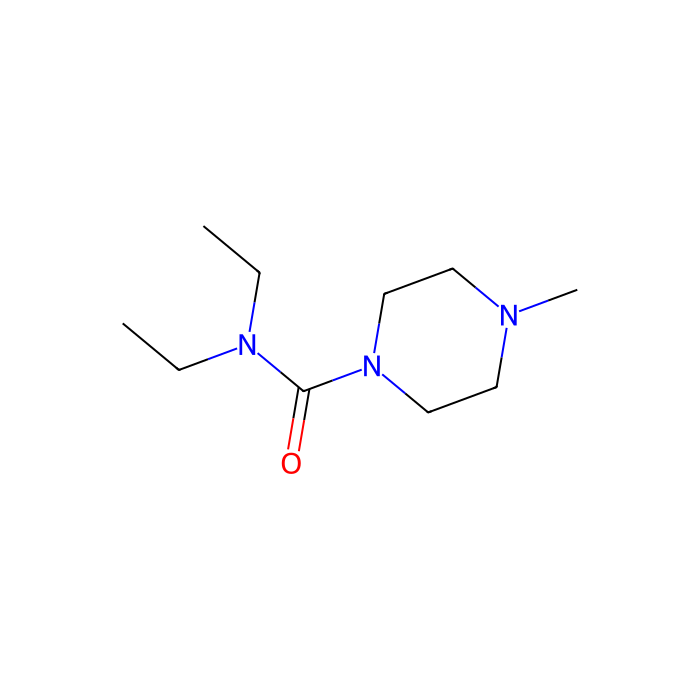
 L1925021
Determine the necessary mass, volume, or concentration for preparing a solution.
| Activity Type | Relation | Activity value | Units | Action Type | Journal | PubMed Id | doi | Assay Aladdin ID |
|---|
Taxonomy Tree
| Kingdom | Organic compounds |
|---|---|
| Superclass | Organoheterocyclic compounds |
| Class | Diazinanes |
| Subclass | Piperazines |
| Intermediate Tree Nodes | Piperazine carboxylic acids and derivatives |
| Direct Parent | Piperazine carboxamides |
| Alternative Parents | N-methylpiperazines Ureas Trialkylamines Azacyclic compounds Organopnictogen compounds Organic oxides Hydrocarbon derivatives Carbonyl compounds |
| Molecular Framework | Aliphatic heteromonocyclic compounds |
| Substituents | Piperazine-1-carboxamide - N-alkylpiperazine - N-methylpiperazine - Carbonic acid derivative - Tertiary amine - Tertiary aliphatic amine - Urea - Azacycle - Amine - Hydrocarbon derivative - Organic oxide - Organopnictogen compound - Organic oxygen compound - Organooxygen compound - Organonitrogen compound - Organic nitrogen compound - Carbonyl group - Aliphatic heteromonocyclic compound |
| Description | This compound belongs to the class of organic compounds known as piperazine carboxamides. These are heterocyclic compounds containing a piperazine ring substituted by one or more carboxamide group. |
| External Descriptors | N-methylpiperazine - N-carbamoylpiperazine |
| Activity Type | Relation | Activity value | Units | Action Type | Journal | PubMed Id | doi | Assay Aladdin ID |
|---|
| Activity Type | Relation | Activity value | Units | Action Type | Journal | PubMed Id | doi | Assay Aladdin ID |
|---|
| Activity Type | Relation | Activity value | Units | Action Type | Journal | PubMed Id | doi | Assay Aladdin ID |
|---|
| Activity Type | Relation | Activity value | Units | Action Type | Journal | PubMed Id | doi | Assay Aladdin ID |
|---|
| Activity Type | Relation | Activity value | Units | Action Type | Journal | PubMed Id | doi | Assay Aladdin ID |
|---|
| Activity Type | Relation | Activity value | Units | Action Type | Journal | PubMed Id | doi | Assay Aladdin ID |
|---|
| Activity Type | Relation | Activity value | Units | Action Type | Journal | PubMed Id | doi | Assay Aladdin ID |
|---|
| Activity Type | Relation | Activity value | Units | Action Type | Journal | PubMed Id | doi | Assay Aladdin ID |
|---|
| Activity Type | Relation | Activity value | Units | Action Type | Journal | PubMed Id | doi | Assay Aladdin ID |
|---|
| Activity Type | Relation | Activity value | Units | Action Type | Journal | PubMed Id | doi | Assay Aladdin ID |
|---|
| Activity Type | Relation | Activity value | Units | Action Type | Journal | PubMed Id | doi | Assay Aladdin ID |
|---|
| Activity Type | Relation | Activity value | Units | Action Type | Journal | PubMed Id | doi | Assay Aladdin ID |
|---|
| Activity Type | Relation | Activity value | Units | Action Type | Journal | PubMed Id | doi | Assay Aladdin ID |
|---|
| Activity Type | Relation | Activity value | Units | Action Type | Journal | PubMed Id | doi | Assay Aladdin ID |
|---|
| Activity Type | Relation | Activity value | Units | Action Type | Journal | PubMed Id | doi | Assay Aladdin ID |
|---|
| Activity Type | Relation | Activity value | Units | Action Type | Journal | PubMed Id | doi | Assay Aladdin ID |
|---|
| Activity Type | Relation | Activity value | Units | Action Type | Journal | PubMed Id | doi | Assay Aladdin ID |
|---|
| Activity Type | Relation | Activity value | Units | Action Type | Journal | PubMed Id | doi | Assay Aladdin ID |
|---|
| Activity Type | Relation | Activity value | Units | Action Type | Journal | PubMed Id | doi | Assay Aladdin ID |
|---|
| Activity Type | Relation | Activity value | Units | Action Type | Journal | PubMed Id | doi | Assay Aladdin ID |
|---|
| Activity Type | Relation | Activity value | Units | Action Type | Journal | PubMed Id | doi | Assay Aladdin ID |
|---|
| Activity Type | Relation | Activity value | Units | Action Type | Journal | PubMed Id | doi | Assay Aladdin ID |
|---|
| Activity Type | Relation | Activity value | Units | Action Type | Journal | PubMed Id | doi | Assay Aladdin ID |
|---|
| Activity Type | Relation | Activity value | Units | Action Type | Journal | PubMed Id | doi | Assay Aladdin ID |
|---|
| Activity Type | Relation | Activity value | Units | Action Type | Journal | PubMed Id | doi | Assay Aladdin ID |
|---|
| Activity Type | Relation | Activity value | Units | Action Type | Journal | PubMed Id | doi | Assay Aladdin ID |
|---|
| Activity Type | Relation | Activity value | Units | Action Type | Journal | PubMed Id | doi | Assay Aladdin ID |
|---|
| Activity Type | Relation | Activity value | Units | Action Type | Journal | PubMed Id | doi | Assay Aladdin ID |
|---|
| Activity Type | Relation | Activity value | Units | Action Type | Journal | PubMed Id | doi | Assay Aladdin ID |
|---|
| Activity Type | Relation | Activity value | Units | Action Type | Journal | PubMed Id | doi | Assay Aladdin ID |
|---|
| Activity Type | Relation | Activity value | Units | Action Type | Journal | PubMed Id | doi | Assay Aladdin ID |
|---|
| Activity Type | Relation | Activity value | Units | Action Type | Journal | PubMed Id | doi | Assay Aladdin ID |
|---|
| Activity Type | Relation | Activity value | Units | Action Type | Journal | PubMed Id | doi | Assay Aladdin ID |
|---|
| Activity Type | Relation | Activity value | Units | Action Type | Journal | PubMed Id | doi | Assay Aladdin ID |
|---|
| Activity Type | Relation | Activity value | Units | Action Type | Journal | PubMed Id | doi | Assay Aladdin ID |
|---|
| Activity Type | Relation | Activity value | Units | Action Type | Journal | PubMed Id | doi | Assay Aladdin ID |
|---|
| Activity Type | Relation | Activity value | Units | Action Type | Journal | PubMed Id | doi | Assay Aladdin ID |
|---|
| Activity Type | Relation | Activity value | Units | Action Type | Journal | PubMed Id | doi | Assay Aladdin ID |
|---|
| Activity Type | Relation | Activity value | Units | Action Type | Journal | PubMed Id | doi | Assay Aladdin ID |
|---|
| Activity Type | Relation | Activity value | Units | Action Type | Journal | PubMed Id | doi | Assay Aladdin ID |
|---|
| Activity Type | Relation | Activity value | Units | Action Type | Journal | PubMed Id | doi | Assay Aladdin ID |
|---|
| Activity Type | Relation | Activity value | Units | Action Type | Journal | PubMed Id | doi | Assay Aladdin ID |
|---|
| Activity Type | Relation | Activity value | Units | Action Type | Journal | PubMed Id | doi | Assay Aladdin ID |
|---|
| Activity Type | Relation | Activity value | Units | Action Type | Journal | PubMed Id | doi | Assay Aladdin ID |
|---|
| Activity Type | Relation | Activity value | Units | Action Type | Journal | PubMed Id | doi | Assay Aladdin ID |
|---|
| Activity Type | Relation | Activity value | Units | Action Type | Journal | PubMed Id | doi | Assay Aladdin ID |
|---|
| Activity Type | Relation | Activity value | Units | Action Type | Journal | PubMed Id | doi | Assay Aladdin ID |
|---|
| Activity Type | Relation | Activity value | Units | Action Type | Journal | PubMed Id | doi | Assay Aladdin ID |
|---|
| Molecular Weight | 199.29 |
|---|---|
| XLogP3 | 0.300 |
| Hydrogen Bond Donor Count | 0 |
| Hydrogen Bond Acceptor Count | 2 |
| Rotatable Bond Count | 2 |
| Exact Mass | 199.168 Da |
| Monoisotopic Mass | 199.168 Da |
| Topological Polar Surface Area | 26.800 Ų |
| Heavy Atom Count | 14 |
| Formal Charge | 0 |
| Complexity | 184.000 |
| Isotope Atom Count | 0 |
| Defined Atom Stereocenter Count | 0 |
| Undefined Atom Stereocenter Count | 0 |
| Defined Bond Stereocenter Count | 0 |
| Undefined Bond Stereocenter Count | 0 |
| The total count of all stereochemical bonds | 0 |
| Covalently-Bonded Unit Count | 1 |
H302:Harmful if swallowed
H315:Causes skin irritation
H319:Causes serious eye irritation
H332:Harmful if inhaled
H335:May cause respiratory irritation
P264:Wash hands [and …] thoroughly after handling.
P270:Do not eat, drink or smoke when using this product.
P280:Wear protective gloves/protective clothing/eye protection/face protection.
P330:Rinse mouth.
P305+P351+P338:IF IN EYES: Rinse cautiously with water for several minutes. Remove contact lenses if present and easy to do - continue rinsing.
P501:Dispose of contents/container to an approved waste disposal plant.
Validated, product-specific application protocols are not provided for this SKU. The following general procedures are commonly used in research labs when working with small, basic, amide-containing molecules.
Preparation of stock solutions (analytical/bioassay):
HPLC assay setup (general):
Salt formation (example):
Note: Optimize conditions experimentally; verify identity and purity by NMR/LC–MS.
Scope: Research-only context. No medical or clinical claims are made for this product.
General background (literature/general knowledge):
Biochemical/biophysical considerations (no claims for this item):
Note: For specific mechanistic studies, consult primary literature on piperazine carboxamides; verify identity, purity, and solution behavior with this SKU before biological experimentation.
Diethylcarbamazine is not a classical buffering agent. It lacks the conjugate acid/base pair characteristics and well-defined pKa spacing typically desired for laboratory buffers.
However, in research contexts:
Practical guidance (general):
Item-specific buffer properties and pKa values: Not specified for this item; refer to CoA/Spec Sheet.
Context: Diethylcarbamazine is a target molecule rather than a commodity solvent. “Green alternatives” focus on greener solvents and practices when handling, analyzing, or modifying this compound.
Greener solvent choices (general guidance):
Comparison (general; not item-specific):
Process considerations:
Waste and EHS:
Research-use-only statement: This product is supplied strictly for research and laboratory use. No clinical or therapeutic use is intended or implied.
Formulation and analytical research context (general/literature):
Regulatory references:
Item-specific pharmacopeial status, residual solvent limits, and impurity profiles: Not specified for this item; refer to CoA/Spec Sheet.
Item-specific specifications:
General/literature information (for context only; not item specifications):
Practical notes (general):
Always consult the product’s CoA/Spec Sheet for authoritative, lot-specific physical data.
Item-specific grade/purity details: Not specified for this item; refer to CoA/Spec Sheet.
Interpreting potential grades (general guidance):
Purity and impurity considerations (general):
Stabilizers/additives:
Documentation:
Manufacturer Applications: Not provided. The following expands on common research uses of diethylcarbamazine as a chemical entity (no clinical claims):
Analytical and reference uses (general):
Chemical reactivity and derivatization (general chemistry):
Assay and formulation research:
Notes:
Item-specific, validated reaction conditions are not provided for this SKU. The following are general considerations for handling and derivatizing piperazine carboxamides in research (literature/general guidance):
Salt formation/crystallization:
N-acylation/N-sulfonylation (if an accessible secondary amine is present in the scaffold being modified):
N-alkylation (on nucleophilic nitrogen sites, scaffold-dependent):
Analytical control:
Caveats:
Authoritative safety data for this specific item (GHS classification, pictograms, H-statements) are Not specified for this item; refer to the product SDS.
General laboratory safety guidance (for structurally related piperazine carboxamides):
Note: For definitive hazard classification, exposure limits, decomposition products, and firefighting measures, always consult the SDS for this SKU.
Applicability: As a polar, amine-containing carboxamide, diethylcarbamazine typically dissolves well in polar organic solvents and forms soluble salts in water. Item-specific solubility is Not specified for this item; refer to CoA/Spec Sheet.
General solvent guidance (literature/general chemistry):
Selection tips:
Always confirm actual solubility and solution stability for this lot from the CoA or preliminary solubility tests.
Item-specific conditions from Product Data:
General storage guidance (small organic bases):
Reconstitution and solution handling (general):
Specifications not provided for this item (confirm on CoA/Spec Sheet): appearance, water content, assay/purity, stabilizers, and solution stability limits.
For any long-term storage or critical assays, perform a small stability pre-test under intended conditions.
Brief description: Diethylcarbamazine (DEC) is a small-molecule, piperazine-based carboxamide used in research settings, typically handled as the free base or as pharmaceutically acceptable salts in analytical and formulation studies.
Structural features (general chemistry knowledge):
Identity notes:
Role: Diethylcarbamazine is primarily a finished small molecule; nevertheless, its functional groups and scaffold provide opportunities for derivatization and use as a building block in discovery chemistry.
Functional group leverage (general chemistry):
Typical transformations (contextual examples):
Retrosynthetic considerations:
Note: Exact reactivity depends on substitution pattern and protecting strategies; confirm by small-scale screening and analytical monitoring.
This section is primarily applicable to biological macromolecules (e.g., antibodies, enzymes) with defined binding targets. Diethylcarbamazine is a small organic molecule; no antigen/epitope or isotype information applies.
For researchers investigating molecular interactions, characterize specificity using biophysical/biochemical assays (e.g., binding kinetics, transporter assays) tailored to your system of interest. Item-specific target data are Not specified for this item.