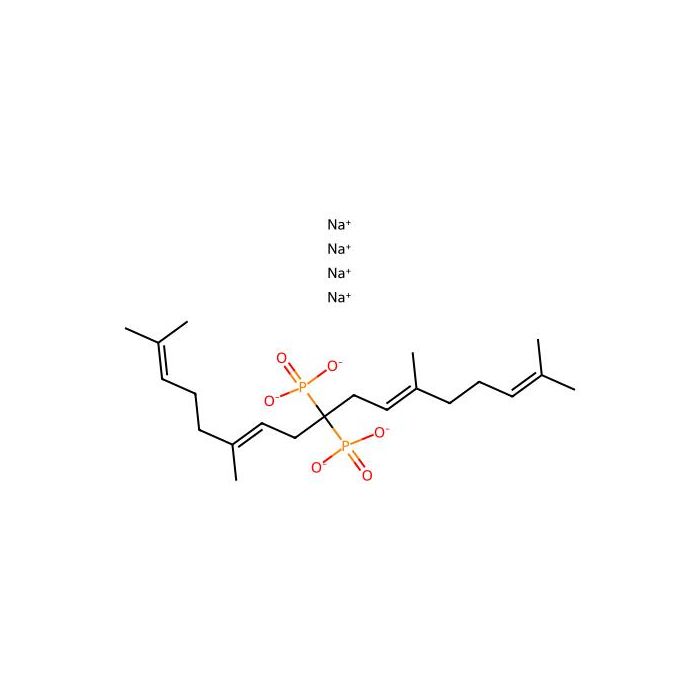
≥98% for sensitive chromatographic and analytical workflows requiring minimal baseline interference.
🌡
Storage & shipping
Protected from light,Store at -20°C,Argon charged Ships Ice chest + Ice pads Check lot-specific COA for exact specifications.
📋
Quality documents
SDS, COA, datasheet, and spec sheet available for download. Lot-specific COA accessible via lot number lookup.
📚
Literature proof
Cited in 0 peer-reviewed publications across chromatography, organic synthesis, and cross-coupling reactions.
Overview
Digeranyl bisphosphonate (DGBP) is a potent geranylgeranylpyrophosphate (GGPP) synthase inhibitor, which inhibits geranylgeranylation of Rac1.
In Vitro
Digeranyl bisphosphonate (DGBP) impairs geranylgeranylation. To examine if Digeranyl bisphosphonate modulates Rac1 activity, cells are exposed to vehicle or Digeranyl bisphosphonate. Rac1 activation increases significantly after chrysotile exposure, whereas the activity in Digeranyl bisphosphonate -treated cells is reduced to control levels. Digeranyl bisphosphonate also decreases H 2 O 2 generation in chrysotile-exposed macrophages. MCE has not independently confirmed the accuracy of these methods. They are for reference only.
In Vivo
To further evaluate the effect of Digeranyl bisphosphonate (DGBP; 0.2 mg/kg/day) in protecting mice from chrysotile-induced pulmonary fibrosis, the mice are administered vehicle or Digeranyl bisphosphonate subcutaneously in osmotic pumps, and exposed to saline or chrysotile the following day. Mice exposed to saline have normal lung architecture with vehicle and Digeranyl bisphosphonate treatment. Chrysotile-exposed mice that receive vehicle have significant architectural changes in their lung parenchyma and large amounts of collagen deposition, whereas the lungs of the Digeranyl bisphosphonate -treated mice are essentially normal. To investigate the effect of Digeranyl bisphosphonate in Bleomycin-induced fibrosis, osmotic pumps containing either vehicle or Digeranyl bisphosphonate are implanted subcutaneously in WT mice. Mice are exposed to saline or Bleomycin the following day. Digeranyl bisphophonate (0.2 mg/kg/day)-treated mice show significantly less hydroxyproline compared to vehicle-treated mice exposed to Bleomycin . MCE has not independently confirmed the accuracy of these methods. They are for reference only.
Form:Solid
IC50& Target:Rac1
Specifications
Specifications & Purity
≥98%
Biochemical and Physiological Mechanisms
Digeranyl bisphosphonate (DGBP) is a potent geranylgeranylpyrophosphate (GGPP) synthase inhibitor, which inhibits geranylgeranylation of Rac1.
Storage
Protected from light,Store at -20°C,Argon charged
Shipped In
Ice chest + Ice pads
This product requires cold chain shipping. Ground and other economy services are not available.
Action Type
INHIBITOR
Purity
≥98%
Names and Identifiers
Molecular Weight
536.40
Documentation
📋 Safety Data Sheet (SDS)
Comprehensive hazard, handling, storage, and regulatory compliance document.
We use cookies to ensure the website functions properly and, where permitted, to improve your experience. You can manage your preferences at any time in Settings. Learn more in our Cookie Policy.
Shall we send you a message when we have discounts available?
Remind me later
Thank you! Please check your email inbox to confirm.
Products are supplied to verified businesses, institutions, and qualified professionals for research and development use only. Not for use in humans, animals, diagnosis, or therapy.