Determine the necessary mass, volume, or concentration for preparing a solution.
Dilution Calculator
Determine the dilution needed to prepare a stock solution.
Reconstitution Calculator
Reviews
Customer Reviews
Application Protocols
No manufacturer-validated protocols are provided in the Product Data for this item. For general use as a chelating/derivatizing reagent:
Metal complex preparation (general/literature):
Dissolve dimedone dioxime in warm ethanol. Add equimolar or slight excess of the chosen metal salt (e.g., Ni(OAc)2·4H2O) and a mild base (e.g., NaOEt). Stir at RT to reflux until complex precipitates or analysis indicates completion. Isolate by filtration, wash with cold ethanol, and dry under vacuum.
O-acylation (general):
Suspend in dry DCM with pyridine; cool to 0–5 °C; add acyl chloride dropwise; stir 1–2 h at 0–25 °C; quench with aqueous NaHCO3; extract, dry, and purify.
These are illustrative, literature-style workflows. Optimize stoichiometry, solvent, and temperature for your specific system. For analytical verification, combine 1H/13C NMR, IR (C=N, N–O), MS, and elemental analysis.
Biological Roles
This product is intended for research and synthetic chemistry. Dimedone dioxime is not a natural metabolite, enzyme cofactor, or known signaling molecule.
General biochemical context (literature/general):
Oxime functional groups are occasionally found in bioorthogonal chemistry and as transient intermediates in bioconjugation (e.g., oxime ligation between aldehydes/ketones and alkoxyamines). However, dimedone dioxime itself is a fully formed dioxime and is not typically used in bioconjugation workflows.
Coordination to biometals: Dioximes can chelate transition metals in vitro; such complexes can be used as model compounds for studying coordination environments, redox properties, or as probes in materials interfacing with biological systems. These are research applications and not biological functions.
No medical, diagnostic, or therapeutic uses are implied. If you plan to use this compound in any biological setting, verify compatibility, endotoxin/bioburden status, and solvent effects, and consult the SDS for safe handling.
Buffer Applications
Dimedone dioxime is not a buffering agent and is not typically used to prepare biological or analytical buffers. If your application requires a defined pH environment (e.g., for metal complexation), select an appropriate buffer system (e.g., acetate, phosphate, carbonate) that does not compete strongly with metal binding, and validate that the buffer does not sequester the target metal more strongly than the dioxime.
For preparative metal complexation, simple alcohols (ethanol, methanol) with mild base are often preferred over aqueous buffers to avoid competing ligands.
Green Alternatives
Choice of chelating/derivatizing reagent and solvent system heavily influences the environmental footprint.
Alternative ligands (literature/general):
Dimethylglyoxime (DMG): Classic Ni(II) precipitant; lower molecular mass and often effective in aqueous–alcoholic media. Pros: established methods, often lower solvent load. Cons: different sterics/electronics; may not mimic the coordination environment afforded by ring-constrained dioximes.
1,2-Cyclohexanedione dioxime (nioxime): Cyclic dioxime with different substitution pattern; sometimes higher aqueous compatibility. Pros: can enable greener solvent blends. Cons: different selectivity.
Greener solvent choices for complexation/processing (general):
Prefer ethanol, isopropanol, or water–alcohol mixtures over chlorinated solvents. Use minimal volumes and recover via distillation.
Where high polarity is required, consider propylene carbonate or glycerol derivatives as alternatives to DMF/DMSO, if compatible with the chemistry.
Small comparison (general trends):
Parameter | DDO (this item) | DMG | Nioxime
Solubility in water | Low (typical) | Low–moderate with base | Moderate (varies)
Metal complex bulk | Higher (gem-dimethyl) | Lower | Intermediate
Implementation tips:
Optimize processes to minimize solvent volumes and enable solvent recycling.
Assess waste streams for metal content; recover metals where feasible via chelate decomposition and capture.
Pharmaceutical Uses
No pharmacopeial/excipient role is specified for this item. Dimedone dioxime is provided for research use only and is not intended for use in human or veterinary drug products.
General formulation context (if used in process R&D/materials research):
As a ligand/complexant in materials or catalyst development supporting process chemistry, ensure removal of residual ligand from API streams via appropriate workup (e.g., aqueous washes, carbon treatment) and analytical controls (validated LC/GC methods).
If used in trace-metal scavenging studies, evaluate extractables/leachables and set suitable acceptance criteria for residual organic content.
Regulatory note: This product has no stated compendial status (USP/EP/JP) in the provided data. For any application intersecting GMP, obtain full CoA, impurity profile, and change-control documentation.
Physical Properties
Item-specific physical specifications are not listed in the provided Product Data. Do not treat the following as specifications; they are literature/contextual values to support method development.
Appearance (item-specific): Not specified for this item; refer to CoA/Spec Sheet.
Molecular weight: ~170.21 g/mol (literature, for C8H14N2O2)
Molecular formula: C8H14N2O2 (literature)
Melting point: Not specified for this item; refer to CoA/Spec Sheet. (Literature values for analogous dioximes are typically in the 180–240 °C range; verify for this compound on the CoA.)
Boiling point: Not typically applicable; compound is expected to decompose before boiling at 1 atm (literature expectation for dioximes). Not specified for this item; refer to CoA/Spec Sheet.
Density: Not specified for this item; refer to CoA/Spec Sheet.
Solubility (literature/general):
Poorly soluble in water for many dioximes; often soluble in polar protic (ethanol, methanol) and polar aprotic solvents (DMF, DMSO, acetone); check CoA for this item.
LogP, pKa, refractive index: Not specified for this item; refer to CoA/Spec Sheet. (Oxime –OH typically shows weak acidity; dissociation is solvent-dependent.)
Practical notes (general):
Oxime –OH engages in hydrogen bonding; expect higher melting point and limited volatility.
If solubility is limiting, consider gentle warming or co-solvent blends (e.g., EtOH/DMF), validating against your analytical method.
Quality & Grades
Grade/Purity (item-specific): Not specified for this item; refer to CoA/Spec Sheet.
UV cutoff, residual solvents, trace metals, water content, and stabilizers (item-specific): Not specified for this item; refer to CoA/Spec Sheet.
Guidance for interpreting grades (general):
Research-grade reagents are manufactured for laboratory R&D. Purity is typically adequate for synthesis and analytical method development, but specific impurity limits (e.g., metals, residual solvents) must be verified on the CoA if critical to your application.
If employing dimedone dioxime as a complexometric reagent or ligand precursor, low levels of transition metal contaminants may be important; request trace-metal data when relevant.
For chromatographic or spectroscopic applications, consider lots characterized for UV absorbance/fluorescence background and dryness. Absent a stated stabilizer, assume the neat material; any stabilizer present will be declared on the CoA.
Lot-specific documentation:
CoA typically includes assay method, identity confirmation (e.g., NMR/IR/HRMS), and key physical constants (e.g., melting point). Always cross-check your method needs (e.g., moisture limits for organometallic complexation) with the lot’s CoA/spec sheet.
Reaction & Applications
The dioxime motif makes dimedone dioxime a bidentate (potentially N,O- or N,N-) donor system useful in coordination and derivatization chemistry. The following are literature/general applications for dioxime ligands; verify suitability for your specific system.
Complexation and analytical chemistry:
Many dioximes form stable chelate complexes with late transition metals (e.g., Ni(II), Pd(II), Co(II/III)) via oxime nitrogens, sometimes with deprotonated O coordination. The gem-dimethyl-substituted ring can modulate steric and electronic properties relative to acyclic dioximes (e.g., DMG).
Solid chelate formation can facilitate gravimetric separations or metal enrichment for analysis. Solvent choice and pH/base are critical to drive complexation.
Ligand precursor for catalysis/materials:
Metal–dioxime complexes serve as precatalysts or structural models; ring-constrained dioximes can tune square-planar vs octahedral preferences.
Derivatization chemistry:
Oxime –OH can undergo O-acylation or O-alkylation to form O-derivatives, altering donor properties.
Under dehydrating conditions, oximes can participate in transformations (e.g., Beckmann-type rearrangements with ketoximes; for dioximes, stepwise reactivity depends on conditions and substitution).
Protecting/transforming carbonyl precursors:
While dimedone dioxime is already the fully oximated form of dimedone, selective hydrolysis/back-conversion (under acidic conditions) can provide access to related monoximes or influence tautomeric states in related systems (literature-dependent).
Practical tips:
Dry the ligand (vacuum, mild heat) before coordination reactions to ensure reproducibility.
Control pH: mild base (e.g., NaOEt/EtOH or Na2CO3 in alcohol) often promotes deprotonation and chelation; avoid strong oxidants.
Reaction Conditions
The following guidance reflects literature/general practices for dioxime ligands; optimize for your specific substrates and metals. Item-specific validated conditions are not provided in the Product Data.
Metal complexation (general):
Solvent: EtOH or MeOH; for low solubility, switch to DMF/DMSO or mixed EtOH/DMF.
Base: Mild base (e.g., NaOEt in EtOH, Na2CO3, or triethylamine) to deprotonate oxime –OH and promote chelation.
Metals: Ni(II), Pd(II), Co(II/III), Cu(II) salts (acetates, chlorides) are commonly explored with dioximes.
Temperature/time: RT to reflux (1–6 h) depending on solubility; monitor by UV–vis, IR (νC=N shifts), or elemental analysis of isolated chelate.
O-acylation/O-alkylation of oxime –OH (general):
Reagents: Acyl chlorides/anhydrides or alkyl halides; base such as pyridine, Et3N, or NaH.
Solvent: DCM, THF, acetone, or DMF depending on reagent; 0–25 °C for acylations; 0–50 °C for alkylations.
Workup: Aqueous quench then extraction; verify integrity by NMR (downfield shift of oxime proton disappears upon O-substitution).
Purification/crystallization:
Many dioxime complexes and ligands crystallize from hot ethanol or ethanol/acetone. Slow cooling or vapor diffusion can afford analytically pure solids.
Yields: Highly system-dependent; isolate complexes to constant weight and confirm stoichiometry by microanalysis and spectroscopic methods.
Safety & Handling
The Product Data do not list GHS classifications for this item. Always consult the product SDS for authoritative safety information and local regulatory compliance.
GHS status (item-specific): Not specified for this item; refer to SDS.
Anticipated hazards (general for oximes): May cause irritation to skin, eyes, and respiratory tract; ingestion/inhalation should be avoided. Some oximes can release NOx upon thermal decomposition. Avoid dust generation.
Recommended PPE (good laboratory practice):
Safety glasses or chemical splash goggles
Lab coat
Nitrile gloves (change regularly); consider double-gloving for extended handling
Handle powders in a fume hood to avoid dust inhalation
Storage incompatibilities (general):
Strong oxidizers and strong acids/bases may react with oxime functionality; avoid mixing.
Avoid excessive heat; oximes may decompose.
First-aid overview (general):
Skin/eye contact: Rinse with water for ≥15 minutes; remove contaminated clothing; seek medical evaluation if irritation persists.
Inhalation: Move to fresh air; support breathing as needed; seek medical attention for symptoms.
Ingestion: Rinse mouth; do not induce vomiting; seek medical attention.
Fire-fighting (general):
Use water fog, CO2, dry chemical, or foam. Combustion may produce COx and NOx; firefighters should wear SCBA.
Note: This product is labeled “For research use only” and is not intended for human or animal consumption or clinical/diagnostic use.
Solvent Selection
Dimedone dioxime is an organic solid bearing two oxime –OH groups and a hydrophobic cyclohexane core with a gem-dimethyl substituent.
General solvent behavior (literature/analogous dioximes):
Polarity and H-bonding: The –OH groups enable hydrogen-bond donation; expect improved solubility in polar protic and highly polar aprotic media versus nonpolar solvents.
Typical solubility trend: DMSO ≈ DMF > ethanol ≈ methanol > acetone ≈ acetonitrile >> ethyl acetate ≈ dichloromethane >> water, hexanes. Actual solubility for this item is not specified; confirm experimentally.
For metal-complex formation: Alcohols (EtOH/MeOH) or mixed solvents (EtOH/H2O with base) are often used to dissolve both ligand and inorganic salts; DMF/DMSO can aid solubilization but may compete for coordination in some systems.
When to choose which solvent (practical tips):
NMR characterization: DMSO-d6 or CD3OD often provide sharp signals for oximes; CDCl3 may give limited solubility.
Crystallization: Slowly cool saturated ethanol, isopropanol, or ethanol/acetone mixtures to promote crystalline product formation.
Avoid strong basic aqueous media if you need the neutral dioxime; deprotonation can change solubility and coordination behavior.
Comparison (general):
Versus dimethylglyoxime (DMG): DDO is bulkier/hydrophobic; may require stronger solvents (DMSO/DMF) relative to DMG’s behavior in alcohol/water blends.
Storage & Reconstitution
Storage conditions (item-specific): Room temperature (from Product Data). Store tightly closed in a dry, well-ventilated area away from incompatible materials (strong oxidizers/acids/bases). Protect from excessive heat and moisture.
Shipping (item-specific): Shipped at ambient conditions (Normal) per Product Data.
Stability: Item-specific shelf-life and stability data are not provided; refer to CoA/Spec Sheet. As a general practice, minimize exposure to moisture and light to prevent degradation or polymorphic changes.
Reconstitution/solubilization (general):
For solution preparation, begin with ethanol, methanol, or DMSO depending on downstream application; gentle warming and stirring can aid dissolution.
Prepare fresh solutions for sensitive applications; if storage is required, keep solutions in airtight, amber vials at 2–8 °C and bring to ambient before use to avoid precipitation (verify stability empirically).
Packaging: Keep container tightly closed after each use to limit moisture uptake and contamination.
Always consult the SDS for safe handling, and the CoA for lot-specific analytical data before critical applications.
Structure & Identity
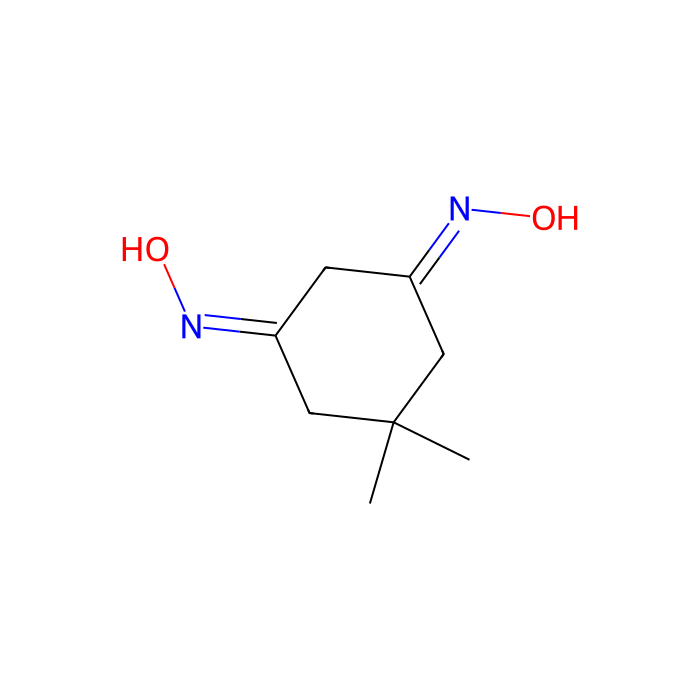
Dimedone Dioxime is the dioxime derivative of 5,5-dimethyl-1,3-cyclohexanedione (dimedone), featuring two oxime functionalities installed at the 1- and 3-positions of the cyclohexane ring.
Item-specific identifiers (from Product Data):
SKU: D350863
CAS: 37110-24-0
CID: 9562213
InChIKey: 145315 (as provided)
SMILES: Not specified for this item; refer to CoA/Spec Sheet.
Structure description (general/literature):
Core: Saturated six-membered ring bearing a gem-dimethyl (C(CH3)2) at C5 (relative to oxime positions).
Functional groups: Two C=N–OH (oxime) groups at C1 and C3 (dioxime), capable of E/Z configurations about each C=N (mixture typically handled without resolution unless specified).
Stereochemistry: No stereocenters; possible geometric isomerism around the C=N bonds.
Composition (literature):
Molecular formula: C8H14N2O2 (literature)
Molecular weight: ~170.21 g/mol (literature)
Notes:
Where exact item-specific identifiers (e.g., definitive SMILES/InChI) are required for regulatory filings, please consult the product CoA/Spec Sheet or SDS. Values above marked “literature” are provided for context and not as product specifications.
Synthetic Utility
Dimedone dioxime provides two oxime functionalities on a cyclohexane framework with a gem-dimethyl substituent, yielding a rigid, chelation-capable scaffold.
Key reactive features (literature/general):
Oxime N–O–H: Weakly acidic; deprotonation promotes metal binding or O-functionalization (acylation/alkylation) to tune donor properties.
C=N functionality: Under activating conditions, oximes can undergo transformations (e.g., Beckmann-type rearrangements for ketoximes), though reactivity of dioximes depends on substitution and conditions; selective mono-transformation may be possible with careful control.
Bidentate ligand: The two oxime nitrogens can coordinate to metals, enabling preparation of discrete chelates or extended structures (coordination polymers/MOF motifs), depending on auxiliary donors and metal choice.
Synthetic roles:
Ligand platform to assemble and isolate metal complexes for catalysis screening or redox studies.
Derivatization handle: Sequential O-acylation to install electron-withdrawing groups can modulate coordination strength and solubility; protecting-group-like behavior for staged manipulations.
Precursor comparison: Relative to acyclic dioximes (e.g., DMG), the cyclic, gem-dimethylated backbone offers different steric/electronic effects, potentially altering complex geometry and stability.
Practical considerations:
Drying under vacuum at mild temperature before use improves reproducibility in metalation.
Use non-coordinating or weakly coordinating solvents when assessing intrinsic ligand effects on complex formation.
Target Specificity
Not applicable. This product is a small-molecule reagent and not an antibody, enzyme, or biorecognition probe. No antigen, epitope, clone, isotype, or species reactivity is associated with this item.
We use cookies to ensure the website functions properly and, where permitted, to improve your experience. You can manage your preferences at any time in Settings. Learn more in our Cookie Policy.
Shall we send you a message when we have discounts available?
Remind me later
Thank you! Please check your email inbox to confirm.
Products are supplied to verified businesses, institutions, and qualified professionals for research and development use only. Not for use in humans, animals, diagnosis, or therapy.