GRADE & PURITYMoligand™?Moligand™ — Aladdin's line of ligands and bioactive small molecules. Use for receptor, pathway, and binding studies needing defined small-molecule tools.10 mM in DMSO
Moligand™, 10 mM in DMSO Moligand™ for sensitive chromatographic and analytical workflows requiring minimal baseline interference.
🌡
Storage & shipping
Protected from light,Argon charged,Store at -80°C Ships Dry ice packs + Cold packs Check lot-specific COA for exact specifications.
📋
Quality documents
SDS, COA, datasheet, and spec sheet available for download. Lot-specific COA accessible via lot number lookup.
📚
Literature proof
Cited in 0 peer-reviewed publications across chromatography, organic synthesis, and cross-coupling reactions.
Overview
Dimethindene maleate is a selective histamine H1 antagonist with antihistamine effects. Dimethindene maleate can be used for the research of hypersensitivity reactions.
Specifications
Specifications & Purity
Moligand™, 10 mM in DMSO
Storage
Protected from light,Argon charged,Store at -80°C
Shipped In
Dry ice packs + Cold packs
This product requires cold chain shipping. Ground and other economy services are not available.
Determine the necessary mass, volume, or concentration for preparing a solution.
Dilution Calculator
Determine the dilution needed to prepare a stock solution.
Reconstitution Calculator
Reviews
Customer Reviews
Application Protocols
Item-specific tested applications, recommended dilutions, or protocols are not provided for this product.
General research-use guidance (non-validated, for orientation only):
Radioligand binding: Prepare serial dilutions in assay buffer; assess displacement of an H1-selective radioligand across a broad concentration range to derive Ki via Cheng–Prusoff analysis.
Functional assays: Use calcium flux or IP1 accumulation readouts in H1-expressing cells; include vehicle controls and reference ligands for assay window.
Analytical standard: Prepare calibration curves in solvent or matrix-matched conditions for LC–MS/MS quantitation; evaluate recovery and matrix effects.
Refer to peer-reviewed literature and develop SOPs validated for your laboratory. For product-specific instructions, consult the CoA/SDS or contact technical support.
Biological Roles
General biochemical context (literature; no clinical claims):
Pharmacological class: Histamine H1 receptor antagonist (inverse agonist), acting at a class A GPCR. The tertiary amine engages an anionic binding site; the benzhydryl/indene scaffold contributes hydrophobic and π–π interactions.
Functional consequences in vitro: Blocks H1-mediated signaling (e.g., PLC/IP3/Ca2+ pathways) in cellular assays. Often used to benchmark H1 receptor engagement and to define assay windows in calcium flux or radioligand displacement studies.
Off-target considerations: As with many first-generation H1 antagonists, literature notes potential interactions with muscarinic and other aminergic receptors at higher concentrations; evaluate selectivity panels as needed.
ADME-relevant properties: Aromatic, lipophilic core with a basic center; displays pH-dependent solubility and membrane permeability (logD7.4 lower for the maleate salt vs free base). Protein binding and nonspecific adsorption can influence apparent potency in cell-based assays.
Use in research:
Positive control in H1 binding/functional assays.
Tool compound for studying receptor-ligand kinetics, biased signaling, and receptor desensitization.
Item-specific bioassay data, potency (Ki/IC50), or selectivity: Not specified for this item; consult literature primary sources or generate in-house data.
Buffer Applications
This compound is not a buffering agent and is not typically used to control solution pH. Accordingly, no standard buffer recipes apply.
Practical note for assay buffers (general guidance):
Use phosphate- or HEPES-based buffers at pH 6.8–7.4 to maintain the protonated form and solubility of the maleate salt.
Include low levels of surfactant (e.g., 0.01–0.05% Tween 20) or protein (e.g., 0.1% BSA) if nonspecific adsorption is observed in plasticware.
Item-specific buffer recommendations: Not specified for this item; tailor to your assay requirements.
Green Alternatives
Context: Dimethindene maleate is a research ligand rather than a process solvent or reagent. “Green alternatives” primarily concern solvent choices and handling to reduce environmental footprint while maintaining data quality.
As a small-molecule salt, the maleate form improves aqueous compatibility versus the free base, which can aid in preparing reference solutions, calibrators, and in vitro test articles.
For pre-formulation research, evaluate salt stability across pH and ionic strengths, hygroscopicity, and polymorphism. Avoid extrapolating research findings to clinical use without appropriate regulatory studies.
Compendial status, dosage forms, and clinical claims: Not addressed here; not applicable to this research-use product.
Physical Properties
Item-specific specs: Not specified for this item; refer to CoA/Spec Sheet.
Literature/general reference values (do not treat as item specifications):
Physical form: Typically a crystalline solid (literature for maleate salt of tertiary amine antihistamines).
Solubility: Maleate salts are generally more water- and alcohol-soluble than the corresponding free bases; dimethindene maleate is commonly reported as soluble in water, ethanol, and DMSO; sparingly soluble in nonpolar solvents (literature qualitative).
Partitioning: The free base is lipophilic (benzhydryl/indene core) with protonation shifting apparent logP/logD; maleate salt exhibits increased aqueous compatibility (literature trend).
UV/Vis: Benzenoid/benzhydryl chromophores show strong π–π* absorption in the UV (literature); maleate contributes a weakly absorbing C=C chromophore. Specific UV cutoff/ε: Not specified for this item; refer to CoA/Spec Sheet.
Melting point, density, refractive index: Not specified for this item; refer to CoA/Spec Sheet.
Practical implications:
For solution preparation in screening, 10–50 mM DMSO stocks are commonly achievable (literature practice), with subsequent aqueous dilution buffered near neutral pH to maintain salt form and clarity.
Avoid assigning quantitative physical constants to this lot without consulting the product’s CoA.
Quality & Grades
Item-specific grade information:
Grade/Purity: Moligand™ (vendor designation). No numerical purity or stabilizer is specified for this item; refer to CoA/Spec Sheet for assay, residual solvents, and impurity profile.
What Moligand™ generally implies (contextual, not a specification):
The Moligand™ designation is typically used for small-molecule ligands intended for screening, SAR studies, and reference controls in biochemical assays. Emphasis is placed on identity confirmation and suitability for research applications rather than compendial compliance.
How to use grade information in practice:
Identity/assay: Confirm by vendor CoA (e.g., HPLC/LC–MS, NMR) prior to quantitative pharmacology.
UV/background: If planning optical readouts (UV/Vis or fluorescence), request or measure blank spectra to ensure low background at assay wavelengths.
Trace contaminants: If metal or halide sensitivity is critical (e.g., in certain catalytic reactions), pre-test or purify in-house; specific metal limits are not provided for this item.
Summary of item-specific unknowns:
Purity (%), water content, residual solvent levels, and counterion stoichiometry confirmation: Not specified for this item; refer to CoA/Spec Sheet.
Reaction & Applications
Research applications (non-clinical):
Reference ligand: Widely used as a reference antagonist for histamine H1 receptor binding and functional assays (literature). Suitable as a positive control or benchmarking compound in GPCR pharmacology.
Probe compound: Useful in comparative SAR studies involving benzhydryl/indene antihistamine scaffolds, pKa/logD-driven permeability studies, and salt-form effects on solubility.
Stock solutions: Prepare 10–50 mM in DMSO or 1–10 mg/mL in water/ethanol. Filter (0.2 µm PTFE/nylon) if particulate persists.
Salt/base interconversion: If the free base is required, basify an aqueous solution (e.g., pH > 10), extract into an organic solvent (DCM/EtOAc), dry, and convert to desired salt after purification. Ensure this aligns with your regulatory and safety framework.
Assay considerations: Account for potential nonspecific binding due to aromatic hydrophobic surface area. Include detergent or protein in assay buffers to reduce adsorption.
Stability: Protect from light as instructed; avoid prolonged exposure at elevated temperature or extreme pH which may promote degradation of the maleate or tertiary amine.
Note: No specific reaction chemistry (e.g., as a reagent/catalyst) is typical for this molecule; its primary value is as a characterized small-molecule ligand in receptor pharmacology and ADME method development.
Reaction Conditions
This compound is a research ligand rather than a synthetic reagent; no canonical “reaction conditions” apply. The following are practical handling conditions for solution preparation and assays (general guidance):
Stock preparation: Dissolve to 10–50 mM in anhydrous DMSO or to 1–10 mg/mL in water or ethanol; vortex and sonicate if needed. Filter through 0.2 µm if clarity is required.
Working solutions: Dilute into assay buffer (e.g., HEPES or PBS, pH 7.2–7.4) to desired concentrations, keeping final DMSO ≤0.1–0.5% v/v where biology permits.
Adsorption mitigation: Use low-bind plastics or add 0.01–0.05% surfactant or 0.1% BSA for low-nanomolar assays to reduce wall losses.
Stability window: Prepare fresh daily or aliquot and freeze; minimize light exposure per item storage guidance.
Free base generation (if needed): Adjust an aqueous solution to pH >10, extract with DCM/EtOAc, dry, and evaporate under reduced pressure; immediately convert to target salt or store under inert atmosphere at low temperature. This is general methodology—optimize for your scale and compliance.
Item-specific kinetic/thermodynamic data, degradation rates, or assay-validated conditions: Not specified for this item.
Safety & Handling
Item-specific hazard classifications (GHS, H-statements, pictograms, signal word): Not specified for this item; refer to the SDS.
General safety guidance for tertiary amine organic salts (literature/practice):
Likely hazards: May cause skin/eye irritation and respiratory tract irritation upon dust generation; avoid inhalation of powders and contact with eyes/skin. Some tertiary amines can be sensitizers.
PPE: Use lab coat, safety glasses or splash goggles, and appropriate chemically resistant gloves (e.g., nitrile). Handle powders in a fume hood or ventilated enclosure to minimize airborne particulates.
Storage incompatibilities: Keep away from strong oxidizers and strong bases/acids when not intended for neutralization; avoid moisture ingress that could affect weighing. Protect from light as specified for this item.
First aid (overview; defer to SDS): If inhaled, move to fresh air. If on skin or in eyes, rinse cautiously with water for several minutes; remove contact lenses if present and easy to do. If ingested, rinse mouth; seek medical attention as needed.
Thermal/photochemical sensitivity: Aromatic amine salts may discolor upon prolonged light exposure; follow “protect from light” instruction. No known peroxide formation issues.
Always consult the product SDS for authoritative hazard, toxicology, disposal, and spill response information. For research use only.
Solvent Selection
Compound class and polarity considerations:
Dimethindene maleate is an organic ammonium carboxylate salt. The maleate counterion and protonated tertiary amine increase polarity and aqueous compatibility relative to the free base.
Practical solvent choices (literature/practice):
Primary stock solvents: DMSO and water. The salt is typically soluble in water; DMSO enables high-concentration stocks (e.g., 10–50 mM) for HTS workflows.
Alcohols: Ethanol and methanol often dissolve this salt readily and can be useful co-solvents for assay buffers.
Buffers: Phosphate or HEPES at pH 6.5–7.4 help maintain the protonated form and clarity upon dilution from DMSO.
Avoid: Nonpolar solvents (hexanes, toluene) where the salt has poor solubility; if the free base is required for organic synthesis, convert the salt to the base before using such media.
Selection guidance:
Choose water or aqueous buffer for biological assays to minimize organic content.
Choose DMSO for concentrated master stocks and serial dilution accuracy; confirm final DMSO percentage tolerance for your assay system.
If LC–MS quantitation is planned, use water/acetonitrile with formic acid or ammonium formate; assess ion-pairing/retention behavior due to the tertiary amine and aromatic core.
Item-specific solubility values are not provided; verify experimentally for your system.
Storage & Reconstitution
Item-specific storage and shipping (from Product Data):
Storage Conditions: Protected from light, Argon charged, Store at -80°C.
Shipped In: Dry ice packs + Cold packs.
Practical handling recommendations:
Upon receipt: Keep container sealed; equilibrate briefly to avoid condensation before opening. Maintain under inert gas blanket (argon) to minimize oxidative and moisture exposure.
Aliquoting: If frequent use is expected, aliquot the solid under low humidity and inert atmosphere into amber vials to limit freeze–thaw and light exposure.
Reconstitution (general): For screening stocks, dissolve in anhydrous DMSO (e.g., 10–50 mM) or aqueous buffer/ethanol as compatible with your assay. Mix thoroughly and, if needed, filter through a 0.2 µm membrane.
Storage of solutions: Store small aliquots at ≤−20°C (short term) or −80°C (long term), protected from light and air headspace. Avoid repeated freeze–thaw; thaw once, dispense, and refreeze only if stability has been verified.
Item-specific stability data (shelf life, solution stability, water content, impurity limits): Not specified for this item; refer to CoA/Spec Sheet and SDS. Research use only.
Structure & Identity
Item-specific identifiers from Product Data:
CAS: 3614-69-5
SKU: D1496554
Product Name: Dimethindene maleate
InChIKey: Not specified for this item; refer to CoA/Spec Sheet.
SMILES: Not specified for this item; refer to CoA/Spec Sheet.
Literature identifiers and structural description (for reference only):
Molecular formula (maleate salt, literature): C24H28N2O4
Molecular weight (literature): ~408.49 g/mol
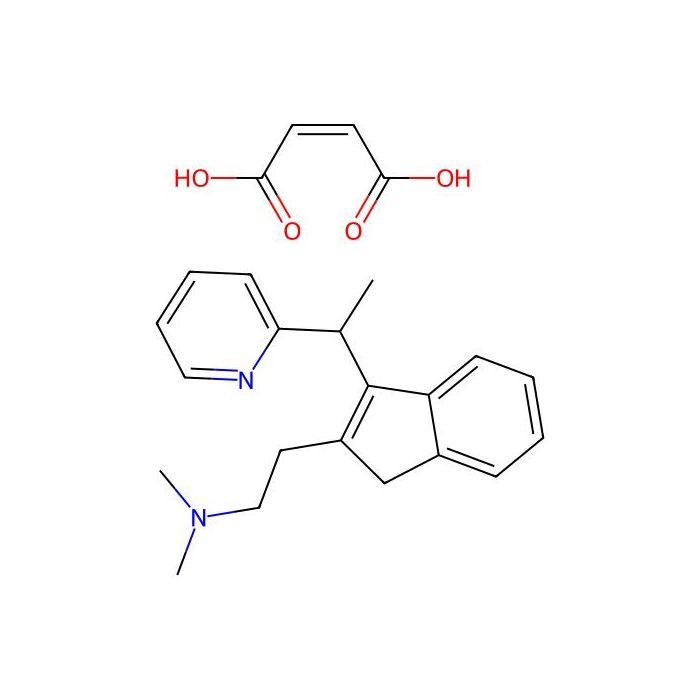
Common name: Dimetindene maleate (1:1 salt of dimetindene with maleic acid)
Structural features: The cation is a tertiary amine antihistamine based on an indene core bearing a benzhydryl (diphenylmethyl) motif and a dimethylaminoalkyl side chain. The counterion is maleate (the monoanion of cis-butenedioic acid), featuring a conjugated C=C and two carboxylates (one protonated, one deprotonated at typical salt pH).
2D description: A fused five-membered carbocycle (indene) substituted at the bridgehead carbon with two phenyl rings (benzhydryl) and at the adjacent position with a –CH2–CH2–N(CH3)2 tertiary amine chain. The maleate anion contains HOOC–CH=CH–COO− in the cis configuration.
Notes:
The salt stoichiometry is typically 1:1 (literature). Verify exact stoichiometry on the item’s CoA before quantitative work.
Synthetic Utility
Dimethindene maleate is generally not used as a synthetic reagent. Its value lies in serving as a reference compound and scaffold in medicinal chemistry research.
Utility in synthesis and analysis (literature/practice):
Scaffold benchmarking: Provides a benzhydryl–indene tertiary amine framework useful for comparing structure–property relationships (pKa, logD, permeability) across related antihistamine chemotypes.
Salt manipulation: Demonstrates principles of salt screening (maleate vs other counterions) on solubility and crystallinity; can be used in teaching/optimization of salt selection workflows.
Analytical standards: Employed as a reference standard in chromatographic method development, including LC–MS/MS quantitation in complex matrices (matrix effects and ion suppression should be assessed due to basic tertiary amine).
If chemical modification is intended:
Transformations would typically start from the free base. Standard reactions on tertiary amines (quaternization, N-oxide formation) and on aromatic rings (electrophilic substitutions) may be explored on model systems; however, direct late-stage diversification may be constrained by steric hindrance and the benzhydryl center stability.
Target Specificity
Item-specific target, epitope, clone/isotype, or species reactivity data are not applicable to this small-molecule product and are not provided in the Product Data.
General literature context (for researcher orientation only): Dimethindene is a histamine H1 receptor antagonist used as a reference ligand in H1-binding and functional assays. Do not treat this as product-verified data; confirm target engagement in your own system.
Frequently Asked Questions
How should this product be stored?
Store at ?80 °C, protected from light, under argon. It is supplied under an argon blanket; reseal under inert gas after each use.
What is Moligand??
Moligand? is one of Aladdin Scientific's premium product lines, formulated for high-purity applications across multiple workflows. Compared to standard grades in the same workflow, Moligand? products typically offer tighter specifications, more rigorous QC, and stronger lot-to-lot consistency.
How is this product shipped?
This product ships frozen with dry ice and cold packs. Unpack on arrival and transfer it to the storage condition stated above; handle dry ice with insulated gloves in a ventilated area.
What are the CAS number, molecular formula and molecular weight?
The CAS Number is 3614-69-5, the molecular formula is C24H28N2O4, and the molecular weight is 408.49 g/mol.
What documentation is provided?
Available product documentation, including Certificates of Analysis (COA), Safety Data Sheets (SDS), and specification sheets, is shown in the product document area. Document availability and access follow the current site policy.
Need help choosing the grade?
Our grade selection guide covers purity, stabilizer status, and application suitability for all variants in our catalog.
We use cookies to ensure the website functions properly and, where permitted, to improve your experience. You can manage your preferences at any time in Settings. Learn more in our Cookie Policy.
Shall we send you a message when we have discounts available?
Remind me later
Thank you! Please check your email inbox to confirm.
Products are supplied to verified businesses, institutions, and qualified professionals for research and development use only. Not for use in humans, animals, diagnosis, or therapy.