This compound belongs to the class of organic compounds known as dialkyl alkylphosphonates. These are compounds containing a phosphonic acid that is diesterified with alkyl groups, and the phosphorus atom is also directly attached to an alkyl group.
External Descriptors
Not available
1. Djoumbou Feunang Y, Eisner R, Knox C, Chepelev L, Hastings J, Owen G, Fahy E, Steinbeck C, Subramanian S, Bolton E, Greiner R, and Wishart DS. ClassyFire: Automated Chemical Classification With A Comprehensive, Computable Taxonomy. Journal of Cheminformatics, 2016, 8:61.
Determine the necessary mass, volume, or concentration for preparing a solution.
Dilution Calculator
Determine the dilution needed to prepare a stock solution.
Reconstitution Calculator
Reviews
Customer Reviews
Application Protocols
No assay application protocols (e.g., WB, IHC, IF, FC) are applicable to this small-molecule synthetic reagent. For synthetic use, consider the general workflow below (informative, not item-specific):
HWE olefination workflow (general):
Dry glassware and charge with inert gas (argon). Dissolve the phosphonate in dry THF at 0 °C.
Add base (e.g., NaH, 60% dispersion) portionwise; stir until gas evolution ceases and a homogeneous suspension forms.
Add aldehyde solution dropwise at 0 to −20 °C; allow to warm to 0–25 °C as needed.
Quench with cold, saturated NH4Cl; extract with DCM/EtOAc; dry and concentrate.
Purify by silica gel chromatography.
For detailed, substrate-specific procedures, consult primary literature on 1,3‑dithiole‑2‑yl phosphonate olefinations. All uses are for research only.
Biological Roles
This product is a synthetic organophosphorus heteroaromatic reagent intended for laboratory research in organic/materials chemistry. It does not have a recognized endogenous biological role.
Endogenous function: None; 1,3‑dithiole phosphonates are not natural metabolites.
Biochemical interactions (general): Phosphonate esters may chelate or hydrogen‑bond with proteins/enzymes in non‑specific ways, but this compound is not designed for biochemical selectivity.
Use context: Predominantly a synthetic building block for constructing sulfur‑rich π‑systems (e.g., dithiafulvenes/TTFs) of interest in materials science (conductivity, redox) rather than in biochemistry.
For any biological testing, treat as a research chemical of unknown biological activity. No clinical, diagnostic, or therapeutic uses are claimed or supported.
Buffer Applications
Not typically applicable. Dimethyl 2‑(1,3‑Dithiole)phosphonate is an organic synthetic reagent and is not used to prepare aqueous buffer systems. If aqueous manipulations are necessary (e.g., workup), use neutral to slightly basic buffers (e.g., saturated NH4Cl, NaHCO3) as appropriate for quenching bases and minimizing oxidation of sulfur functionalities. For buffer formulation guidance, refer instead to dedicated buffering agents (HEPES, MOPS, phosphate, Tris).
Green Alternatives
While the compound itself is a specialized phosphonate reagent, greener choices can be made in the associated solvents, bases, and workup methods. The following are literature-based suggestions to improve the sustainability profile of workflows using this reagent.
Greener solvent swaps (informative comparison):
2‑MeTHF vs THF
Pros: Bio‑based, higher boiling point (simplifies low‑temperature workups), improved phase separation with water, often comparable reactivity in HWE.
Cons: Slightly different polarity; solubility of inorganic bases/salts may be lower.
CPME vs diethyl ether
Pros: Peroxide formation rate is slower than Et2O; higher boiling point; good for extractions.
Cons: Less common; may require method re‑optimization.
EtOAc or MeCN vs DCM/CHCl3 (for chromatography or reactions)
Pros: Reduced chlorinated solvent use; MeCN supports many base‑promoted reactions.
Cons: Silica performance/selectivity may change; MeCN has toxicity considerations and requires proper recovery.
Base and process considerations:
Use DBU or carbonates (Cs2CO3, K2CO3) in polar aprotic media when feasible to replace pyrophoric bases; note that for less activated substrates, NaH/KH may still be required (trade‑off between safety/greenness and reactivity).
Favor room‑temperature or microwave‑assisted procedures to reduce energy consumption, provided the 1,3‑dithiole ring integrity is maintained.
Implement solvent recycling (MeCN, EtOAc) and molecular sieves instead of stoichiometric drying agents when possible.
As always, validate any substitution with small‑scale trials to ensure chemoselectivity and E/Z outcomes are preserved.
Pharmaceutical Uses
No pharmacopeial or excipient role is indicated for this item. It is supplied strictly for research use in chemical synthesis.
General context (informative):
Role in R&D: Organophosphorus reagents like phosphonates are used in discovery chemistry to build carbon–carbon double bonds (olefination). Sulfur‑rich motifs derived from 1,3‑dithiole frameworks are explored in materials and, less commonly, in medicinal chemistry scaffold diversification.
Formulation status: Not used as an excipient or API; no compendial monograph is known for this specific structure.
All uses are restricted to research and laboratory development; no clinical or therapeutic applications are claimed.
Physical Properties
Item-specific physicochemical specifications are not provided in the Product Data for this listing. Refer to the lot-specific CoA/Spec Sheet for authoritative values.
Item-specific (from Product Data):
Appearance: Not specified for this item; refer to CoA/Spec Sheet.
Molecular weight: Not specified for this item; refer to CoA/Spec Sheet.
General/literature expectations for analogous dimethyl aryl/heteroaryl phosphonates (informative only; not item specifications):
State: Typically a low‑melting solid or viscous oil depending on ring substitution; many phosphonates are colorless to pale yellow.
Polarity: Moderately polar due to P=O and P–O–Me groups; often soluble in polar aprotic organic solvents (e.g., CH2Cl2, THF, MeCN, DMF) and poorly soluble in water.
Boiling/melting behavior: Many dialkyl phosphonates decompose before boiling at atmospheric pressure; purification is commonly by column chromatography rather than distillation.
Acidity/basicity: The methylene α to phosphorus in phosphonates is relatively acidic when present (pKa ~22–30 in DMSO, literature, system-dependent). For a 1,3‑dithiole‑2‑yl phosphonate, the C‑2 linkage is sp2; deprotonation occurs at the carbon α to P when present in the side chain; for this 2‑yl system, HWE-type reactivity is accessed via the P‑stabilized carbanion at the ring carbon under strong base (literature context).
Stability: Sensitive to strong acids/bases (transesterification, cleavage) and prolonged moisture; sulfur heterocycle is generally stable but can be oxidized to sulfoxides/sulfones under strong oxidants.
Always verify actual values and handling parameters on the CoA/SDS for the specific lot.
Quality & Grades
Item-specific grade/purity information is not provided in the Product Data for this SKU.
Grade/Purity: Not specified for this item; refer to CoA/Spec Sheet.
General guidance for interpreting grades (informative):
Research/technical grade: Suitable for most synthetic applications; typical impurities may include residual solvents or trace inorganic salts. Verify by NMR/LC if sensitive to impurities.
Synthetic/intermediate grade for organophosphorus reagents: Emphasis on low water content and minimal acidic/basic impurities to preserve base‑sensitive phosphonate esters.
HPLC grade solvents vs. reagent grade reagents: If using this compound in moisture‑sensitive anionic chemistry (e.g., HWE), reaction outcomes are often more sensitive to the solvent quality (water/acid content) than to ppm-level impurities in the phosphonate itself.
Stabilizers/antioxidants:
No stabilizer information is provided in the Product Data. If present, stabilizers would be listed on the CoA/SDS. For sulfur heterocycles, antioxidants are rarely added; protection is typically via inert gas and low‑temperature storage (as specified for this item).
Recommendation:
Check the CoA for assay (%), NMR purity, and residual solvent profile for your lot. If conducting base‑promoted olefinations, consider a brief vacuum-drying step under inert gas prior to use.
Reaction & Applications
This reagent is a 1,3‑dithiole‑2‑yl phosphonate, a class widely used as carbanion-stabilized partners in olefination chemistry and in the synthesis of electron‑rich sulfur heterocycles.
Key application families (literature/general):
Horner–Wadsworth–Emmons (HWE) and related olefinations:
Deprotonation adjacent to the P=O group generates a stabilized carbanion that reacts with aldehydes/ketones to form vinyl‑substituted 1,3‑dithiole derivatives after elimination of a phosphate. The sulfur ring helps stabilize the anion and can direct E/Z selectivity (often favoring E‑alkenes with stabilized systems).
Dithiafulvene (DTF) and tetrathiafulvalene (TTF) precursors:
1,3‑Dithiole‑substituted alkenes serve as TTF building blocks. Subsequent oxidation or dimerization steps furnish TTF cores, key motifs in organic conductors and charge‑transfer materials.
Annulation and cross‑coupling sequences:
The vinyl‑dithiole products can undergo electrophilic substitution, oxidation (to sulfoxides/sulfones), or cross‑coupling after suitable functionalization (e.g., via halogenation of the vinyl unit), enabling modular access to sulfur‑rich π‑systems.
Practical tips:
Work dry and under argon; the product is shipped cold and specified for −20 °C inert storage, consistent with moisture/air sensitivity of performance.
For base‑promoted steps, pre‑dry the reagent under high vacuum at ambient temperature to remove residual volatiles.
Quench HWE reactions carefully (e.g., with NH4Cl or buffered aqueous workup) to avoid ring sulfur oxidation.
Purify via silica gel using DCM/EtOAc mixtures; minimize exposure to strong Lewis acids on silica which may promote side reactions.
All applications are for research use only.
Reaction Conditions
General literature guidance for phosphonate-based olefinations and 1,3‑dithiole chemistry (informative; optimize for your substrate set):
HWE/Olefination (stabilized phosphonate):
Solvent: THF (dry), 2‑MeTHF, or MeCN.
Base: NaH (60% oil), KH, t‑BuOK (0.9–1.5 equiv) for strong deprotonation; DBU (1.2–2.0 equiv) for milder systems and activated carbonyls.
Temperature: −78 to 0 °C for strong bases; 0 to 25 °C for DBU-mediated protocols.
Electrophile: Aldehydes preferred for high E‑selectivity; ketones may react slower.
Typical times: 0.5–6 h depending on electrophile and temperature.
Workup: Careful quench with NH4Cl (aq) or buffered solutions; avoid strongly acidic quench which may promote sulfur oxidation.
Formation of dithiafulvenes (DTFs):
After olefination, neutralization and purification give vinyl‑dithiole products; oxidative dimerization to TTFs may use I2, FeCl3, or trityl salts under controlled conditions (monitor by TLC/UV‑vis due to chromophore development).
Chromatography: Silica gel with DCM/EtOAc/hexanes; include 0.1–1% TEA in eluent if basic tailing observed (test to ensure ring integrity).
Drying: Store and handle under argon (as per item data). Dry glassware and solvents; consider 3 Å sieves in MeCN protocols.
Expected outcomes (literature):
E/Z selectivity: Often E‑favored with stabilized carbanions and aldehydes.
Yields: Commonly 60–90% for well‑matched substrates; ketones and sterically hindered partners may be lower.
These are general starting points; adjust equivalents, temperature, and timing based on substrate electronics and desired selectivity.
Safety & Handling
Authoritative safety classification for this specific item is not provided in the Product Data. Consult the product SDS for definitive information.
Item-specific (from Product Data):
Storage: Store at −20 °C, argon charged (inert atmosphere recommended).
Shipping: Ice chest with ice pads.
GHS classification, signal word, hazard statements, pictograms: Not specified for this item; refer to SDS.
General handling guidance for organophosphorus phosphonates and sulfur-containing heteroaromatics (literature/best practice):
PPE: Use lab coat, safety glasses or face shield, and appropriate chemical-resistant gloves (e.g., nitrile). Handle in a fume hood.
Incompatibilities: Avoid strong oxidizers (may oxidize sulfur atoms), strong acids/bases (can induce hydrolysis/transesterification), and moisture (can slowly hydrolyze phosphonate esters). Maintain an inert, dry atmosphere during use and storage.
Hygiene measures: Prevent skin/eye contact and inhalation of vapors/aerosols. Wash thoroughly after handling.
First aid (overview): If inhaled, move to fresh air; if on skin, wash with soap/water; if in eyes, rinse with water for several minutes; if ingested, rinse mouth and seek medical attention. Follow SDS instructions.
Thermal hazards: Avoid heating to decomposition. Many phosphonates may decompose, releasing acrid fumes containing phosphorus oxides and sulfur oxides.
Waste: Collect organic waste containing phosphorous/sulfur species in appropriate halogenated/non‑halogenated organic waste streams per institutional and local regulations.
Note: The above are general precautions. Always defer to the SDS for this catalog item and your institution’s EHS guidelines.
Solvent Selection
Applicability: As a moderately polar organophosphorus reagent bearing a 1,3‑dithiole ring, this compound typically dissolves well in polar aprotic organic solvents used for anionic chemistry. Specific solubility values for this item are not provided; use the guidance below as literature-based best practice.
Preferred classes (literature/typical):
Dichloromethane (DCM), chloroform: Good solubility; convenient for room‑temperature manipulations and chromatography.
THF, 2‑MeTHF, diethyl ether: Useful for strong‑base deprotonations (NaH, t‑BuOK); ensure dryness and inert atmosphere.
Acetonitrile (MeCN): Polar, aprotic; suitable for HWE-type reactions with soluble bases (DBU) or phase-transfer systems.
DMF/DMSO: High polarity; enable reactions with heterogeneous bases; consider workup challenges and potential decomposition at high temperature.
Generally poor choices: Water and very nonpolar alkanes (hexanes) typically show limited solubility for dialkyl phosphonates.
Selection tips (general):
For HWE/olefination, choose THF/2‑MeTHF when using strong bases (NaH, KH, t‑BuOK) at 0 to −78 °C; choose MeCN or DCM for DBU- or fluoride-promoted variants at 0–25 °C.
For chromatography, DCM/EtOAc/hexanes gradients often provide clean separations; avoid strong basic alumina when sulfur-containing substrates are present.
For scalability/green metrics, 2‑MeTHF or CPME can replace THF/Et2O in many protocols; confirm solubility and base compatibility.
Note: Always dry solvents (molecular sieves or distillation) and maintain an inert atmosphere to match the item’s storage guidance.
Storage & Reconstitution
Item-specific guidance (from Product Data):
Storage conditions: Store at −20 °C, argon charged (maintain an inert atmosphere). Keep container tightly closed and protect from moisture and air.
Shipping: Supplied in an ice chest with ice pads, indicating preference for cool transit and temperature control.
Best practices (general) for this class of reagents:
Aliquot on receipt under dry argon/nitrogen to minimize headspace oxygen and moisture ingress during repeated use. Use septum‑cap vials if possible.
Headspace management: Backfill with argon after each use. Consider storing over a small plug of activated molecular sieves (3 Å) in a separate container if compatible.
Avoid freeze–thaw cycling: Keep working aliquots at refrigerator temperature during the day’s use; return long‑term stock to −20 °C promptly.
No reconstitution needed: Typically supplied neat. If a solution is desired (e.g., 0.5–1.0 M in dry THF or MeCN), prepare under inert atmosphere using oven‑dried solvents and glassware; label with solvent, concentration, and preparation date, and store at ≤−20 °C.
Stability notes: Prolonged exposure to moisture or strong light/oxidants may degrade phosphonate esters and the sulfur heterocycle; monitor by 31P and 1H NMR as needed.
For lot-specific stability and retest dates, consult the CoA/Spec Sheet.
Molecular formula: Not specified for this item; refer to CoA/Spec Sheet.
Molecular weight: Not specified for this item; refer to CoA/Spec Sheet.
SMILES: Not specified for this item; refer to CoA/Spec Sheet.
InChIKey: Not specified for this item; refer to CoA/Spec Sheet.
Structural description (general/literature):
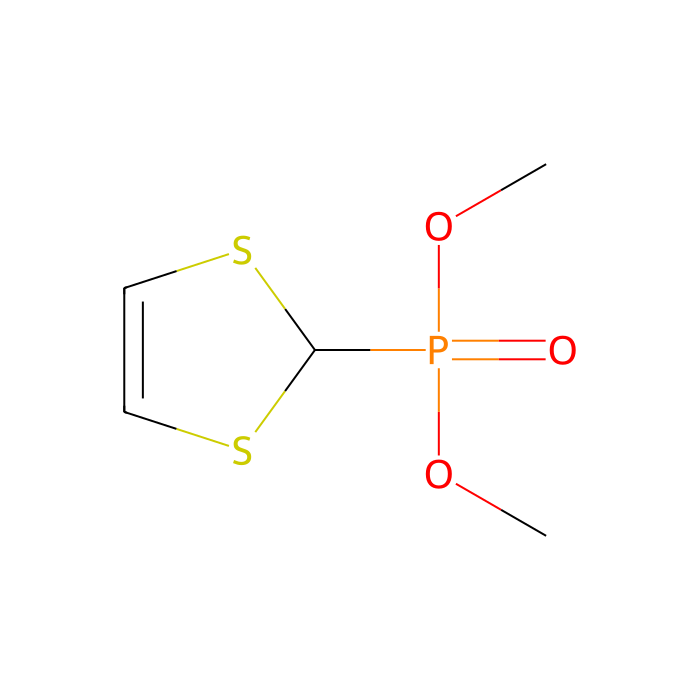
Core motif: A 1,3-dithiole five‑membered ring (two ring sulfurs at positions 1 and 3) bearing a substituent at the 2‑position.
Phosphonate group: The substituent is a phosphonate (P=O) with two methoxy (–OCH3) ester groups (i.e., a dimethyl phosphonate). The P–C bond links the phosphonate to the 1,3‑dithiole‑2‑yl carbon.
Functional groups: P=O (phosphoryl), two P–O–Me ester moieties, heteroaromatic 1,3‑dithiole ring (C3S2). No stereocenters are expected in the parent structure.
2D structure in words: A five‑membered ring S–C–S framework (1,3‑dithiole) with a vinylogous sp2 carbon at C‑2 bonded to a tetra‑coordinate phosphorus(V) center (P=O) that also bears two methoxy substituents.
Notes:
The above is a structural interpretation from the systematic name; exact identifiers (SMILES/InChIKey) are not specified for this item and should be confirmed from the CoA/Spec Sheet.
Synthetic Utility
Functional elements and reactivity (literature/general):
Phosphonate (P=O, P–OMe2): Enables formation of a stabilized carbanion for Horner–Wadsworth–Emmons (HWE) and related olefination reactions with aldehydes/ketones. The leaving group after olefination is a phosphate ester, facilitating E‑selective alkene formation in many cases.
1,3‑Dithiole ring: Electron‑rich, sulfur‑containing heteroaromatic that stabilizes adjacent anions and serves as a precursor to dithiafulvenes/TTFs. The ring can tolerate many conditions, but is susceptible to oxidation and strong electrophiles.
Typical synthetic sequences:
Anionic olefination: Base (NaH, KH, t‑BuOK, or DBU) generates the phosphonate carbanion which condenses with carbonyls to give vinyl‑1,3‑dithiole derivatives (often high E‑selectivity with conjugated acceptors).
TTF assembly: Two dithiafulvene units can be coupled/oxidized to tetrathiafulvalenes, central to organic conductors and redox‑active materials.
Divergent functionalization: Post‑olefination manipulation (halogenation, cross‑coupling, oxidation to sulfoxide/sulfone, nucleophilic substitution at activated positions) expands chemical space for materials applications.
Practical recommendations:
Ensure strict anhydrous/inert conditions; moisture compromises carbanion formation and can hydrolyze phosphonates.
Choose base/solvent to balance reactivity and selectivity: THF or 2‑MeTHF for strong bases at low temperature; MeCN/DCM for DBU-mediated variants.
Employ mild oxidation control to preserve the dithiole ring; avoid over‑oxidation which degrades sulfur functionality.
This utility profile makes the reagent valuable for assembling highly conjugated, sulfur‑rich frameworks.
Target Specificity
Not applicable. This product is a small-molecule synthetic reagent and does not have biological target specificity (no antigen/epitope, clone, isotype, or species reactivity).
We use cookies to ensure the website functions properly and, where permitted, to improve your experience. You can manage your preferences at any time in Settings. Learn more in our Cookie Policy.
Shall we send you a message when we have discounts available?
Remind me later
Thank you! Please check your email inbox to confirm.
Products are supplied to verified businesses, institutions, and qualified professionals for research and development use only. Not for use in humans, animals, diagnosis, or therapy.

 A2219451