This compound belongs to the class of organic compounds known as fatty acid esters. These are carboxylic ester derivatives of a fatty acid.
External Descriptors
Not available
1. Djoumbou Feunang Y, Eisner R, Knox C, Chepelev L, Hastings J, Owen G, Fahy E, Steinbeck C, Subramanian S, Bolton E, Greiner R, and Wishart DS. ClassyFire: Automated Chemical Classification With A Comprehensive, Computable Taxonomy. Journal of Cheminformatics, 2016, 8:61.
Determine the necessary mass, volume, or concentration for preparing a solution.
Dilution Calculator
Determine the dilution needed to prepare a stock solution.
Reconstitution Calculator
Reviews
Customer Reviews
Application Protocols
No assay protocols (e.g., WB, IHC, IF, FC) apply to this small‑molecule reagent. For synthetic applications, refer to the Reaction Conditions and Synthetic Utility sections for stepwise guidance on hydrolysis, aminolysis, reductions, and transesterification. Always conduct small‑scale trials to optimize equivalents, temperature, solvent, and catalysts for your specific system.
Biological Roles
Item context
Research Use Note: For research use only.
General notes (literature; not item-specific claims)
Dimethyl hexafluoroglutarate is a synthetic fluorinated diester with no known natural occurrence or biological role. The perfluoroalkyl segment is metabolically robust; such motifs typically resist biotransformation due to strong C–F bonds and lack of enzymatic handles.
In biochemical method development, fluorinated compounds can serve as inert probes or 19F NMR reporters; however, this particular diester is primarily a chemical building block rather than a biochemical reagent.
Hydrolysis could generate hexafluoroglutaric acid derivatives; nonetheless, these do not function as canonical metabolites in central metabolic pathways.
Cell and enzyme interactions (general observations)
Esters can undergo nonspecific hydrolysis under strong acidic/basic conditions, but spontaneous enzymatic hydrolysis in biological media is expected to be limited by steric/electronic deactivation and hydrophobicity.
No medical, therapeutic, or diagnostic uses are implied. Any work with biological systems should be preceded by appropriate biocompatibility and toxicity assessments per institutional guidelines.
Buffer Applications
Not typically applicable. Dimethyl hexafluoroglutarate is a neutral, hydrophobic diester and is not used to prepare aqueous buffers. If hydrolyzed to the diacid, the resulting hexafluoroglutaric acid could, in principle, participate in buffer systems, but this is uncommon in laboratory practice. For this catalog item, focus on the Synthetic Utility and Reaction Conditions sections for relevant usage guidance.
Green Alternatives
This compound is a fluorinated specialty building block; direct “green” replacements provide different properties. Consider the following when evaluating alternatives:
When the goal is a diester spacer without fluorination effects
Alternatives: dimethyl glutarate (DMG) or dimethyl adipate (DMA). These are biodegradable, have better EHS profiles, and are used as green solvents/reagents in some processes.
Trade‑off: loss of the strong electron‑withdrawing and lipophobic characteristics imparted by –CF2– units (affecting reactivity, polarity, and materials properties).
When used primarily as a solvent (not typical here)
Prefer green solvents such as 2‑MeTHF, CPME, ethyl acetate, propylene carbonate, or dimethyl carbonate depending on reaction class. Dimethyl hexafluoroglutarate is generally not employed as a process solvent.
Process intensification and waste minimization (general guidance)
Employ catalytic transesterification/aminolysis (e.g., organocatalysts, biocatalysts where compatible) to reduce energy and byproducts.
Use solvent‑less or high‑solids approaches when feasible; recover alcohol by‑product (MeOH/EtOH) via distillation.
Comparison snapshot (general)
Fluorinated diester vs nonfluorinated analog
EHS: fluorinated materials raise persistence concerns; nonfluorinated diesters are typically more benign.
Performance: fluorinated diester offers enhanced chemical resistance and distinctive polarity; nonfluorinated analogs offer greener footprint but different properties.
Conclusion: Choose alternatives based on whether fluorine‑specific attributes are a hard requirement for your study or formulation.
Pharmaceutical Uses
This compound is primarily a synthetic intermediate and specialty building block in research chemistry.
Formulation/excipient role: Not standard. Fluorinated diesters of this type are not typical pharmaceutical excipients.
Medicinal chemistry context (general): May be leveraged to introduce a perfluoroalkyl spacer into small molecules or materials for property modulation (lipophilicity, metabolic stability) at the discovery/research stage.
Regulatory status: No pharmacopeial monograph is known for dimethyl hexafluoroglutarate.
No therapeutic or clinical claims are made. Any use is strictly for research and development by qualified personnel.
Physical Properties
Item-specific specifications
Appearance: Not specified for this item; refer to CoA/Spec Sheet.
Grade/Purity: Not specified for this item; refer to CoA/Spec Sheet.
Storage and shipping (from Product Data)
Storage Conditions: Room temperature
Shipped In: Normal
Literature/general reference values (for context; not item specifications)
Phase at ambient conditions: typically a colorless liquid for lower alkyl perfluorinated diesters of this chain length.
Polarity: polar aprotic functionality with low hydrogen‑bond donating ability; overall low cohesive energy due to perfluoroalkyl core.
Volatility: moderate; fluorinated esters often exhibit relatively higher density and lower surface energy vs hydrocarbon analogs.
Solubility profile (qualitative, literature): miscible with many organic solvents (e.g., acetone, chlorinated solvents, ethers); low solubility in water expected for perfluoroalkyl diesters.
Not specified for this item; refer to CoA/Spec Sheet
Boiling point, melting point, density, refractive index, viscosity, UV cutoff, water content, residual metals.
Important: Use authoritative CoA/SDS for exact physicochemical values required for method development or regulatory documentation.
Quality & Grades
Item-specific grade/purity status
Grade/Purity: Not specified for this item; refer to CoA/Spec Sheet.
How to interpret common grades for this type of reagent (general guidance)
Synthetic/technical grade: adequate for most preparative chemistry; may contain higher residual volatiles or assay variance.
≥95–98% (organic synthesis grade): suitable for routine transformations (hydrolysis, reductions, transesterifications). Verify by GC/GC–MS or 1H/19F/13C NMR.
≥99% (high purity): preferred for mechanism studies, materials applications, or when residual acidity/protic impurities would bias outcomes (e.g., base‑sensitive catalysis).
HPLC grade (if offered): implies low UV-absorbing impurities and tight specs on residue after evaporation—useful if the compound is employed as a reference or in analytical method development.
Stabilizers/inhibitors
No stabilizers are typically required for aliphatic diesters; any stabilizer use would be disclosed on the CoA. For this catalog item, stabilizers are Not specified for this item; refer to CoA/Spec Sheet.
Recommended incoming QC (user practice)
Check identity/purity by 1H NMR (expected: two OMe singlets often overlapping), 19F NMR (three equivalent CF2 sets), and 13C NMR (carbonyls and CF2 carbons strongly deshielded).
Confirm water content and acidity if reaction is moisture/base sensitive; perform small‑scale test reaction to benchmark performance.
Reaction & Applications
Dimethyl hexafluoroglutarate serves as a versatile fluorinated C3‑spacer diester for introducing a perfluoroalkyl segment between two carbonyl termini. Representative research applications include:
Access to hexafluoroglutaric derivatives
Hydrolysis (base- or acid‑catalyzed) to hexafluoroglutaric acid, followed by conversion to diacid chloride (e.g., SOCl2, oxalyl chloride) for step‑growth polymerizations, crosslinkers, or acylation chemistry in materials science.
Transesterification to alternative alkyl esters (e.g., ethyl, benzyl) under acid or base catalysis to tailor volatility and handling.
Formation of diamides and mixed derivatives
Direct aminolysis of the diester to diamides typically requires activation or strong conditions (elevated temperature, neat amine or catalytic transamidation protocols). The electron‑withdrawing CF2 units can reduce nucleophilicity requirements by increasing carbonyl electrophilicity, yet steric/electronic effects may still necessitate catalysts (e.g., Ti(OiPr)4, DBU) or stepwise acid chloride routes.
Reductive transformations
Reduction to the corresponding diol using strong hydride donors (LiAlH4) or stepwise partial reductions (DIBAL-H) enabling access to fluorinated diols and diols–diesters for specialty materials.
Cross‑coupling and further derivatization (indirect)
While the perfluoroalkyl chain lacks direct handles for metal‑catalyzed coupling, derivatization via α‑functionalization of the diester or through diacid chloride intermediates enables introduction of aryl or heteroatom substituents in advanced syntheses.
Applications in research fields (general)
Fluorinated polymer precursors, surface‑energy modifiers, and benchmarking probes in 19F NMR studies where a defined CF2–CF2–CF2 motif is advantageous.
Notes: Select methods and conditions below are literature‑style guidance; validate experimentally on small scale.
Reaction Conditions
The following are literature‑style, non‑item‑specific guidelines for common transformations of fluorinated diesters. Optimize on small scale and confirm with analytical data.
Hydrolysis to diacid (saponification)
Conditions: 1–2 M NaOH or KOH in MeOH/H2O (e.g., 3:1 v/v), 0–25 °C initially, then warm to 40–60 °C as needed.
Stoichiometry: 2.2–2.5 equiv base per diester.
Time: 2–16 h depending on temperature.
Workup: evaporate MeOH, acidify aqueous phase (pH ~1–2) with HCl at 0–5 °C, isolate precipitated diacid, wash, and dry.
Aminolysis to diamide
Conditions: Neat primary amine (4–10 equiv) or in toluene/THF with Ti(OiPr)4 (5–10 mol%) or DBU (10–20 mol%) as catalyst.
Temperature: 80–120 °C (neat) or reflux in chosen solvent.
Time: 6–24 h; monitor by 19F/1H NMR or LC–MS.
Note: Stepwise mono‑amidation can be achieved by controlling equivalents and time, then further conversion to diamide.
Reduction to diol
Reagent: LiAlH4 (2.5–3.0 equiv per ester) in dry THF at 0 °C to reflux.
Addition: slow addition under inert atmosphere; after completion, cautious quench (H2O/iPrOH/NaOH sequence), filter salts, and concentrate.
Alternative: BH3·THF for smoother reductions with fewer over‑reduction pathways.
Transesterification
Acidic: catalytic p‑TsOH (1–5 mol%) in the target alcohol (neat) with Dean–Stark or under reduced pressure to remove MeOH; 60–120 °C.
Basic: NaOMe/MeONa (1–5 mol%) in the target alcohol; 25–60 °C.
Conversion to diacid chloride (from diacid)
SOCl2 (3–5 equiv) with catalytic DMF (0.1 equiv) in DCM or neat; reflux 1–3 h. Remove volatiles under reduced pressure; use immediately or store under inert atmosphere at low temperature.
These conditions reflect common practice for analogous diesters; actual rates/yields depend on substrate scale, purity, and equipment.
Safety & Handling
GHS classification and hazard statements
Not specified for this item; refer to SDS for definitive GHS classification, signal word, hazard (H) statements, and pictograms.
General hazards for fluorinated diesters (literature/experience; not item-specific)
May cause irritation to skin, eyes, and respiratory tract upon contact or prolonged exposure.
Combustible organic liquid; combustion/pyrolysis can release toxic/corrosive hydrogen fluoride (HF) and carbonyl fluoride—avoid heating to decomposition.
Hydrolysis under strong basic conditions can form the corresponding diacid; strong acids/bases can be corrosive and exothermic with esters.
Recommended PPE and handling practices (standard laboratory practice)
Wear lab coat, safety glasses or face shield, and appropriate chemically resistant gloves (e.g., nitrile). Use splash protection when transferring volumes.
Handle in a well‑ventilated fume hood to avoid inhalation of vapors or aerosols.
Avoid contact with strong bases (for saponification), strong nucleophiles, and strong reducing agents unless intended for reaction.
First-aid overview (consult SDS for details)
Inhalation: move to fresh air; seek medical attention if symptoms persist.
Skin/eye contact: rinse with water for at least 15 minutes; remove contaminated clothing; obtain medical advice as needed.
Ingestion: rinse mouth; do not induce vomiting; seek medical attention.
Fire response
Use CO2, dry chemical, or alcohol‑resistant foam. Firefighters should wear self‑contained breathing apparatus due to potential HF generation.
Always defer to the product SDS for authoritative safety, exposure limits, spill response, and disposal guidance.
Solvent Selection
This product is a diester building block, not a routine laboratory solvent. Solvent selection therefore pertains to dissolving/processing it in reactions or purifications.
Polarity and miscibility (general/literature)
Functional class: polar aprotic organic compound (diester) with a perfluoroalkyl core.
Expected miscibility: good solubility in many organic solvents (ethyl acetate, THF, acetone, dichloromethane, toluene); limited solubility in water.
Fluorinated backbone may show enhanced solubility in fluorinated solvents (e.g., perfluorohexane mixtures) compared with hydrocarbon analogs.
Choosing solvents for common operations
Nucleophilic substitution/aminolysis or transesterification: use polar aprotic media (THF, MeCN, DMF) or alcohol solvents (MeOH, EtOH) with catalysts/base.
Hydrolysis (saponification): aqueous base (NaOH/KOH) in mixed THF/MeOH/H2O to manage phase behavior; monitor by LC or GC.
The low surface energy of fluorinated species can alter phase partitioning; salting-out and vigorous mixing are helpful.
Column chromatography: normal phase often effective; eluents such as hexanes/EtOAc or heptane/MTBE. Fluorinated compounds can show atypical Rf; confirm by TLC with 254 nm and 19F TLC stains where available.
Comparison note
Versus nonfluorinated dimethyl glutarate, this compound is less polar overall and may prefer less polar eluents for chromatography and exhibit lower water affinity.
Storage & Reconstitution
Storage (from Product Data)
Store at room temperature. Protect from moisture to prevent slow hydrolysis over extended periods.
Shipped under normal conditions.
General handling
Keep container tightly closed in a dry, well‑ventilated place. If transferring to inert atmosphere storage (optional), ensure container compatibility with fluorinated organics.
Avoid prolonged exposure to strong bases or acids unless intended for reaction.
Stability considerations (general)
Esters are generally stable under neutral, dry conditions. Hydrolysis can occur in the presence of water and base/acid catalysts.
Elevated temperatures can lead to decomposition; avoid heating above necessary process temperatures and prevent contact with ignition sources.
Reconstitution
Not applicable: supplied as a neat liquid (typical for lower alkyl diesters). If crystallization or viscosity occurs at low temperature, gently warm to ambient and ensure homogeneity before use.
Shelf-life
Not specified for this item; refer to CoA/Spec Sheet for recommended retest or expiry date.
Follow institutional best practices for labeling, periodic impurity checks (e.g., NMR/GC), and segregated storage away from strong oxidizers, strong bases, and reactive metals.
Structure & Identity
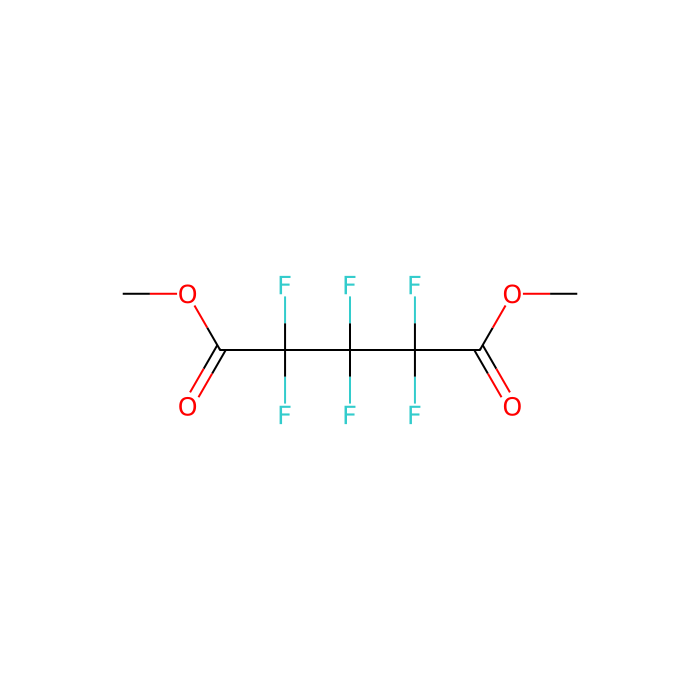
Dimethyl hexafluoroglutarate is the dimethyl diester of hexafluoroglutaric acid, featuring a perfluorinated three‑carbon backbone flanked by two methyl ester groups.
Item-specific identifiers from Product Data
SKU: D154399
CAS: 1513-62-8
Product Name: Dimethyl Hexafluoroglutarate
InChIKey: Not specified for this item; refer to CoA/Spec Sheet.
SMILES: Not specified for this item; refer to CoA/Spec Sheet.
Literature/computed identifiers (for reference; not item specifications)
Structural features (general chemistry description)
Functional groups: two methyl ester groups (diester), one per side of a perfluoroalkyl (–CF2–CF2–CF2–) chain.
No stereocenters; acyclic, fully saturated carbon framework in the spacer segment.
Strongly electron‑withdrawing –CF2– units impart high inductive effects on the carbonyls, reducing basicity of the carbonyl oxygen and influencing reactivity toward nucleophiles.
2D description: A five‑carbon backbone where C1 and C5 are carbonyl carbons each esterified with a methyl group; C2–C4 form a linear chain with each of C2, C3, and C4 bearing two fluorine atoms (–CF2–) in sequence.
Note: Exact structural strings (SMILES/InChI) and definitive elemental analysis for this catalog lot should be confirmed against the item’s CoA/Spec Sheet.
Synthetic Utility
Functional group logic
Two activated carbonyls (methyl esters) separated by a strongly electron‑withdrawing –CF2–CF2–CF2– spacer. The inductive effect increases carbonyl electrophilicity compared with nonfluorinated glutarates, which can facilitate certain nucleophilic acyl substitutions under milder conditions.
Transformations enabled (literature/general)
Hydrolysis → Hexafluoroglutaric acid: base (NaOH, KOH) or acid (H2SO4) conditions; work up to isolate diacid or its salts.
Conversion to diacid chloride: SOCl2 or (COCl)2 with catalytic DMF under anhydrous conditions; useful for diamide/diester/diol coupling and polymerizations.
Aminolysis/transamidation: direct reaction with primary amines at elevated temperature or with catalysts (e.g., Ti(OiPr)4, DBU) to afford diamides or half‑amides; the fluorinated spacer can enhance materials performance (chemical resistance, surface energy).
Reductions: LiAlH4 (or Borane reagents) to the corresponding diol; DIBAL-H for partial reductions to hemiacetals/alcohol‑esters under controlled conditions.
Transesterification: acid (p‑TsOH) or base (NaOMe) catalysis to exchange the methyl groups for other alcohol residues (Et, i‑Pr, Bn) to tune volatility and reactivity.
Retrosynthetic value
Serves as a convergent handle to introduce a perfluoro C3 unit into architectures where subsequent diversification at both termini is desired (e.g., diacids, diamides, diurethanes, polyesters).
Analytical handles
19F NMR provides three CF2 environments; useful for monitoring reaction progress and verifying symmetry/derivatization state.
Note: Specific yields and optimization depend on substrate and conditions; see Reaction Conditions for representative setups.
Target Specificity
Not applicable. This product is a small‑molecule fluorinated diester, not a biological targeting reagent or antibody. No antigen, epitope, clone, isotype, or species reactivity information applies.
We use cookies to ensure the website functions properly and, where permitted, to improve your experience. You can manage your preferences at any time in Settings. Learn more in our Cookie Policy.
Shall we send you a message when we have discounts available?
Remind me later
Thank you! Please check your email inbox to confirm.
Products are supplied to verified businesses, institutions, and qualified professionals for research and development use only. Not for use in humans, animals, diagnosis, or therapy.

 B2308618