
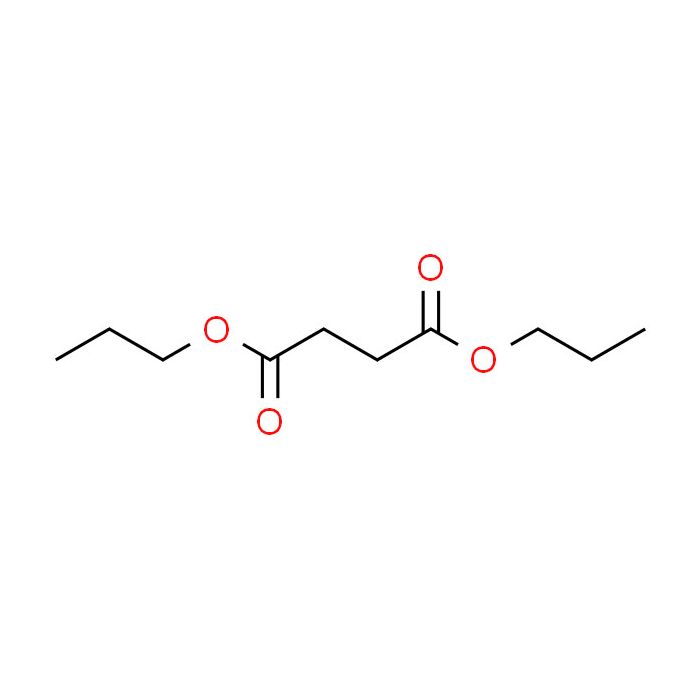
Determine the necessary mass, volume, or concentration for preparing a solution.
Dipropyl succinate - ≥95% , CAS No.925-15-5
AVAILABLE TO ORDER
GRADE & PURITY ≥95%
Storage
Store at 2-8°C,Argon charged
Shipped In
Wet ice
≥95% for sensitive chromatographic and analytical workflows requiring minimal baseline interference.
Store at 2-8°C,Argon charged Ships Wet ice Check lot-specific COA for exact specifications.
SDS, COA, datasheet, and spec sheet available for download. Lot-specific COA accessible via lot number lookup.
Cited in 0 peer-reviewed publications across chromatography, organic synthesis, and cross-coupling reactions.
| Canonical Smiles | CCCOC(=O)CCC(=O)OCCC |
|---|---|
| IUPAC Name | dipropyl butanedioate |
| InChIKey | SZHZCPHKDJWHNG-UHFFFAOYSA-N |
| INCHI | 1S/C10H18O4/c1-3-7-13-9(11)5-6-10(12)14-8-4-2/h3-8H2,1-2H3 |
| Molecular Weight | 202.25 |
Comprehensive hazard, handling, storage, and regulatory compliance document.
Download SDS →Lot-specific quality data. Enter your lot number to retrieve the exact COA.
Look up COA →Full quality attributes and acceptance criteria for this grade.
View spec sheet →Taxonomy Tree
| Kingdom | Organic compounds |
|---|---|
| Superclass | Lipids and lipid-like molecules |
| Class | Fatty Acyls |
| Subclass | Fatty acid esters |
| Intermediate Tree Nodes | Not available |
| Direct Parent | Fatty acid esters |
| Alternative Parents | Dicarboxylic acids and derivatives Carboxylic acid esters Organic oxides Hydrocarbon derivatives Carbonyl compounds |
| Molecular Framework | Aliphatic acyclic compounds |
| Substituents | Fatty acid ester - Dicarboxylic acid or derivatives - Carboxylic acid ester - Carboxylic acid derivative - Organic oxygen compound - Organic oxide - Hydrocarbon derivative - Organooxygen compound - Carbonyl group - Aliphatic acyclic compound |
| Description | This compound belongs to the class of organic compounds known as fatty acid esters. These are carboxylic ester derivatives of a fatty acid. |
| External Descriptors | Not available |
Find and download the COA for your product by matching the lot number on the packaging.
| Lot Number | Certificate Type | Date | Item |
|---|---|---|---|
 D2613237 D2613237 | Certificate of Analysis | Apr 01, 2026 | D1073067 |
| D2613238 | Certificate of Analysis | Apr 01, 2026 | D1073067 |
| D2613240 | Certificate of Analysis | Apr 01, 2026 | D1073067 |
| D2613246 | Certificate of Analysis | Apr 01, 2026 | D1073067 |
| Molecular Weight | 202.250 g/mol |
|---|---|
| XLogP3 | 2.200 |
| Hydrogen Bond Donor Count | 0 |
| Hydrogen Bond Acceptor Count | 4 |
| Rotatable Bond Count | 9 |
| Exact Mass | 202.121 Da |
| Monoisotopic Mass | 202.121 Da |
| Topological Polar Surface Area | 52.600 Ų |
| Heavy Atom Count | 14 |
| Formal Charge | 0 |
| Complexity | 157.000 |
| Isotope Atom Count | 0 |
| Defined Atom Stereocenter Count | 0 |
| Undefined Atom Stereocenter Count | 0 |
| Defined Bond Stereocenter Count | 0 |
| Undefined Bond Stereocenter Count | 0 |
| The total count of all stereochemical bonds | 0 |
| Covalently-Bonded Unit Count | 1 |
No antibody/assay protocols apply to this small-molecule reagent. For synthetic and processing workflows, see Reaction Conditions and Application notes provided in Reaction & Applications and Synthetic Utility.
Item-specific biological data: Not specified for this item; refer to CoA/Spec Sheet.
General biochemical context (literature)
Use constraints
Dipropyl succinate is not a buffering agent and is not typically used to prepare aqueous buffer systems. If your work requires succinate-buffered systems (pH ~5.0–6.5), use sodium/potassium salts of succinic acid (succinate buffer) rather than hydrophobic dialkyl esters. See Reaction & Applications for relevant non-buffer uses of this ester.
Context
Comparisons (literature/general)
Trade‑offs
Practical guidance
Item-specific pharmacopeial status: Not specified for this item; refer to CoA/Spec Sheet.
General formulation context (literature/general)
No therapeutic claims are made. This product is for research/laboratory use only.
Item-specific specs (from Product Data)
Literature/typical properties (for reference; not item specifications)
General chemistry notes
For exact numeric BP/MP, density, refractive index, logP, or UV cut-off relevant to this SKU: Not specified for this item; refer to CoA/Spec Sheet.
Item-specific grade/purity: Not specified for this item; refer to CoA/Spec Sheet.
How to interpret grades for this class of product (general guidance)
Documentation
Ester transformations (general/literature)
Reductive routes
Polymer and materials chemistry
Practical tips (general)
The following are general literature guidelines for dialkyl succinate chemistry; adjust to your substrate, scale, and equipment. They are not item-specific specifications.
Transesterification
Hydrolysis/saponification
Aminolysis/amidation
Reductions
Workup/monitoring
Item-specific hazard data
Storage conditions (from Product Data)
General safety guidance for aliphatic diesters (literature/typical; defer to SDS)
Always consult the product’s SDS for authoritative hazard, exposure limits, and emergency measures.
Dipropyl succinate is primarily a building block/reagent rather than a routine chromatography solvent; however, its solvency and polarity can be leveraged in synthesis and formulations.
Polarity and miscibility (general chemistry)
When to choose
Alternatives (selection logic)
Note: If your application primarily involves reaction chemistry, see Reaction & Applications and Reaction Conditions for solvent choice in those contexts.
Storage (from Product Data)
General handling
Stability notes (general)
Reconstitution
Dipropyl succinate is the symmetrical di-n-propyl diester of succinic acid, featuring two terminal n-propyl groups connected through ester linkages to a central butane-1,4-dioate core.
Item-specific identifiers (from Product Data)
Computed/literature identity (for reference; not item specifications)
Structural features (general chemistry)
Functional group handles
Retrosynthetic value
Named/typical transformations (literature)
Practical notes
This product is a small-molecule chemical reagent and does not have biological target specificity (no antigen/epitope, clone, or isotype). Section not applicable.