DY131 - Moligand™, ≥98% , Agonist of Estrogen-related receptor-β;Agonist of Estrogen-related receptor-γ, CAS No.95167-41-2, Agonist of Estrogen-related receptor-β;Agonist of Estrogen-related receptor-γ
DY131 - Moligand™, ≥98% , Agonist of Estrogen-related receptor-β;Agonist of Estrogen-related receptor-γ, CAS No.95167-41-2, Agonist of Estrogen-related receptor-β;Agonist of Estrogen-related receptor-γ
GRADE & PURITYMoligand™?Moligand™ — Aladdin's line of ligands and bioactive small molecules. Use for receptor, pathway, and binding studies needing defined small-molecule tools.≥98%
DY131(GSK 9089) is a novel selective agonist of ERRβ and ERRγ; displays minimal activity at ERRα, ERα and ERβ at concentrations up to 30 μM. A novel selective agonist at ERRβ and ERRγ
Specifications
Synonyms
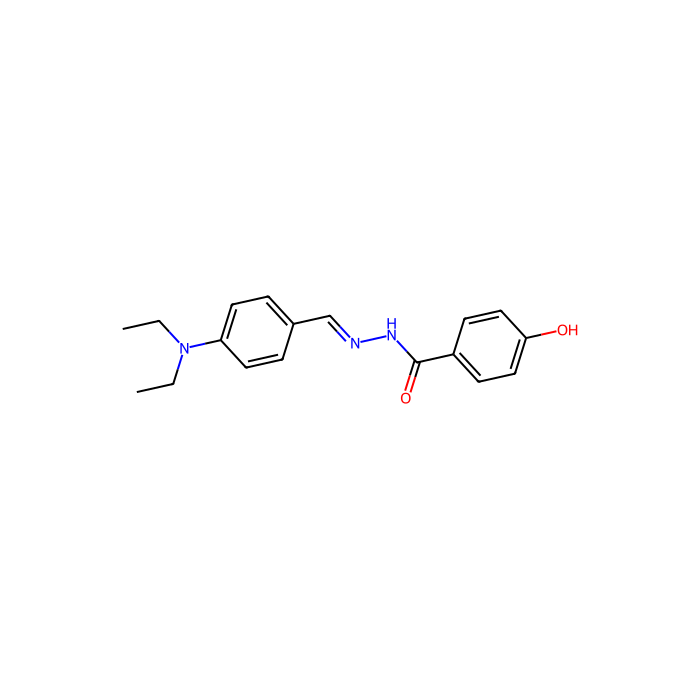
N'-((1E)-(4-(diethylamino)phenyl)methylene)-4-hydroxybenzohydrazide | DY131 | N'-{[4-(diethylamino)phenyl]methylidene}-4-hydroxybenzohydrazide | Aminotris(methylenephoshonic acid) pentasodium salt | (e)-N'-(4-(diethylamino) benzylidene)-4-hydroxybenzohydrazide | (E)-N'-[4-(Diethylamino)benzylidene]-4-hydroxybenzohydrazide | Benzoic acid, Show more
Specifications & Purity
Moligand™, ≥98%
Biochemical and Physiological Mechanisms
Novel selective agonist at estrogen-related receptors ERRβand ERRγ. Displays minimal activity at ERRα, ERαand ERβat concentrations up to 30μM.
Storage
Store at 2-8°C
Shipped In
Wet ice
This product requires cold chain shipping. Ground and other economy services are not available.
Grade
Moligand™
Action Type
AGONIST
Mechanism of action
Agonist of Estrogen-related receptor-β;Agonist of Estrogen-related receptor-γ
This compound belongs to the class of organic compounds known as benzoic acids and derivatives. These are organic compounds containing a carboxylic acid substituent attached to a benzene ring.
External Descriptors
Not available
1. Djoumbou Feunang Y, Eisner R, Knox C, Chepelev L, Hastings J, Owen G, Fahy E, Steinbeck C, Subramanian S, Bolton E, Greiner R, and Wishart DS. ClassyFire: Automated Chemical Classification With A Comprehensive, Computable Taxonomy. Journal of Cheminformatics, 2016, 8:61.
We use cookies to ensure the website functions properly and, where permitted, to improve your experience. You can manage your preferences at any time in Settings. Learn more in our Cookie Policy.
Shall we send you a message when we have discounts available?
Remind me later
Thank you! Please check your email inbox to confirm.
Products are supplied to verified businesses, institutions, and qualified professionals for research and development use only. Not for use in humans, animals, diagnosis, or therapy.

 D1727042