GRADE & PURITYMoligand™?Moligand™ — Aladdin's line of ligands and bioactive small molecules. Use for receptor, pathway, and binding studies needing defined small-molecule tools.≥98%
Moligand™,≥98% Moligand™ for sensitive chromatographic and analytical workflows requiring minimal baseline interference.
🌡
Storage & shipping
Store at 2-8°C,Protected from light Ships Wet ice Check lot-specific COA for exact specifications.
📋
Quality documents
SDS, COA, datasheet, and spec sheet available for download. Lot-specific COA accessible via lot number lookup.
📚
Literature proof
Cited in 5 peer-reviewed publications across chromatography, organic synthesis, and cross-coupling reactions.
Overview
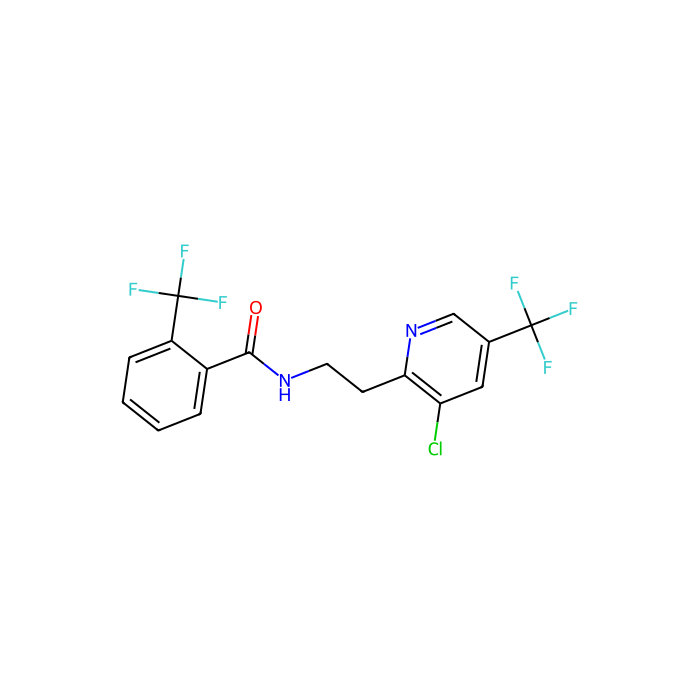
Fluopyram is a new pyridinylethylbenzamide fungicide. It is highly efficient in controlling a wide variety of pathogens such as Botrytis spp., Sclerotinia spp., and Monilia spp., and also against powdery mildews and some leaf spot diseases in a broad range of crops.
Application:
Refer to the product′s Certificate of Analysis for more information on a suitable instrument technique. Contact Technical Service for further support.
Fluopyram affects the fungal growth at all stages beginning from germination to sporulation. According to various studies, its biochemical mode of action is shown to rely on the inhibition of succinate dehydrogenase (complex II) that is present in the fun
Storage
Store at 2-8°C,Protected from light
Shipped In
Wet ice
This product requires cold chain shipping. Ground and other economy services are not available.
This compound belongs to the class of organic compounds known as trifluoromethylbenzenes. These are organofluorine compounds that contain a benzene ring substituted with one or more trifluoromethyl groups.
1. Djoumbou Feunang Y, Eisner R, Knox C, Chepelev L, Hastings J, Owen G, Fahy E, Steinbeck C, Subramanian S, Bolton E, Greiner R, and Wishart DS. ClassyFire: Automated Chemical Classification With A Comprehensive, Computable Taxonomy. Journal of Cheminformatics, 2016, 8:61.
Determine the necessary mass, volume, or concentration for preparing a solution.
Dilution Calculator
Determine the dilution needed to prepare a stock solution.
Reconstitution Calculator
Reviews
Customer Reviews
Application Protocols
General research-use protocols (guidance; optimize per system)
A. Preparing assay-ready stocks
Weigh compound quickly under low light. Dissolve to 10–50 mM in anhydrous DMSO. Vortex until clear. Aliquot into amber, low-bind microtubes. Store per Storage tab.
B. Enzyme inhibition (cell-free, complex II)
Prepare serial dilutions (e.g., 0.001–30 μM final) in assay buffer containing matched DMSO (e.g., 0.2% v/v). Measure succinate:ubiquinone reductase activity spectrophotometrically or by O2 consumption. Include vehicle control and an orthogonal SDHI for benchmarking. Fit IC50 using appropriate models accounting for baseline drift.
C. Cell-based assays
Seed cells to desired density. Treat with Fluopyram dilutions (typical 0.05–20 μM range) keeping DMSO constant across wells. Incubate under reduced light. Assess endpoints such as mitochondrial respiration (Seahorse XF), ATP levels, or ROS with validated probes. Confirm lack of precipitation visually and, if needed, by LC–MS of media extracts.
D. Analytical reference standard
Prepare calibration solutions in acetonitrile or DMSO/acetonitrile. Use matrix-matched calibration for residue or exposure studies. Monitor one or more SRM transitions by LC–MS/MS; confirm retention time and ion ratios with a reference matrix.
Notes
These are general literature-guided suggestions. Exact conditions, dose ranges, and readouts should be empirically determined for your system and are not specifications of this SKU.
Biological Roles
Literature/general scientific context (no clinical claims)
Primary biochemical role: Fluopyram is a succinate dehydrogenase inhibitor (SDHI) that binds at the ubiquinone-binding site of mitochondrial complex II (SQR site). Inhibition disrupts electron transfer from succinate to ubiquinone, altering cellular respiration and potentially increasing ROS under certain contexts.
Organismal scope: designed for phytopathogenic fungi, but complex II is conserved across eukaryotes and many prokaryotes; potency and selectivity vary with SDH subunit sequences. This enables use as a probe to compare species-specific complex II pharmacology.
Cellular consequences: inhibition of SDH can downregulate TCA cycle flux, affect fumarate/succinate balance, and modulate signaling pathways sensitive to mitochondrial redox state.
Research uses: a reference ligand for target validation, resistance mutation mapping (SdhB/C/D), and studies of mitochondrial metabolism, bioenergetics, and respiration-driven signaling.
Caveats for biological experiments
Off-targets: while SDH is the primary target, halogenated aromatic amides may interact with other membrane-associated proteins at higher concentrations; include orthogonal probes and rescue experiments (e.g., varying succinate levels) to confirm on-target effects.
Solvent considerations: maintain consistent final DMSO across treatments; confirm compound stability under assay illumination due to the product’s light sensitivity note.
Item-specific notes
No potency data, target selectivity panel results, or biological EC50/IC50 values are specified for this item; consult literature appropriate to your system.
Buffer Applications
Not typically applicable
Fluopyram is not a buffering agent and does not form classical buffer systems.
Practical guidance for use with buffers (general)
Prepare a concentrated DMSO stock and dilute into your chosen biological buffer (e.g., PBS, HEPES, Tris) with vigorous mixing to avoid local supersaturation. Keep final DMSO within assay tolerance (often ≤0.1–1% v/v).
If precipitation persists, introduce a small percentage of cosolvent (e.g., 0.1–0.5% additional DMSO) or a nonionic surfactant compatible with your assay.
Not specified for this item
Any validated buffer recipes or system-specific compatibility data—please generate empirically for your matrix.
Green Alternatives
Context
Fluopyram is a specific, halogenated bioactive small molecule. There is no direct “green alternative” to the compound itself when its specific target engagement (SDHI) is required.
Greener handling and solvent choices (general guidance)
Prefer DMSO or ethanol over chlorinated solvents for stock preparation when compatible with your assay and analytics.
For chromatographic methods, water/acetonitrile systems (with volatile buffers) are typically greener than water/methanol where acetonitrile recovery is optimized; evaluate solvent recycling.
Minimize waste by preparing concentrated master stocks and aliquoting to avoid repeated freeze-thaw and disposal of degraded material.
Comparison of solvent options for stock/dilution (typical)
DMSO: excellent solvency, fully miscible with water in small percentages; relatively low toxicity profile among aprotics; widely accepted in bioassays.
Ethanol: greener, but solvency for highly halogenated aromatics may be limited; precipitation risk upon aqueous dilution is higher than DMSO.
Acetone/EtOAc: workable for some preparative steps, but less ideal for aqueous assay dilution.
Waste and environmental considerations
Treat solutions and residues as hazardous organic waste; many SDHI fungicides are persistent and toxic to aquatic organisms. Employ closed transfers, secondary containment, and compliant disposal.
Note
If a different SDHI pharmacophore could serve your mechanistic study, consider comparing multiple scaffolds to reduce reliance on halogen-rich chemotypes; however, this is a scientific design choice rather than a direct green substitute.
Pharmaceutical Uses
Scope of this product
This product is supplied for research use only. It is not an excipient and has no pharmacopeial monograph provided here.
General context (literature)
Fluopyram is an agrochemical (SDHI fungicide) and is not employed as a pharmaceutical excipient. In pharmaceutical R&D laboratories, it may serve as a reference standard or tool compound in mitochondrial research or as a spike-in analyte for method development and validation (e.g., LC–MS matrix effect studies).
Operational guidance
For any work in regulated environments, confirm identity and purity with the supplied CoA and follow site procedures for reference standard qualification (retention samples, verified potency values, expiry assignment).
Not specified for this item; refer to CoA/Spec Sheet
Pharmacopeial status, if any
Residual solvent, elemental impurity class assignments
Assigned potency value for quantitative reference use
Physical Properties
Item-specific (from Product Data)
Appearance: Not specified for this item; refer to CoA/Spec Sheet.
Storage and shipping (from Product Data)
Store at 2–8 °C, protected from light; shipped on wet ice.
Literature/General properties for Fluopyram (informational; not item specifications)
Aggregate physical form: typically an off-white to light solid at ambient conditions; hydrophobic.
Solubility profile: very low in water; readily soluble in polar aprotic organic solvents (DMSO, DMF, acetone, acetonitrile) and moderately soluble in chlorinated solvents and alcohols. Stock solutions are commonly prepared in dry DMSO.
Volatility: low; non-volatile solid under ambient conditions.
Acid/base behavior: contains an amide (weakly basic nitrogen is delocalized; overall neutral at physiological pH); heteroaromatic nitrogen can engage in H-bond acceptance.
Spectral features: strong UV absorption in the 200–300 nm range typical of halogenated aryl/heteroaryl amides; useful for HPLC-UV quantification (literature behavior).
Not specified for this item; refer to CoA/Spec Sheet
Melting point / boiling point
Density
LogP/logD and pKa
Refractive index
Water content, residual solvents, or other analytical limits
Practical notes
Because of high hydrophobicity, aqueous working solutions are best prepared by serial dilution from a concentrated DMSO stock with attention to final cosolvent percentage.
Quality & Grades
Item-specific
Grade: Moligand™ (as provided). This denotes a screening-grade small-molecule ligand suitable for discovery biology, target profiling, and SAR work.
What Moligand™ typically implies (general guidance; confirm with CoA for this lot)
Intended use: in vitro research, assay development, and chemical biology. Not for human or animal therapeutic use.
Focus attributes: identity confirmation (e.g., NMR/HRMS), assay-ready solubility in common screening solvents (DMSO), and impurity levels controlled to support reproducible bioassay results. UV profile and counterion content are generally compatible with optical readouts.
Clarifications for professional users
Analytical specs such as purity %, residual solvents, water content, and stabilizers are not listed here. For exact values and test methods (HPLC/GC, NMR, MS), see the Certificate of Analysis for SKU F304303.
If your application is chromatography-sensitive (e.g., LC–MS quantitation), verify background UV absorbance and any stabilizers in the batch documentation before use.
Not specified for this item; refer to CoA/Spec Sheet
Purity percentage and analytical method
Stabilizers or formulating excipients
Metal or halide limits
Residual solvent profiles and water content
Reaction & Applications
Applicability to this compound type
Fluopyram is primarily a bioactive reference compound (SDHI class) rather than a general-purpose reagent. Its principal laboratory applications are in assay development, target engagement studies, resistance mechanism research, and method development (analytical standards) rather than as a stoichiometric reactant.
Research and screening uses (literature/general)
Enzyme inhibition studies: probe and benchmark inhibitor for mitochondrial complex II (succinate dehydrogenase, SDH), especially in fungal systems.
Chemical biology: tool compound for studying electron transport chain modulation, reactive oxygen species generation secondary to complex II inhibition, and metabolic reprogramming in eukaryotic cells.
Resistance mapping: competitor ligand in binding and mutational analyses of SDH subunits (SdhB/C/D) to profile resistance-associated substitutions.
Analytical: LC–MS/LC–UV method development and matrix-effect studies in environmental or residue analysis.
Practical notes
Stock preparation: dissolve in dry DMSO; filter if necessary (0.2 μm PTFE). Protect from light per Product Data.
Adsorption/precipitation: minimize plastic adsorption by using low-binding tubes/plates; confirm solubility at working concentrations upon dilution into aqueous buffers.
Controls: include vehicle controls (matching DMSO%) and, where relevant, orthogonal SDHI chemotypes to benchmark potency/phenotype.
Not typically used
As a coupling partner or catalyst in synthetic transformations—see Synthetic Utility for limited use cases.
Reaction Conditions
This section is interpreted for experimental handling rather than synthetic reactions, as Fluopyram is used primarily as a tool compound.
General handling and preparation (literature/practice)
Stock solutions: prepare at 10–50 mM in anhydrous DMSO. Vortex and, if needed, warm gently (≤40 °C) to aid dissolution. Filter through 0.2 μm PTFE to remove particulates.
Working solutions: dilute stocks into assay buffer with vigorous mixing; maintain consistent final DMSO across controls and treated samples. Typical working ranges in cell-free or cell-based assays are in the 0.01–50 μM span, depending on system sensitivity and target expression (determine empirically).
Light protection: use amber vials/foil wrapping during preparation and storage, consistent with the product’s “protect from light” note.
HPLC: C18 column; water/acetonitrile gradient with 0.1% formic acid or ammonium formate; detection by UV (approx. 220–280 nm) or MS. Expect strong hydrophobic retention; start at high organic (e.g., 60–80% acetonitrile) to shorten run time.
Sample preparation from complex matrices: acetonitrile extraction, MgSO4/NaCl salting-out (QuEChERS), dSPE cleanup (PSA/C18) prior to LC–MS.
Not specified for this item; refer to CoA/Spec Sheet
Any guaranteed assay potency, exact extinction coefficients, or stability-indicating conditions specific to SKU F304303.
Safety & Handling
Authoritative safety data for this specific SKU are not provided here. Always consult the product’s SDS for definitive information.
From Product Data
Storage: 2–8 °C, protected from light; shipped on wet ice.
General laboratory safety guidance for Fluopyram (literature-based; not item-specific)
Likely hazards: halogenated aryl amides used as crop protection agents can cause irritation to skin/eyes and may be harmful if swallowed or inhaled; many SDHI fungicides are hazardous to aquatic life. Treat as harmful and environmentally hazardous unless your SDS indicates otherwise.
PPE: lab coat, safety glasses, and suitable gloves (e.g., nitrile). Avoid skin contact and inhalation of dust/aerosols. Handle powders in a fume hood or containment.
Incompatibilities: strong oxidizers may react with organic materials; avoid strong bases/acids that can hydrolyze amides under forcing conditions. Protect from light as noted to minimize potential photodegradation.
Spill/accident: avoid generating dust; collect with inert absorbent. Decontaminate area with organic solvent-compatible cleaning solution. Dispose of waste as hazardous organic waste per institutional and regulatory requirements.
First aid (overview): eye/skin contact—rinse with water for at least 15 minutes; ingestion—rinse mouth, do not induce vomiting; inhalation—move to fresh air. Seek medical attention in all cases; bring SDS.
Not specified for this item; refer to SDS
GHS classification, signal word, pictograms, H-statements specific to this SKU.
Solvent Selection
Compound type: hydrophobic, halogenated aryl/heteroaryl benzamide (neutral). Polar aprotic solvents are preferred for stock solutions and analytics.
Recommended choices (general/literature-guided)
Primary: DMSO (excellent solvency; stable stocks at 10–50 mM are typical), DMF.
Secondary: acetonitrile, acetone, ethyl acetate, dichloromethane, methanol (moderate to good solubility; check for precipitation upon aqueous dilution).
Aqueous systems: very low intrinsic solubility; use cosolvents and/or surfactants. Keep final DMSO ≤0.1–1% v/v in sensitive biochemical assays.
Practical tips
Prepare a concentrated, well-defined DMSO stock (e.g., 10 mM), then serially dilute into assay buffers while vortexing. Add DMSO stock last to minimize local supersaturation.
Pre-wet plasticware with buffer containing the intended DMSO percentage to reduce adsorption losses of hydrophobic molecules.
For HPLC/UPLC analytics, water/acetonitrile or water/methanol with 0.1% formic acid or ammonium formate are typical; expect strong retention on C18—use higher organic content or shallow gradients.
Comparison to alternatives
Versus strongly protic media (water, phosphate buffer): risk of precipitation is high without cosolvent.
Versus ethers (THF, 2-MeTHF): these can dissolve Fluopyram but are less common in bioassays; DMSO provides superior miscibility into aqueous buffers.
Note
Exact solubility values in specific solvents are not specified for this item; consult CoA or perform a small-scale solubility screen for your matrix.
Storage & Reconstitution
From Product Data (item-specific)
Storage conditions: Store at 2–8 °C, protected from light.
Shipping: Shipped on wet ice.
Reconstitution and handling (general guidance)
Solid handling: minimize light exposure. Allow container to equilibrate to room temperature in the dark before opening to prevent condensation. Reseal promptly with desiccant if provided.
Stock solutions: dissolve in anhydrous DMSO to a convenient concentration (e.g., 10–50 mM). Mix thoroughly until fully dissolved. Optional: sterile-filter through 0.2 μm PTFE if sterility/clarity is required.
Aliquoting: dispense single-use aliquots into amber vials or foil-wrapped low-bind tubes to avoid repeated freeze–thaw and light exposure.
Solution storage: while the neat product should be kept at 2–8 °C as specified, DMSO stocks are commonly stored at ≤−20 °C in the dark for extended stability. Validate stability in your own lab and avoid multiple freeze–thaw cycles.
Working solutions: prepare fresh on the day of use. Keep protected from light during experiments.
Not specified for this item; refer to CoA/Spec Sheet
Guaranteed shelf life/expiry
Stabilizers, if any
Certified solubility limits in specific solvents
Stability under defined assay conditions (pH, light intensity, temperature)
Structure & Identity
Item-specific (from Product Data)
SKU: F304303
Product name: Fluopyram
CAS: 658066-35-4
PubChem CID: 11158353
InChIKey (as provided): 190434
Grade: Moligand™
Research use: For research use only
Literature/General structural information (for scientific context; not item-specific specs)
Common chemical class: halogenated benzamide fungicide; succinate dehydrogenase inhibitor (SDHI)
Core features: an amide (benzamide) linked to a heteroaromatic ring; multiple fluorine substituents (trifluoromethyl groups) and one chloro substituent on a pyridinyl moiety. Overall, a highly lipophilic, weakly basic/neutral molecule dominated by halogenated aryl groups.
Typical 2D description: a substituted benzamide bearing a CF3 group on the benzene ring, connected through the amide to a substituted pyridine that carries a chloro and a CF3 group. The amide carbonyl provides the principal hydrogen-bond acceptor; no classical donors are present.
Not specified for this item; refer to CoA/Spec Sheet
Molecular formula
Molecular weight
SMILES
Canonical InChI/InChIKey (full)
Notes
Where exact identifiers (SMILES, formula, MW) are required for regulatory or analytical purposes, use the batch-specific CoA/SDS for this SKU.
Synthetic Utility
Compound role
Fluopyram is a final, highly functionalized small molecule rather than a general building block. It sees limited direct use as a reagent in synthesis.
Relevance to synthetic chemists (literature/general)
Reference standard: used to validate and calibrate analytical methods for halogenated benzamide herbicides/fungicides; supports development of extraction/cleanup protocols (QuEChERS, SPE) from complex matrices.
Scaffold comparisons: serves as a benchmark SDHI scaffold in SAR efforts; analog synthesis often explores modifications to the amide linkage, heteroaryl ring substitution, and CF3 placement.
Retrosynthetic insight (for context)
Typical assembly involves amide coupling between a CF3-substituted benzoic acid (or activated derivative) and an appropriately substituted heteroarylamine, with halogenation and trifluoromethylation steps introduced via electrophilic or cross-coupling strategies.
Not typically recommended
As a coupling partner, organometallic reagent, or catalyst in general transformations due to its densely substituted, deactivated aryl rings and lack of reactive handles under mild conditions.
Item-specific
No reactivity or transformation specifications are provided for this SKU; for preparative chemistry, consult primary literature on Fluopyram syntheses and analog development.
Target Specificity
Literature/general scientific context (no claims about item-specific testing)
Primary target: mitochondrial complex II (succinate dehydrogenase, SDH), specifically the ubiquinone-binding site (SQR site) formed by SDH subunits in the inner mitochondrial membrane.
Binding mode: SDHI class ligands occupy the Q-site pocket, interfering with electron transfer from the FAD-bound succinate oxidation site to ubiquinone. Key interactions often include hydrophobic contacts in a halogen-rich subpocket with limited hydrogen bonding via the amide carbonyl.
Selectivity: potency is influenced by sequence variations in SdhB/C/D across species; fungal SDH is generally more sensitive than many non-target organisms, though cross-species activity can occur at higher concentrations.
Item-specific
No internal target validation, Ki/IC50 values, or selectivity panel data are specified for this SKU. Users should determine activity in their system and consult peer-reviewed reports for expected potencies.
Recommendations
Confirm on-target effects using complementary assays (e.g., measuring succinate-dependent respiration, assessing rescue by alternative electron acceptors) and incorporate resistance-associated SDH mutants where available.
Frequently Asked Questions
What is the purity of this product?
This product is supplied at ≥98% purity (chemical assay). Lot-specific values are stated on the Certificate of Analysis.
What is Moligand??
Moligand? is one of Aladdin Scientific's premium product lines, formulated for high-purity applications across multiple workflows. Compared to standard grades in the same workflow, Moligand? products typically offer tighter specifications, more rigorous QC, and stronger lot-to-lot consistency.
How should this product be stored?
Store at 2–8 °C, protected from light. The material is light-sensitive — keep it in its original opaque or amber container.
How is this product shipped?
This product ships chilled on wet ice. Unpack on arrival and transfer it to the storage condition stated above.
What are the CAS number, molecular formula and molecular weight?
The CAS Number is 658066-35-4, the molecular formula is C16H11ClF6N2O, and the molecular weight is 396.71 g/mol. InChIKey KVDJTXBXMWJJEF-UHFFFAOYSA-N.
What documentation is provided?
Available product documentation, including Certificates of Analysis (COA), Safety Data Sheets (SDS), and specification sheets, is shown in the product document area. Document availability and access follow the current site policy.
We use cookies to ensure the website functions properly and, where permitted, to improve your experience. You can manage your preferences at any time in Settings. Learn more in our Cookie Policy.
Shall we send you a message when we have discounts available?
Remind me later
Thank you! Please check your email inbox to confirm.
Products are supplied to verified businesses, institutions, and qualified professionals for research and development use only. Not for use in humans, animals, diagnosis, or therapy.

 I2306242