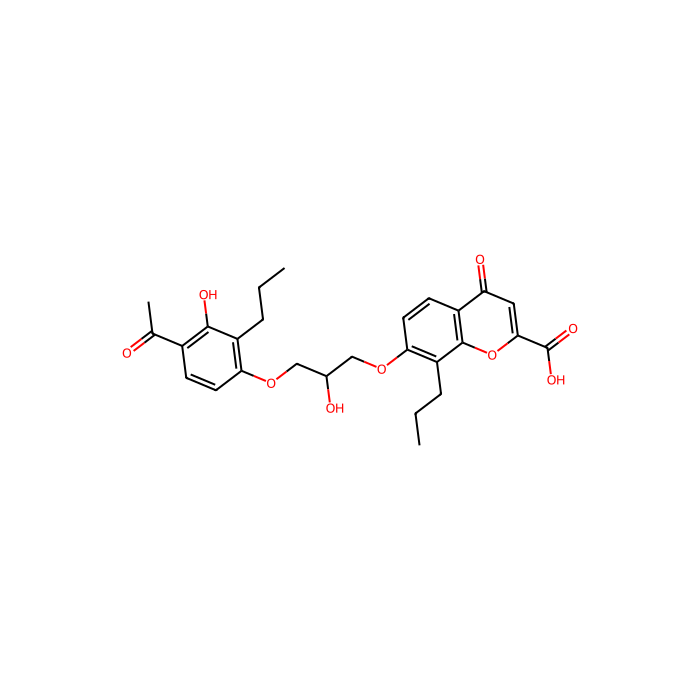
This compound belongs to the class of organic compounds known as alkyl-phenylketones. These are aromatic compounds containing a ketone substituted by one alkyl group, and a phenyl group.
External Descriptors
Not available
1. Djoumbou Feunang Y, Eisner R, Knox C, Chepelev L, Hastings J, Owen G, Fahy E, Steinbeck C, Subramanian S, Bolton E, Greiner R, and Wishart DS. ClassyFire: Automated Chemical Classification With A Comprehensive, Computable Taxonomy. Journal of Cheminformatics, 2016, 8:61.
Solvent:100mM NaOH, Max Conc. mg/mL: 24.93, Max Conc. mM: 50
Molecular Weight
498.500 g/mol
XLogP3
4.900
Hydrogen Bond Donor Count
3
Hydrogen Bond Acceptor Count
9
Rotatable Bond Count
12
Exact Mass
498.189 Da
Monoisotopic Mass
498.189 Da
Topological Polar Surface Area
140.000 Ų
Heavy Atom Count
36
Formal Charge
0
Complexity
809.000
Isotope Atom Count
0
Defined Atom Stereocenter Count
0
Undefined Atom Stereocenter Count
1
Defined Bond Stereocenter Count
0
Undefined Bond Stereocenter Count
0
The total count of all stereochemical bonds
0
Covalently-Bonded Unit Count
1
Solution Calculators
Molarity Calculator
Determine the necessary mass, volume, or concentration for preparing a solution.
Dilution Calculator
Determine the dilution needed to prepare a stock solution.
Reconstitution Calculator
Reviews
Customer Reviews
Application Protocols
No tested application protocols are provided in the Product Data for this item. Use case will depend on your assay format and target biology.
General small-molecule handling protocols (for reference only):
Preparation of a 10 mM DMSO stock (example): Accurately weigh compound under dry conditions; dissolve to 10 mM in anhydrous DMSO; vortex and sonicate briefly if needed; filter (0.22 µm PTFE) only if compatible and mass is sufficient; dispense into low-bind tubes; aliquot to single-use portions; store at −20 °C.
Plate handling for HTS: Warm plate sealer and tips to room temperature to avoid condensation; equilibrate compound plate to room temperature before opening; minimize exposure time; reseal under dry inert gas if feasible; return to −20 °C promptly.
Assay delivery: Add compound to assay plates to achieve desired final concentration while keeping vehicle ≤0.5–1% v/v; include vehicle-only controls on each plate.
Note: These are general practices; adapt to your SOPs and confirm compatibility with your assay system.
Biological Roles
The Product Data do not specify a biological target, pathway, or mode of action for FPL 55712 in this catalog entry. Therefore, no item-specific biological role can be asserted here. Consult literature sources and the CoA/SDS for authoritative information before designing target-based assays.
General guidance for small-molecule research compounds:
Use as chemical probes: Small molecules can serve as tools to interrogate cellular pathways, enzyme function, or receptor signaling. Robust conclusions require confirmation of identity, purity, and stability of the probe used.
Assay design: Include appropriate controls (vehicle, positive/negative comparators), dynamic range checks, and counterscreens (e.g., redox cycling, aggregation, reporter interference) to rule out assay artifacts.
Physicochemical profiling: Determine solubility at working concentrations, permeability (e.g., PAMPA/MDCK), and potential for nonspecific binding or aggregation (e.g., detergent-sensitivity tests) to contextualize biological readouts.
Data traceability: Record lot numbers, preparation dates, and storage history, as small differences in impurity or degradation profile can affect biological outcomes.
Important note:
Avoid inferring pharmacology from name recognition alone; ensure your specific lot corresponds to the structure and activity you intend to study. Where target specificity is critical, validate with orthogonal methods (biochemical vs cellular assays) and, if possible, reference material from an independent source.
Buffer Applications
Not typically applicable. FPL 55712 is offered as a small-molecule research compound and is not a buffering agent. No buffer system, pKa, or formulation information is provided in the Product Data.
Practical notes (if preparing assay solutions):
Vehicle preparation: Prepare concentrated DMSO or ethanol stocks, then dilute into the assay buffer immediately before use to minimize precipitation or degradation.
Compatibility: Verify that the final organic cosolvent percentage is tolerated by your biological system (commonly ≤0.5–1% v/v for many cell-based assays; confirm for your model).
Order of addition: Add compound stock to buffer while mixing to avoid local supersaturation; pre-wet pipette tips with vehicle to improve accuracy at small volumes.
Green Alternatives
This product is a small-molecule research compound rather than a process solvent or bulk reagent; the standard “green alternatives” framework (e.g., solvent substitution) is not directly applicable.
Sustainable practices for small-molecule assays (general):
Solvent minimization: Use concentrated DMSO stocks and miniaturize assay volumes (e.g., 384/1536-well formats) to reduce organic solvent use and waste.
Safer solvents: If compatible with solubility and assay tolerance, prefer water with minimal DMSO or ethanol cosolvent. Avoid chlorinated solvents for routine preparation and cleaning.
Inventory management: Implement just-in-time thawing and small aliquots to decrease compound spoilage and repeat shipments.
Analytical efficiencies: Employ short UHPLC methods and column reuse strategies where scientifically justified to reduce solvent consumption.
Waste considerations:
Segregate DMSO-containing aqueous waste according to local regulations. Avoid disposing concentrated organic stocks to drain; collect in designated organic waste containers.
If you intend to use this compound as a synthetic starting point (derivatization campaigns):
Map any steps involving hazardous solvents or reagents to greener substitutes using guides such as CHEM21 or PMI (process mass intensity) targets, once the structure and reactivity are confirmed.
Pharmaceutical Uses
No pharmaceutical or excipient uses are provided in the Product Data for this item. This product is supplied strictly for research use only and is not intended for human or veterinary use, diagnostic applications, or as an active pharmaceutical ingredient (API).
General considerations for research compounds (non-clinical):
Formulation screening in vitro: If your research requires solubility/permeability assessment, evaluate multiple vehicles (e.g., DMSO, PEG400, cyclodextrins) and note any assay interference.
Stability: Determine stability in the presence of light, oxygen, and at relevant pH values. Use amber vials, inert gas backfill (e.g., nitrogen/argon), and low-temperature storage as appropriate.
Regulatory note: Do not use research-grade materials in clinical settings. For any translational work, source GMP-grade material and full regulatory documentation.
Documentation:
Maintain SDS/CoA on file. If additional characterization (polymorph, residual solvents, elemental impurities) is needed for advanced studies, request expanded QC services.
Physical Properties
Item-specific physicochemical specifications were not provided in the Product Data. Do not infer performance-critical parameters in regulated work; confirm by CoA/SDS.
From Product Data (item-specific):
Appearance: Not specified for this item; refer to CoA/Spec Sheet.
Molecular weight: Not specified for this item; refer to CoA/Spec Sheet.
Commonly referenced properties (for planning purposes only; obtain item-specific values from CoA/SDS before use):
Melting point (MP): Not specified for this item; refer to CoA/Spec Sheet.
Boiling point (BP): Not specified for this item; refer to CoA/Spec Sheet.
Density: Not specified for this item; refer to CoA/Spec Sheet.
Solubility profile: Not specified for this item; refer to CoA/Spec Sheet.
LogP/logD: Not specified for this item; refer to CoA/Spec Sheet.
pKa(s): Not specified for this item; refer to CoA/Spec Sheet.
UV-Vis characteristics, ε: Not specified for this item; refer to CoA/Spec Sheet.
Refractive index: Not applicable to solids; if liquid, not specified—refer to CoA.
Practical guidance (general):
For small-molecule screening compounds, DMSO is commonly used to prepare stock solutions; however, confirm actual solubility and chemical stability for this specific lot from the CoA/SDS or by a small-scale solubility/stability assessment (e.g., 1–10 mg/mL trials, visual clarity check, HPLC follow-up).
If hygroscopicity or polymorphism is a concern, validate mass by Karl Fischer or TGA/DSC as appropriate (user testing).
Quality & Grades
Item-specific quality indicators (grade, purity, stabilizers) are not provided in the Product Data for FPL 55712 (SKU: F287941).
From Product Data (item-specific):
Grade/Purity: Not specified for this item; refer to CoA/Spec Sheet.
Stabilizers/inhibitors: Not specified for this item; refer to CoA/Spec Sheet.
Guidance on typical grade conventions (general information):
Screening/library grade: Often suitable for discovery biology and high-throughput screening (HTS); supplied with identity confirmation (e.g., NMR/HRMS) and typical purity ≥95% by HPLC/LC–MS unless otherwise stated. Verify actual specifications on the CoA.
Analytical grade: Emphasizes low inorganic/organic impurities but may not specify biological assay suitability.
Custom QC: Upon request, vendors may provide additional QC such as water content (KF), residual solvents, and expanded metal impurity panels; consult our technical support for custom specs.
Interpreting documentation:
CoA/Spec Sheet will define lot-specific identity (spectra), purity (HPLC/GC/NMR), and any additives. Use that document as the controlling specification in your laboratory records.
If UV transparency or LC baseline is critical (e.g., bioassay readouts, photophysical studies), request low-UV chromatographic purity traces and impurity profiling.
Reaction & Applications
From Product Data, FPL 55712 is categorized under small molecules/compound libraries and is intended for research use only. No synthetic-reagent application claims are provided for this item.
Applicable uses (general, non-item-specific):
Chemical biology/assay development: Small molecules in screening libraries are typically used to probe biochemical pathways, validate targets, and develop structure–activity relationships (SAR). If you intend to use FPL 55712 as a reference modulator or comparator, confirm identity/purity and match your historical lot to ensure continuity in data.
Analytical characterization: Prior to deployment in critical assays, verify compound identity and purity (e.g., 1H NMR, LC–MS, HRMS if needed). If stability is uncertain, conduct stress tests (room temperature vs 4 °C vs −20 °C, light exposure, aqueous dilutions) and monitor by LC.
Not typically applicable (for this item):
Classical synthetic transformations (e.g., cross-couplings, condensations) are generally not relevant unless you are derivatizing this scaffold. If derivatization is planned, obtain or determine the exact structure first to map functional group compatibility and protecting-group strategy.
Practical tips:
Prepare minimal-use aliquots to limit freeze–thaw.
When benchmarking biological activity, include vehicle controls and, where possible, an orthogonal reference compound to de-risk off-target assay artifacts.
Reaction Conditions
Not applicable in a strict sense for this catalog entry, as no synthetic or catalytic role is provided for FPL 55712 and the structure is not disclosed in the Product Data.
General notes relevant to handling in solution for assays (non-synthetic):
Stock preparation: Typical screening stocks are 10–50 mM in dry DMSO; verify actual solubility and chemical stability for this item by small-scale trials and LC–MS monitoring over 24–72 hours at room temperature and 4 °C.
Aqueous dilutions: Prepare immediately before use; maintain gentle mixing to avoid precipitation when entering buffered media. Keep final DMSO ≤0.5–1% v/v unless your system tolerates more.
Light/oxygen sensitivity: If instability is suspected, prepare under subdued light, use amber vials, and consider inert gas backfill. Store working solutions on ice during use.
If employing chemical reactions with this scaffold (user-driven derivatization):
Select solvents, temperatures, and catalysts only after the structure and functional groups are confirmed. Perform micro-scale scouting reactions and monitor by LC–MS/UPLC to establish conditions before scale-up.
Safety & Handling
Safety details are not provided in the Product Data. Always consult the official SDS for hazard classification and response measures before handling.
GHS classification, pictograms, signal word, H-statements: Not specified for this item; refer to SDS.
General laboratory precautions (non-specific, best practice):
PPE: Use lab coat, appropriate chemical-resistant gloves (e.g., nitrile), and safety glasses or goggles. Handle powders/solids in a fume hood to minimize inhalation/exposure.
Handling: Avoid dust/aerosol formation. Keep container tightly closed when not in use. Minimize freeze–thaw and repeated warming cycles.
Incompatibilities: Unknown for this item; check SDS. As a general rule for organic small molecules, avoid strong oxidizers and strong acids/bases unless stability is known.
First aid (overview; defer to SDS): If inhaled—move to fresh air; seek medical attention. Skin/eye contact—rinse with water for at least 15 minutes; remove contaminated clothing; seek medical attention. If ingested—rinse mouth; do not induce vomiting unless directed by medical personnel.
Spill response: Contain and collect with inert absorbent; avoid generating dust; dispose of according to institutional and local regulations.
Waste: Collect in organic solid/halogenated or non-halogenated waste as appropriate; follow your facility’s hazardous waste SOPs.
Solvent Selection
Item-specific solubility data are not provided. For small-molecule screening compounds, solvent choice typically balances solubility, stability, assay compatibility, and downstream analytics.
General recommendations (confirm experimentally for this item):
Primary stock solvent: DMSO is commonly used at 10–50 mM for screening libraries due to broad solubilizing power and assay compatibility in low final percentages (≤0.5–1% v/v). Confirm FPL 55712 solubility and stability in DMSO prior to scale-up.
Alternative solvents: DMF or ethanol can be considered if DMSO is unsuitable; aqueous buffers with co-solvent (e.g., 5–20% DMSO or ethanol) may be used for assay delivery if compound is sufficiently soluble and stable.
pH effects: If the compound is ionizable, solubility may be enhanced at appropriate pH. Without a known pKa for this item, perform a small pH–solubility screen (e.g., pH 3, 7.4, 9) using cosolvent blends.
Adsorption/precipitation control: Use low-binding plasticware for sub-micromolar work. After dilution into assay buffer, visually inspect for precipitate and consider nephelometry or light scattering to verify solution state.
Comparative note:
DMSO vs ethanol: DMSO typically offers higher solubility for diverse chemotypes and is less volatile; ethanol may better suit membrane assays but can alter membrane fluidity at higher percentages. Choose based on biological assay tolerance and compound behavior.
Record-keeping: Document exact solvent lot, concentration, and dilution scheme to ensure reproducibility across plates/batches.
Reconstitution and handling (general best practices for small molecules; verify with CoA/SDS for this specific item):
Solid material: Allow the sealed container to equilibrate to room temperature before opening to prevent moisture condensation. Work quickly in a low-humidity environment.
Stock solutions: Prepare concentrated stocks (e.g., 10–50 mM) in dry DMSO or another suitable solvent after verifying solubility and stability. Record exact concentration by weight and solvent density, or by quantitative NMR if precision is required.
Aliquoting: Divide into single-use aliquots in chemically compatible, low-binding vials or 96/384-well storage plates. Avoid repeated freeze–thaw cycles.
Storage of solutions: Store aliquots at −20 °C or below, protected from light. For long-term storage, consider −80 °C. Document freeze–thaw history and discard aliquots after a defined number of cycles or time-in-service.
Stability: Item-specific stability, hygroscopicity, and light sensitivity are not specified; monitor by LC–MS/HPLC over time to confirm integrity for critical experiments.
Research use note: For research use only. Not for human or veterinary use.
Structure & Identity
Brief overview: This item is supplied as a small-molecule research compound under the name FPL 55712 (SKU: F287941). Structural identifiers are not provided in the product data for this specific catalog entry.
CAS: 40785-97-5 (from Product Data)
PubChem CID: 105007 (from Product Data)
InChIKey: Not specified for this item; refer to CoA/Spec Sheet. (Product Data lists a placeholder that is not in standard InChIKey format)
SMILES: Not specified for this item; refer to CoA/Spec Sheet.
Molecular formula: Not specified for this item; refer to CoA/Spec Sheet.
Molecular weight: Not specified for this item; refer to CoA/Spec Sheet.
Structural features (general note):
Product Data does not disclose functional groups, ring systems, or stereochemistry. Consult the Certificate of Analysis (CoA) or Specification Sheet for definitive structural information.
2D structure description:
Not available in the provided data. If a structure file (SDF/MOL) or SMILES is supplied with your shipment, use that source as primary reference for cheminformatics, inventory registration, and spectral assignment.
Synthetic Utility
Not typically applicable. The Product Data list FPL 55712 as a small-molecule library member for research use, without disclosure of functional groups or reactivity. Without a confirmed structure, proposing derivatizations or named-reaction compatibility would be speculative.
If derivatization or analog synthesis is intended (general guidance):
Confirm structure: Obtain an authentic structural representation (SMILES/SDF) and validate by NMR (1H, 13C, 2D as needed) and HRMS.
Map reactivity: Identify functional handles (e.g., aryl halides, amines, acids, alcohols) and assess protection needs and chemoselectivity.
Platform reactions: Once functionalities are known, consider amide couplings, SNAr/arylation, Suzuki–Miyaura couplings, reductive aminations, or late-stage C–H functionalization as appropriate to the scaffold.
Purification/analytics: Establish an HPLC/LC–MS method and reference standards to support SAR campaigns and impurity profiling.
Target Specificity
Not specified for this item; refer to CoA/Spec Sheet and primary literature. The Product Data do not provide a target, pathway, or binding profile for FPL 55712.
Guidance (general):
If using as a probe in target-based assays, independently confirm activity with orthogonal readouts and multiple concentrations, and include target-negative controls where possible.
Consider off-target risk assessments (e.g., counter-screens, broad panel profiling) if conclusions depend on high target selectivity.
Frequently Asked Questions
What is the purity of this product, and how is it determined?
This product is supplied at ≥97% purity, determined by HPLC. Lot-specific values are stated on the Certificate of Analysis.
How should this product be stored?
Store at ?20 °C. Freezer storage is required to maintain the specified shelf life.
How is this product shipped?
This product ships in an insulated container with ice pads. Unpack on arrival and transfer it to the storage condition stated above.
What are the CAS number, molecular formula and molecular weight?
The CAS Number is 40785-97-5, the molecular formula is C27H30O9, and the molecular weight is 498.52 g/mol. InChIKey LMQBMWHHGVZWMR-UHFFFAOYSA-N.
What documentation is provided?
Available product documentation, including Certificates of Analysis (COA), Safety Data Sheets (SDS), and specification sheets, is shown in the product document area. Document availability and access follow the current site policy.
We use cookies to ensure the website functions properly and, where permitted, to improve your experience. You can manage your preferences at any time in Settings. Learn more in our Cookie Policy.
Shall we send you a message when we have discounts available?
Remind me later
Thank you! Please check your email inbox to confirm.
Products are supplied to verified businesses, institutions, and qualified professionals for research and development use only. Not for use in humans, animals, diagnosis, or therapy.