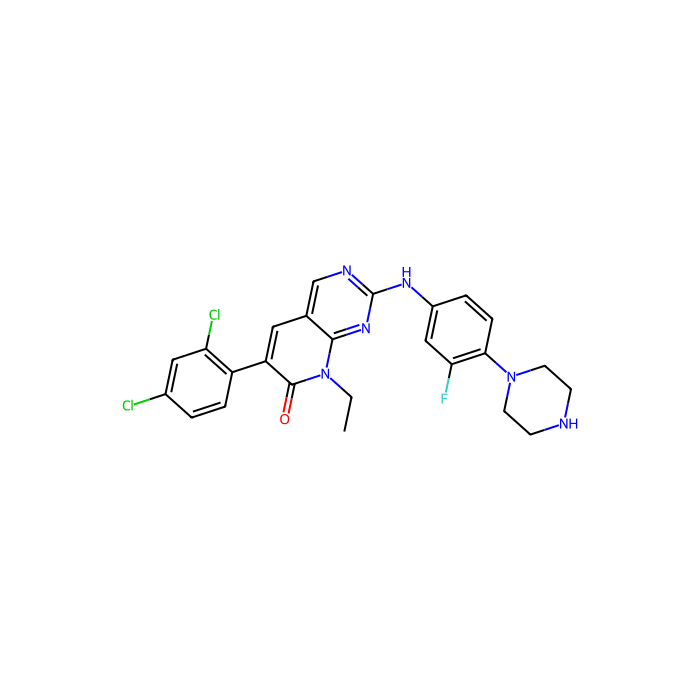
FRAX 486 - Moligand™, ≥96% , Inhibitor of p21 (RAC1) activated kinase 1;Inhibitor of p21 (RAC1) activated kinase 2;Inhibitor of p21 (RAC1) activated kinase 3;Inhibitor of p21 (RAC1) activated kinase 4, CAS No.1232030-35-1, Inhibitor of p21 (RAC1) activated kinase 1;Inhibitor of p21 (RAC1) activated kinase 2;Inhibitor of p21 (RAC1) activated kinase 3;Inhibitor of p21 (RAC1) activated kinase 4

CAS: 1232030-35-1 Cat. No.: F286996 Formula: C25H23Cl2FN6O Molecular Weight: 513.39
AVAILABLE TO ORDER
GRADE & PURITY Moligand™ ? Moligand™ — Aladdin's line of ligands and bioactive small molecules. Use for receptor, pathway, and binding studies needing defined small-molecule tools. ≥96%
Synonyms
FRAX486 | 6-(2,4-Dichlorophenyl)-8-ethyl-2-[[3-fluoro-4-(1-piperazinyl)phenyl]amino]pyrido[2,3-d]pyrimidin-7(8H)-one, FRAX 486, FRAX-486, 6-(2,4-Dichlorophenyl)-8-ethyl-2-(3-fluoro-4-(piperazin-1-yl)phenylamino)pyrido[2,3-d] pyrimidin-7(8H)-one | 6-(2,4-d
Storage
Store at -20°C
Shipped In
Ice chest + Ice pads
★
Size
Germany (EU)
USA*
Price
Qty
5mg
F286996-5mg
—
3 In stock

€32.89

€49.37
Save €16.49 (33.39%)
10mg
F286996-10mg
—
2 In stock

€51.98

€78.01
Save €26.03 (33.37%)
25mg
F286996-25mg
—
2 In stock

€114.45

€171.73
Save €57.27 (33.35%)
50mg
F286996-50mg
—
2 In stock

€151.77

€228.13
Save €76.36 (33.47%)
100mg
F286996-100mg
Made to order · 8–12 wks

€255.90

€384.32
Save €128.43 (33.42%)
250mg
F286996-250mg
—
1 In stock

€433.78

€650.72
Save €216.93 (33.34%)
Enter a quantity for the sizes you want to add.
🧪
Why this grade

Moligand™, ≥96% Moligand™ for sensitive chromatographic and analytical workflows requiring minimal baseline interference.

🌡

Storage & shipping

Store at -20°C Ships Ice chest + Ice pads Check lot-specific COA for exact specifications.

📋

Quality documents

SDS, COA, datasheet, and spec sheet available for download. Lot-specific COA accessible via lot number lookup.

📚

Literature proof

Cited in 0 peer-reviewed publications across chromatography, organic synthesis, and cross-coupling reactions.

Specifications

Synonyms
FRAX486 | 6-(2,4-Dichlorophenyl)-8-ethyl-2-[[3-fluoro-4-(1-piperazinyl)phenyl]amino]pyrido[2,3-d]pyrimidin-7(8H)-one, FRAX 486, FRAX-486, 6-(2,4-Dichlorophenyl)-8-ethyl-2-(3-fluoro-4-(piperazin-1-yl)phenylamino)pyrido[2,3-d] pyrimidin-7(8H)-one | 6-(2,4-d
Specifications & Purity
Moligand™, ≥96%
Biochemical and Physiological Mechanisms
Potent p21-activated kinase (PAK) inhibitor (IC50 values ​​of 14, 33, 39 and 575 nM for PAK1, PAK2, PAK3 and PAK4, respectively). Blocks and reverses DISC1 knockdown-induced reduction in dendritic spine size in cortical neurons. Attenuates dendritic spine
Storage
Store at -20°C
Shipped In
Ice chest + Ice pads
This product requires cold chain shipping. Ground and other economy services are not available.
Grade
Moligand™
Action Type
INHIBITOR
Mechanism of action
Inhibitor of p21 (RAC1) activated kinase 1;Inhibitor of p21 (RAC1) activated kinase 2;Inhibitor of p21 (RAC1) activated kinase 3;Inhibitor of p21 (RAC1) activated kinase 4
Purity
≥96%
Names and Identifiers
Pubchem Sid
Pubchem Sid Url
https://pubchem.ncbi.nlm.nih.gov/substance/488202115
Canonical Smiles
CCN1C2=NC(=NC=C2C=C(C1=O)C3=C(C=C(C=C3)Cl)Cl)NC4=CC(=C(C=C4)N5CCNCC5)F
IUPAC Name
6-(2,4-dichlorophenyl)-8-ethyl-2-(3-fluoro-4-piperazin-1-ylanilino)pyrido[2,3-d]pyrimidin-7-one
InChIKey
DHKFOIHIUYFSOF-UHFFFAOYSA-N
INCHI
1S/C25H23Cl2FN6O/c1-2-34-23-15(11-19(24(34)35)18-5-3-16(26)12-20(18)27)14-30-25(32-23)31-17-4-6-22(21(28)13-17)33-9-7-29-8-10-33/h3-6,11-14,29H,2,7-10H2,1H3,(H,30,31,32)
Isomeric SMILES
CCN1C2=NC(=NC=C2C=C(C1=O)C3=C(C=C(C=C3)Cl)Cl)NC4=CC(=C(C=C4)N5CCNCC5)F
Molecular Weight
513.39
Reaxy-Rn
20473374
Reaxys-RN_link_address
https://www.reaxys.com/reaxys/secured/hopinto.do?context=S&query=IDE.XRN=20473374&ln=

Documentation

📋 Safety Data Sheet (SDS)

Comprehensive hazard, handling, storage, and regulatory compliance document.

<<<<<<< HEAD Download SDS → ======= Download SDS → >>>>>>> release248-p3

✅ Certificate of Analysis (COA)

Lot-specific quality data. Enter your lot number to retrieve the exact COA.

Look up COA →

📊 Datasheet

Quick-reference summary of product specifications and applications.

View datasheet →

🔬 Specification Sheet

Full quality attributes and acceptance criteria for this grade.

View spec sheet →

Advanced Data

Taxonomic Classification

Taxonomy Tree

KingdomOrganic compounds
SuperclassOrganoheterocyclic compounds
ClassDiazinanes
SubclassPiperazines
Intermediate Tree Nodes Not available
Direct ParentPhenylpiperazines
Alternative Parents Phenylpyridines  N-arylpiperazines  Pyrido[2,3-d]pyrimidines  Aniline and substituted anilines  Dichlorobenzenes  Dialkylarylamines  Pyridinones  Aminopyrimidines and derivatives  Fluorobenzenes  Aryl chlorides  Aryl fluorides  Heteroaromatic compounds  Lactams  Azacyclic compounds  Dialkylamines  Hydrocarbon derivatives  Organic oxides  Organochlorides  Organofluorides  Organooxygen compounds  
Molecular FrameworkAromatic heteropolycyclic compounds
Substituents Phenylpiperazine - 3-phenylpyridine - N-arylpiperazine - Pyrido[2,3-d]pyrimidine - Pyridopyrimidine - 1,3-dichlorobenzene - Tertiary aliphatic/aromatic amine - Dialkylarylamine - Aniline or substituted anilines - Chlorobenzene - Fluorobenzene - Halobenzene - Pyridinone - Aminopyrimidine - Pyrimidine - Benzenoid - Aryl fluoride - Pyridine - Aryl halide - Monocyclic benzene moiety - Aryl chloride - Heteroaromatic compound - Tertiary amine - Lactam - Azacycle - Secondary aliphatic amine - Secondary amine - Organohalogen compound - Hydrocarbon derivative - Organonitrogen compound - Amine - Organooxygen compound - Organic nitrogen compound - Organic oxygen compound - Organic oxide - Organochloride - Organofluoride - Aromatic heteropolycyclic compound
DescriptionThis compound belongs to the class of organic compounds known as phenylpiperazines. These are compounds containing a phenylpiperazine skeleton, which consists of a piperazine bound to a phenyl group.
External Descriptors Not available
3D Structure
Interactive Chemical Structure Model


Associated Targets(Human)
PAK4 Tchem Serine/threonine-protein kinase PAK 4 (1 Activities)
Activity TypeActivity Value -log(M)Mechanism of ActionActivity ReferencePublications (PubMed IDs)
PAK1 Tchem Serine/threonine-protein kinase PAK 1 (2 Activities)
Activity TypeActivity Value -log(M)Mechanism of ActionActivity ReferencePublications (PubMed IDs)
PAK2 Tchem Serine/threonine-protein kinase PAK 2 (1 Activities)
Activity TypeActivity Value -log(M)Mechanism of ActionActivity ReferencePublications (PubMed IDs)
PAK3 Tchem Serine/threonine-protein kinase PAK 3 (1 Activities)
Activity TypeActivity Value -log(M)Mechanism of ActionActivity ReferencePublications (PubMed IDs)
ABL1 Tclin Tyrosine-protein kinase ABL (18331 Activities)
Activity TypeRelationActivity valueUnitsAction TypeJournalPubMed IddoiAssay Aladdin ID
CSNK2A1 Tchem Casein kinase II alpha (3512 Activities)
Activity TypeRelationActivity valueUnitsAction TypeJournalPubMed IddoiAssay Aladdin ID
DAPK3 Tchem Death-associated protein kinase 3 (2108 Activities)
Activity TypeRelationActivity valueUnitsAction TypeJournalPubMed IddoiAssay Aladdin ID
NQO2 Tchem Quinone reductase 2 (885 Activities)
Activity TypeRelationActivity valueUnitsAction TypeJournalPubMed IddoiAssay Aladdin ID
MAPK14 Tchem MAP kinase p38 alpha (12866 Activities)
Activity TypeRelationActivity valueUnitsAction TypeJournalPubMed IddoiAssay Aladdin ID
GSK3B Tclin Glycogen synthase kinase-3 beta (11785 Activities)
Activity TypeRelationActivity valueUnitsAction TypeJournalPubMed IddoiAssay Aladdin ID
MAP2K6 Tchem Dual specificity mitogen-activated protein kinase kinase 6 (1284 Activities)
Activity TypeRelationActivity valueUnitsAction TypeJournalPubMed IddoiAssay Aladdin ID
FGFR2 Tclin Fibroblast growth factor receptor 2 (3405 Activities)
Activity TypeRelationActivity valueUnitsAction TypeJournalPubMed IddoiAssay Aladdin ID
FGFR1 Tclin Fibroblast growth factor receptor 1 (9149 Activities)
Activity TypeRelationActivity valueUnitsAction TypeJournalPubMed IddoiAssay Aladdin ID
STK3 Tchem Serine/threonine-protein kinase MST2 (3069 Activities)
Activity TypeRelationActivity valueUnitsAction TypeJournalPubMed IddoiAssay Aladdin ID
CSNK1D Tchem Casein kinase I delta (4546 Activities)
Activity TypeRelationActivity valueUnitsAction TypeJournalPubMed IddoiAssay Aladdin ID
CAMK2B Tchem CaM kinase II beta (1626 Activities)
Activity TypeRelationActivity valueUnitsAction TypeJournalPubMed IddoiAssay Aladdin ID
SRC Tclin Tyrosine-protein kinase SRC (10310 Activities)
Activity TypeRelationActivity valueUnitsAction TypeJournalPubMed IddoiAssay Aladdin ID
CHEK2 Tchem Serine/threonine-protein kinase Chk2 (4015 Activities)
Activity TypeRelationActivity valueUnitsAction TypeJournalPubMed IddoiAssay Aladdin ID
AKT3 Tchem Serine/threonine-protein kinase AKT3 (3157 Activities)
Activity TypeRelationActivity valueUnitsAction TypeJournalPubMed IddoiAssay Aladdin ID
PIM1 Tchem Serine/threonine-protein kinase PIM1 (9629 Activities)
Activity TypeRelationActivity valueUnitsAction TypeJournalPubMed IddoiAssay Aladdin ID
RPS6KA5 Tchem Ribosomal protein S6 kinase alpha 5 (3355 Activities)
Activity TypeRelationActivity valueUnitsAction TypeJournalPubMed IddoiAssay Aladdin ID
RPS6KA1 Tchem Ribosomal protein S6 kinase alpha 1 (2796 Activities)
Activity TypeRelationActivity valueUnitsAction TypeJournalPubMed IddoiAssay Aladdin ID
CSNK1E Tclin Casein kinase I epsilon (1412 Activities)
Activity TypeRelationActivity valueUnitsAction TypeJournalPubMed IddoiAssay Aladdin ID
CAMK4 Tbio CaM kinase IV (2116 Activities)
Activity TypeRelationActivity valueUnitsAction TypeJournalPubMed IddoiAssay Aladdin ID
MAP2K4 Tchem Dual specificity mitogen-activated protein kinase kinase 4 (1051 Activities)
Activity TypeRelationActivity valueUnitsAction TypeJournalPubMed IddoiAssay Aladdin ID
MAPK13 Tchem MAP kinase p38 delta (2605 Activities)
Activity TypeRelationActivity valueUnitsAction TypeJournalPubMed IddoiAssay Aladdin ID
MAPKAPK2 Tchem MAP kinase-activated protein kinase 2 (4814 Activities)
Activity TypeRelationActivity valueUnitsAction TypeJournalPubMed IddoiAssay Aladdin ID
DAPK1 Tchem Death-associated protein kinase 1 (1664 Activities)
Activity TypeRelationActivity valueUnitsAction TypeJournalPubMed IddoiAssay Aladdin ID
MAPK9 Tchem c-Jun N-terminal kinase 2 (4655 Activities)
Activity TypeRelationActivity valueUnitsAction TypeJournalPubMed IddoiAssay Aladdin ID
MAPK10 Tchem c-Jun N-terminal kinase 3 (3396 Activities)
Activity TypeRelationActivity valueUnitsAction TypeJournalPubMed IddoiAssay Aladdin ID
CAMK2D Tchem CaM kinase II delta (2813 Activities)
Activity TypeRelationActivity valueUnitsAction TypeJournalPubMed IddoiAssay Aladdin ID
CDK2 Tchem Cyclin-dependent kinase 2 (9050 Activities)
Activity TypeRelationActivity valueUnitsAction TypeJournalPubMed IddoiAssay Aladdin ID
PAK3 Tchem Serine/threonine-protein kinase PAK 3 (1514 Activities)
Activity TypeRelationActivity valueUnitsAction TypeJournalPubMed IddoiAssay Aladdin ID
DYRK1A Tchem Dual-specificity tyrosine-phosphorylation regulated kinase 1A (6484 Activities)
Activity TypeRelationActivity valueUnitsAction TypeJournalPubMed IddoiAssay Aladdin ID
MAPK8 Tchem c-Jun N-terminal kinase 1 (5038 Activities)
Activity TypeRelationActivity valueUnitsAction TypeJournalPubMed IddoiAssay Aladdin ID
PHKG2 Tchem Phosphorylase kinase gamma subunit 2 (2281 Activities)
Activity TypeRelationActivity valueUnitsAction TypeJournalPubMed IddoiAssay Aladdin ID
CSNK2A2 Tchem Casein kinase II alpha (prime) (1587 Activities)
Activity TypeRelationActivity valueUnitsAction TypeJournalPubMed IddoiAssay Aladdin ID
MAP2K7 Tchem Dual specificity mitogen-activated protein kinase kinase 7 (1145 Activities)
Activity TypeRelationActivity valueUnitsAction TypeJournalPubMed IddoiAssay Aladdin ID
AURKA Tchem Serine/threonine-protein kinase Aurora-A (10240 Activities)
Activity TypeRelationActivity valueUnitsAction TypeJournalPubMed IddoiAssay Aladdin ID
GAK Tchem Serine/threonine-protein kinase GAK (1150 Activities)
Activity TypeRelationActivity valueUnitsAction TypeJournalPubMed IddoiAssay Aladdin ID
AAK1 Tchem Adaptor-associated kinase (1053 Activities)
Activity TypeRelationActivity valueUnitsAction TypeJournalPubMed IddoiAssay Aladdin ID
PLK4 Tchem Serine/threonine-protein kinase PLK4 (1882 Activities)
Activity TypeRelationActivity valueUnitsAction TypeJournalPubMed IddoiAssay Aladdin ID
STK17B Tchem Serine/threonine-protein kinase 17B (773 Activities)
Activity TypeRelationActivity valueUnitsAction TypeJournalPubMed IddoiAssay Aladdin ID
STK10 Tchem Serine/threonine-protein kinase 10 (2119 Activities)
Activity TypeRelationActivity valueUnitsAction TypeJournalPubMed IddoiAssay Aladdin ID
EPHA2 Tclin Ephrin type-A receptor 2 (3499 Activities)
Activity TypeRelationActivity valueUnitsAction TypeJournalPubMed IddoiAssay Aladdin ID
TTK Tchem Dual specificity protein kinase TTK (2978 Activities)
Activity TypeRelationActivity valueUnitsAction TypeJournalPubMed IddoiAssay Aladdin ID
CLK1 Tchem Dual specificty protein kinase CLK1 (2189 Activities)
Activity TypeRelationActivity valueUnitsAction TypeJournalPubMed IddoiAssay Aladdin ID
CLK3 Tchem Dual specificity protein kinase CLK3 (2711 Activities)
Activity TypeRelationActivity valueUnitsAction TypeJournalPubMed IddoiAssay Aladdin ID
BMX Tchem Tyrosine-protein kinase BMX (1995 Activities)
Activity TypeRelationActivity valueUnitsAction TypeJournalPubMed IddoiAssay Aladdin ID
NEK2 Tchem Serine/threonine-protein kinase NEK2 (3514 Activities)
Activity TypeRelationActivity valueUnitsAction TypeJournalPubMed IddoiAssay Aladdin ID
LIMK1 Tchem LIM domain kinase 1 (2329 Activities)
Activity TypeRelationActivity valueUnitsAction TypeJournalPubMed IddoiAssay Aladdin ID
EPHA5 Tchem Ephrin type-A receptor 5 (1056 Activities)
Activity TypeRelationActivity valueUnitsAction TypeJournalPubMed IddoiAssay Aladdin ID
EPHB1 Tchem Ephrin type-B receptor 1 (840 Activities)
Activity TypeRelationActivity valueUnitsAction TypeJournalPubMed IddoiAssay Aladdin ID
EPHA4 Tchem Ephrin type-A receptor 4 (2022 Activities)
Activity TypeRelationActivity valueUnitsAction TypeJournalPubMed IddoiAssay Aladdin ID
Associated Targets(non-human)
Mapk1 MAP kinase ERK2 (650 Activities)
Activity TypeRelationActivity valueUnitsAction TypeJournalPubMed IddoiAssay Aladdin ID
Hdac6 Histone deacetylase 6 (222 Activities)
Activity TypeRelationActivity valueUnitsAction TypeJournalPubMed IddoiAssay Aladdin ID
Fgfr3 Fibroblast growth factor receptor 3 (21 Activities)
Activity TypeRelationActivity valueUnitsAction TypeJournalPubMed IddoiAssay Aladdin ID
rep Replicase polyprotein 1ab (378 Activities)
Activity TypeRelationActivity valueUnitsAction TypeJournalPubMed IddoiAssay Aladdin ID
SARS-CoV-2 (38078 Activities)
Activity TypeRelationActivity valueUnitsAction TypeJournalPubMed IddoiAssay Aladdin ID
Mechanisms of Action
Certificates (CoA,COO,BSE/TSE and Analysis Chart)
C of A & Other Certificates(BSE/TSE, COO):
Analytical Chart:

Find and download the COA for your product by matching the lot number on the packaging.

13 results found

Lot NumberCertificate TypeDateItem
I2615080I2615080Certificate of AnalysisSep 24, 2026 F286996
C23311074C23311074Certificate of AnalysisJan 20, 2026 F286996
C23311075C23311075Certificate of AnalysisJan 20, 2026 F286996
C23311076C23311076Certificate of AnalysisJan 20, 2026 F286996
C23311077C23311077Certificate of AnalysisJan 20, 2026 F286996
C23311078C23311078Certificate of AnalysisJan 20, 2026 F286996
C23311079C23311079Certificate of AnalysisJan 20, 2026 F286996
C23311080C23311080Certificate of AnalysisJan 20, 2026 F286996
C23311081C23311081Certificate of AnalysisJan 20, 2026 F286996
C23311082C23311082Certificate of AnalysisJan 20, 2026 F286996
C23311083C23311083Certificate of AnalysisJan 20, 2026 F286996
C23311084C23311084Certificate of AnalysisJan 20, 2026 F286996
C2331390C2331390Certificate of AnalysisJan 20, 2026 F286996
Chemical and Physical Properties
SolubilitySolvent:DMSO, Max Conc. mg/mL: 10.27, Max Conc. mM: 20
Molecular Weight513.400 g/mol
XLogP34.800
Hydrogen Bond Donor Count2
Hydrogen Bond Acceptor Count7
Rotatable Bond Count5
Exact Mass512.129 Da
Monoisotopic Mass512.129 Da
Topological Polar Surface Area73.400 Ų
Heavy Atom Count35
Formal Charge0
Complexity783.000
Isotope Atom Count0
Defined Atom Stereocenter Count0
Undefined Atom Stereocenter Count0
Defined Bond Stereocenter Count0
Undefined Bond Stereocenter Count0
The total count of all stereochemical bonds0
Covalently-Bonded Unit Count1
Solution Calculators
Reviews

Customer Reviews

Application Protocols

No tested application protocols are provided in the product data for this item.

General, non-validated guidance for chemical probe use:

  • Enzyme assays: Start with a broad concentration range (e.g., 0.1 nM–30 µM), maintain constant vehicle, and measure initial rates to avoid time-dependent artifacts.
  • Cell-based assays: Titrate across 7–10 half-log dilutions with replicate wells; monitor cytotoxicity separately. Limit final DMSO ≤0.1–0.5% v/v when possible.
  • Washout/Recovery: For reversibility studies, perform washout and follow recovery kinetics relative to vehicle controls.
  • Data quality: Include biological replicates, plate controls (positive/negative), and appropriate curve-fitting (four-parameter logistic) with goodness-of-fit diagnostics.

Note: These are general practices; they are not validated protocols for FRAX 486. Tailor to your system and confirm with pilot experiments.

Biological Roles

Scope: No target or MoA information is provided in the product data for this SKU. The following provides general, literature-framed context for small-molecule research probes of kinase pathways; do not treat as item specifications.

General/literature context:

  • Small-molecule kinase-pathway modulators are widely used to interrogate signaling cascades governing cell proliferation, cytoskeletal dynamics, and stress responses. They can serve as tools to validate pathway involvement in phenotypes by acute, reversible modulation of enzymatic activity.
  • Chemical probes typically feature heteroaromatic scaffolds that engage ATP-binding clefts or allosteric pockets via H-bonding and hydrophobic contacts, enabling potency in the low micromolar to nanomolar ranges (compound- and target-dependent).
  • In cellular systems, probe performance depends on permeability, efflux liabilities, protein binding, and metabolic stability. Thus, observed biological effects can deviate from purified-enzyme results, underscoring the need for orthogonal assays and counterscreens.

Good practices:

  • Define a concentration-response curve and report EC50/IC50 with confidence intervals and Hill slope.
  • Include selectivity panels or at least sentinel off-target assays to contextualize findings.
  • Use appropriate negative controls (inactive analogs or vehicle) and, where feasible, genetic perturbations (e.g., siRNA/CRISPR) to triangulate on-target activity.

Note: Consult primary literature and your internal data for FRAX 486-specific targets, potencies, and selectivity before drawing mechanistic conclusions.

Buffer Applications

Not typically applicable as a buffering agent. FRAX 486 is a bioactive small molecule used as a chemical probe rather than a pH buffer.

Practical notes for assay buffers (general):

  • Use standard biological buffers (e.g., PBS, HEPES, Tris) compatible with your target system.
  • Maintain constant vehicle concentration (e.g., DMSO 0.1–1% v/v) across all wells/tubes.
  • To mitigate compound precipitation on dilution, pre-warm buffers, add DMSO stock slowly with mixing, and incorporate solubilizing aids (e.g., minimal Tween 80 or 0.1% BSA) if assay-tolerated.
  • Filter buffers (0.2 µm) and degas when performing sensitive spectroscopic or microfluidic assays to reduce noise and bubble formation.
Green Alternatives

Context: For FRAX 486 as a bioactive probe, "green alternatives" primarily concern solvent and formulation choices rather than replacing the compound itself.

Greener handling strategies (general):

  • Solvent selection: Prefer water-rich media with minimal DMSO (≤0.1–0.5% v/v) where activity permits. Evaluate ethanol/water or PEG 400/water vehicles as alternatives to high-DMSO content.
  • Stock management: Use concentrated, small-volume aliquots to reduce solvent use and waste. Implement just-in-time preparation to minimize expired materials.
  • Assay miniaturization: Transition to microplate formats (e.g., 384- or 1536-well) to reduce per-experiment solvent and compound consumption.
  • Waste reduction: Segregate DMSO/organic waste; explore solvent recycling programs where permitted.

Illustrative comparison (general):

  • DMSO vs Ethanol for stock prep:
    • Environmental profile: Ethanol is bio-based and has a lower environmental persistence than DMSO.
    • Performance: DMSO typically offers greater solubility for hydrophobic inhibitors. Ethanol may require higher final percentages, which can limit biological compatibility.

Trade-offs:

  • Lower-toxicity vehicles (ethanol, PEG/water) may lower solubility ceilings; careful titration and pre-solubilization steps are required. Always confirm assay performance and target integrity when changing vehicles.
Pharmaceutical Uses

No pharmaceutical/formulation status is provided in the product data. This item is supplied strictly for research use only (product data: Research Use Note).

General R&D context (non-clinical, non-therapeutic):

  • Preformulation screening: Evaluate solubility, stability, and compatibility with excipient systems (e.g., cyclodextrins, PEGs) for in vitro and ex vivo studies.
  • Bioanalytical reference: Use as a reference standard in method development (e.g., LC–MS/MS), ensuring identity/purity are verified for the specific lot (CoA review essential).
  • Exploratory delivery vehicles: For non-clinical models, typical vehicles include DMSO/PEG/saline mixtures or lipid-based carriers; performance and tolerability are model-dependent and must be justified by IACUC/ethical review where applicable. These considerations remain research-only and are not product specifications.

Compliance reminder:

  • Not for human or veterinary use. No claims are made regarding safety, efficacy, or pharmacopeial compliance. For any regulated application, obtain and review batch CoA and SDS, and perform internal qualification.
Physical Properties

Item-specific specifications:

  • Appearance: Not specified for this item; refer to CoA/Spec Sheet.
  • Molecular Weight: Not specified for this item; refer to CoA/Spec Sheet.
  • Molecular Formula: Not specified for this item; refer to CoA/Spec Sheet.
  • Melting point / Boiling point / Density / Refractive index / UV cutoff / Residuals: Not specified for this item; refer to CoA/Spec Sheet.

General/literature guidance for FRAX-series inhibitors (non-spec, for planning only):

  • Physical state: Typically solid at ambient temperature (literature, class expectation for small-molecule kinase inhibitors).
  • Solubility (assay preparation): Often prepared as concentrated stocks in anhydrous DMSO (e.g., 10–50 mM), then diluted into aqueous assay buffers with final DMSO ≤0.1–1% v/v to minimize solvent effects (general practice).
  • Aqueous solubility: Frequently limited without cosolvent or surfactant; consider DMSO, ethanol, or PEG-containing vehicles for intermediate dilutions (general guidance).
  • Stability: Many kinase inhibitors are light- and moisture-sensitive to varying degrees; avoid prolonged exposure to air and light; store at low temperature as directed by product data.

Important: Do not use the above generalities as specifications. For quantitative properties (e.g., exact solubility, pKa, logP, polymorph), consult the CoA/Spec Sheet or primary literature for FRAX 486 specifically.

Quality & Grades
  • Grade/Purity: Moligand™ (product data).

About Moligand™ (general description of grade):

  • Moligand™ designates a bioactive small-molecule/research-ligand grade intended for chemical biology, target validation, and screening workflows. Emphasis is typically on high chemical purity (often HPLC verified), identity confirmation (NMR/MS), and controlled impurities suited for discovery workflows. Exact purity thresholds, residual solvent limits, water content, and chromatographic parameters are item-specific.

This item:

  • Purity, assay (HPLC/NMR), residual solvents, water/peroxide/metal limits, counter-ion content, and salt form: Not specified for this item; refer to CoA/Spec Sheet.
  • Appearance and batch-specific test methods: Not specified for this item; refer to CoA/Spec Sheet.

Implications for use:

  • Moligand™ materials are generally suitable for screening (biochemical/cellular), mechanistic studies, and as reference standards. For quantitative SAR, bioanalytical calibration, or in vivo method development, confirm batch-specific attributes (purity, identity, form, and stability) using the supplied CoA.
  • If low-UV baseline for chromatography is critical, verify UV profile on the CoA or run a quick scouting gradient to ensure compatibility with your detection wavelength.
Reaction & Applications

Scope: As supplied, FRAX 486 is primarily used as a research probe/screening compound rather than as a synthetic reagent. No manufacturer application text is provided for this SKU.

Practical laboratory applications (general for bioactive probes):

  • Target engagement studies: Use in biochemical enzyme assays, cellular target engagement, or pathway modulation assays as a chemical probe (literature context). Validate concentration ranges and exposure times empirically.
  • Comparative SAR: Benchmark activity against structural analogs or reference inhibitors to establish selectivity profiles (orthogonal assays recommended).
  • Chemical biology tool: Apply in phenotypic screens to interrogate pathway dependence. Include vehicle controls and concentration-response designs (e.g., 8–12 points, half-log spacing).

Assay preparation tips (general):

  • Prepare fresh DMSO stock solutions (e.g., 10–20 mM), filter if compatible (PTFE, 0.2 µm) to remove particulates, and avoid repeated freeze–thaw by aliquoting.
  • Minimize nonspecific binding by using low-binding plasticware and adding carrier protein (e.g., 0.1% BSA) when compatible with the assay.
  • Monitor precipitation after dilution into aqueous buffers; gentle warming and slow addition under mixing can help. Discard solutions showing visible precipitate or turbidity drift during the assay window.

Note: Specific biochemical targets and potencies for FRAX 486 are not provided in the product data; consult primary literature and confirm with internal controls.

Reaction Conditions

Not primarily applicable: FRAX 486 is a finished small-molecule probe rather than a reagent for promoting chemical reactions.

General laboratory handling for solution preparation (non-reaction conditions):

  • Stock solutions: Dissolve in anhydrous DMSO (common practice) at 10–50 mM. Vortex and, if necessary, sonicate briefly. Filter through 0.2 µm PTFE if particulate persists.
  • Working dilutions: Prepare immediately before use by serial dilution into assay buffer, maintaining consistent final vehicle percentage across samples.
  • Temperature: Perform dissolution at ambient temperature; mild warming (30–37°C) can assist solubilization. Avoid prolonged heating that may cause degradation.
  • Light/Moisture: Protect from light and moisture during preparation and storage to enhance stability (general good practice for bioactives).

If employing FRAX 486 in chemical biology conjugations or immobilization (general):

  • Reaction conditions depend entirely on the verified functional groups present; consult primary literature and test on small scale first. Avoid conditions that could modify the pharmacophore if biological activity must be retained.
Safety & Handling

Authoritative safety information must be taken from the product SDS.

Item-specific hazard data:

  • GHS Classification / Pictograms / Signal Word / H-Statements: Not specified for this item; refer to SDS.

General laboratory precautions for bioactive small molecules:

  • PPE: Wear lab coat, safety glasses, and appropriate chemical-resistant gloves (e.g., nitrile). Handle powders in a fume hood or ventilated enclosure to avoid dust/aerosol generation.
  • Avoid exposure: These compounds may be biologically active at low concentrations; prevent inhalation, ingestion, or skin contact. Use closed containers and secondary containment for transfers.
  • First aid (overview): If skin contact occurs, wash with soap and water. If eye contact, rinse with water for ≥15 minutes and seek medical attention. If inhaled, move to fresh air. If ingested, seek medical attention. Follow SDS-specified procedures.
  • Incompatibilities: Strong oxidizers and strong acids/bases may degrade organic inhibitors (general). Keep away from ignition sources when using organic solvents (DMSO/ethanol).
  • Waste: Collect solutions and contaminated disposables as organic hazardous waste per institutional and regulatory requirements.
  • Transport/Shipping: Shipped with ice packs; maintain low temperature to preserve integrity. Inspect for container integrity on receipt.

Always defer to the SDS and institutional EHS guidance for risk assessment and controls specific to FRAX 486.

Solvent Selection

Applicability: FRAX 486 is a bioactive, hydrophobic small molecule; solvent choice primarily concerns preparing assay stocks and dosing solutions rather than reaction media.

General guidance (non-spec):

  • Primary stock solvent: Anhydrous DMSO is commonly used due to strong solubilizing power and assay compatibility at ≤0.1–1% v/v (literature/general practice for kinase inhibitors).
  • Alternative cosolvents/vehicles: Ethanol (absolute), DMF (anhydrous), PEG 400, or aqueous buffers with cosolvent and/or surfactants (e.g., 0.5–1% Tween 80) may help during intermediate dilutions. Verify biological compatibility for your assay system.
  • Aqueous buffers: Use PBS, HEPES, or assay-specific buffers; to mitigate precipitation after dilution, pre-warm buffer and add DMSO stock slowly with vigorous mixing; maintain final DMSO % constant across controls.

Polarity/miscibility notes (general):

  • DMSO: Polar aprotic, fully miscible with water; excellent for hydrophobes but can affect membrane integrity and enzyme activity at higher percentages.
  • Ethanol: Miscible with water; biocompatibility is assay-dependent; often limited to ≤0.5–1% v/v in cell systems.

Small comparison (general):

  • DMSO vs Ethanol: DMSO offers higher solubilizing power; ethanol may be preferable when DMSO-sensitive targets are studied. Pilot solubility and activity checks are recommended before large experiments.
Storage & Reconstitution

Item-specific instructions:

  • Storage Conditions: Store at -20°C (product data).
  • Shipped In: Ice chest + Ice pads (product data).
  • Appearance: Not specified for this item; refer to CoA/Spec Sheet.

General reconstitution guidance (non-spec):

  • Solvent: Reconstitute in anhydrous DMSO to prepare a concentrated stock (e.g., 10–50 mM). If another solvent is preferred (ethanol/DMF), verify compatibility with intended assays.
  • Aliquoting: Dispense single-use aliquots in low-bind tubes to avoid repeated freeze–thaw cycles. Backfill vials with inert gas when feasible to reduce oxidation/moisture uptake.
  • Storage of solutions: Store DMSO stocks at -20°C, protected from light. Allow to equilibrate to room temperature before opening to minimize moisture condensation; re-seal promptly.
  • Stability monitoring: Track preparation date and perform periodic QC (e.g., analytical HPLC) if solutions are stored for extended periods. Discard if precipitation, discoloration, or activity loss is observed.

Important notes:

  • Exact solubility limits, solution stability, and freeze–thaw tolerance are not specified for this item; refer to CoA/Spec Sheet and perform pilot stability tests under your laboratory conditions.
  • For research use only (product data). Not for human or veterinary use.
Structure & Identity

Brief: FRAX 486 is a bioactive small molecule offered for research screening and probe studies.

  • Product Name: FRAX 486 (SKU: F286996)
  • CAS: 1232030-35-1 (product data)
  • PubChem CID: 68060125 (product data)
  • InChIKey: 63533 (as provided in product data)
  • SMILES: Not specified for this item; refer to CoA/Spec Sheet.
  • Molecular Formula: Not specified for this item; refer to CoA/Spec Sheet.
  • Molecular Weight: Not specified for this item; refer to CoA/Spec Sheet.

Structural notes (general/literature context):

  • FRAX-series molecules are typically heteroaromatic, kinase-targeted small molecules containing multiple ring systems and H-bond donor/acceptor motifs. Specific functional groups and stereochemistry for FRAX 486 should be confirmed from the CoA or primary literature.

2D structure description (general guidance):

  • Expect a multi-ring, largely planar core with heteroatoms positioned to engage protein active sites via hydrogen bonding and dipolar interactions; exact atom connectivity is not provided here and should be verified from authoritative databases (e.g., PubChem record 68060125) or the item’s Spec Sheet before quantitative work.
Synthetic Utility

Applicability: FRAX 486 is offered as a finished bioactive probe rather than as a synthetic intermediate.

General utility in chemistry workflows:

  • Reference compound: Serves as a comparator in SAR campaigns and as a control in biochemical or cellular assays.
  • Analytical marker: Useful for developing and validating chromatographic and spectrometric methods (retention behavior, fragmentation patterns). Ensure availability of a stable isotopologue or internal standard if quantitative bioanalysis is intended.

If derivatization is desired (general considerations):

  • Without item-specific structure data here, any functionalization strategy must be based on verified structural information (consult PubChem CID 68060125 and primary literature). Common modifications in probe development include bioorthogonal tags (alkynes/azides) or linkers for affinity reagents, typically installed at positions shown to be solvent-exposed in structure–activity studies.

Caveat:

  • No item-specific functional group list, protecting group strategy, or reactivity profile is provided in the product data; confirm structure and compatibility before planning transformations.
Target Specificity

Item-specific target information is not provided in the product data for this SKU.

  • Target(s), pathway, isoform selectivity, Kd/IC50 values, and off-target profile: Not specified for this item; refer to CoA/Spec Sheet and primary literature for FRAX 486.

Guidance:

  • Establish target specificity empirically using a combination of biochemical assays, cellular phenotyping, and orthogonal counterscreens. Include appropriate negative controls and, where possible, genetic validation to corroborate chemical probe findings.

Frequently Asked Questions

What is the purity of this product?
This product is supplied at ≥96% purity (chemical assay). Lot-specific values are stated on the Certificate of Analysis.
What is Moligand??
Moligand? is one of Aladdin Scientific's premium product lines, formulated for high-purity applications across multiple workflows. Compared to standard grades in the same workflow, Moligand? products typically offer tighter specifications, more rigorous QC, and stronger lot-to-lot consistency.
How should this product be stored?
Store at ?20 °C. Freezer storage is required to maintain the specified shelf life.
How is this product shipped?
This product ships in an insulated container with ice pads. Unpack on arrival and transfer it to the storage condition stated above.
What are the CAS number, molecular formula and molecular weight?
The CAS Number is 1232030-35-1, the molecular formula is C25H23Cl2FN6O, and the molecular weight is 513.39 g/mol. InChIKey DHKFOIHIUYFSOF-UHFFFAOYSA-N.
What documentation is provided?
Available product documentation, including Certificates of Analysis (COA), Safety Data Sheets (SDS), and specification sheets, is shown in the product document area. Document availability and access follow the current site policy.

Shall we send you a message when we have discounts available?

Remind me later

Thank you! Please check your email inbox to confirm.

Oops! Notifications are disabled.