≥90% for sensitive chromatographic and analytical workflows requiring minimal baseline interference.
🌡
Storage & shipping
Store at -20°C,Desiccated Ships Ice chest + Ice pads Check lot-specific COA for exact specifications.
📋
Quality documents
SDS, COA, datasheet, and spec sheet available for download. Lot-specific COA accessible via lot number lookup.
📚
Literature proof
Cited in 1 peer-reviewed publications across chromatography, organic synthesis, and cross-coupling reactions.
Overview
Source:Isolated from Fusicoccum amygdali.
application:
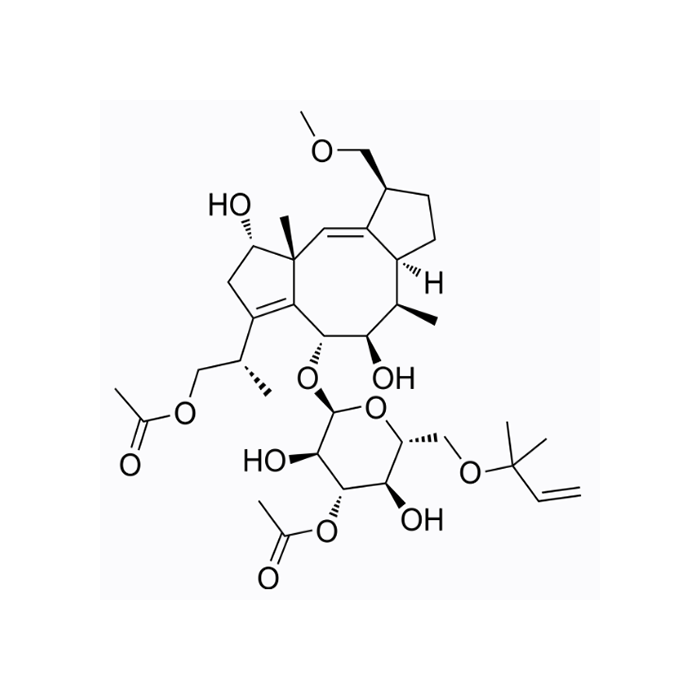
Fusicoccin (Fusicoccin A), a diterpene glucoside phytotoxin, is used to study 14-3-3-dependent processes such as the activation of H+-ATPase in plants and other client proteins with mode III binding motifs. Fusicoccin is an inducer of a catalase inhibitor that leads to oxidative damage in plants.
Specifications
Synonyms
CHEBI:51015 | 1o9e | fuscicoccin A | FSC | [(2S)-2-[(1E,3R,4S,8R,9R,10R,11S,14S)-8-[(2S,3R,4S,5R,6R)-4-acetyloxy-3,5-dihydroxy-6-(2-methylbut-3-en-2-yloxymethyl)oxan-2-yl]oxy-4,9-dihydroxy-14-(methoxymethyl)-3,10-dimethyl-6-tricyclo[9.3.0.03,7]tetradeca-1
Specifications & Purity
≥90%
Biochemical and Physiological Mechanisms
H + -ATPase activator. NF-κB activator. 14-3-3 protein binder. Induces H + extrusion from plant cells. Stimulates cytochrome c release from mitochondria. Reduces cellular H 2 O 2 scavenging capacity. Induces membrane hyperpolarization.
Storage
Store at -20°C,Desiccated
Shipped In
Ice chest + Ice pads
This product requires cold chain shipping. Ground and other economy services are not available.
Note
Wherever possible, you should prepare and use solutions on the same day. However, if you need to make up stock solutions in advance, we recommend that you store the solution as aliquots in tightly sealed vials at -20°C. Generally, these will be useable for up to one month. Before use, and prior to opening the vial we recommend that you allow your product to equilibrate to room temperature for at least 1 hour. Need more advice on solubility, usage and handling? Please visit our frequently asked questions (FAQ) page for more details.
This compound belongs to the class of organic compounds known as diterpene glycosides. These are diterpenoids in which an isoprene unit is glycosylated.
External Descriptors
acetate ester
1. Djoumbou Feunang Y, Eisner R, Knox C, Chepelev L, Hastings J, Owen G, Fahy E, Steinbeck C, Subramanian S, Bolton E, Greiner R, and Wishart DS. ClassyFire: Automated Chemical Classification With A Comprehensive, Computable Taxonomy. Journal of Cheminformatics, 2016, 8:61.
We use cookies to ensure the website functions properly and, where permitted, to improve your experience. You can manage your preferences at any time in Settings. Learn more in our Cookie Policy.
Shall we send you a message when we have discounts available?
Remind me later
Thank you! Please check your email inbox to confirm.
Products are supplied to verified businesses, institutions, and qualified professionals for research and development use only. Not for use in humans, animals, diagnosis, or therapy.

 A2619670