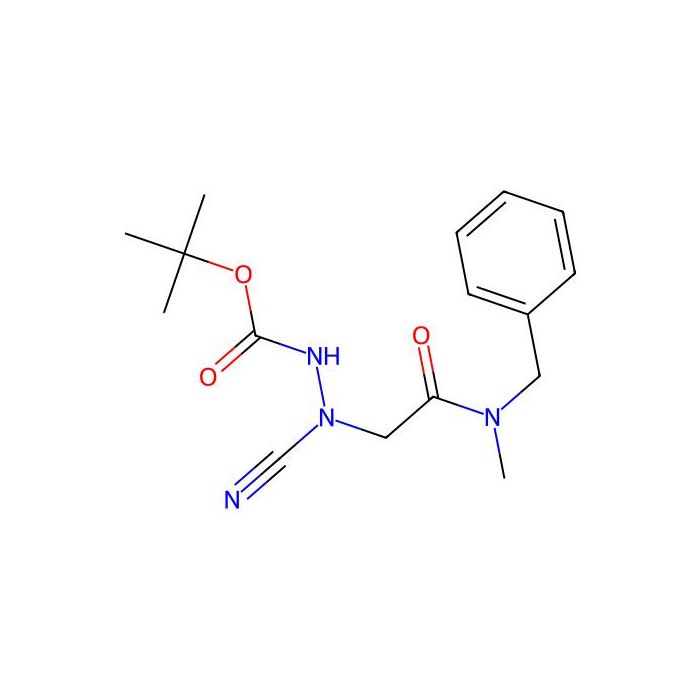
Gü2602 is a potent, reversible cathepsin K (CatK) inhibitor with a K i of 0.013 nM for mature CatK (mCatK). Gü2602 suppresses the autocatalytic activation of the cathepsin K zymogen
Form:Solid
IC50& Target:cathepsin K
Specifications
Specifications & Purity
≥98%
Biochemical and Physiological Mechanisms
Gü2602 is a potent, reversible cathepsin K (CatK) inhibitor with a K i of 0.013 nM for mature CatK (mCatK). Gü2602 suppresses the autocatalytic activation of the cathepsin K zymogen.
Storage
Store at 2-8°C,Protected from light,Desiccated
Shipped In
Wet ice
This product requires cold chain shipping. Ground and other economy services are not available.
Action Type
INHIBITOR
Purity
≥98%
Names and Identifiers
Molecular Weight
318.37
Advanced Data
Certificates (CoA,COO,BSE/TSE and Analysis Chart)
C of A & Other Certificates(BSE/TSE, COO):
Analytical Chart:
Chemical and Physical Properties
Solubility
DMSO : 66.67 mg/mL (209.41 mM; Need ultrasonic)
Solution Calculators
Molarity Calculator
Determine the necessary mass, volume, or concentration for preparing a solution.
Dilution Calculator
Determine the dilution needed to prepare a stock solution.
Reconstitution Calculator
Reviews
Customer Reviews
Application Protocols
Validated, product-specific protocols (WB, IHC, IF, FC, enzymatic assays, etc.): Not specified for this item; refer to CoA/Spec Sheet.
General protocols for small-molecule screening materials:
Stock preparation: Accurately weigh under dry conditions, dissolve in anhydrous DMSO to 10–20 mM, vortex/sonicate briefly, and filter if needed (0.2 µm PTFE) to remove particulates. Record purity-corrected molarity if CoA provides assay purity.
Working dilutions: Add DMSO stock to assay buffer under rapid mixing to a final DMSO of 0.1–1% v/v. Inspect for precipitation; if present, consider co-solvent up to assay-tolerated limits or adjust pH if compatible.
Storage of stocks: Aliquot into amber vials or plates and store at −20°C to 4°C per stability findings; minimize freeze–thaw cycles.
Note: Always adapt concentrations, incubation times, and detection modalities to the requirements of your specific target and assay format.
Biological Roles
Item-specific biological function or pathway roles: Not specified for this item; refer to the primary literature or CoA if available.
General note:
Gü2602 is supplied strictly for research use. No endogenous biological role, target class, or pathway association is provided in the current listing. Any inferred mechanism of action must be established experimentally by the end user through validated assays (e.g., enzymatic activity, binding biophysics, transcriptomics/chemoproteomics).
Good experimental practices (general guidance):
Confirm activity across multiple orthogonal assays to reduce false positives.
Quantify nonspecific effects (cytotoxicity, membrane disruption, redox cycling) before proposing a biological role.
If cellular work is intended, assess permeability, solubility in culture media, and chemical stability at 37°C and physiological pH.
Buffer Applications
This section is not typically applicable: Gü2602 is a small-molecule research compound rather than a buffering agent.
Practical guidance (general):
When preparing aqueous assay dilutions from DMSO stocks, select assay buffers appropriate to your biological system (e.g., PBS, HEPES, Tris) and validate compound solubility at the final DMSO percentage.
If the compound is ionizable (unknown here), apparent solubility may vary with pH; small pilot tests across pH 6.5–8.0 can help identify compatible conditions.
Item-specific buffer properties (pKa, buffer capacity, formulary recipes): Not specified for this item; refer to CoA/Spec Sheet.
Green Alternatives
Without a disclosed structure, solvent and process choices are the primary levers for greener handling of Gü2602. The following options are general, literature-based considerations for stock preparation, analytics, and workup.
Greener solvent substitutions (general guidance):
DMSO (baseline for stocks) vs. alternatives: While DMSO is widely accepted, propylene carbonate or Cyrene can sometimes substitute for high-polarity needs if assay-compatible.
Replace chlorinated solvents in workup/analytics: Prefer ethyl acetate or methyl tert-butyl ether (MTBE) over dichloromethane when feasible; consider cyclopentyl methyl ether (CPME) as a low-peroxide, hydrophobic ether.
Chromatography: Use ethanol/water or acetone/heptane systems where compatible; reduce acetonitrile usage by switching to methanol/water gradients if resolution allows.
Illustrative comparison (general):
2-MeTHF vs THF: 2-MeTHF is biorenewable, less miscible with water, and often easier to separate; THF has wider solubility but forms peroxides more readily.
CPME vs DCM: CPME offers lower density (simpler phase separations), higher boiling point, and improved stability with bases; DCM provides rapid evaporation but is chlorinated and more hazardous.
Trade-offs:
Solubility and assay background must be validated case-by-case. Conduct small-scale compatibility checks before wholesale substitution to ensure data quality and compound integrity.
Pharmaceutical Uses
No pharmacopeial status or excipient role is provided for this product.
Important limitations:
For research use only. Not for human or veterinary use, diagnostic procedures, or as a drug substance/excipient in manufacturing.
General formulation context (if pursuing preclinical research only):
In early-stage in vivo method development (non-clinical), vehicles commonly include aqueous buffers containing co-solvents (e.g., PEG400, ethanol, Cremophor EL, or captisol), but such choices must be justified by compound-specific solubility, stability, and tolerability data. Since Gü2602 lacks disclosed properties, users should first characterize solubility, stability (light, pH, oxidative), and polymorphism.
Item-specific pharmaceutical information: Not specified for this item; refer to CoA/Spec Sheet.
Physical Properties
Item-specific physical data: Not specified for this item; refer to CoA/Spec Sheet.
The following typical properties cannot be reported without a disclosed structure and lot data:
Appearance: Not specified for this item; refer to CoA/Spec Sheet.
Melting point / Boiling point: Not specified for this item; refer to CoA/Spec Sheet.
Density / Refractive index: Not specified for this item; refer to CoA/Spec Sheet.
Solubility profile (water/organic): Not specified for this item; refer to CoA/Spec Sheet.
LogP / pKa: Not specified for this item; refer to CoA/Spec Sheet.
General laboratory guidance (literature/general):
For unknown small molecules in screening libraries, initial solubility evaluation is commonly performed in DMSO (10–50 mM stock), followed by dilution into assay buffers or organic solvents (MeOH, ACN) as needed.
If crystallinity prevents rapid dissolution, gentle warming to ambient or 30–40°C and brief sonication are typical approaches; avoid prolonged heating or light exposure unless stability data confirm compatibility.
For hygroscopic materials, handle in a dry box or quickly in ambient with desiccation to minimize water uptake, which can confound gravimetric stock preparation.
Quality & Grades
Item-specific quality information:
Grade/Purity: Not specified for this item; refer to CoA/Spec Sheet.
General context for library compounds (literature/general):
Small-molecule library members are commonly supplied at ≥95% HPLC purity for screening; however, exact purity, residual solvent content, and water content are lot-specific and should be verified from the CoA and analytical pack (HPLC/UPLC trace, 1H NMR, MS).
Common identity/quality checks: LC–MS (ESI), 1H/13C NMR, HRMS where applicable; sometimes accompanied by elemental analysis or Karl Fischer (KF) moisture if hygroscopic.
Stabilizers: None stated for this item. If a stabilizer or counter-ion is present (e.g., as a salt form), it will be listed on the CoA; this can influence solubility and assay response.
What this means for your work:
Prior to biological or chemical studies, confirm purity and identity with the provided lot documents. If UV detection is used in analytics, note that unspecified chromophores may absorb variably; adjust wavelengths based on spectra.
For quantitative assays, gravimetric errors from hydrates/solvates can be significant. If not specified, consider determining water/solvent content (e.g., KF, TGA) for highest accuracy.
Reaction & Applications
Manufacturer Applications (verbatim): Not specified in the listing.
Research-context applications (general guidance for library compounds):
Screening: Suitable for inclusion in biochemical, cell-based, or biophysical assays to identify preliminary activity. Prepare accurately quantified DMSO stocks and confirm solubility at working dilutions to avoid aggregate-based artifacts.
Hit-to-lead support: Once activity is observed, orthogonal confirmatory assays (thermal shift/DSF, SPR, MST, enzymology) can deconvolute mechanism and potency. Record lot, exact concentration (corrected for purity), and any salt/counter-ion.
Analytical characterization: Establish reference LC–MS and NMR fingerprints to support future SAR or impurity monitoring. If photolability is suspected, use amber vials and minimize exposure.
Good practices:
Run detergent controls (e.g., 0.01–0.05% Tween-20) in aggregation-prone targets.
Employ counterscreens to flag redox cyclers, PAINS motifs, and promiscuous binders. Use spectral scans to detect inner-filter effects in fluorescence assays.
For stability, test in assay buffer over time (1–24 h) at room temperature and 37°C, with LC–MS tracking for hydrolysis/oxidation.
Note: Specific reactivity or named-reaction utility cannot be provided without structural information for Gü2602.
Reaction Conditions
Item-specific reaction conditions (solvents, catalysts, temperatures, yields): Not specified for this item; refer to CoA/Spec Sheet and primary literature once the structure is known.
General guidance for method development with small molecules:
Analytics-driven optimization: Begin with stability-indicating LC–MS to identify degradation pathways under heat, light, acid/base, and oxidative stress; use these results to constrain reaction temperature and reagent choices during analogue synthesis.
Solvent selection: Prefer greener options when possible (EtOAc, MeOH, 2-MeTHF, CPME). Reserve DMF/DMAc/NMP for challenging couplings; ensure thorough removal and compliance with safety protocols.
Temperatures and times: Start with mild conditions; escalate as dictated by stability data. Protect from light if photolabile (this product is stored protected from light).
Note: Without structural information, specific named-reaction parameters and expected yields cannot be responsibly provided.
Safety & Handling
GHS and hazard data in Product Data:
Signal Word: Not specified for this item; refer to SDS.
H-Statements: Not specified for this item; refer to SDS.
GHS Classification: Not specified for this item; refer to SDS.
Pictograms: Not specified for this item; refer to SDS.
General laboratory safety guidance (not item-specific; defer to SDS):
Treat as a research-use small molecule of unknown hazard. Work in a chemical fume hood. Avoid inhalation, ingestion, skin, and eye contact.
Personal protective equipment: lab coat, safety glasses, and appropriate chemical-resistant gloves (e.g., nitrile). Change gloves regularly when handling DMSO stocks to minimize dermal transport.
Incompatibilities: Unknown; segregate from strong oxidizers, strong acids/bases, and reducing agents until compatibility is known.
First aid (overview): In case of skin contact, wash with soap and water; for eye exposure, rinse with water for at least 15 minutes and seek medical attention; if inhaled, move to fresh air; if swallowed, seek medical advice. Always consult the SDS for authoritative instructions.
Special risks: Stability to light and moisture is uncertain; this product is specified to be stored protected from light and desiccated at 2–8°C. Minimize freeze–thaw cycles for DMSO solutions; prepare single-use aliquots.
Waste: Collect in appropriate organic waste streams; do not dispose to drain. Follow institutional and local regulations.
Solvent Selection
Item-specific solubility data: Not specified for this item; refer to CoA/Spec Sheet.
General guidance for dissolving unknown small molecules (literature/general):
Primary stock solvent: DMSO is typically first-line due to broad solvency and assay compatibility. Start at 10–20 mM; if fully soluble, higher (up to 50–100 mM) can be explored if viscosity and assay tolerability permit.
Secondary solvents for analytics/preparative work: methanol, acetonitrile, DMF, or mixtures with water containing 0.1% acid/base modifiers for HPLC. For nonpolar scaffolds, try ethyl acetate, dichloromethane, or toluene for workup/extraction, then switch to DMSO for stocks.
Buffered media: When diluting DMSO stocks into aqueous buffers, keep final DMSO ≤0.5–1% for sensitive biochemical assays (unless otherwise validated). Add compound stock to vigorously stirring buffer to minimize precipitation.
Decision considerations:
If the compound is suspected to be basic (amine-containing), acidified aqueous co-solvent (0.1% formic acid) may enhance solubility; for acidic compounds, basic modifiers (e.g., 0.1% NH4OH) can help.
For LC method development, start with ACN/H2O or MeOH/H2O gradients; if retention is excessive, add 0.1% FA or switch to buffered mobile phases.
Note: Without structural data, confirm actual solubility empirically and document any observed polymorphism or oiling-out behaviors.
Storage & Reconstitution
Item-specific storage (from Product Data):
Store at 2–8°C.
Protect from light.
Desiccated storage recommended.
Shipped on wet ice.
Reconstitution guidance (general; not item-specific):
For initial handling, allow container to equilibrate to room temperature in a desiccator before opening to avoid condensation.
Prepare concentrated stocks in anhydrous DMSO unless solubility dictates otherwise. Typical starting concentration: 10–20 mM. Verify complete dissolution by visual inspection and, if critical, UV/LC–MS.
For aqueous use, dilute DMSO stocks into buffered media under vigorous mixing. If precipitation occurs, reduce concentration, alter pH within biologically acceptable ranges, or introduce a small percentage of co-solvent.
Stability considerations (general):
Light and moisture sensitivity are possible; use amber vials and desiccants. Record preparation date and store aliquots to minimize freeze–thaw.
If long-term storage is required beyond 2–8°C recommendations, conduct a small stability study (LC–MS over time) to justify colder storage (e.g., −20°C). Lot-specific stability, purity, and any salt/counter-ion should be confirmed on the CoA.
Item-specific reconstitution protocols, concentration limits, and solution stability: Not specified for this item; refer to CoA/Spec Sheet.
Structure & Identity
Overview: Gü2602 (SKU: G647866) is listed in our small-molecule research library. The detailed structural identity has not been disclosed in the product data below.
Item-specific facts (from Product Data):
Product Name: Gü2602
SKU: G647866
CAS: 1627094-88-5
Category: 全部 / 可售 / 小分子和化合物库
Molecular Formula: Not specified for this item; refer to CoA/Spec Sheet.
Molecular Weight: Not specified for this item; refer to CoA/Spec Sheet.
SMILES: Not specified for this item; refer to CoA/Spec Sheet.
InChIKey: Not specified for this item; refer to CoA/Spec Sheet.
Structural features (general guidance):
2D/3D structure, functional groups, ring systems, and stereochemistry are not provided in the current listing. Please consult the Certificate of Analysis (CoA) or spectral pack (1H/13C NMR, HRMS, HPLC chromatogram) for definitive identity information when available.
Best practice for identity confirmation (general chemistry guidance):
Verify by orthogonal methods such as LC–MS and 1H NMR; if chiral, consider chiral HPLC.
Cross-reference CAS 1627094-88-5 with your internal or published databases when permissible, and ensure match to supplied lot-specific CoA.
Synthetic Utility
Item-specific synthetic roles or transformations cannot be assigned without structural information.
General considerations for library compounds:
If Gü2602 serves as a screening hit, synthetic utility may center on its use as a scaffold for SAR exploration. Retrosynthetic analysis would target diversification points (e.g., aryl substituents, heteroatom handles, side-chain termini), but these are unknown here.
For analogue synthesis, plan for robust analytical characterization (LC–MS, NMR) and, if chiral centers are present, enantioselective routes or chiral resolution. Protecting-group strategies and late-stage diversification (e.g., SNAr on activated heteroarenes, cross-coupling handles such as boronates/halides) are common SAR tactics.
Recommendation:
Once the structure is available (via CoA or internal disclosure), map functional groups to reactivity domains and choose named-reaction manifolds accordingly (e.g., Suzuki–Miyaura for aryl–aryl linkage, Buchwald–Hartwig for C–N formation, amide couplings for side chains).
Target Specificity
Item-specific target, binding partner, or selectivity profile: Not specified for this item; refer to CoA/Spec Sheet or internal screening data.
General guidance:
Establish target engagement using orthogonal biophysical methods (e.g., SPR, ITC, DSF, CETSA) alongside functional assays. Include negative controls and close analogs to test structure–activity relationships.
Evaluate off-target effects early using broad panels or counterscreens appropriate to the modality (kinases, GPCRs, ion channels, etc.).
Frequently Asked Questions
What is the purity of this product?
This product is supplied at ≥98% purity (chemical assay). Lot-specific values are stated on the Certificate of Analysis.
How should this product be stored?
Store at 2–8 °C, protected from light, desiccated. Keep the container tightly closed with desiccant — the material is moisture-sensitive.
How is this product shipped?
This product ships chilled on wet ice. Unpack on arrival and transfer it to the storage condition stated above.
What are the CAS number, molecular formula and molecular weight?
The CAS Number is 1627094-88-5, the molecular formula is C16H22N4O3, and the molecular weight is 318.37 g/mol.
What documentation is provided?
Available product documentation, including Certificates of Analysis (COA), Safety Data Sheets (SDS), and specification sheets, is shown in the product document area. Document availability and access follow the current site policy.
We use cookies to ensure the website functions properly and, where permitted, to improve your experience. You can manage your preferences at any time in Settings. Learn more in our Cookie Policy.
Shall we send you a message when we have discounts available?
Remind me later
Thank you! Please check your email inbox to confirm.
Products are supplied to verified businesses, institutions, and qualified professionals for research and development use only. Not for use in humans, animals, diagnosis, or therapy.