G007-LK reduces Wnt/β-catenin signaling by preventing poly(ADP-ribosyl)ation-dependent AXIN degradation, thereby promoting β-catenin destabilization. G007-LK completely blocks ligand-driven Wnt/β-catenin signaling in cell culture and display approximately 50% inhibition of APC mutation–driven signaling in most CRC cell lines. G007-LK (0.2 μM) reduces the number of COLO-320DM cells in mitosis from 24% to 12% and decreases HCT-15 cells in S-phase from 28% to 18%. G007-LK suppresses colony formation in CRC lines COLO-320DM and SW403. G007-LK suppresses organoids growth with IC50 of 80 nM.
In vivo
G007-LK exhibits antitumor efficacy in xenograft and genetically engineered CRC models. In the COLO-320DM model, G007-LK reduces tankyrases 1 and tankyrases 2 protein levels, stabilizes AXIN1 and AXIN2, and decreases β-catenin level. Wnt/β-catenin signaling is clearly inhibited in a dose-dependent manner in the efficacy study tumors as indicated by reduced expression of β-catenin–activated genes NKD1, APCDD1, and TNFRSF19 (TROY), as well as increased expression of β-catenin–repressed gene CLIC3. G007-LK treatment increases expression of KRT20 and TM4SF4 in COLO-320DM tumors. G007-LK (20 mg/kg twice daily) achieves 61% tumor growth inhibition. G007-LK reduces Wnt/β-catenin signaling and cell proliferation in normal intestine.
Cell Research(from reference)
Cell lines:APC-mutant CRC cell lines COLO-320DM
Concentrations:~0.2 μM
Incubation Time:7 to 13 days
Specifications
Synonyms
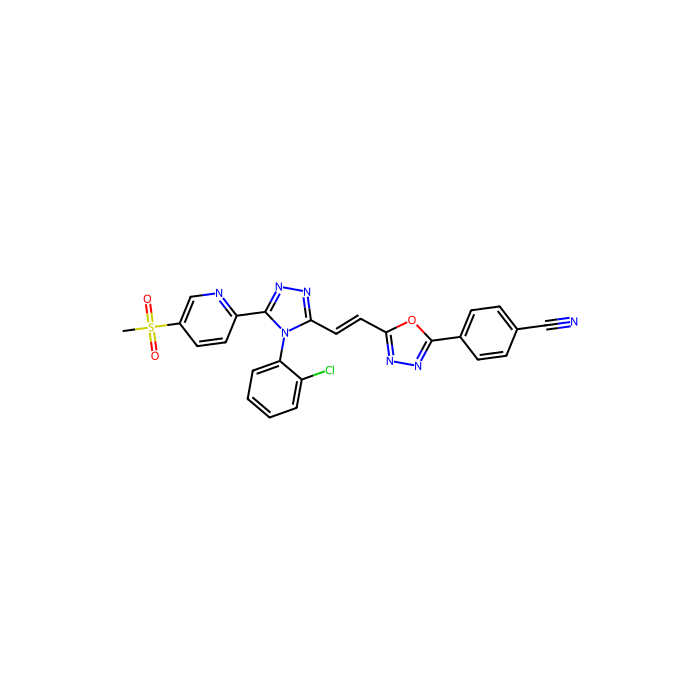
(E)-4-(5-(2-(4-(2-chlorophenyl)-5-(5-(methylsulfonyl)pyridin-2-yl)-4H-1,2,4-triazol-3-yl)vinyl)-1,3,4-oxadiazol-2-yl)benzonitrile | Tankyrase 1/2 Inhibitor VI | G007-LK - Calbiochem | TNKS 1/2 Inhibitor VI | Wnt Pathway Inhibitor XXI | 4-(5-(( E)-2-(4-(2-
Specifications & Purity
≥97%
Biochemical and Physiological Mechanisms
G007-LK is a potent and selective tankyrase inhibitor with IC50 of 46 nM and 25 nM for TNKS1/2, respectively.
Storage
Store at -20°C
Shipped In
Ice chest + Ice pads
This product requires cold chain shipping. Ground and other economy services are not available.
This compound belongs to the class of organic compounds known as pyridyl-1,2,4-triazoles. These are organic compounds containing a pyridine ring attached to a 1,2,4-triazole ring.
External Descriptors
Not available
1. Djoumbou Feunang Y, Eisner R, Knox C, Chepelev L, Hastings J, Owen G, Fahy E, Steinbeck C, Subramanian S, Bolton E, Greiner R, and Wishart DS. ClassyFire: Automated Chemical Classification With A Comprehensive, Computable Taxonomy. Journal of Cheminformatics, 2016, 8:61.
Determine the necessary mass, volume, or concentration for preparing a solution.
Dilution Calculator
Determine the dilution needed to prepare a stock solution.
Reconstitution Calculator
Reviews
Customer Reviews
Application Protocols
No tested applications or protocols are provided for G007-LK in the product listing.
General starting points (for small-molecule screening):
Prepare a 10 mM stock in DMSO, aliquot, and store at −20°C. Thaw once for use; avoid repeated freeze–thaw.
Perform serial dilutions in assay-compatible diluent, maintaining consistent final solvent percentage across wells.
Include vehicle controls and, where applicable, positive/negative control compounds to validate assay dynamic range.
For cell assays, start with 0.1–10 µM ranges and evaluate cytotoxicity independently (e.g., ATP-based viability) to contextualize activity.
All conditions should be optimized per specific assay and verified against the compound’s SDS and CoA.
Biological Roles
No biological function, target, or pathway information is provided for G007-LK in the product data.
Target/Pathway: Not specified for this item; refer to literature or request details if available.
Mechanism of action: Not specified for this item; refer to CoA/Spec Sheet or supporting documentation.
General considerations for small-molecule library members:
Such compounds may act as enzyme inhibitors/activators, receptor ligands, or pathway modulators, but activity is highly structure-dependent and must be empirically established.
Prior to mechanistic interpretations, perform orthogonal assays, concentration–response curves, and artifact controls (fluorescence interference, redox cycling, and aggregation checks).
Assess stability (chemical and metabolic), permeability, and plasma protein binding to contextualize observed biological readouts.
Compliance note:
This product is designated For research use only and is not approved for diagnostic, therapeutic, or clinical use.
Buffer Applications
This item is a small-molecule library compound, not a buffering agent.
No buffer system, pH range, or recipe is applicable to G007-LK based on the provided data.
Guidance (general):
If required to maintain solubility in aqueous media, use standard biological buffers (e.g., PBS, HEPES, Tris) appropriate to your assay, and dissolve G007-LK first in a compatible organic cosolvent (commonly DMSO), then dilute into buffer while monitoring for precipitation.
Keep final organic solvent content low (typically ≤0.5–1% v/v in cell assays) and include solvent-only controls.
Green Alternatives
Without a disclosed structure or synthetic role, green considerations focus on solvent handling for stock preparation and assay workflows.
Greener solvent choices (general):
Prefer ethanol or 2-propanol where solubility permits; they are less hazardous and have lower environmental impact than polar aprotics like DMF/NMP.
Consider cyclopentyl methyl ether (CPME) or 2-MeTHF for nonpolar/lipophilic compounds in synthetic contexts; they offer improved safety vs. THF and can reduce peroxide risks with proper management.
Use water/buffer as diluent at the point of use to minimize organic solvent exposure in assays.
Trade-offs (general):
DMSO provides unmatched solvency but entails worker exposure concerns (dermal transport) and waste burdens; keep final assay DMSO ≤0.5–1% v/v where possible.
Ethanol is greener but may not dissolve highly lipophilic or strongly hydrogen-bonding compounds.
Operational greening tips:
Prepare concentrated stocks to minimize total solvent volume.
Utilize miniaturized assays (384/1536-well) to reduce per-experiment solvent waste.
Implement closed-cap autosampler vials and low-dead-volume dispensing to cut evaporative losses and emissions.
Note: No item-specific synthesis route is provided; process-intensification or biocatalytic alternatives cannot be assessed without structural details.
Pharmaceutical Uses
No pharmacopeial status, excipient role, or manufacturing application is provided for G007-LK.
This product is sold for research use only and is not intended for clinical or diagnostic applications.
General R&D context:
If G007-LK is used as a discovery tool compound or hit, pharmaceutical relevance would be limited to preclinical laboratory studies such as target validation, SAR exploration, or DMPK profiling.
Any formulation exploration (e.g., salt screening, enabling formulations) should only be conducted to support research hypotheses and not for human administration.
Documentation:
No compendial monograph or GMP grade is indicated: Not specified for this item; refer to CoA/Spec Sheet.
Physical Properties
Item-specific physicochemical data are not provided in the listing.
Appearance: Not specified for this item; refer to CoA/Spec Sheet.
Melting point (MP): Not specified for this item; refer to CoA/Spec Sheet.
Boiling point (BP): Not specified for this item; refer to CoA/Spec Sheet.
Density: Not specified for this item; refer to CoA/Spec Sheet.
Refractive index: Not specified for this item; refer to CoA/Spec Sheet.
pKa/logP/logD: Not specified for this item; refer to CoA/Spec Sheet.
Aqueous/organic solubility: Not specified for this item; refer to CoA/Spec Sheet.
General laboratory considerations (literature/practice-based):
Small-molecule library members are commonly supplied as solids or films for dissolution in DMSO at 10–50 mM stock. If insoluble, cosolvents such as DMF, NMP, ethanol, or minimal aqueous surfactant (e.g., 0.01–0.1% Tween 80) may assist. Always determine compatibility with downstream assays.
If the compound is potentially hygroscopic or polymorphic, the observed MP can deviate from literature; use differential scanning calorimetry (DSC) or thermogravimetric analysis (TGA) to characterize where relevant.
For formulations, determine kinetic vs thermodynamic solubility and consider pH-shift or salt formation strategies (if ionizable) after confirming the structure and pKa.
Quality & Grades
Item-specific grade and purity are not disclosed in the listing.
Grade/Purity: Not specified for this item; refer to CoA/Spec Sheet.
Guidance on interpreting grades (general):
Library/screening compounds are commonly supplied at ≥95% HPLC purity (UV at multiple wavelengths) unless otherwise noted. Confirm whether TFA salt or other counterions are present, which can influence mass and solubility.
Typical identity confirmation includes LC–MS and may include 1H NMR and HRMS. Some libraries provide qNMR for purity on a solvent/freedom-from-volatile basis.
If low-UV HPLC grade is relevant (e.g., for analytical quantitation), request HPLC chromatogram and detector wavelengths.
Verify residual solvents, water content (KF), and inorganic impurities if the application is sensitive (e.g., crystallography or structure–activity studies). If not provided: Not specified for this item; refer to CoA/Spec Sheet.
Batch control & documentation:
Request the batch-specific CoA, including lot number, analytical conditions, and any stabilizers/additives used.
If using across multiple screening campaigns, standardize plate maps, stock concentrations, and barcode/ELN registration to ensure traceability.
Reaction & Applications
This product is listed under a small-molecule/compound library category, and no target or application specifics are provided.
Typical research uses (general, non-clinical):
Biochemical or cell-based screening: Evaluate as a putative modulator in enzyme, receptor, or phenotypic assays. Start with broad concentration ranges (e.g., 0.1–50 µM) and narrow based on response while controlling for solvent effects.
Profiling & selectivity panels: If a hit emerges, expand to orthogonal assays, counter-screens, and ADME profiling (stability in buffer/microsomes, permeability, solubility, and protein binding).
Cheminformatics & SAR: Once structure is obtained, analyze scaffold, substituent effects, and physicochemical properties to guide analog selection or synthesis.
Analytical method development: Use LC–MS/MS to create quantitation methods (MRM transitions once fragmentation is known).
Practical considerations:
Confirm identity and purity against CoA before screening.
Account for compound aggregation by including detergents or using Turbidimetry/DLS at higher concentrations.
Monitor stability in assay mediums (pH 6–8, 37°C) over time; aliquot stocks to minimize freeze–thaw.
No specific named reactions or synthetic transformations are provided for this item; if intended as a building block, obtain the structure to plan reactivity.
Reaction Conditions
No reaction conditions are specified for G007-LK, and its structure is not disclosed; as such, preparative or transformation conditions cannot be recommended for this item.
General guidance (if later used synthetically once the structure is available):
Base solvent choices and temperatures on the functional group profile (e.g., polar aprotic for SNAr/couplings; protic or buffered media for condensations).
For metal-catalyzed couplings, ensure metal-sensitive motifs (e.g., aldehydes, free thiols) are protected or tolerated; typical conditions might include Pd/Cu/Ni catalysts at 25–120°C with bases such as K2CO3, Cs2CO3, or DIPEA (literature-dependent).
Monitor reactions with LC–MS and UPLC for rapid optimization; confirm absence of degradation or isomerization.
Until structural details are provided, treat this product as a finished small molecule for screening rather than a synthetic intermediate.
Safety & Handling
Safety details specific to G007-LK are not provided in the listing; defer to the product SDS for authoritative guidance.
GHS Classification / Pictograms / Signal Word / H-Statements: Not specified for this item; refer to SDS.
Research Use: For research use only; not for human or veterinary use.
General laboratory precautions (good practice):
Handle in a certified chemical fume hood; avoid inhalation of dusts/aerosols.
Wear lab coat, safety glasses, and appropriate gloves (nitrile recommended). Change gloves regularly when handling DMSO solutions due to dermal uptake potential of solutes.
Avoid contact with strong oxidizers, strong acids/bases, and reactive reducing agents until compatibility is established from the SDS.
In case of skin/eye contact: rinse with water for at least 15 minutes and seek medical evaluation as needed.
For spills: contain dry powders with damp disposable towels or HEPA vacuum; for solutions, absorb with inert material (vermiculite) and dispose per institutional guidelines.
Waste: collect in organic hazardous waste unless the SDS indicates otherwise; segregate halogenated vs non-halogenated if applicable.
Shipping and thermal sensitivity:
Shipped on ice with ice pads (as provided). Maintain the cold chain to preserve integrity.
Special risks:
Without structure-specific data, treat as a potentially bioactive screening compound; minimize exposure and prevent environmental release.
Solvent Selection
With no disclosed structure, initial dissolution strategies should prioritize broadly compatible, high-boiling polar aprotic solvents commonly used for screening stocks.
Recommended approach (general):
Start with DMSO to prepare 10–50 mM stocks. Warm gently (25–40°C) and vortex/sonicate.
If limited DMSO solubility, test: DMF, NMP, ethanol, or mixtures (e.g., DMSO:water 1:1, DMSO:ethanol 1:1). Confirm assay compatibility and final solvent percentages (<0.5–1% v/v in biological assays typical).
For poorly soluble, nonpolar entities, consider 2-propanol, t-amyl alcohol, or minimal PEG400 cosolvent. For ionic/ionizable compounds, adjust pH (use buffers at appropriate pKa if known) or form salts (acetate, HCl, mesylate) as appropriate.
Small comparison (general properties):
DMSO: high polarity/proticity index, excellent solvency for diverse chemotypes; can carry molecules across skin; cytotoxic above ~0.5–1% in some cell lines.
DMF/NMP: powerful solvents; evaluate toxicity/regulatory constraints; often limited to analytical or synthetic contexts.
Ethanol: greener, volatile, assay-friendly at ≤0.5–1%; solubility may be insufficient for lipophilic compounds.
Practical tips:
Filter through 0.2 µm PTFE if particulates remain.
Record exact solvent lot and composition; verify stock by LC–MS for stability where feasible.
Avoid water uptake in hygroscopic solvents; cap vials promptly and use anhydrous grades for reproducibility.
Storage & Reconstitution
Item-specific storage information is provided; reconstitution guidance is general due to lack of structural data.
Storage Conditions (as provided): Store at −20°C.
Shipping (as provided): Shipped in an ice chest with ice pads. Maintain the cold chain upon receipt.
Appearance: Not specified for this item; refer to CoA/Spec Sheet.
General reconstitution (screening compounds):
Allow vial to equilibrate to room temperature in a desiccated environment before opening to avoid condensation.
Dissolve to prepare a concentrated DMSO stock (e.g., 10–50 mM), vortex and sonicate if needed. If insoluble, consider DMF, NMP, or ethanol, checking assay compatibility.
Filter solutions through 0.2 µm PTFE if particulates are present.
Dispense single-use aliquots to avoid repeated freeze–thaw; store at −20°C, protected from light if chromophoric groups are suspected.
Record solvent, concentration, preparation date, and lot/batch in your ELN. Periodically verify integrity by LC–MS.
Stability notes:
Long-term stability, hygroscopicity, and photolability are not specified for this item; refer to CoA/Spec Sheet. If stability is unknown, minimize exposure to air, moisture, and light, and use within a defined review period (e.g., 3–6 months) pending analytical confirmation.
Structure & Identity
Overview for G007-LK (SKU: G413723) — a small-molecule entry in a screening/compound library. Item-specific structural identifiers are limited in the listing.
Product Name: G007-LK
CAS: 1380672-07-0 (as provided)
PubChem CID: 67960134 (as provided)
InChIKey: 122707 (as provided; note: atypical length versus standard 27-character InChIKey)
SMILES: Not specified for this item; refer to CoA/Spec Sheet.
Molecular Formula: Not specified for this item; refer to CoA/Spec Sheet.
Molecular Weight: Not specified for this item; refer to CoA/Spec Sheet.
Structural description:
Item-specific functional groups, ring systems, stereochemistry, and 2D features are not disclosed in the product data. Please consult the CoA/SDS or reach out to Aladdin Scientific for the structure file (SDF/Mol/SMILES) if available.
Identity best practices (general guidance):
Request and record a unique batch CoA (HPLC purity, HRMS/NMR where available).
Verify salt form/counterion and stereochemical purity (if chiral) prior to biological or synthetic deployment.
For cheminformatics, obtain the canonical SMILES and InChI to ensure unambiguous registration in ELNs and library databases.
Synthetic Utility
Synthetic roles for G007-LK cannot be assigned without the disclosed structure.
If intended as a building block, obtain the structure to evaluate reactive handles (e.g., halides for cross-coupling, carbonyls for condensation, amines/carboxyls for amide coupling, boronates for Suzuki, etc.).
If intended purely as a screening tool compound, routine synthetic elaboration may not be required; instead, consider ordering close analogs or requesting analog sourcing for SAR.
General strategy (when structure is available):
Map functional groups and plan diversity-oriented modifications (bioisosteres, polarity tuning, conformational locks).
Use orthogonal protection schemes if multiple nucleophiles/electrophiles are present.
Confirm each step with LC–MS and 1H/13C NMR; use chiral HPLC if stereocenters are introduced.
Note: No named reactions or reactivity data are provided for this item; do not assume compatibility with common transformations without structural confirmation.
Target Specificity
Target information is not provided for G007-LK.
Target/Pathway/Enzyme: Not specified for this item; refer to literature or internal screening data.
Species reactivity / selectivity: Not specified for this item; refer to CoA/Spec Sheet.
Guidance:
Establish specificity empirically with counter-screens, profiling panels, and orthogonal assay formats to exclude off-target or assay-interference effects (e.g., PAINS, redox cycling, fluorescence quenching).
Frequently Asked Questions
What is the purity of this product?
This product is supplied at ≥97% purity (chemical assay). Lot-specific values are stated on the Certificate of Analysis.
How should this product be stored?
Store at ?20 °C. Freezer storage is required to maintain the specified shelf life.
How is this product shipped?
This product ships in an insulated container with ice pads. Unpack on arrival and transfer it to the storage condition stated above.
What are the CAS number, molecular formula and molecular weight?
The CAS Number is 1380672-07-0, the molecular formula is C25H16ClN7O3S, and the molecular weight is 529.96 g/mol. InChIKey HIWVLHPKZNBSBE-OUKQBFOZSA-N.
What documentation is provided?
Available product documentation, including Certificates of Analysis (COA), Safety Data Sheets (SDS), and specification sheets, is shown in the product document area. Document availability and access follow the current site policy.
We use cookies to ensure the website functions properly and, where permitted, to improve your experience. You can manage your preferences at any time in Settings. Learn more in our Cookie Policy.
Shall we send you a message when we have discounts available?
Remind me later
Thank you! Please check your email inbox to confirm.
Products are supplied to verified businesses, institutions, and qualified professionals for research and development use only. Not for use in humans, animals, diagnosis, or therapy.

 H2229221