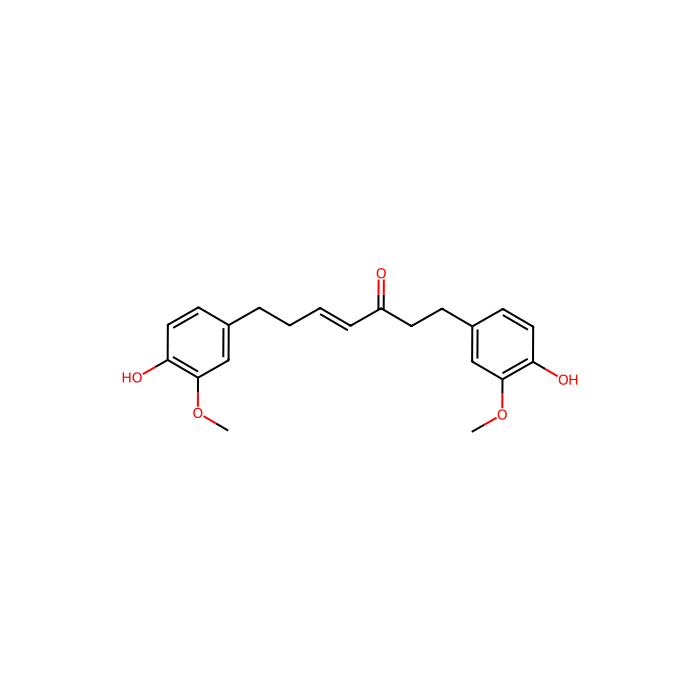
Gingerenone A is an antifungal and antiparasitic diarylheptenone that is isolated from Zingiber officinale (more commonly known as ginger), a medicinal plant that is used to treat inflammation and musculoskeletal disorders.
Specifications
Synonyms
(E)-Gingerenone A | (4E)-1,7-bis(4-hydroxy-3-methoxyphenyl)hept-4-en-3-one | 4-Hepten-3-one, 1,7-bis(4-hydroxy-3-methoxyphenyl)-, (E)- | 4-Hepten-3-one, 1,7-bis(4-hydroxy-3-methoxyphenyl)-, (4E)- | 1,7-bis(4-hydroxy-3-methoxyphenyl)hept-4-en-3-one | (4E)-1,7-Bis(4-hydroxy-3-methoxyphenyl)-4-hepten-3-one | 4-Hepten-3-one, 1,7-bis(4-hydroxy Show more
Specifications & Purity
≥98%
Storage
Store at 2-8°C
Shipped In
Wet ice
This product requires cold chain shipping. Ground and other economy services are not available.
This compound belongs to the class of organic compounds known as linear diarylheptanoids. These are diarylheptanoids with an open heptane chain. The two aromatic rings are linked only by the heptane chain.
External Descriptors
diarylheptanoid
1. Djoumbou Feunang Y, Eisner R, Knox C, Chepelev L, Hastings J, Owen G, Fahy E, Steinbeck C, Subramanian S, Bolton E, Greiner R, and Wishart DS. ClassyFire: Automated Chemical Classification With A Comprehensive, Computable Taxonomy. Journal of Cheminformatics, 2016, 8:61.
Determine the necessary mass, volume, or concentration for preparing a solution.
Dilution Calculator
Determine the dilution needed to prepare a stock solution.
Reconstitution Calculator
Reviews
Customer Reviews
Application Protocols
No antibody/ELISA/IF/IHC/FC protocols are associated with this small-molecule product.
General usage examples (research-only, illustrative)
Analytical standard preparation: dissolve to 10 mM in DMSO, store aliquots at 2–8°C protected from light; dilute into mobile phase for LC–MS calibration.
In vitro enzyme assay: prepare 1000× DMSO stock; add to assay buffer to reach desired final concentration with ≤1% DMSO; include vehicle controls and counter-screens for assay interference.
Refer to peer-reviewed literature and your institutional SOPs for detailed, application-specific procedures.
Biological Roles
Informational (literature context; not product-specific claims): Gingerenone A belongs to the family of ginger phenolic constituents. Such diaryl–conjugated carbonyl frameworks are commonly investigated for their interactions with enzymes and signaling proteins in biochemical assays.
Typical areas of study (in vitro, research use only)
Enzyme modulation assays involving redox enzymes, kinases, or transcriptional regulators sensitive to electrophilic phenolics.
Antioxidant/oxidation chemistry in chemical systems (radical scavenging, metal chelation) relevant to food chemistry and natural product chemistry.
Metabolic profiling studies of Zingiber spp. extracts, including phase II conjugation tendencies (e.g., glucuronidation/sulfation of phenolics) in microsomal/S9 systems.
Mechanistic considerations
Conjugated enones can act as soft electrophiles toward nucleophilic residues (e.g., cysteine) in model systems; outcomes are context- and concentration-dependent.
Phenolic functionalities contribute to hydrogen bonding and redox behavior.
Experimental caveats
Many conjugated phenolics trigger assay interference (chromophore, redox cycling, aggregation). Employ orthogonal assays, counter-screens, and detergent controls.
This section is provided for biochemical context only. No medical, diagnostic, or therapeutic uses are claimed or supported for this product.
Buffer Applications
Gingerenone A is not a buffering agent and does not define a specific pKa-based buffer system.
Practical guidance
For aqueous work, dissolve Gingerenone A first in a compatible cosolvent (e.g., DMSO or ethanol), then dilute into your chosen buffer (PBS, HEPES, Tris) immediately before use.
Maintain final organic cosolvent at minimal levels compatible with your assay (commonly 0.1–1% v/v) and include vehicle controls.
If your objective is to prepare physiological or chromatographic buffers, refer instead to dedicated buffering reagents with well-defined pKa values.
Green Alternatives
This section typically addresses greener choices for solvents or auxiliary reagents. Gingerenone A is a solid small molecule, not a process solvent; hence the concept of a “green alternative” applies primarily to the solvent system used with it rather than to the compound itself.
Greener solvent choices for handling/analysis (general guidance)
Prefer ethanol or ethyl acetate for workup/extraction where feasible instead of chlorinated solvents.
Consider 2-methyltetrahydrofuran (2-MeTHF) or cyclopentyl methyl ether (CPME) over THF/diethyl ether for certain transformations, balancing solubility.
In aqueous assays, minimize DMSO content (<0.5–1% v/v) and assess use of cyclodextrin vehicles.
Packaging and storage best practices
Store at 2–8°C as provided to limit degradation and waste; minimize freeze–thaw by preparing single-use aliquots.
Life-cycle considerations
If using Gingerenone A as an analytical standard, adopt micro-scale workflows to reduce solvent consumption and waste generation.
Note: No greener “substitute compound” is suggested because the molecule itself is the analyte/standard of interest.
Pharmaceutical Uses
This product is supplied strictly for research use only. Gingerenone A is not an excipient or pharmacopeial article in this listing.
Formulation context (general R&D practice)
For in vitro screening, prepare DMSO stock solutions and dilute into assay media just prior to use.
For preformulation research, solubility enhancement approaches (e.g., cosolvents, cyclodextrins, nanodispersion) may be explored to study the material’s behavior. These activities remain research-stage and are not for human or veterinary use.
No clinical, diagnostic, or therapeutic applications are claimed or supported for this item.
Physical Properties
Item-specific physical data
Appearance: Not specified for this item; refer to CoA/Spec Sheet.
Grade/Purity: Not specified for this item; refer to CoA/Spec Sheet.
Storage & shipping (from Product Data)
Storage: Store at 2–8°C.
Shipped on: Wet ice.
General/literature characteristics for gingerenone-type phenolics (informational; not item specifications)
Physical state: typically a yellow to orange solid for conjugated phenolic carbonyls of ginger origin.
Solubility: sparingly soluble in water; readily soluble in DMSO and moderately in ethanol/methanol and other polar organics; improved solubility with mild heating or cosolvents.
UV–Vis: strong absorption in the near-UV due to extended conjugation; exact λmax varies with solvent and substitution.
LogP: moderate lipophilicity is common for diaryl-conjugated phenolics; exact value depends on substitution (consult literature for determinations specific to Gingerenone A).
Stability: phenolic/enone systems can be sensitive to strong base, light, and prolonged air exposure; store protected from light and moisture for best stability.
Not provided for this item (consult CoA/Spec Sheet if needed): melting point, boiling point, density, refractive index, water content, residual solvents, and extinction coefficient.
Quality & Grades
Item-specific quality details
Grade/Purity: Not specified for this item; refer to CoA/Spec Sheet.
How to interpret common grades (general guidance)
Research grade: suitable for discovery chemistry, screening, and method development; identity/purity confirmed by standard analytical methods (e.g., NMR/HPLC/MS) as stated on the CoA.
HPLC grade (if applicable): emphasizes low UV background and minimal trace impurities that interfere with chromatographic detection.
Bioactive small-molecule grade: emphasizes structural identity and purity, with solvent-ready formats (e.g., DMSO stock) when specified.
Stabilizers/antioxidants
None are listed for this item. If a stabilizer or inhibitor is present, it will be disclosed on the CoA/Spec Sheet. Phenolic/enone compounds are sometimes packaged under inert gas or with light protection to preserve integrity.
Recommended verification on receipt (good practice)
Check lot-specific CoA for identity (1H/13C NMR, HRMS), purity (HPLC/UPLC), and water content (if reported).
Inspect for color changes or visible degradation; request fresh material if out of spec.
Fit-for-purpose considerations
For quantitative biological assays, verify purity and counter-screen for assay interference (e.g., PAINS filters for conjugated phenolics) as needed.
Reaction & Applications
Gingerenone A is used predominantly as a reference standard and as a bioactive natural-product scaffold in discovery chemistry.
Typical applications (research use only)
Analytical standard for ginger metabolite profiling by HPLC/UPLC–MS.
Chemical probe candidate in cell-free enzyme assays to study interactions of phenolic enones (literature context; verify assay interference).
Starting point for SAR programs exploring diaryl–conjugated carbonyl motifs.
Reactivity features (general chemistry)
Conjugated enone (if present in the specific substitution pattern) can participate in Michael additions, conjugate reductions (NaBH4 with catalysts, Pd/C–H2), and nucleophilic additions.
Phenolic OH groups undergo etherification (Williamson), esterification (acyl chlorides/anhydrides), and carbonate/urethane formation.
Aromatic rings permit electrophilic substitutions when appropriately activated/deactivated by phenolic/methoxy groups.
Practical tips
Protect phenols (e.g., as benzyl or silyl ethers) before base-sensitive steps.
Use mild, non-nucleophilic bases and anhydrous conditions to preserve the conjugated system.
Monitor by UPLC–PDA–MS to track potential oxidation or isomerization products.
Related named transformations
Michael additions to enones; O-alkylation (Williamson); selective hydrogenation of α,β-unsaturated carbonyls; Fries-like acylation of activated phenols (substrate-dependent).
Reaction Conditions
General literature-style guidance for transformations relevant to gingerenone-type phenolic enones (not product specifications):
O-Acylation/O-alkylation of phenols
Conditions: base (e.g., K2CO3/DMF, Cs2CO3/acetone) or catalytic DMAP with acylating agents at 0–50°C; typical times 0.5–6 h.
Considerations: protect other sensitive sites; minimize strong base exposure to avoid enone side reactions.
Conjugate reduction of enone
Conditions: H2 (1–3 atm) with Pd/C at rt–40°C; or chemoselective 1,4-reduction with Stryker’s reagent or catalytic rhodium/nickel systems.
Outcome: saturation of the C=C can attenuate electrophilicity while preserving the carbonyl.
Michael additions
Nucleophiles: thiols, secondary amines, enolates; solvents like MeOH, MeCN, or DMF; catalysts/base as appropriate; 0–25°C typical.
Monitoring: UPLC–MS; quench carefully to avoid retro-Michael processes.
Oxidation/functionalization
Mild oxidants (e.g., DDQ, IBX) for benzylic or phenolic transformations; light and oxygen can cause unwanted oxidation—conduct under inert atmosphere when necessary.
Purification
Normal-phase silica with gradient hexanes/EtOAc or DCM/MeOH; for closely related analogs, use reverse-phase C18 with water/ACN + 0.1% acid for peak shape.
Signal word: Not specified for this item; refer to SDS.
H-statements: Not specified for this item; refer to SDS.
GHS classification: Not specified for this item; refer to SDS.
Pictograms: Not specified for this item; refer to SDS.
General laboratory precautions (informational)
Handle in a chemical fume hood; avoid inhalation of dust or aerosols.
Use appropriate PPE: lab coat, nitrile gloves, and safety glasses/face shield.
Avoid skin/eye contact; phenolic compounds and conjugated enones can be irritants/sensitizers in some cases (literature).
Prevent prolonged light exposure; store tightly closed at 2–8°C per Product Data.
Incompatibilities (general)
Strong bases (risk of phenolate formation and side reactions), strong oxidizers (risk of oxidation), and strong reducing agents (may reduce enone/carbonyl functionalities).
First-aid overview (general)
Inhalation: move to fresh air; seek medical attention if symptoms occur.
Skin/eye contact: rinse with water for at least 15 minutes; remove contaminated clothing; seek medical advice.
Ingestion: rinse mouth; do not induce vomiting; obtain medical attention.
Always consult the product-specific SDS for authoritative hazard classification, exposure limits, spill response, and waste disposal guidance.
Solvent Selection
This section focuses on dissolving Gingerenone A for analytical work and assays.
Solubility guidance (general, literature-based)
Preferred solvents: DMSO (stock solutions up to 10–50 mM are commonly achievable), DMF; ethanol or methanol for less concentrated stocks; acetone and acetonitrile are usually acceptable.
Aqueous media: sparingly soluble; use cosolvents (e.g., 0.5–2% DMSO or EtOH) or vehicles such as 2-hydroxypropyl-β-cyclodextrin for higher aqueous loading.
Polarity/miscibility context
Moderately lipophilic phenolic with conjugation; expect poor water solubility but good compatibility with polar aprotic organics.
Practical tips
Warm gently (25–40°C) and vortex/sonicate to speed dissolution; avoid prolonged heating.
Filter through 0.22 µm PTFE/nylon before HPLC/LC–MS to remove particulates.
For bioassays, prepare concentrated DMSO stocks and dilute into buffer immediately before use to minimize precipitation.
Comparison (selection logic)
DMSO vs ethanol: DMSO affords higher stock concentrations and better chemical stability; ethanol is preferred where DMSO is incompatible with the assay.
ACN for LC–MS workflows: lower viscosity and UV cut-off; confirm analyte stability and ionization efficiency.
Storage & Reconstitution
Storage (from Product Data)
Store at 2–8°C.
Shipped on wet ice.
Handling recommendations (general best practices)
Protect from light and moisture. Reseal containers promptly after use.
If supplied as a solid, allow to equilibrate to room temperature in a desiccator before opening to prevent condensation.
If supplied as solution, keep tightly capped; avoid repeated freeze–thaw cycles by preparing aliquots.
Reconstitution guidance (general)
For analytical and bioassay work, dissolve in DMSO to prepare a concentrated stock (e.g., 10–50 mM, solubility permitting). Vortex and, if needed, sonicate gently.
Filter through 0.22 µm PTFE prior to use in LC/UPLC.
For aqueous applications, dilute the organic stock into buffer immediately before use; maintain minimal final cosolvent.
Stability remarks
Phenolic/enone systems may slowly oxidize; store under inert headspace if possible and minimize exposure to elevated temperatures.
Always consult the lot-specific CoA for any additional storage or stability notes unique to your shipment.
Structure & Identity
Brief description: Gingerenone A is a plant-derived phenolic diaryl-conjugated carbonyl compound isolated from Zingiber spp. It is typically classified among ginger diarylheptanoid/curcuminoid-like constituents.
Product-specific identifiers (from Product Data)
CAS: 128700-97-0
InChIKey: 93798 (as provided; note: typical InChIKeys are 27 characters; consult CoA/SDS for the definitive key)
SMILES: Not specified for this item; refer to CoA/Spec Sheet.
Molecular formula: Not specified for this item; refer to CoA/Spec Sheet.
Molecular weight: Not specified for this item; refer to CoA/Spec Sheet.
Structural features (general literature description)
Phenolic aromatic rings with methoxy/phenoxy substitution are commonly present in gingerenone-type metabolites.
Conjugated carbonyl system (e.g., an enone) contributing to electrophilic Michael acceptor character.
Overall 2D depiction: two substituted phenyl rings connected through a conjugated carbonyl-containing linker; at least one phenolic OH is typical in this class.
Stereochemistry
Gingerenone A is generally depicted without stereocenters in the main conjugated skeleton (literature). Any atropisomerism or conformational preference is context-dependent.
Note: Where exact atom connectivity and substituent pattern are required (e.g., for registration or modeling), please consult primary literature or the item’s CoA/structure file associated with this SKU.
Synthetic Utility
As an isolated natural product or reference standard, Gingerenone A is primarily used for analytical and bioactivity studies; however, its functional groups also make it a versatile synthetic handle.
Conjugated carbonyl: Michael acceptor chemistry, selective 1,2- vs 1,4-reduction, enone epoxidation, and conjugate addition of thiols/amines.
Aromatic rings: directed electrophilic substitution influenced by methoxy/phenolic substituents; late-stage diversification via Vilsmeier formylation or Friedel–Crafts (substrate-dependent).
Applications in synthesis
Scaffold for SAR elaboration: protecting-group strategies on phenols (Bn, MOM, TBS) enable orthogonal diversification.
Semi-synthesis: transformation into analogs with tuned lipophilicity and electronics for probe development.
Analytical utility
Serves as a retention/indexing marker in phytochemical profiling; provides UV–Vis chromophore for PDA detection and MS-friendly ionization (often [M–H]– in ESI negative mode, literature context).
Target Specificity
Not applicable. Gingerenone A is a small-molecule natural product, not a biological macromolecule or affinity reagent. There are no antigen/epitope, clone, isotype, or species-reactivity attributes associated with this catalog item.
For target engagement studies, users should define and validate targets experimentally using appropriate biochemical/biophysical assays.
We use cookies to ensure the website functions properly and, where permitted, to improve your experience. You can manage your preferences at any time in Settings. Learn more in our Cookie Policy.
Shall we send you a message when we have discounts available?
Remind me later
Thank you! Please check your email inbox to confirm.
Products are supplied to verified businesses, institutions, and qualified professionals for research and development use only. Not for use in humans, animals, diagnosis, or therapy.

 J22181025